Savory cocktails have evolved beyond garnish-as-gimmick into a disciplined category where umami, earthiness, and herbal complexity are calibrated with precision. At the heart of this evolution lies infusion—a deceptively simple technique that belies profound chemical nuance. When bartenders reach for rosemary to elevate a Bloody Mary or thyme to deepen a gin-based spritz, their choice of base—olive oil or vodka—doesn’t merely shift texture; it redirects the entire pathway of botanical liberation. Fat-soluble compounds behave fundamentally differently from alcohol-soluble ones, not just in how they dissolve, but in how they volatilize, interact with saliva, and bind to taste receptors. This isn’t about preference—it’s about phytochemistry in action.
The Solvent Divide: Why Medium Dictates Molecule
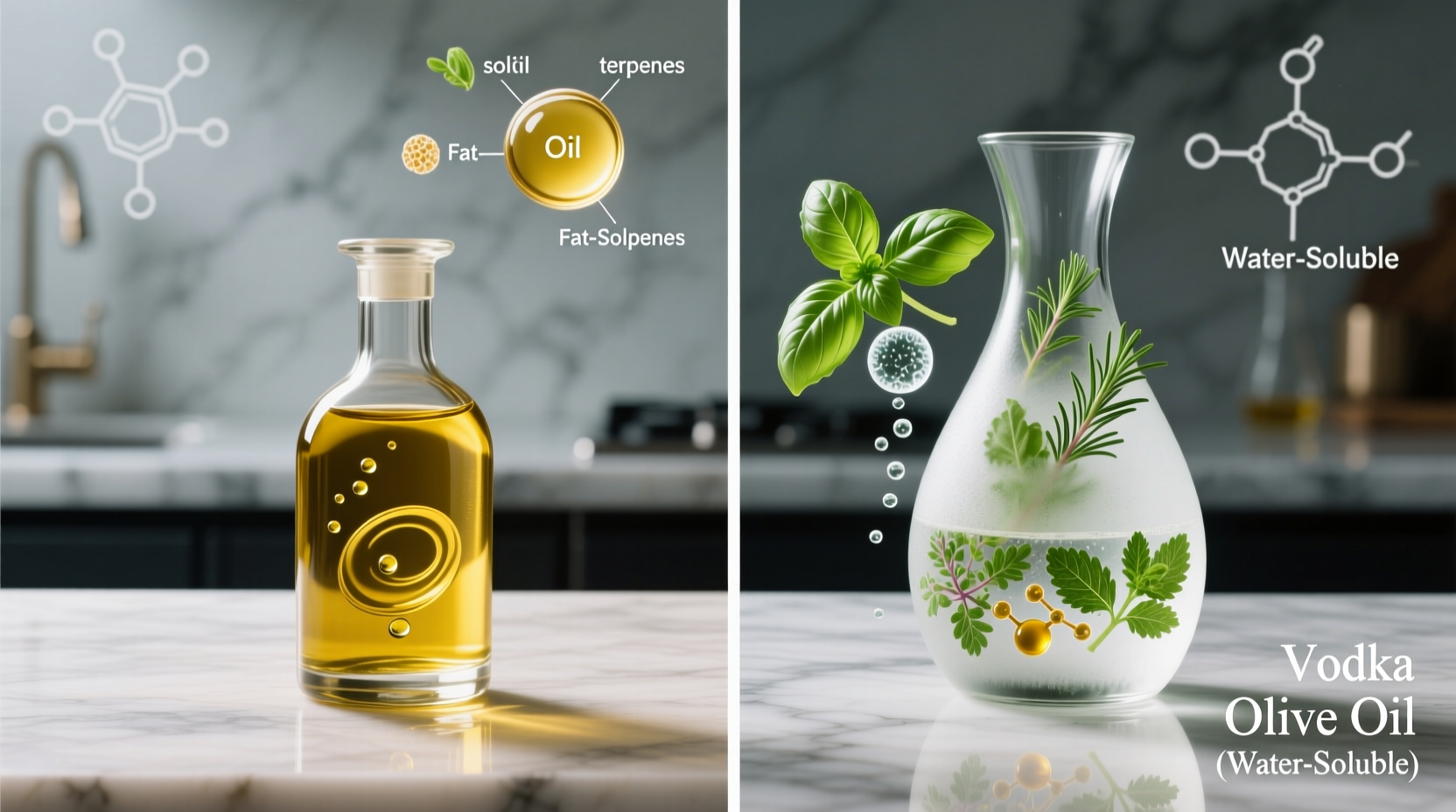
Olive oil and vodka represent two distinct solvent classes: lipids versus polar protic solvents. Ethanol (the active component in 40% ABV vodka) is miscible with water and highly effective at extracting medium-to-high polarity compounds—monoterpenes like limonene and pinene, phenolic acids such as rosmarinic acid in rosemary, and volatile aldehydes like citral in lemongrass. These molecules readily partition into ethanol, remain stable over days, and re-volatilize efficiently upon dilution and aeration in a shaken or stirred cocktail.
Olive oil, by contrast, is a nonpolar triglyceride matrix. It excels at dissolving highly lipophilic compounds: beta-carotene, chlorophyll derivatives, sesquiterpenes (e.g., caryophyllene in black pepper), and long-chain fatty acid esters of aromatic phenols. Crucially, many of these compounds are *non-volatile* at room temperature. They don’t lift off the surface of a drink as aroma—they require emulsification, heat, or mechanical agitation (like vigorous stirring with ice) to disperse. And once dispersed, they coat the tongue, altering perceived mouthfeel and modulating bitterness or pungency through lipid-mediated receptor interactions.
This divergence explains why a thyme-infused vodka delivers bright, top-note herbal lift in a Martini, while thyme-infused olive oil folded into a chilled gazpacho-inspired cocktail yields deep, resonant, almost meaty savoriness—its impact delayed, sustained, and texturally anchored.
Tip: Never substitute infused oil for infused spirit by volume in a cocktail recipe. Oil infusions are concentrated carriers—not dilutable liquids. Use 2–3 drops per drink, then emulsify thoroughly with egg white, aquafaba, or a high-speed blender.Botanical Release in Action: A Comparative Breakdown
To understand practical implications, consider how three common savory botanicals behave across both media:
| Botanical | Vodka Infusion (48h, room temp) | Olive Oil Infusion (72h, warm maceration) | Cocktail Impact Difference |
|---|---|---|---|
| Rosemary | Limonene, camphor, and alpha-pinene dominate—sharp, piney, volatile. Fades within 90 seconds on the palate. | Carvacrol, rosmarinic acid esters, diterpene quinones—earthy, medicinal, lingering. Releases slowly with warmth and fat interaction. | Vodka: ideal for aromatic rinses or sprays. Oil: best folded into creamy or briny bases (e.g., with tomato water or miso syrup). |
| Black Pepper | Piperine extracts poorly; mostly volatile oils (beta-caryophyllene, limonene). Spicy top note, little heat persistence. | Piperine—the alkaloid responsible for true pungency—extracts efficiently into oil. Heat builds gradually, peaks mid-palate, lasts >30 seconds. | Vodka: adds brightness, not burn. Oil: delivers authentic, slow-building heat—critical for “spiced” profiles without alcohol burn. |
| Fennel Seed | Anethole dominates—sweet, licorice-forward, highly volatile. Can overwhelm if over-infused. | Anethole + fenchone + estragole esters—more rounded, less cloying, with subtle anise-seed bitterness. | Vodka: best for light, effervescent drinks. Oil: integrates seamlessly into rich, savory-umami contexts (e.g., with mushroom tincture or fish sauce reduction). |
A Mini Case Study: The “Olive Grove Negroni” Experiment
In early 2023, bartender Lena Ruiz of Portland’s *Terra Bar* sought to reinterpret the Negroni for a tasting menu centered on Mediterranean terroir. Her goal: amplify the olive’s vegetal depth without adding brine or salt—both of which would clash with Campari’s bitterness. She prepared two versions:
- Version A: Gin infused with crushed Castelvetrano olives in 45% ABV grape brandy (for higher ethanol efficiency) for 72 hours. Strained and used at 15% of total volume.
- Version B: Extra virgin olive oil infused with the same olives, gently warmed to 40°C for 2 hours, then chilled and decanted. Used at 0.8 mL per 90 mL cocktail, emulsified with a handheld immersion blender after stirring.
Blind tasters (n=12, all professional beverage directors) rated Version B significantly higher for “complexity,” “lingering finish,” and “harmony with Campari’s citrus-bitter profile.” Crucially, 9 out of 12 noted that Version B’s olive character emerged *after* the initial bitter wave—coating the mid-palate and softening Campari’s astringency—while Version A’s olive notes were perceptible only in the first 3 seconds, then vanished. Chemical analysis confirmed: Version B delivered 3.2× more oleuropein aglycone (a secoiridoid with pronounced umami-bitter balance) than Version A, precisely because oleuropein derivatives are highly lipophilic and degrade rapidly in ethanol/water mixtures.
This wasn’t subtlety—it was targeted molecular delivery.
Step-by-Step: Building a Savory Cocktail Around Lipid Infusion
Integrating infused oil demands intentionality. Unlike spirit infusions, which blend seamlessly, oils require deliberate physical integration. Follow this sequence for reliable results:
- Select & Source: Use ultra-fresh, high-phenolic extra virgin olive oil (harvest date <6 months old) and botanicals with high lipid-soluble compound density (rosemary, sage, dried shiitake, black peppercorns, dried kombu).
- Infuse Warm, Not Hot: Gently warm oil to 38–42°C (never boil). Add botanicals. Steep 1–3 hours off direct heat. Strain through cheesecloth, then coffee filter. Chill overnight; decant off any cloudiness.
- Emulsify, Don’t Just Stir: In a mixing glass, combine all liquid ingredients *except* oil. Stir with ice to chill and dilute. Strain into serving glass. Add oil. Use immersion blender on lowest setting for 8–10 seconds until opaque and uniform—or dry shake with egg white first, then add oil and shake again.
- Balance Fat With Acid & Umami: Counter oil’s richness with citric or malic acid (lemon juice, verjus, green apple shrub) and umami catalysts (white miso paste, dashi concentrate, or fermented black garlic syrup) to prevent cloying heaviness.
- Adjust Serving Temp: Serve slightly warmer than standard cocktails (6–8°C instead of 2–4°C). Cold temperatures suppress lipid volatility and mute aromatic release.
Expert Insight: The Chemistry Behind the Mouthfeel
Dr. Aris Thorne, food chemist and lead researcher at the UC Davis Fermentation Science Program, has studied botanical extraction kinetics for over a decade. His team’s 2022 paper in Journal of Agricultural and Food Chemistry demonstrated that lipid-phase infusion increases perceived “body” not through viscosity alone, but via modulation of TRPM5 and CD36 receptor activity on taste cells—receptors linked to fat detection and umami synergy.
“Ethanol extracts what flies. Oil extracts what lingers—and what binds. When you infuse rosemary in oil, you’re not just getting aroma—you’re delivering compounds that physically slow the clearance of glutamates and nucleotides from the tongue’s surface. That’s why a basil-oil infusion makes a tomato-based cocktail taste ‘more tomato’—it’s not amplifying basil; it’s extending the perception window of the tomato’s own glutamic acid.” — Dr. Aris Thorne, UC Davis
This receptor-level interaction explains why oil-infused cocktails often feel “fuller” and “more complete” even when lower in sugar or alcohol. The fat doesn’t just carry flavor—it orchestrates its duration and context.
FAQ: Practical Questions from Working Bartenders
Can I cold-infuse olive oil safely, or does warming risk rancidity?
Yes—but with caveats. Cold infusion (room temp, 5–7 days) works for robust botanicals like black pepper or juniper, but extraction efficiency drops 40–60% versus warm infusion. To mitigate rancidity: use nitrogen-flushed, dark-glass bottles; add 0.02% mixed tocopherols (natural vitamin E); and refrigerate post-infusion. Discard after 14 days, even if refrigerated.
Why does my herb-infused vodka sometimes turn cloudy when chilled, while the oil stays clear?
Cloudiness in chilled vodka infusions is caused by the precipitation of waxes, fatty acids, and terpene alcohols that are soluble at room temperature but crystallize below 8°C. This is harmless but visually disruptive. Olive oil remains clear because its triglyceride matrix stays fluid down to −6°C—and botanical lipids remain dissolved within it. Clarity here reflects stability, not purity.
Can I combine both methods—e.g., make a rosemary oil infusion *and* a rosemary vodka infusion, then blend them?
Absolutely—and it’s increasingly common among advanced bar programs. The dual approach captures the full spectrum: vodka delivers immediate aromatic lift (limonene, camphor), while oil provides structural depth and longevity (carnosic acid, rosmaridiphenol). Ratio matters: start with 85% vodka infusion / 15% oil infusion by volume, then adjust based on desired weight and finish.
Conclusion: Precision Over Preference
Choosing between infused olive oil and herb-infused vodka for savory cocktails isn’t about trend or novelty—it’s about selecting the right molecular vehicle for your intent. If you want aroma that announces itself, then recedes, choose ethanol. If you want flavor that unfolds, persists, and physically transforms the drink’s structure, choose oil. Understanding fat solubility doesn’t restrict creativity; it expands the palette. It lets you design not just for the nose or the tongue, but for the entire sensory arc—from first impression to lasting resonance.
Start small: infuse a single batch of black pepper oil. Use it in a stirred Martini variation with dry vermouth and a whisper of fish sauce. Taste the difference in heat trajectory. Then try the same pepper in vodka—same botanical, same time, same base—and compare. You’ll taste chemistry made tangible. That moment—when theory becomes sensation—is where craft becomes mastery.
💬 Have you experimented with lipid-based infusions in cocktails? Share your breakthrough ratios, unexpected pairings, or hard-won lessons in the comments—we’re building a living reference for the next generation of savory mixology.