Wine decanters are more than elegant vessels—they’re functional instruments in the sensory experience of fine wine. Their purpose is twofold: to aerate young, tannic reds and to separate older wines from sediment. But a decanter’s utility collapses the moment it introduces foreign elements—especially invisible ones. Soap residue, even in trace amounts, is not merely an aftertaste; it’s a molecular intruder. It coats the glass surface, binds with volatile aromatic compounds (esters, terpenes, thiols), and mutates or suppresses the very bouquet the wine was crafted to express. A single misrinsed decanter can mute blackberry in a Barolo, flatten the petrol note in aged Riesling, or dull the violet lift in a Syrah. This isn’t theoretical. It’s biochemical—and entirely preventable.
Why soap residue matters far more than you think
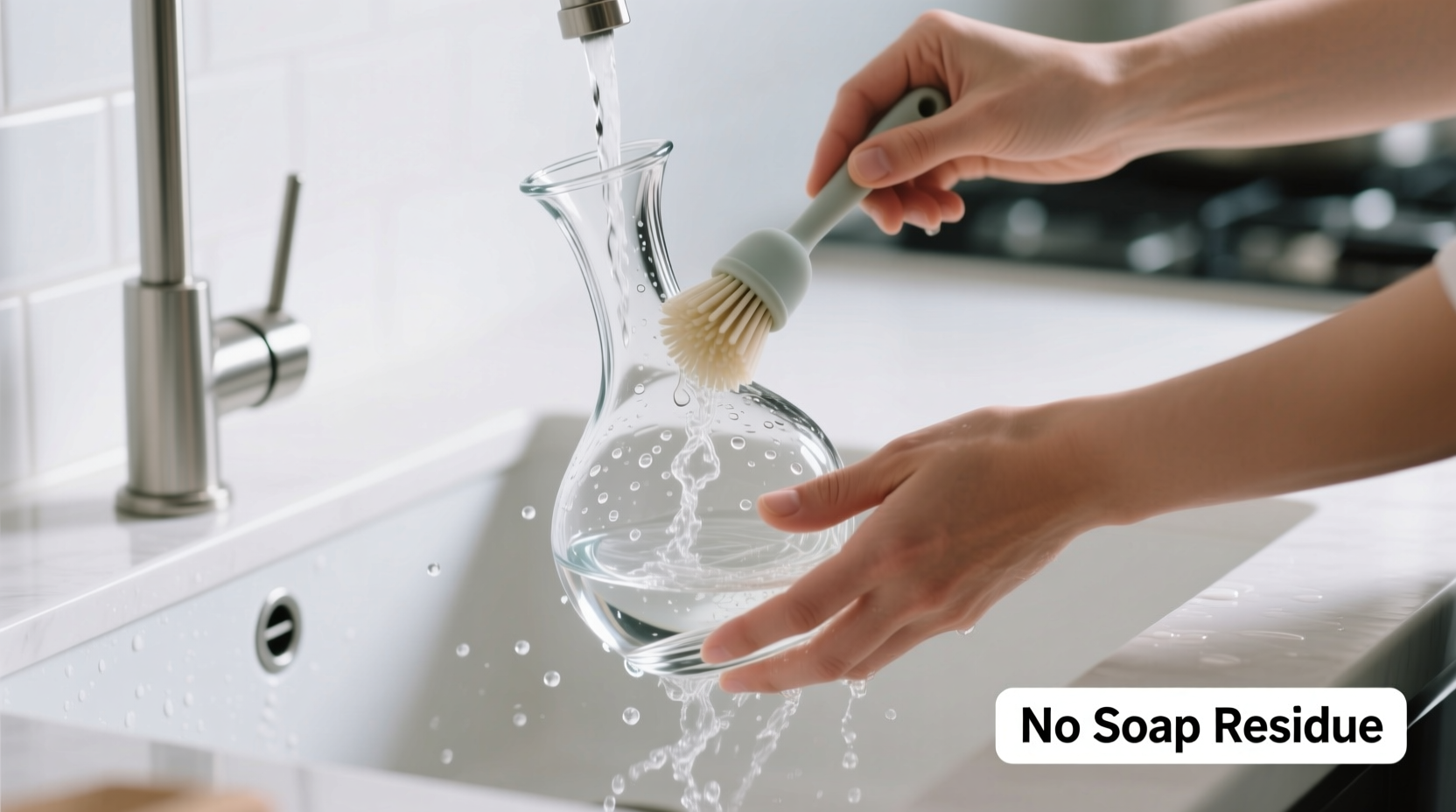
Most people assume “a little soap won’t hurt.” That assumption ignores three critical realities: the chemistry of wine aromatics, the physics of glass adhesion, and the sensitivity of human olfaction. Wine contains over 800 volatile organic compounds—many present at parts-per-trillion concentrations. Our noses detect them at thresholds as low as 0.0000000001 grams per liter. Sodium lauryl sulfate (SLS), a common surfactant in dish soaps, doesn’t just linger—it forms micelles that trap and sequester those delicate molecules. Worse, SLS leaves behind a hydrophobic film on glass, altering surface tension and interfering with how wine spreads across the bowl during swirling—a subtle but perceptible disruption to aroma release.
Research published in the Journal of Agricultural and Food Chemistry (2021) confirmed that residual detergent at concentrations as low as 0.05 ppm reduced perceived floral intensity in Gewürztraminer by 37% in blind panel testing. The effect was most pronounced in high-pH, low-alcohol whites—precisely the wines often served from decanters for clarity and temperature control.
“Residue isn’t about taste—it’s about volatility. You don’t need to *taste* the soap to lose the rose petal. You only need enough to disrupt the evaporation kinetics of key esters.” — Dr. Elena Rossi, Oenologist & Sensory Scientist, University of Bordeaux
The step-by-step rinse protocol: precision over habit
Rinsing a decanter isn’t passive—it’s a deliberate, calibrated sequence. Skip any step, and risk compromise. Follow this exact order:
- Immediate post-use rinse (within 90 seconds): As soon as wine is poured out, fill the decanter halfway with cool, filtered tap water. Swirl vigorously for 15 seconds—not gently, but with controlled force—to dislodge wine film before it polymerizes. Empty completely. Do not let wine dry inside.
- Soak only if needed (never routine): For stubborn residue (e.g., dried tannin films or port crust), use a solution of 1 tsp food-grade citric acid + 500 mL warm (not hot) distilled water. Soak no longer than 3 minutes. Citric acid breaks down tartrate crystals and organic deposits without leaving alkaline residue like baking soda or vinegar can.
- Soap application—minimal and targeted: If washing is required (e.g., after serving multiple bottles or dessert wine), use *only* 1–2 drops of unscented, phosphate-free, SLS-free liquid castile soap (e.g., Dr. Bronner’s Pure-Castile Liquid Soap, Unscented). Apply directly to a clean, lint-free microfiber cloth—not into the decanter. Gently wipe interior surfaces in overlapping vertical strokes. Never pour soap directly into the vessel.
- First rinse cycle (cold, filtered, high-volume): Hold decanter under a steady stream of cold, filtered water (not tap—chlorine and minerals increase residue risk). Tilt and rotate slowly for 45 seconds, ensuring water flows continuously over all interior surfaces. Use a gooseneck kettle or pitcher if faucet pressure is weak.
- Second rinse cycle (distilled water polish): Fill decanter with room-temperature distilled water (not spring or purified—those contain dissolved solids). Swirl for 20 seconds, then empty. Repeat once. Distilled water carries zero mineral load, eliminating the chance of calcium carbonate or magnesium silicate deposits that mimic soap film.
- Drying protocol (no air-drying): Invert decanter on a clean, lint-free microfiber drying rack (never paper towels or dishcloths). Let drain for 10 minutes. Then, using a *dry*, dedicated microfiber cloth, gently wipe the interior with slow, upward strokes—starting at the base and moving toward the neck. Never rub in circles.
What to avoid—and why each mistake has consequences
Many well-intentioned practices actually worsen residue risk. Here’s what fails—and the science behind the failure:
| Mistake | Why It Compromises the Bouquet | Better Alternative |
|---|---|---|
| Using scented or “grease-cutting” dish soap | Fragrance oils (limonene, linalool) bind irreversibly to glass, creating competing aromas that mask wine volatiles for up to 48 hours | Unscented, plant-based castile soap (pH 8.5–9.0), used sparingly |
| Rinsing with hot water | Heat accelerates soap film formation and causes rapid evaporation, leaving concentrated surfactant traces in microscopic glass imperfections | Cold or room-temperature filtered water for first rinse; distilled at room temp for final polish |
| Air-drying overnight | Evaporation concentrates any remaining ions or organics, forming a hazy, hydrophobic layer that repels wine and traps aromas | Controlled draining + immediate microfiber wipe with upward strokes |
| Using vinegar or baking soda soaks routinely | Vinegar (acetic acid) etches glass over time; baking soda (sodium bicarbonate) leaves alkaline salts that interact with wine acids, creating off-aromas | Citric acid soak only when necessary; never weekly |
| Storing damp decanters in cabinets | Trapped moisture breeds biofilm—microscopic colonies of bacteria and yeast that metabolize residual sugar into acetaldehyde (green apple/sherry-like off-note) | Store fully dry, inverted, in open air—not in enclosed cupboards or dust bags |
A real-world case: When residue cost $280 and a reputation
In March 2023, sommelier Daniel Cho hosted a private vertical tasting of Château Margaux 1996–2015 for six collectors. He’d cleaned his lead-crystal decanters the night before using his usual method: warm water, a splash of lemon-scented dish soap, thorough rinsing, and air-drying in a closed cabinet. At the tasting, guests noted a persistent “waxy, citrus-rind bitterness” in the 2005 and 2010—wines known for their ethereal violet and graphite notes. Cho re-decanted fresh bottles into a colleague’s unused decanter: the off-note vanished. Back in his kitchen, he performed a simple test: filled one of his decanters with distilled water, swirled, and smelled the vapor above the rim. A distinct, lingering lime zest aroma confirmed soap residue—not from the soap itself, but from oxidized limonene trapped in micro-scratches.
He repeated the full rinse protocol—cold filtered rinse, double distilled polish, microfiber wipe—and retested. No aroma. The next day, he re-tasted the same 2010 with identical conditions: the wine showed its true structure and perfume. The lesson wasn’t about carelessness—it was about cumulative habit. His decanters had been rinsed “well enough” for years. But for elite, aromatic-sensitive Bordeaux, “well enough” was never sufficient.
Essential tools and materials checklist
You don’t need specialty gear—but you do need precise, consistent tools. Avoid improvisation.
- Filtered water pitcher (with activated carbon + ion exchange filter—removes chlorine, chloramine, and heavy metals)
- Small bottle of distilled water (USP grade, not “purified” or “spring”)
- Unscented liquid castile soap (verify SLS/SLES-free on label; check INCI list)
- Dedicated microfiber cloths (100% polyester/polyamide blend, 300+ gsm; launder separately with fragrance-free detergent)
- Gooseneck kettle or narrow-spout pitcher (for controlled, high-velocity rinsing)
- Microfiber drying rack with angled supports (prevents pooling at base)
- Citric acid powder (food-grade, not “vitamin C tablets”—those contain fillers)
FAQ: Your most practical questions, answered precisely
Can I use a dishwasher for my decanter?
No—absolutely not. Dishwashers use high heat (damaging lead crystal), alkaline detergents (leaving salt residues), and forced-air drying (baking on film). Even “delicate” cycles exceed safe parameters. Hand-rinsing is non-negotiable for aromatic integrity.
How do I know if my decanter is truly residue-free?
Perform the “water break test”: Pour 50 mL of distilled water into the clean, dry decanter. Swirl gently and observe the interior surface as you tilt. Residue-free glass will show uniform, continuous water sheeting—no beading, streaking, or “shivering” (where water pulls away in thin lines). Beading indicates hydrophobic film; streaking signals mineral deposits.
What if I forgot to rinse right after use and wine dried inside?
Do not scrub. Soak for 2 minutes in 500 mL warm distilled water + 1 tsp citric acid. Then proceed with the full rinse protocol—skip soap entirely. Dried wine film is organic, not greasy; citric acid dissolves it cleanly without surfactants.
Conclusion: Precision is reverence
Rinsing a wine decanter isn’t a chore—it’s an act of stewardship. Every swirl, every careful rinse, every deliberate dry is a quiet acknowledgment that wine is alive: fragile, complex, and profoundly sensitive to its environment. The bouquet isn’t decoration; it’s information—the vineyard’s soil, the vintage’s weather, the winemaker’s intent, all encoded in scent. When we eliminate soap residue, we aren’t just cleaning glass. We’re removing static from the signal. We’re honoring the decades of labor behind the bottle and the milliseconds of perception in the glass.
Start tonight. Not tomorrow. Not after the next special occasion. Tonight—with the decanter you used for dinner, or the one gathering dust in your cupboard. Run the cold filtered rinse. Add the distilled polish. Wipe with intention. Then pour your next glass and inhale deeply. Notice the difference—not as absence, but as presence: the unobstructed voice of the wine, finally heard.
💬 Your palate is your most valuable tool. Try the distilled water rinse this week—and share what you discover in the comments. Did the violet note in your Syrah bloom? Did the petrol in your Riesling sharpen? Real observations help us all refine our craft.