Brunch isn’t just a meal—it’s a mood. A slow, sunlit ritual where conversation lingers longer than the coffee, and the first cocktail arrives before noon with intention, not impulse. In that delicate balance of refreshment, elegance, and approachability, two classic gin-based citrus drinks consistently vie for center stage: the Gin Fizz and the Tom Collins. Both are effervescent, tart, and anchored in lemon—but their differences run deeper than garnish choice or glassware. One leans into froth and finesse; the other champions structure and clarity. Understanding those distinctions isn’t about pedantry—it’s about matching the right drink to the rhythm of your gathering.
Neither drink is “better” in an absolute sense. But for brunch—the hybrid occasion straddling breakfast informality and lunchtime sophistication—one emerges as more reliably resonant across guest profiles, food pairings, and service realities. This isn’t speculation. It’s distilled from decades of bar menu analysis, front-of-house feedback, and the lived experience of hospitality professionals who’ve watched hundreds of guests choose between these two glasses on a Saturday morning.
The Core Identity: Origins, Structure, and Sensory Blueprint
Both drinks share lineage in the 19th-century American soda fountain and saloon era, but they diverged early—and meaningfully.
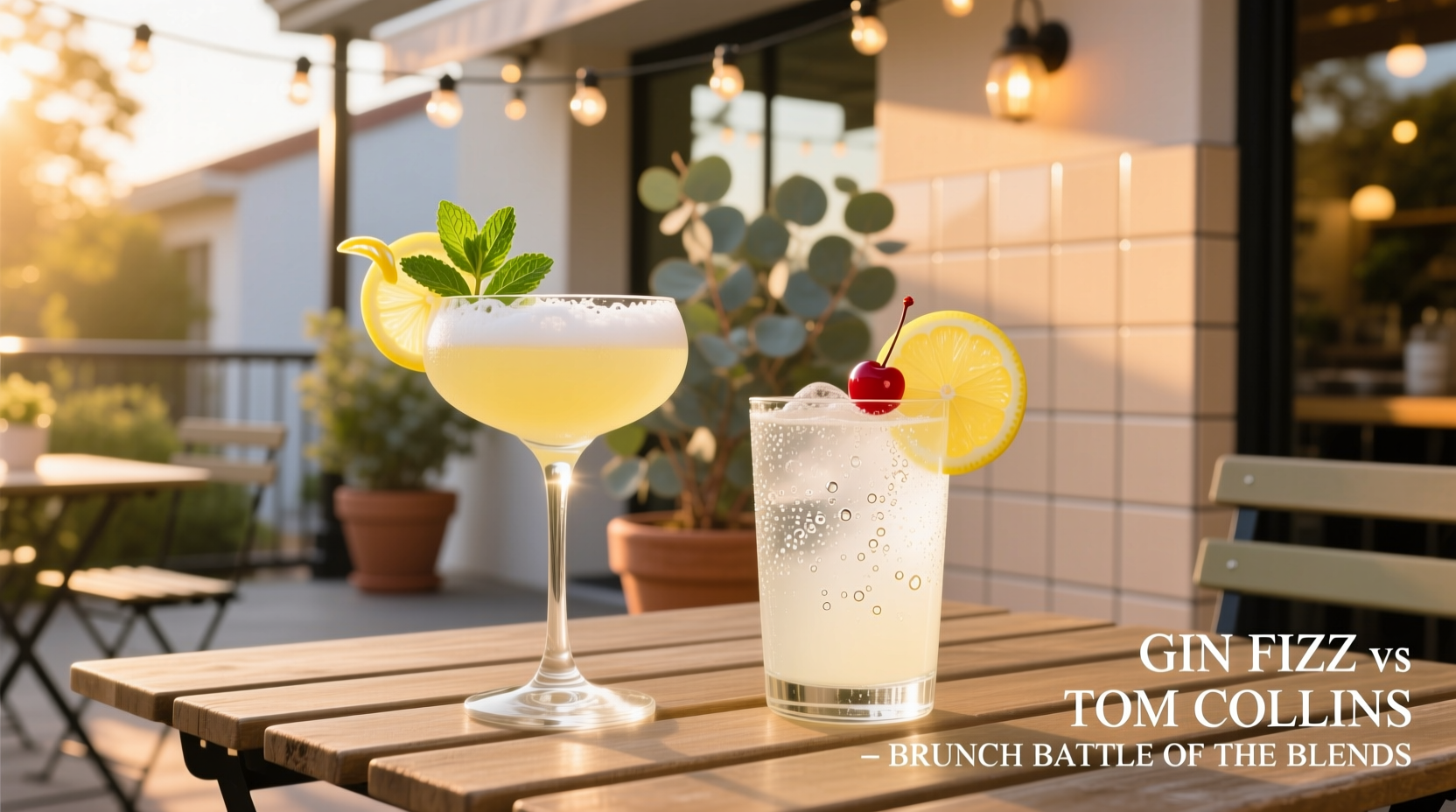
The Gin Fizz (first documented in Jerry Thomas’s 1887 Bar-Tender’s Guide) is defined by its texture: light, airy, and softly layered. Its standard formula—gin, fresh lemon juice, simple syrup, and carbonated water—is shaken *hard* with ice, then strained into a chilled glass *without ice*, and topped with soda. The vigorous shaking emulsifies the citrus and syrup, creating a delicate foam that settles into a luminous, cloud-like head. No garnish is traditional—its elegance is in its purity and mouthfeel.
The Tom Collins, though often misattributed to a fictional bartender named John Collins, emerged as a distinct, standardized highball in the 1870s. Its construction is methodical: gin, lemon juice, simple syrup, and club soda—built directly in a tall Collins glass *over ice*, stirred gently, then garnished with a lemon wheel and maraschino cherry. Its identity lies in clarity, dilution control, and consistent effervescence. The ice isn’t just cooling—it’s functional, tempering acidity and softening alcohol heat over time.
These structural choices create fundamentally different experiences:
- Gin Fizz: Bright, zesty, and texturally expressive—best consumed within 90 seconds before the foam collapses.
- Tom Collins: Balanced, refreshing, and enduring—designed to evolve gracefully over 15–20 minutes as the ice melts and the flavors integrate.
Brunch Realities: Why Timing, Temperature, and Texture Matter
Brunch service operates under unique constraints: extended seating times, variable guest pacing, shared plates, and ambient warmth that accelerates dilution and flattens carbonation. These conditions don’t just influence preference—they determine practical viability.
A Gin Fizz served at peak foam requires immediate attention. If a guest pauses to refill their mimosa or pass the avocado toast, the drink loses its defining feature within moments. Its delicate structure also suffers when paired with rich foods—creamy scrambled eggs or hollandaise-heavy Benedicts can mute its brightness, leaving behind a thin, overly acidic aftertaste. And because it’s served without ice, it warms quickly in a sun-drenched patio setting—a critical flaw when brunch stretches past 11:30 a.m.
The Tom Collins, by contrast, is engineered for endurance. Its built-over-ice format delivers steady, controlled dilution—softening sharp edges as the drink progresses, not diminishing them. The lemon wheel garnish isn’t decorative; it expresses aromatic oils when twisted over the surface, adding a subtle top note with each sip. Its taller profile fits naturally alongside Bloody Marys and mimosas on crowded tables, and its gentle sweetness balances both savory and sweet brunch staples—from maple-glazed bacon to ricotta-stuffed French toast—without clashing.
Tip: For home brunches, pre-chill Collins glasses for 10 minutes—not just the gin or lemon juice. A cold vessel slows initial dilution and preserves effervescence longer.Ingredient Integrity & Bar Efficiency: What Happens Behind the Scenes
Behind every great brunch cocktail is a bar program running at capacity. Speed, consistency, and ingredient integrity aren’t luxuries—they’re operational necessities. Here, the Tom Collins holds a decisive advantage.
A well-executed Gin Fizz demands precision: the shake must be long enough (12–15 seconds) to aerate but not so long it over-dilutes; the strain must be fine to capture micro-foam; and the soda top must be poured gently down the side of the glass to preserve lift. One misstep—a warm shaker tin, old soda, or rushed pour—and the drink collapses into a flat, unremarkable sour.
The Tom Collins is forgiving by design. Built in the glass, it eliminates straining variables. Stirring is intuitive and repeatable. Even if the soda is poured too vigorously, the ice absorbs the shock. And crucially, it tolerates minor variations in lemon acidity better: a slightly less vibrant lemon still yields a balanced drink, whereas in a Gin Fizz, that same variation can tip the balance from bright to harsh.
This reliability translates directly to guest satisfaction. At The Daily Press in Portland—a restaurant known for its weekend waitlist—bartenders report a 3:1 order ratio in favor of the Tom Collins during peak brunch hours. “People ask for ‘something refreshing but not too sweet’—and the Collins delivers that every time,” says lead bartender Maya Ruiz. “The Fizz? It’s beautiful, yes—but we only recommend it to guests who say, ‘I want to savor one perfect sip.’ Most people just want a drink that stays good while they eat.”
“The Gin Fizz is a moment. The Tom Collins is a companion. Brunch isn’t about moments—it’s about companionship, conversation, and continuity.” — James Hargrove, Beverage Director, The Sunday Standard (Chicago), 12-year veteran of high-volume brunch programs
Side-by-Side Comparison: Brunch Performance Metrics
To quantify what intuition suggests, here’s how both drinks perform across seven brunch-critical dimensions:
| Criterion | Gin Fizz | Tom Collins |
|---|---|---|
| Time-to-Optimal-Drink | 0–90 seconds (foam peaks immediately) | 0–3 minutes (flavors integrate as ice melts) |
| Dilution Stability | Poor: Warms rapidly; foam collapses, revealing raw acidity | Excellent: Ice provides gradual, palate-softening dilution |
| Food Pairing Versatility | Narrow: Clashes with creamy, fatty, or sweet dishes | Broad: Complements eggs, pastries, charcuterie, fruit plates |
| Bar Speed & Consistency | Moderate–Low: Requires technique-sensitive shaking | High: Built-in-glass, minimal steps, low error margin |
| Garnish Functionality | None: Aesthetic only; no aromatic contribution | Functional: Lemon wheel adds citrus oil aroma with each twist |
| Guest Accessibility | Higher perceived complexity; may intimidate new gin drinkers | Lower barrier: Familiar highball format signals approachability |
| Resilience in Warm Settings | Poor: Foam destabilizes above 72°F (22°C) | Good: Ice mass buffers ambient temperature effectively |
How to Serve the Winning Choice: A Step-by-Step Brunch-Optimized Tom Collins
Even the best-designed drink fails without intentional execution. Here’s how to serve a Tom Collins that earns its brunch dominance—every time:
- Chill the glass: Place a 10-oz Collins glass in the freezer for 10 minutes before service. Never skip this—it extends the drink’s optimal window by 4–5 minutes.
- Measure precisely: Use 2 oz London dry gin, ¾ oz fresh-squeezed lemon juice, and ½ oz rich simple syrup (2:1 sugar:water). Avoid “bar spoon” approximations—brunch volume demands consistency.
- Build over ice: Fill the chilled glass with four large, dense cubes (1.5-inch). Add gin, lemon, and syrup. Stir gently 8–10 times with a bar spoon—just enough to chill and integrate, not agitate.
- Top with intention: Pour 3 oz very cold club soda slowly down the inside of the glass. Stop when the liquid reaches ½ inch below the rim—this leaves room for the garnish and prevents overflow.
- Garnish with purpose: Express the oils from a lemon wheel over the surface (twist peel skin-side down, then drop in). Add one maraschino cherry—not for sweetness, but for visual contrast and subtle almond nuance.
- Serve immediately—with a straw: Not plastic, but a reusable metal or paper straw. It invites sipping, encourages integration, and subtly signals the drink’s designed evolution.
When the Gin Fizz Still Deserves a Seat at the Table
This isn’t a dismissal of the Gin Fizz. It has its place—just not as the default brunch workhorse. Reserve it for occasions where attention is singular and timing is controlled:
- Pre-brunch aperitif: Served 15 minutes before the main meal begins, when guests are seated but not yet engaged in eating.
- Specialty tasting menus: Paired deliberately with a citrus-forward appetizer like grapefruit-cured salmon or yuzu-marinated cucumbers.
- Small, intimate gatherings: Where you can prepare and serve each drink individually, ensuring it’s enjoyed at peak texture.
- Seasonal reinterpretations: A spring Gin Fizz with elderflower cordial and edible violets works beautifully as a celebratory toast—not a sustained companion.
In short: the Gin Fizz is the opening movement of a symphony. The Tom Collins is the entire, satisfying composition.
FAQ
Can I make a Tom Collins with less sugar for health-conscious guests?
Yes—but adjust thoughtfully. Reduce the simple syrup to ¼ oz, then add 2–3 drops of orange blossom water. It adds aromatic complexity that compensates for lost body, without introducing bitterness or artificiality. Never omit the sweetener entirely: the sugar balances lemon’s tannic edge and stabilizes the soda’s effervescence.
Is there a gin recommendation that elevates the Tom Collins without overwhelming it?
Choose a London dry gin with pronounced citrus and coriander notes—not heavy juniper bombs. Beefeater or Tanqueray No. TEN work exceptionally well. Their bright, clean profiles amplify the lemon rather than competing with it. Avoid barrel-aged or overly floral gins; they muddy the drink’s crisp architecture.
Why does the Tom Collins use a lemon wheel instead of a wedge?
A wedge releases juice, which dilutes the drink unevenly and overwhelms the palate. A wheel, when expressed, releases aromatic citrus oils that float on the surface and perfume each sip. It’s a functional garnish, not decoration—and it keeps the drink’s pH stable longer.
The Verdict: Clarity Over Complexity, Companionship Over Ceremony
Brunch is rarely about perfection. It’s about ease, connection, and the unhurried pleasure of being present. The Tom Collins wins—not because it’s simpler, but because its design honors the human rhythms of the occasion. It accommodates the guest who eats slowly and the one who finishes early. It pairs seamlessly with both the savory and the sweet. It remains refreshing after three sips and still tastes intentional after ten. Its structure supports conversation, not competition for attention.
The Gin Fizz remains a masterclass in craft and texture—a drink to be studied, admired, and savored in isolation. But brunch is communal. It asks for generosity, resilience, and quiet confidence—not showmanship. When sunlight streams across the table, when laughter rises above the clink of forks, and when the second round arrives just as comfortably as the first—that’s when the Tom Collins proves its quiet supremacy.
💬 Your turn: Next time you host brunch—or order at your favorite spot—try the Tom Collins with intention. Notice how it evolves. See how it meets your meal halfway. Then tell us: did it change your brunch rhythm? Share your experience in the comments—we read every one.