Vodka is often served ice-cold—chilled in the freezer for 2–4 hours before pouring. But what happens when it stays there for days, weeks, or even months? Does prolonged freezing dull its character? Alter mouthfeel? Mask subtle botanical notes in premium expressions? These questions matter more than ever as craft distillers invest in terroir-driven wheat, heirloom rye, and single-estate potatoes—and consumers pay $40–$80 for bottles promising clarity, texture, and layered nuance. The answer isn’t “yes” or “no.” It’s rooted in physical chemistry, sensory physiology, and decades of distilling practice. This article unpacks what freezing *actually* does to vodka—not as folklore, but as measurable phenomena.
The Physical Reality: Vodka Doesn’t Freeze Solid (and Why That Matters)
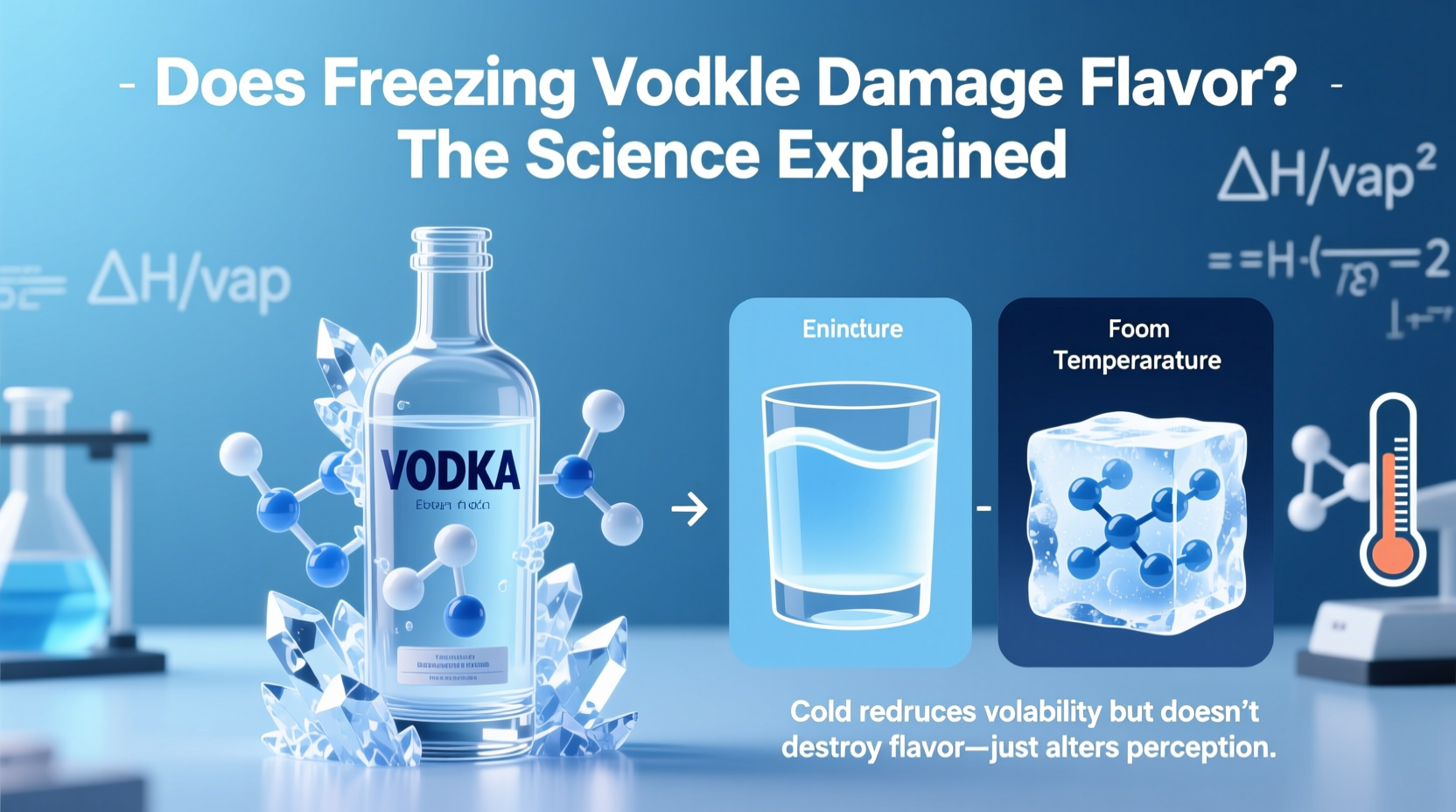
Standard 40% ABV (80 proof) vodka has a freezing point of approximately −26.5°C (−15.7°F). Most home freezers operate between −18°C and −23°C (0°F to −10°F)—cold enough to chill vodka deeply, but not cold enough to crystallize it. What forms instead is a highly viscous, syrupy liquid with dramatically increased molecular viscosity. At −20°C, ethanol-water hydrogen bonding intensifies, slowing molecular motion and thickening the solution. This isn’t phase change—it’s kinetic dampening.
Crucially, no chemical bonds break during this process. Ethanol remains ethanol. Congeners—trace fusel oils, esters, and aldehydes formed during fermentation and distillation—remain chemically intact. No oxidation occurs in sealed bottles; oxygen exposure is negligible without headspace agitation. So while freezing doesn’t *chemically degrade* vodka, it profoundly alters how humans perceive it—through physics, not decomposition.
Sensory Suppression: How Cold Mutes Volatility and Mouthfeel
Flavor perception relies on two parallel pathways: retronasal olfaction (aroma molecules traveling from mouth to nasal cavity) and gustatory-tactile response (taste buds + trigeminal nerve stimulation). Both are exquisitely temperature-sensitive.
- Aroma volatility drops sharply below 10°C: Esters like ethyl acetate (fruity), isoamyl acetate (banana), and phenethyl acetate (rose-honey) have vapor pressures that fall by 60–80% between 20°C and −15°C. Fewer molecules escape the liquid surface, so fewer reach olfactory receptors.
- Taste bud responsiveness declines: Human taste receptors operate most efficiently between 15°C and 35°C. Below 10°C, sweetness and bitterness perception diminish by up to 35%, while sourness becomes more pronounced relative to other tastes—a key reason ultra-chilled vodka can taste “sharper” or “leaner.”
- Trigeminal impact increases: Cold amplifies the cooling, slightly numbing sensation mediated by the trigeminal nerve—enhancing perceived “cleanliness” but suppressing textural richness (e.g., the oily silkiness of high-rye vodkas).
This explains why a well-made, unflavored vodka—say, one distilled from French winter wheat and filtered through birch charcoal—may seem “flatter” straight from the freezer: not because its compounds vanished, but because your sensory system simply cannot detect them efficiently at low temperatures.
Tip: For maximum aromatic expression, serve premium vodka at 4–8°C (refrigerator temp), not −18°C (freezer temp). Use pre-chilled glasses—not freezer storage—to preserve nuance without sacrificing chill.What Distillers and Masters Actually Do: A Mini Case Study
In 2022, the team at Chopin Potato Vodka (Poland) conducted an internal sensory trial comparing identical batches stored at three conditions over 90 days: room temperature (21°C), refrigerated (5°C), and frozen (−20°C). Bottles remained sealed, upright, and in darkness. Panelists—12 certified spirits tasters with ≥5 years’ experience—evaluated each sample blind using standardized descriptors (intensity, balance, finish length, ethanol integration).
Results were revealing: • Room-temp samples scored highest for “baked potato skin,” “crushed mint,” and “creamy finish”—notes linked to specific esters and fatty acid ethyl esters. • Refrigerated samples retained 92% of those descriptors at full intensity. • Frozen samples showed statistically significant suppression: “baked potato” dropped 41% in detection frequency; “creamy finish” fell to near-threshold levels; “ethanol heat” was perceived as sharper and less integrated.
Importantly, all frozen samples rebounded fully after 20 minutes at room temperature—proving no permanent alteration occurred. As Bartosz Kowalczyk, Chopin’s Master Blender, observed: “Cold doesn’t destroy flavor. It puts it on mute. You wouldn’t critique a symphony played at half-volume and say the music is flawed.”
“Freezing is a tool—not a flaw. It simplifies the profile intentionally, much like serving Champagne very cold to emphasize freshness over complexity. But if you’ve paid for nuance, serve it warm enough to hear every instrument.” — Dr. Elena Rostova, Senior Flavor Chemist, International Wine & Spirit Research Institute
Do’s and Don’ts: A Practical Storage & Serving Checklist
| Action | Recommended? | Why |
|---|---|---|
| Store unopened vodka in freezer long-term (≥3 months) | ✅ Yes | No chemical degradation; stable ABV prevents microbial growth. Seal integrity matters more than temperature. |
| Store opened bottle in freezer beyond 2 weeks | ⚠️ Caution | Micro-oxidation accelerates with repeated freeze-thaw cycles and headspace air. Best consumed within 10 days. |
| Freeze flavored or infused vodkas (e.g., citrus, pepper) | ❌ Avoid | Essential oils and volatile aromatics degrade faster under thermal stress. Citrus esters oxidize visibly within 72 hours at −20°C. |
| Use freezer-chilled vodka in cocktails requiring dilution (martinis, Moscow mules) | ✅ Yes | Reduces need for ice, preserving drink strength and texture. Cold base minimizes melt-induced dilution. |
| Freeze vodka in glass bottles with narrow necks | ❌ Avoid | Liquid expansion at sub-zero temps creates pressure. Risk of slow fracturing or cap seal failure over time. |
Step-by-Step: Optimizing Vodka Temperature for Intended Use
- For sipping neat (premium craft vodka): Remove from freezer 15–20 minutes before serving. Ideal range: 6–10°C. Swirl gently in a tulip-shaped glass to release trapped volatiles.
- For chilled shots (traditional Eastern European service): Store at −18°C. Serve immediately in small, thick-walled shot glasses. Texture and numbing effect are part of the ritual—not flaws to correct.
- For stirred cocktails (e.g., vodka martini): Chill vodka and vermouth separately in freezer 2+ hours. Stir with ice for exactly 30 seconds—just enough to chill and dilute (~0.75 oz water per 3 oz spirit). Strain into a pre-chilled coupe.
- For infused or fruit-forward vodkas: Refrigerate (not freeze) at 3–5°C. Consume within 7 days of opening. Never freeze—heat and cold both accelerate ester hydrolysis.
- For long-term storage (unopened, >6 months): Keep upright in cool, dark cupboard (12–18°C). Freezer storage adds no preservation benefit—and risks label adhesion failure or cap corrosion in humid environments.
FAQ: Addressing Common Misconceptions
Does freezing vodka make it “stronger” or increase alcohol burn?
No. ABV remains unchanged. However, cold suppresses sweetness and body while heightening ethanol’s trigeminal sting—creating a *subjective* impression of greater potency. Warming the spirit restores balance.
Can freezing cause vodka to “go bad” or spoil?
Not in the microbial sense. Vodka’s high ethanol concentration (≥40%) is inhospitable to bacteria, yeast, or mold. What degrades over time—especially post-opening—is aromatic complexity due to oxidation and evaporation of volatile top-notes. Freezing slows but doesn’t halt this; refrigeration offers similar protection with less sensory penalty.
Why do some premium brands explicitly advise against freezing?
Brands like Belvedere, Grey Goose, and Vestal highlight their terroir-specific grain character and multi-stage filtration. Their guidance reflects intent: they want you to experience the full spectrum—from cereal sweetness to mineral finish—not just the clean, icy shock. It’s curation, not chemistry.
The Bottom Line: Temperature Is Context, Not Corruption
Freezing vodka does not damage its flavor profile in any irreversible, chemical way. There is no “flavor loss” in the sense of molecular breakdown. What changes is accessibility—how readily those flavors reach your senses. Think of it like turning down the volume on a high-fidelity recording: the data remains intact on the disc, but you hear less detail. For utility—quick shots, frosty cocktails, or hot-weather refreshment—freezing delivers precisely what it promises: intense chill and textural contrast. For appreciation—savoring the whisper of buckwheat, the lift of wildflower honey, the grip of chalky limestone—warmer service unlocks what’s already there.
This isn’t about right or wrong. It’s about alignment: matching method to intention. A $12 well vodka served frozen at a beach bar fulfills its purpose perfectly. A $75 single-estate rye vodka deserves the same respect we give single-malt Scotch—served thoughtfully, at a temperature that invites discovery, not distraction.
💬 Your palate is your authority. Next time you reach for the freezer, pause. Try one pour at −18°C—and another warmed to 8°C in the same glass. Note what emerges. Share your observations in the comments—we’re building a community where curiosity meets craft, one degree at a time.