Chilling vodka has long been treated as gospel in bars and home cabinets alike—often assumed to “smooth out” harshness, mute burn, or even compensate for lower-quality spirit. But does cold temperature genuinely enhance the liquid’s intrinsic character, or does it simply suppress sensory input—masking both flaws and virtues? This question sits at the intersection of chemistry, neurology, and craft distillation. To answer it, we must move beyond ritual and examine what happens to ethanol, congeners, and human perception when vodka drops from room temperature to near-freezing. The truth is neither dismissive nor magical: chilling changes how we experience vodka—but rarely improves what’s actually in the bottle.
The Science of Cold: How Temperature Alters Perception
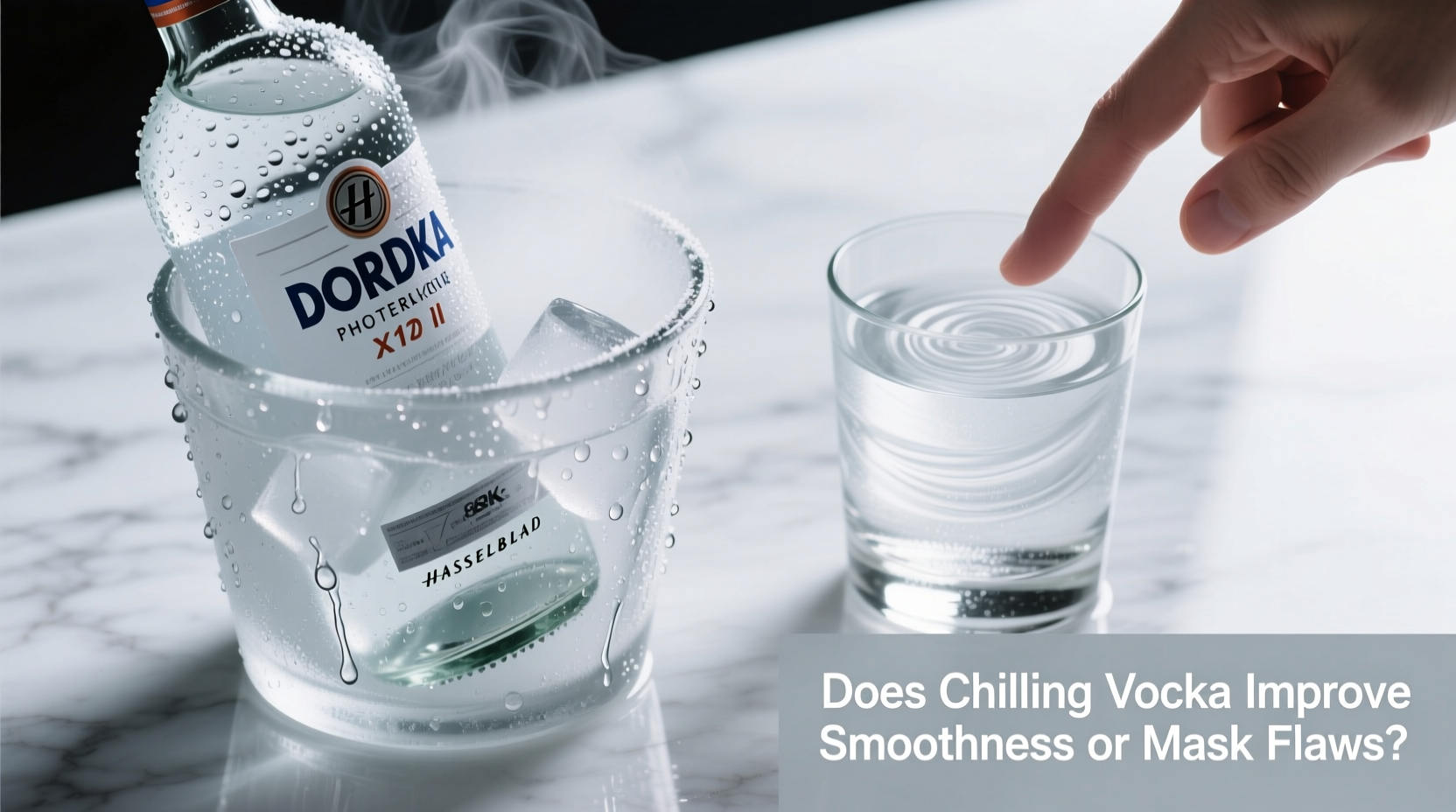
Vodka is legally defined in most markets as a neutral spirit—distilled or treated to be without distinctive character, aroma, taste, or color. In practice, however, no vodka is truly neutral. Even ultra-refined vodkas retain trace congeners (esters, aldehydes, higher alcohols), subtle grain or potato notes, and minute variations in mouthfeel driven by water-mineral composition and filtration method. These compounds behave differently at varying temperatures.
At colder temperatures—typically 0–4°C (32–39°F)—ethanol’s volatility decreases significantly. This means less alcohol vapor reaches the olfactory receptors in the nasal cavity, reducing the perceived “heat” or sharpness on the nose and initial palate. Simultaneously, taste bud sensitivity declines: sweetness perception drops by up to 30%, bitterness and sourness are muted, and trigeminal nerve response (responsible for the burn of alcohol) slows. A 2017 study published in Food Quality and Preference confirmed that panelists consistently rated identical vodkas as “smoother” and “less aggressive” when served at 2°C versus 22°C—even though chemical composition remained unchanged.
This isn’t deception—it’s physiology. Cold doesn’t remove impurities; it dampens the body’s ability to detect them. That distinction matters critically when evaluating quality.
What Chilling *Does*—and What It *Doesn’t*
Tip: Chill only if serving neat or in low-dilution cocktails (like a vodka martini). Never chill before tasting analytically—warm vodka reveals true balance, texture, and flaw structure.Chilling delivers three measurable effects:
- Reduces ethanol volatility → less nasal burn, quieter aroma profile
- Slows trigeminal response → diminished perception of heat and alcohol “prickle”
- Thickens mouthfeel slightly due to increased viscosity of the ethanol-water matrix at low temperatures
What chilling does not do:
- Eliminate off-notes (e.g., solvent-like acetone, rubbery sulfur, or musty oxidation)
- Improve mouthfeel texture (e.g., silkiness vs. watery thinness)
- Correct poor distillation cuts (e.g., fusel oil carryover)
- Enhance purity—only rigorous distillation, charcoal or quartz filtration, and proper water blending achieve that
In fact, over-chilling (below −5°C / 23°F) can cause temporary cloudiness in some vodkas due to fatty acid ester precipitation—a harmless but visually jarring sign that temperature is overriding stability, not improving integrity.
A Real-World Case Study: The Blind Tasting at Kyrö Distillery
In early 2023, master distiller Mikko Rämä at Finland’s Kyrö Distillery conducted an internal blind evaluation of their flagship rye vodka across three temperatures: 22°C (room), 6°C (standard fridge), and −2°C (freezer-chilled). Twenty trained tasters—including bartenders, sommeliers, and sensory scientists—evaluated each sample for aroma intensity, ethanol burn, perceived sweetness, mouthfeel viscosity, and lingering finish.
Results were telling. At 6°C, 87% rated the vodka “more approachable,” with 72% noting reduced burn. Yet 64% also reported diminished aromatic nuance—especially the delicate rye spice and baked grain notes intentionally preserved through gentle copper pot distillation. At −2°C, 41% detected faint cloudiness and a slight waxy mouthfeel shift; more critically, 58% missed the telltale sign of over-dilution (a hollow mid-palate), which was unmistakable at room temperature.
Rämä concluded: “Cold makes our vodka easier to drink quickly—but it hides the very qualities we worked hardest to express. If a vodka needs freezing to be palatable, it hasn’t earned its place behind the bar.”
Expert Insight: The Distiller’s Perspective
“Temperature is a filter—not a polish. You can chill away the symptoms of poor distillation, but you cannot chill away the cause. A well-made vodka should be balanced, clean, and texturally coherent at 15°C. If it’s only ‘good’ at −3°C, then something went wrong before the bottle was sealed.”
— Dmitriy Serebryakov, Head Distiller, Russian Standard Platinum & former consultant to over 30 Eastern European distilleries
Serebryakov’s point underscores a critical industry standard: premium vodka producers routinely conduct quality control tastings at 12–15°C—the “sweet spot” where flaws are exposed but the spirit remains stable. At this range, harshness from rushed distillation, metallic notes from poor still maintenance, or flatness from over-filtration become unmistakable. Chilling bypasses that diagnostic step.
Do’s and Don’ts of Vodka Temperature Management
| Action | Why It’s Recommended | Risk If Done Incorrectly |
|---|---|---|
| Chill to 4–6°C for service | Optimizes mouthfeel and minimizes burn without suppressing all character | Over-chilling dulls aroma and may cause haze in unfiltered vodkas |
| Store upright in cool, dark place (10–15°C) | Preserves stability; prevents cork drying (if cork-finished) and slow oxidation | Storing in freezer long-term invites condensation, label damage, and thermal shock to glass |
| Never serve below −3°C unless specified | Maintains structural integrity; avoids ester precipitation and viscosity anomalies | May trigger temporary cloudiness and a waxy, coating sensation on the palate |
| Taste new vodkas first at 15°C, then chilled | Establishes baseline quality before temperature modulation | Starting cold risks normalizing flaws and missing opportunities for refinement |
| Avoid repeated freeze-thaw cycles | Prevents micro-stress on glass, seal integrity, and volatile compound equilibrium | Can accelerate oxygen ingress and promote subtle flavor degradation over time |
Step-by-Step: How to Evaluate Vodka Temperature Effectively
- Start warm: Pour 15 mL into a tulip-shaped nosing glass. Let sit at 15–18°C for 2 minutes. Note aroma clarity, ethanol presence, and any off-notes (rubber, nail polish, wet cardboard).
- Assess mouthfeel: Sip slowly. Observe weight, viscosity, and finish length. Does it coat evenly? Is there astringency or heat spike?
- Chill deliberately: Place same bottle in refrigerator (not freezer) for 90 minutes—target 5°C. Re-taste side-by-side using identical glassware and volume.
- Compare objectively: Use a simple 3-column chart: (A) Aroma intensity, (B) Palate heat, (C) Finish persistence. Rate each 1–5. Note whether reduction in one area correlates with loss in another.
- Conclude with intent: If chilled version gains smoothness but loses aromatic complexity and finish depth, temperature is masking—not enhancing. If both versions show balance, chilling is a valid service choice—not a crutch.
FAQ
Does freezing vodka make it “stronger” or increase alcohol concentration?
No. Freezing does not alter ABV. Ethanol freezes at −114°C; water freezes at 0°C. In a typical freezer (−18°C), only trace water may form micro-crystals—insufficient to concentrate alcohol meaningfully. Any perceived “strength” is sensory illusion from intensified cold-induced trigeminal stimulation, not actual potency change.
Can chilling reveal hidden flaws—or only hide them?
Chilling rarely reveals flaws—it usually conceals them. However, in rare cases, extreme cold can expose instability: cloudiness indicates ester or fatty acid separation; a waxy film suggests improper rectification or water source mismatch. These aren’t “flaws” per se, but signs the formulation lacks thermal resilience—a quality benchmark for premium vodkas.
Is there a vodka type that genuinely benefits from deep chilling?
Yes—but narrowly. Unfiltered, high-ester vodkas (e.g., some Polish rye or Japanese rice vodkas) may gain textural roundness at 2–4°C due to subtle congener interaction. Conversely, ultra-light, heavily carbon-filtered vodkas (e.g., many Swedish or American brands) often flatten entirely below 7°C, losing their delicate mineral lift and becoming perceptually “thin.” Context matters more than category.
Conclusion
Chilling vodka is neither a sin nor a salvation—it is a deliberate, reversible intervention with predictable physiological consequences. It smooths the ride, yes—but often at the cost of depth, honesty, and intentionality. A truly refined vodka earns its place neat at cellar temperature, not just in a frost-rimed glass. When you reach for the freezer, ask yourself: am I enhancing the experience—or avoiding the truth in the bottle? The most confident distillers don’t hide behind ice. They build spirits robust enough to speak clearly, at any reasonable temperature. Your palate deserves that clarity. Taste thoughtfully. Serve intentionally. And never let convenience override craftsmanship.
💬 Have you discovered a vodka that shines equally at 15°C and 5°C? Share your findings—and the why—in the comments. Real-world tasting notes help us all drink smarter.