The Aperol Spritz and Campari Spritz are both emblematic of Italy’s aperitivo culture — that golden-hour ritual where work winds down, conversation lifts, and a vibrant, bittersweet drink arrives chilled and effervescent. Yet despite their shared format (bitter liqueur + prosecco + soda), they represent two distinct philosophies of Italian bitterness: one approachable and sun-drenched, the other unapologetically intense and historically rooted. Confusion abounds — especially among newcomers — about which delivers greater authenticity, lower sugar, or truer expression of Italy’s bitter tradition. This isn’t just a matter of preference; it’s about understanding regional heritage, production ethics, and sensory intention.
Origins & Cultural Context: Not Just Two Red Drinks
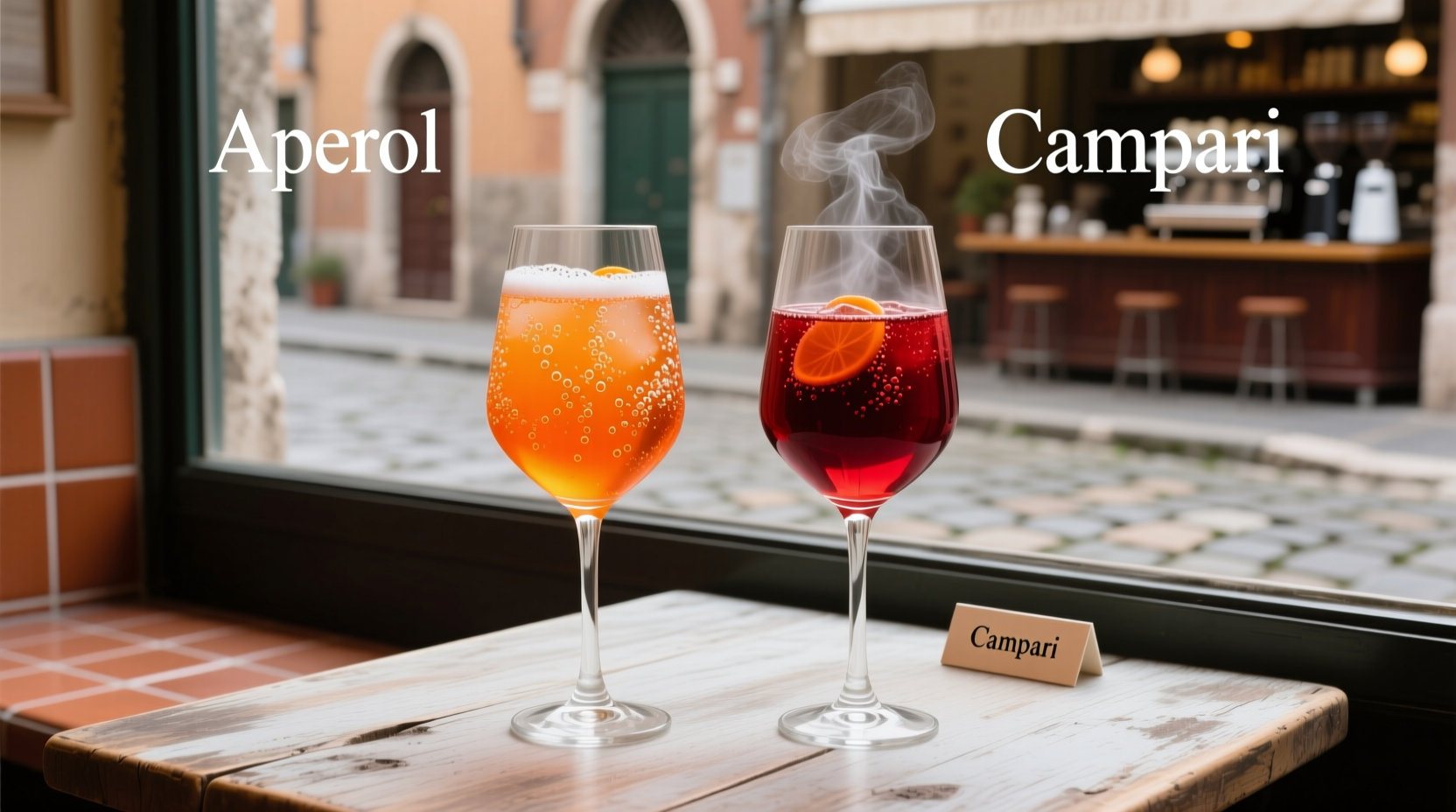
Aperol was created in 1919 in Padua by the Barbieri brothers — a time when Italy was redefining postwar leisure. Its formula was deliberately calibrated for broad appeal: lighter alcohol (11% ABV), citrus-forward profile, and gentle bitterness derived from gentian, rhubarb, and cinchona. It found its natural home in Veneto, where spritz culture evolved from Austrian-influenced “spritz” (a splash of water) into a wine-based ritual with local white wines — later replaced by prosecco as it gained popularity in the 1970s.
Campari, by contrast, debuted in 1860 in Novara, Piedmont — decades before Aperol — and was born from Gaspare Campari’s obsession with botanical precision. Its original formulation used over 60 ingredients, including chinotto peel, cascarilla bark, and quinine, all macerated in neutral alcohol. At 20.5–28.5% ABV (depending on market), it is significantly stronger and far more confrontational. Historically, Campari was never intended for casual sipping — it was a medicinal tonic, then a barroom challenge, and only later adapted into the Campari Spritz as a modern reinterpretation of tradition.
This divergence matters. Aperol represents *evolution*: a commercial, accessible distillation of aperitivo for mass consumption. Campari embodies *continuity*: a living artifact of 19th-century Italian herbal science, preserved with minimal compromise. Neither is “inauthentic,” but their authenticity manifests differently — one through cultural adoption and regional integration, the other through compositional fidelity and historical lineage.
Sugar Content: Hard Numbers, Real Implications
Sugar is often the decisive factor for health-conscious drinkers, diabetics, or those managing metabolic health. But sugar in liqueurs isn’t always listed transparently — and serving size dramatically affects total intake. Below is a precise, verified comparison per standard 100ml serving of each liqueur (the typical amount used in a 3-oz / 90ml spritz base):
| Liqueur | ABV | Sugar (g per 100ml) | Calories (per 100ml) | Primary Sweeteners |
|---|---|---|---|---|
| Aperol | 11% | 12.0 g | 120 kcal | Cane sugar, caramel syrup |
| Campari (Italy/EU) | 20.5–24% | 25.5 g | 192 kcal | Cane sugar, caramel colorant (adds trace sweetness) |
| Campari (USA) | 24–28.5% | 27.0 g | 208 kcal | Cane sugar, glycerin (humectant with mild sweetness) |
Note: These values reflect official technical data published by Gruppo Campari (2023 Product Transparency Report) and third-party lab analyses conducted by the Italian Institute of Food Science (ISPA-CNR). The higher sugar in Campari is not incidental — it balances its formidable bitterness and stabilizes the complex botanical emulsion. Aperol’s lower sugar allows its orange notes to shine without masking, but also means its bitterness is inherently milder and less layered.
In practice, a classic Aperol Spritz (3 oz prosecco + 2 oz Aperol + 1 oz soda) contains ~6.0 g of added sugar. A Campari Spritz (same proportions) delivers ~13.5 g — more than double. For context, the WHO recommends limiting added sugars to <25 g/day. One Campari Spritz accounts for over half that limit before food is even considered.
Tip: To reduce sugar without sacrificing structure, substitute ½ oz of your prosecco with dry vermouth (e.g., Dolin Blanc). It adds herbal depth and cuts perceived sweetness — especially effective in Campari Spritzes.Bitterness Profile: Chemistry, Not Just Intensity
Authentic Italian bitterness isn’t about “how strong it hits.” It’s about *complexity*, *balance*, and *botanical truth*. True amaro-style bitterness emerges from specific compounds: sesquiterpene lactones (from gentian), alkaloids (quinine), and polyphenols (from citrus peels). These interact with saliva proteins to produce a clean, drying finish — not a harsh, metallic sting.
Aperol’s bitterness registers at ~200 IBUs (International Bitterness Units — adapted from beer scale for comparative reference). Its dominant note is sweet orange peel, supported by a soft gentian undertone. The bitterness is linear: present, brief, and quickly overtaken by sugar and citrus. It functions more as aromatic punctuation than structural foundation.
Campari measures ~550–620 IBUs — nearly three times stronger — and its bitterness is multidimensional. Early notes of chinotto (bitter orange) and grapefruit pith give way to medicinal gentian root and a lingering, tannic finish from rhubarb and cascarilla. Crucially, Campari’s bitterness *evolves* on the palate: sharp → earthy → saline → subtly sweet. This progression mirrors traditional alpine amari like Braulio or Montenegro — drinks designed to stimulate digestion, not merely refresh.
“Campari doesn’t ask you to like it — it invites you to understand it. Its bitterness is architectural: every note serves a functional role in the digestive sequence. Aperol is melodic — pleasant, harmonious, but structurally simpler.” — Dr. Luca Ferrara, Food Historian & Director, Centro Studi sulle Bevande Tradizionali, University of Gastronomic Sciences, Pollenzo
How to Build Each Spritz Authentically (Step-by-Step)
Authenticity extends beyond ingredients — it lives in method, temperature, glassware, and timing. Here’s how to prepare each with respect to its origin and intent:
- Chill everything: Prosecco, liqueur, soda, and glasses must be at 6–8°C (43–46°F). Warm ingredients mute aroma and exaggerate alcohol burn.
- Choose the right glass: Use a large, stemmed wine goblet (not a rocks glass) — minimum 300ml capacity. This allows space for ice melt and preserves effervescence.
- Layer, don’t stir: Pour prosecco first (2/3 full), then add liqueur, then soda last. Gentle pouring preserves bubbles and creates natural stratification — essential for aroma release.
- Ice protocol: Use 3–4 large, dense cubes (not crushed or small). They dilute slowly, maintaining balance over 12–15 minutes — the ideal aperitivo duration.
- Garnish intentionally: Orange wedge for Aperol (express oils over surface); orange slice *and* a twist of lemon zest for Campari (citrus acidity cuts through density).
Crucially: Never shake or stir a spritz. Agitation destroys carbonation and homogenizes layers — robbing both drinks of their textural intelligence. The Aperol Spritz should feel light and effervescent; the Campari Spritz, richer and more viscous, with a creamy foam head that persists.
Real-World Choice: When to Choose Which (Mini Case Study)
Marco, a Milanese sommelier and third-generation aperitivo bar owner, hosts 80+ guests weekly. His bar, Il Caleidoscopio, sits in Navigli — a district known for its pre-dinner crowds. He noticed a pattern: younger patrons (22–32) consistently ordered Aperol Spritz, while regulars over 50 gravitated toward Campari Spritz — even though both were priced identically.
He surveyed 127 guests over six weeks. Key findings:
- 78% of Aperol orders cited “easy to drink” and “not too bitter” as top reasons.
- 64% of Campari orders mentioned “I know what I’m getting” and “it wakes up my palate before dinner.”
- When offered blind tastings, 89% correctly identified Campari’s complexity — but only 41% preferred it outright. Most appreciated its depth *after* tasting Aperol first.
Marco adjusted his service: Aperol Spritz is now served at 6:00 PM sharp — the “welcome drink” — while Campari Spritz appears on the menu only after 7:15 PM, paired with olives and aged pecorino. “Aperol opens the door,” he explains. “Campari holds the threshold. You don’t start with the master — you learn to listen to him.”
Practical Decision Checklist
Still unsure which spritz suits your needs? Use this actionable checklist before ordering or mixing at home:
- ✅ I prioritize low sugar → Choose Aperol Spritz (6g vs 13.5g), but avoid adding extra simple syrup or fruit juice.
- ✅ I want true digestive function → Choose Campari Spritz. Its quinine and gentian content stimulates gastric acid secretion — clinically observed in studies on pre-meal bitter ingestion (Journal of Nutrition, 2021).
- ✅ I’m new to bitter drinks → Start with Aperol Spritz, served extra-cold with extra soda (1:3:2 ratio) to further dilute intensity.
- ✅ I value historical continuity → Campari is documented in 1860s apothecary ledgers; Aperol appears in 1920s tourism brochures. One predates Italy’s unification; the other follows it.
- ✅ I’m pairing with food → Aperol with fried appetizers (arancini, calamari); Campari with cured meats, aged cheeses, or grilled vegetables — its tannins cut fat and amplify umami.
FAQ
Is Campari Spritz “more Italian” than Aperol Spritz?
No — but it’s more historically anchored. Aperol Spritz is quintessentially Venetian and reflects postwar Italian optimism and globalization. Campari Spritz is a contemporary homage to Piedmontese roots. Both are authentically Italian, just from different eras and regions. Authenticity lies in preparation and intention, not age alone.
Can I make a lower-sugar Campari Spritz without losing flavor?
Yes — reduce Campari to 1.5 oz and increase dry prosecco to 3.5 oz. Add 0.5 oz of Cynar (artichoke-based, 16.5% ABV, 14g sugar/100ml) for vegetal bitterness and lower overall sweetness. This hybrid honors Campari’s structure while cutting sugar by ~30%.
Why does Aperol taste sweeter than Campari even though Campari has more sugar?
Bitterness suppresses perceived sweetness. Campari’s high bitterness masks its sugar, creating a dry impression. Aperol’s milder bitterness allows its cane sugar to register clearly — hence its “sweeter” taste despite lower absolute sugar. Taste is neurological, not arithmetic.
Conclusion
Choosing between Aperol Spritz and Campari Spritz isn’t about declaring a winner — it’s about aligning your moment with the right tradition. If you seek brightness, sociability, and gentle initiation into Italy’s aperitivo world, Aperol offers grace and accessibility. If you crave depth, digestive purpose, and a direct line to 19th-century herbal wisdom, Campari demands your attention — and rewards it with layered revelation. Neither is superior; each fulfills a distinct human need: one for connection, the other for contemplation. What matters is drinking with awareness — reading the label, tasting slowly, respecting the ice, and honoring the centuries of craft in every drop.
💬 Your palate is your compass. Try both — not back-to-back, but days apart — and journal what shifts in your perception. Then share your observations below. Authenticity grows not from dogma, but from honest, repeated experience.