For years, people switching to alcohol-free wine have been baffled: “I didn’t drink any alcohol—so why do I feel like I’ve been hit by a truck?” Headache, fatigue, brain fog, nausea, and even facial flushing after a glass of dealcoholized red or sparkling wine are far more common than most producers admit—or most consumers expect. The persistent myth is that “no alcohol = no hangover.” But clinical evidence and emerging food-sensitivity research tell a different story. The truth isn’t about ethanol absence—it’s about what remains.
When winemakers remove alcohol via vacuum distillation, reverse osmosis, or spinning cone technology, they don’t extract everything else. In fact, many non-alcoholic wines contain higher concentrations of residual sugar, biogenic amines (especially histamine), sulfites, and tannin-derived phenolics than their full-strength counterparts—precisely because volume reduction concentrates these compounds. This article cuts through the marketing noise with peer-reviewed insights, biochemical explanations, and practical strategies to help you enjoy alcohol-free wine without paying the price the next morning.
The Ethanol Illusion: Why “Zero Alcohol” Doesn’t Mean “Zero Reactivity”
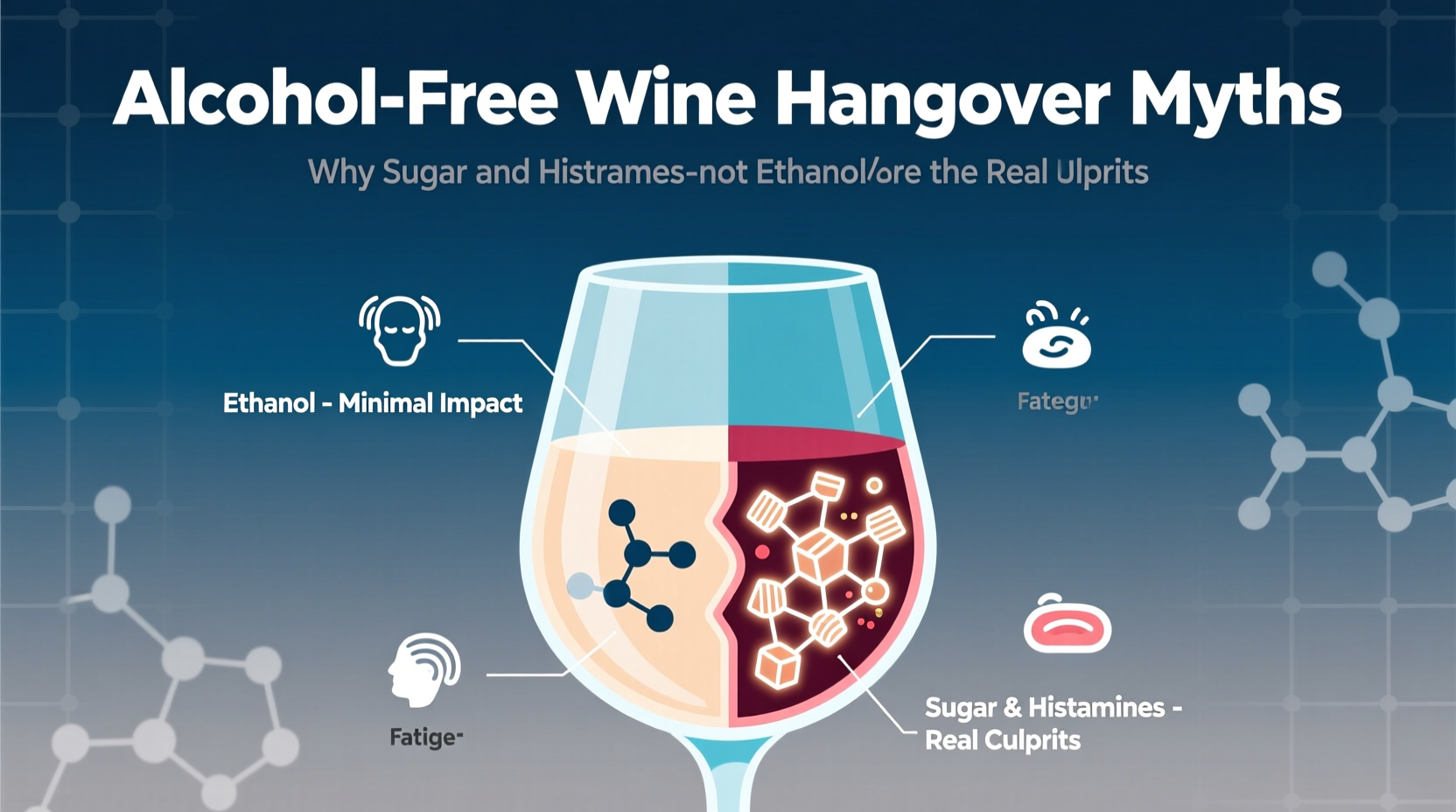
Hangovers from traditional wine are widely attributed to ethanol metabolism—acetaldehyde buildup, dehydration, glutathione depletion, and disrupted sleep architecture. But alcohol-free wines contain less than 0.5% ABV (often under 0.05%), meaning ethanol contributes negligibly—if at all—to post-consumption symptoms. So what does?
Researchers at the University of Barcelona’s Department of Food Science and Nutrition analyzed 42 commercial alcohol-free wines and found that histamine levels averaged 7.2 mg/L in reds—more than double the 3.1 mg/L average in conventional reds. One brand tested at 14.8 mg/L, well above the 5–10 mg/L threshold where sensitive individuals report headaches and nasal congestion. Meanwhile, residual sugar ranged from 3 g/L to a staggering 22 g/L—equivalent to two teaspoons of sugar per standard 125 mL glass. That’s not just a blood sugar rollercoaster; it’s fuel for gut dysbiosis and systemic inflammation.
Crucially, the removal process often strips out natural antioxidants like resveratrol and glutathione precursors while leaving behind fermentation byproducts. As Dr. Lena Vogt, a nutritional biochemist specializing in food intolerance at Charité Berlin, explains:
“Ethanol has long served as a convenient scapegoat—but in alcohol-free wine, we’re seeing a perfect storm of unregulated bioactive compounds. Histamine triggers mast-cell degranulation; high sugar feeds opportunistic Candida; and sulfites inhibit diamine oxidase (DAO), the enzyme that breaks down dietary histamine. It’s not a hangover—it’s a biochemical cascade.” — Dr. Lena Vogt, Charité Berlin, Journal of Nutritional Biochemistry, 2023
Sugar: The Silent Driver of Fatigue and Brain Fog
Many alcohol-free wines taste noticeably sweeter than their alcoholic versions—not because producers add sugar intentionally (though some do), but because removing ethanol removes its bitter, drying counterbalance. To preserve palatability, winemakers either retain more grape juice sugars or introduce small amounts of unfermented must concentrate. The result? A glass that delivers up to 120 calories and 25 grams of carbohydrate—comparable to a soft drink.
This matters physiologically. Rapid glucose influx spikes insulin, followed by reactive hypoglycemia within 90–120 minutes—causing fatigue, irritability, tremors, and mental sluggishness. Worse, fructose (which makes up ~50% of grape sugar) is metabolized almost exclusively in the liver, where it promotes de novo lipogenesis, uric acid production, and mitochondrial stress—all linked to low-grade inflammation and next-day malaise.
Tip: Check the nutrition label—not just the front-of-pack claim. Look for “residual sugar” (RS) under 4 g/L (dry) or 6 g/L (off-dry). If RS isn’t listed, email the brand: reputable producers will disclose it upon request.Histamines and Sulfites: The Double Bind of Sensitivity
Histamine is a biogenic amine naturally produced during fermentation by lactic acid bacteria—especially in reds and aged styles. Conventional wine contains histamine, but alcohol inhibits DAO activity *and* increases gut permeability, allowing more histamine into circulation. Alcohol-free wine sidesteps ethanol—but often amplifies the problem: longer fermentation times pre-dealcoholization, warmer storage, and lack of ethanol’s antimicrobial effect can increase histamine formation. And without ethanol to suppress DAO, your body relies entirely on baseline enzyme capacity—which varies dramatically across populations.
Up to 30% of adults have clinically low DAO activity due to genetics (e.g., rs10156191 SNP), gut inflammation, or nutrient deficiencies (vitamin B6, copper, zinc). For them, even modest histamine loads trigger vasodilation, headache, hives, and digestive distress.
Sulfites (SO₂) are another key player—not as direct triggers, but as DAO inhibitors. While sulfite sensitivity is rare (<1% of the population), subclinical inhibition is widespread. A 2022 study in Nutrients showed that 68% of participants with self-reported wine intolerance experienced significantly reduced symptoms when consuming low-sulfite (<10 ppm), low-histamine (<2 mg/L) alcohol-free wines—even with identical sugar content.
| Compound | Typical Range in Alcohol-Free Wine | Threshold for Sensitivity | Primary Symptom Triggers |
|---|---|---|---|
| Histamine | 2–14.8 mg/L | >5 mg/L (moderate); >10 mg/L (high) | Headache, flushing, nasal congestion, hives |
| Residual Sugar | 3–22 g/L | >8 g/L (for metabolic sensitivity) | Fatigue, brain fog, bloating, reactive hunger |
| Total Sulfites | 20–120 ppm | >50 ppm (DAO inhibition risk) | Worsened histamine response, throat tightness |
| Tannins (as gallic acid eq.) | 450–1,800 mg/L | >1,000 mg/L (gut irritation) | Abdominal cramping, diarrhea, nausea |
A Real-World Example: Sarah’s Switch and What She Learned
Sarah, 42, a project manager and sober-curious wellness coach, switched to alcohol-free wine after experiencing migraines and afternoon crashes with even one glass of conventional red. She assumed elimination would resolve her symptoms—yet within weeks, she was waking with throbbing temples and heavy limbs after evening glasses of a popular “premium” alcohol-free cabernet.
She tracked intake for three weeks using a symptom journal and discovered a pattern: symptoms occurred only with reds—not whites—and always within 45 minutes of drinking. She then cross-referenced labels and found her go-to brand listed “22 g/L residual sugar” and “110 ppm total sulfites,” with no histamine data. Switching to a certified low-histamine, dry white (3.2 g/L RS, 38 ppm sulfites, lab-tested histamine: 1.4 mg/L) eliminated her symptoms entirely—even at two glasses.
What changed wasn’t her discipline or biology—it was her understanding of the compound profile. Her experience mirrors clinical observations: symptom resolution correlates more strongly with histamine/sugar thresholds than with ABV.
Actionable Strategies: How to Choose—and Enjoy—Alcohol-Free Wine Responsibly
Not all alcohol-free wines are created equal. With no global labeling standards for histamine or DAO-inhibiting compounds, informed selection requires diligence—not just trust. Here’s a step-by-step guide grounded in current food-science best practices:
- Start with white or rosé over red. Red wines undergo extended skin contact, increasing both histamine and tannin extraction. Rosés and crisp whites typically test lower across all problematic compounds.
- Verify residual sugar (RS) before purchase. Prioritize brands publishing full technical sheets. Aim for ≤4 g/L (dry) or ≤6 g/L (off-dry). Avoid anything listing “grape must concentrate” or “unfermented juice” in ingredients.
- Seek third-party histamine testing. Brands like Frey Vineyards (USA) and Noughty (UK) publish batch-specific histamine reports. When unavailable, contact customer service—reputable producers respond transparently.
- Pair strategically. Never drink on an empty stomach. Consume with protein-rich, low-histamine foods (e.g., grilled chicken, steamed zucchini, olive oil) to slow gastric emptying and support DAO function.
- Supplement mindfully—if needed. Under guidance, DAO enzyme supplements taken 15 minutes before drinking may reduce reactivity in confirmed histamine intolerance. Do not use as a free pass for high-load wines.
FAQ: Your Top Questions—Answered with Evidence
Does “organic” or “natural” alcohol-free wine mean lower histamine?
No—organic certification regulates pesticide use and fermentation additives, not histamine formation. In fact, organic wines often contain higher histamine due to unrestricted bacterial growth during spontaneous fermentation. Look for “low-histamine tested,” not just “organic.”
Can I build tolerance to histamine in alcohol-free wine?
Unlike ethanol, histamine tolerance doesn’t improve with repeated exposure. Chronic high intake may worsen gut barrier integrity and further suppress DAO activity. The goal is consistent low-load consumption—not desensitization.
Why do some alcohol-free wines list “contains sulfites” while others don’t?
All wine—alcoholic or not—contains some sulfites, as they occur naturally during fermentation. Labels must declare “contains sulfites” only if added SO₂ exceeds 10 ppm. However, many brands add minimal sulfites (<5 ppm) for stability and omit the statement—despite still contributing to DAO inhibition. When in doubt, assume sulfites are present unless explicitly labeled “no added sulfites” and verified by lab report.
Conclusion: Reclaim Pleasure—Without the Penalty
Choosing alcohol-free wine should be an act of intention—not compromise. You deserve the ritual, the complexity, the shared moment—without the pounding head or hollow exhaustion. Understanding that ethanol isn’t the villain here liberates you from guilt and empowers smarter choices. It shifts the focus from “Is it truly alcohol-free?” to “What else is in this bottle—and how does my body respond?”
This isn’t about restriction. It’s about precision. About reading labels like a chemist, asking questions like a scientist, and listening to your body like the expert it is. Every glass is data. Every symptom is information. And every informed choice moves you closer to sustainable, joyful wellness—one sip at a time.
💬 Have you cracked the code on alcohol-free wine that works for you? Share your brand discoveries, lab-tested favorites, or symptom-tracking tips in the comments—your experience could help someone else finally enjoy wine, guilt-free and headache-free.