In modern kitchens, space is a premium commodity. With every appliance vying for real estate on the countertop, consumers face tough decisions about which gadgets deliver real value versus those that simply clutter their workflow. Two appliances frequently compared — and often confused — are the air fryer and the convection oven. Both promise faster, crispier results than traditional ovens by using circulating hot air. But when it comes down to performance, convenience, and footprint, does the air fryer’s speed truly justify sacrificing valuable counter space over a full-sized convection oven?
The answer isn’t as simple as “one is better.” It depends on your cooking habits, household size, kitchen layout, and expectations for meal quality. This article breaks down the technical differences, real-world usage scenarios, energy efficiency, and long-term practicality of each appliance to help you make an informed decision.
How They Work: The Science Behind the Crisp
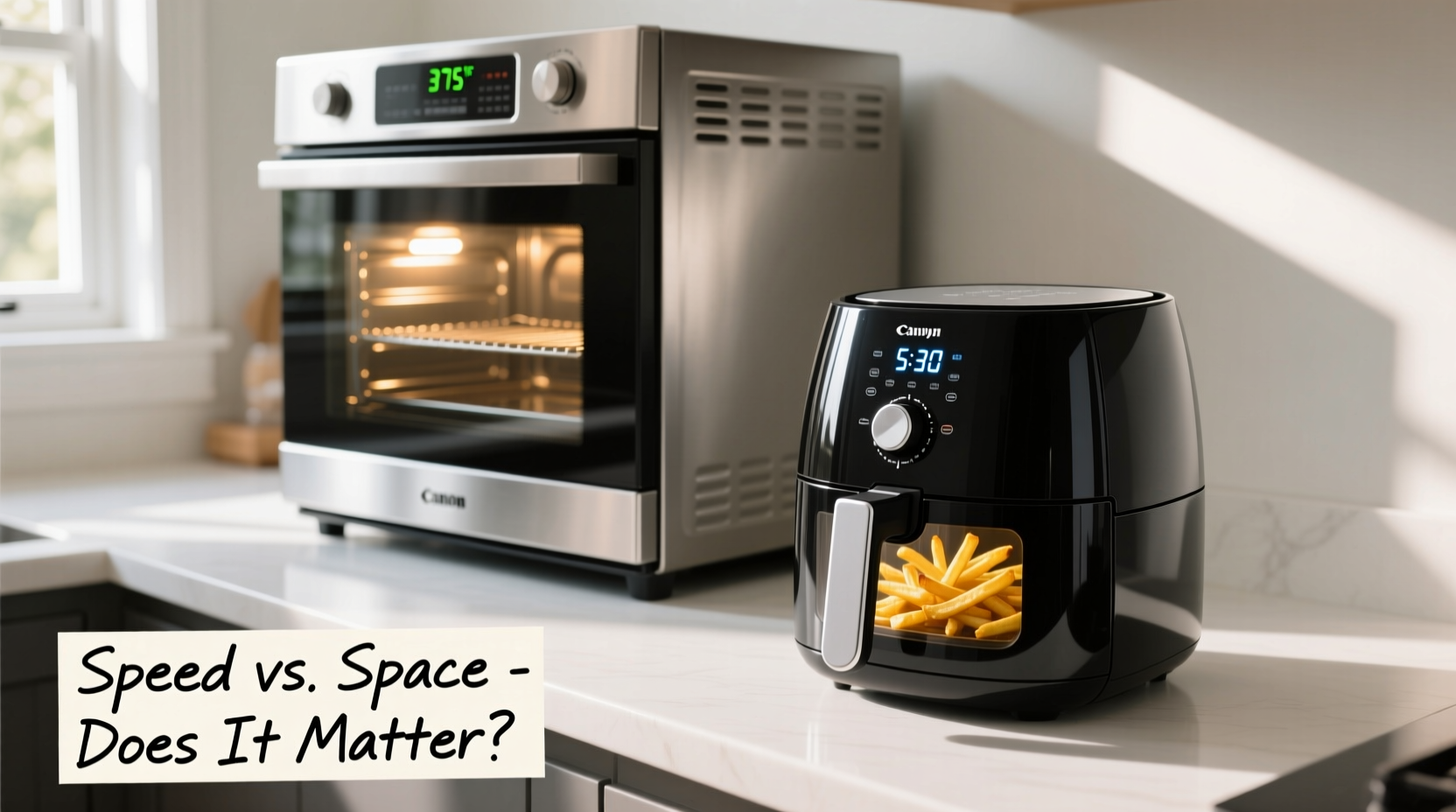
At their core, both air fryers and convection ovens rely on the same principle: forced convection. A fan circulates hot air around food, transferring heat more efficiently than still air in a conventional oven. This leads to faster cooking times and a crisp exterior without the need for deep frying.
However, the design differences significantly affect performance:
- Air fryers are compact, high-powered countertop units with a powerful fan located close to a small cooking chamber. This proximity increases airflow velocity, creating intense, rapid heat transfer. Many models use a basket design that promotes even exposure to air currents.
- Convection ovens, whether built-in or countertop models, have larger chambers and slightly slower fans relative to volume. While they also circulate air effectively, the larger space means air cools slightly between cycles, leading to marginally longer cook times.
Despite these distinctions, both can produce golden fries, roasted vegetables, and juicy proteins. The key difference lies not in capability but in scale, speed, and consistency.
Tip: For optimal browning in either appliance, avoid overcrowding the basket or tray—air needs space to circulate.Speed Comparison: Is the Air Fryer Really Faster?
One of the most cited advantages of air fryers is their speed. Manufacturers often claim meals can be ready in half the time of a conventional oven. In practice, this is conditionally true.
Air fryers typically preheat in 2–3 minutes due to their small size and concentrated heating elements. Convection ovens, especially full-sized ones, may take 8–12 minutes to reach target temperature. When cooking small portions—like a single chicken breast or a serving of fries—the air fryer consistently finishes 5 to 10 minutes faster.
But this advantage diminishes with volume. Cooking for four people? An air fryer will require multiple batches, negating any time savings. A convection oven, with its larger capacity, can handle everything at once—even if it takes 15% longer per batch.
“Speed matters most when you’re cooking one or two servings. Beyond that, throughput becomes more important than raw cook time.” — Daniel Park, Appliance Engineer and Culinary Technologist
Cooking Time Benchmarks (Per Serving)
| Food Item | Air Fryer (Avg. Time) | Countertop Convection Oven (Avg. Time) | Notes |
|---|---|---|---|
| Frozen French Fries (1 serving) | 12–14 min | 18–20 min | Air fryer wins on crispiness and speed |
| Chicken Breast (skin-on) | 18 min | 22 min | Slight edge to air fryer; juiciness similar |
| Roasted Vegetables (4 cups) | 25 min (2 batches) | 28 min (1 batch) | Oven wins on efficiency and hands-off time |
| Reheating Pizza | 5 min | 7 min | Air fryer delivers superior crisp crust |
The data shows that while air fryers are faster for individual servings, their small capacity forces trade-offs when scaling up. If your household regularly eats together, the convection oven’s ability to cook more food simultaneously may offer greater net time savings.
Space and Practicality: Countertop Real Estate Matters
Kitchen space is finite. Before adding any appliance, consider not just footprint but also usability, storage, and frequency of use.
An average air fryer occupies 1.5 to 2 square feet of counter space. Most are designed to remain out due to frequent use and the inconvenience of storing bulky power cords and baskets. A countertop convection oven is larger—often 2.5 to 3.5 square feet—but replaces the need for a microwave or toaster oven in many homes.
For small kitchens or studio apartments, every inch counts. One user in Brooklyn, Maria T., shared her experience:
💬 Mini Case Study: The Studio Apartment Dilemma
Maria lives in a 450-square-foot apartment with limited cabinetry. She initially bought an air fryer for quick weeknight meals. “It was amazing for crispy tofu and reheating leftovers,” she said. “But after three months, I realized I was using it only twice a week. My convection toaster oven does almost everything the air fryer does—and fits my baking sheets.”
She eventually donated the air fryer. “I gained back counter space and didn’t lose functionality. Now I use parchment-lined trays in the convection oven for the same crisp results.”
This scenario reflects a broader trend: occasional use doesn’t justify permanent space allocation. According to a 2023 consumer report by KitchenTech Insights, 41% of air fryer owners use their device fewer than three times per week, and 22% store it in a cabinet due to space constraints.
Energy Efficiency and Long-Term Cost
Smaller appliances generally consume less energy, but real-world savings depend on how you use them.
Air fryers typically use 1200–1500 watts. Convection ovens range from 1200 to 1800 watts, depending on size and features. However, because air fryers cook faster, their total energy consumption per meal is often lower—especially for short tasks like reheating or cooking frozen snacks.
But again, batch cooking changes the equation. Running an air fryer twice uses nearly double the energy of a single convection oven cycle for the same amount of food.
Tip: For maximum efficiency, match the appliance size to the meal. Small portions → air fryer. Family-sized meals → convection oven.Do’s and Don’ts: Choosing Based on Lifestyle
| Action | Do | Don't |
|---|---|---|
| Single-person or couple households | Consider an air fryer for daily speed and crisp results | Buy a large model if you rarely cook big meals |
| Family of four or more | Opt for a convection oven with air fry settings | Rely on an air fryer for main dishes without planning extra time |
| Small kitchen | Choose a multi-function convection oven | Dedicate counter space to a single-purpose appliance |
| Frequent entertainers | Use convection oven for roasting multiple trays | Try to air-fry appetizers in batches during gatherings |
When the Air Fryer Shines — And When It Doesn’t
The air fryer excels in specific niches:
- Reheating fried foods: It revives pizza, fries, and fried chicken better than any other method.
- Cooking frozen convenience foods: Tater tots, nuggets, and mozzarella sticks achieve near-deep-fried texture with minimal oil.
- Quick single servings: Ideal for solo lunches or last-minute side dishes.
But it struggles with:
- Larger cuts of meat: Whole chickens or roasts won’t fit.
- Baking or roasting in quantity: Limited capacity disrupts meal flow.
- Liquid-heavy dishes: Sauces and marinades drip through baskets, causing smoke and mess.
Modern convection ovens increasingly include “air fry” modes, blurring the line. These models use turbo fans and preset programs to mimic air fryer results—without requiring a separate appliance. For example, the Breville Smart Oven Air Fryer combines convection baking, broiling, dehydrating, and air frying in one unit.
Step-by-Step: How to Decide Which Appliance Fits Your Kitchen
Follow this decision timeline to assess your needs objectively:
- Track your cooking habits for one week. Note how many meals are for one, two, or more people. Identify common dishes (e.g., roasted veggies, frozen items, baked goods).
- Measure available counter space. Can you permanently dedicate 2+ square feet? If not, prioritize multi-use appliances.
- Evaluate current appliances. Do you already own a convection oven or toaster oven? Does it perform well?
- Test air fryer results virtually. Search YouTube or recipe sites for your go-to meals cooked in both appliances. Compare visuals and reviews.
- Consider future needs. Are you living alone now but planning to grow your household? Buy accordingly.
- Decide: Replace or add? If you lack a convection option, choose a multi-functional oven. If you want speed boosts and have space, add an air fryer.
FAQ: Common Questions Answered
Can a convection oven replace an air fryer?
Yes, especially if it has an air fry setting. You’ll get similar crispness, though results may take slightly longer. Use a wire rack or perforated tray to improve airflow and mimic air fryer performance.
Is food healthier in an air fryer?
Not necessarily. Both appliances reduce oil compared to deep frying. The health benefit comes from the cooking method—not the machine. A well-used convection oven with minimal oil produces equally nutritious meals.
Do I need both appliances?
Rarely. Unless you cook constantly for varied portion sizes, one well-chosen appliance suffices. A high-end convection oven with air frying capabilities offers the best flexibility without doubling footprint.
Final Verdict: Speed vs. Space — Finding Balance
The air fryer’s speed is real, but it’s a narrow advantage. For individuals or couples who value fast, crispy results and have room to spare, it’s a worthwhile addition. Its ability to reheat leftovers to near-fresh quality alone makes it a favorite among busy professionals and college students.
Yet for families, home cooks, or anyone with limited kitchen space, the convection oven—especially a modern multi-function model—delivers broader utility. It handles everything from slow-roasting to baking cookies, with air frying as just one feature. The slight increase in cook time is offset by the ability to prepare entire meals at once.
Ultimately, the question isn’t just about speed or counter space—it’s about alignment with your lifestyle. Technology should serve your routine, not dictate it. The most efficient kitchen isn’t the one with the fastest gadget, but the one where every tool earns its place.
🚀 Ready to optimize your kitchen? Audit your appliances this week. Test one meal in both devices. Share your findings with others facing the same choice—your real-world insight could save someone from buyer’s remorse.