
Choosing the right way to carry your cards and essentials isn’t just about style—it’s about function, security, and daily usability. Two of the most popular compact wallet alternatives today are the accordion card holder and the zipper pouch. While both aim to streamline your carry, they differ significantly in how they protect your belongings and adapt to your lifestyle. Understanding these differences can help you decide which one aligns with your priorities.
Design and Structure: Built for Different Needs
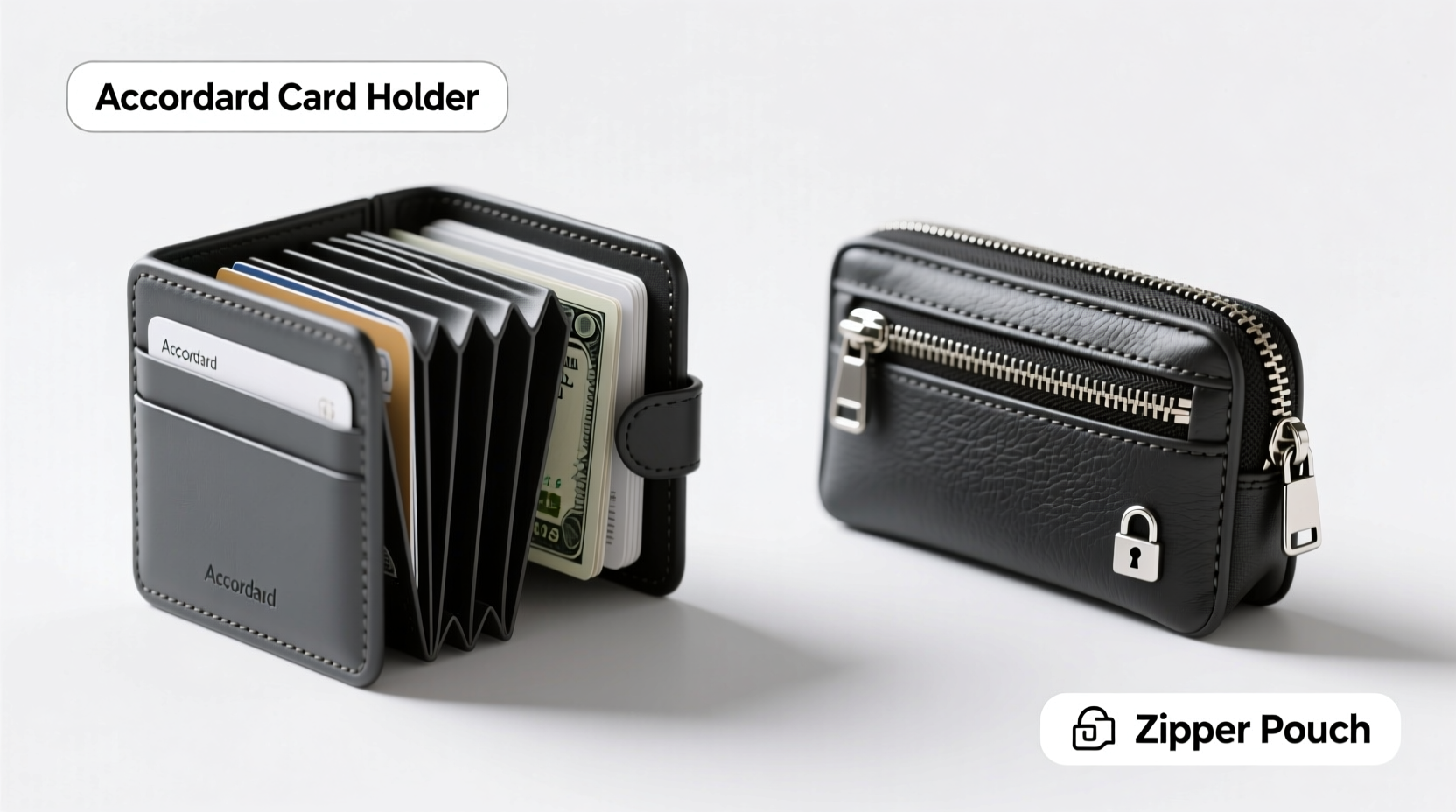
The fundamental difference between an accordion card holder and a zipper pouch lies in their construction. An accordion card holder typically features multiple stacked card slots arranged in a fan-like layout, often made from leather or synthetic materials with no closure mechanism. It's designed for quick access, allowing users to flip through cards like a Rolodex. Most models hold 6–12 cards and may include a single cash pocket or ID window.
In contrast, a zipper pouch is fully enclosed with a continuous zipper that seals all contents inside. These pouches usually have internal card slots or open compartments, but the defining feature is the full enclosure. They’re commonly used as minimalist wallets, travel organizers, or even small tech pouches. Materials range from ballistic nylon to full-grain leather, often with reinforced stitching.
Because of this structural difference, the zipper pouch inherently provides a higher degree of physical containment. Cards won’t slip out if the pouch is dropped or turned upside down. Accordion holders, while elegant and accessible, rely on friction to keep cards in place—meaning a sudden jolt or overstuffing can result in lost cards.
Tip: If you frequently carry loose receipts or coins, a zipper pouch prevents spillage—something accordion holders can't reliably do.Security: What Keeps Your Cards Safest?
Security comes in two forms: protection against accidental loss and defense against theft. In both areas, the zipper pouch holds a clear advantage.
A zipper creates a physical barrier that must be deliberately opened. This not only keeps cards from falling out but also makes it harder for pickpockets to access your belongings in crowded spaces. Many modern zipper pouches include RFID-blocking linings, adding digital protection against contactless skimming.
Accordion card holders, by design, are open at the top. While some feature elastic closures or snap buttons, these are easily bypassed compared to a full zipper. The exposed edges of cards can also make them vulnerable to RFID scanning unless the holder includes built-in shielding—which many don’t.
“From a security standpoint, any open-top design increases risk. A zipper adds a critical layer of passive protection.” — Marcus Lin, Personal Security Consultant
That said, high-quality accordion holders made from stiff materials can reduce slippage. But if you regularly commute, travel, or attend events where crowd density is high, a zipper pouch offers peace of mind that’s hard to match.
Convenience and Accessibility: Speed vs. Safety
Where the accordion card holder shines is in day-to-day convenience. Need to grab your credit card at a checkout counter? With an accordion, you can fan out the cards and select the right one in under two seconds—often without even opening your bag. This speed is why many professionals and frequent travelers prefer them for quick-access scenarios.
Zipper pouches require more steps: unzip, reach in, locate the card, retrieve it, then re-zip. Even with well-organized internal slots, the process is inherently slower. However, newer designs have improved this with partial zippers, magnetic flaps, or dual-sided access to mitigate the delay.
If your routine involves constant transactions—like grabbing coffee, using transit cards, or making multiple purchases—an accordion may feel more intuitive. But if you value organization and control over speed, the slight delay of a zipper is a fair trade-off.
Comparative Overview: Key Features Side by Side
| Feature | Accordion Card Holder | Zipper Pouch |
|---|---|---|
| Card Access Speed | Very Fast (open-top) | Moderate (requires unzipping) |
| Drop Protection | Poor (cards can fall out) | Excellent (fully enclosed) |
| Theft Resistance | Moderate (exposed cards) | High (zipper + optional RFID blocking) |
| Capacity Flexibility | Low (rigid slot limits) | High (can hold cards, cash, coins, keys) |
| Daily Convenience | High (minimal steps) | Medium (extra step to open) |
| Travel Suitability | Fair (risk of spillage) | Excellent (secure, organized) |
Real-World Use Case: Commuter vs. Traveler
Consider Sarah, a city-based marketing executive who commutes daily via subway and walks to client meetings. She uses an accordion card holder because she needs instant access to her work badge, transit pass, and credit card. Her routine is predictable, and she rarely carries cash or loose items. For her, speed trumps total enclosure.
Now consider James, a freelance photographer who travels internationally several times a year. He uses a slim zipper pouch with RFID protection. On a recent trip to Tokyo, his bag was briefly jostled in a crowded train station. Because his pouch was zipped and shielded, his cards remained untouched—while a fellow traveler reported a stolen card from an open-top wallet.
This contrast shows that context matters. Your environment, habits, and risk tolerance should guide your choice.
Step-by-Step: How to Choose the Right One for You
- Assess your daily routine: Do you need rapid card access, or is security your top priority?
- List what you carry: If you carry cash, coins, or IDs beyond cards, a zipper pouch offers better compartmentalization.
- Consider your environment: Frequent travel, public transit, or crowded cities favor zipper pouches.
- Test for comfort: Try holding both styles. Does the accordion bulge when full? Is the zipper smooth and durable?
- Check for added features: Look for RFID blocking, water-resistant materials, and reinforced zippers or seams.
Checklist: Before You Buy Either Option
- ✅ Can it hold all your essential cards without overstuffing?
- ✅ Does it fit comfortably in your pocket or bag?
- ✅ Is the material durable enough for daily wear?
- ✅ For zipper pouches: Is the zipper bidirectional or easy to snag?
- ✅ For accordion holders: Do the slots grip cards securely?
- ✅ Does it include RFID protection if needed?
- ✅ Is it easy to clean and maintain long-term?
Frequently Asked Questions
Can an accordion card holder be secure enough for travel?
It depends on your travel style. For short domestic trips with minimal movement, yes. But for international travel or crowded destinations, the risk of card loss or theft increases significantly. A zipper pouch is strongly recommended for such scenarios.
Are zipper pouches bulkier than accordion holders?
Not necessarily. Many modern zipper pouches are designed to be ultra-slim, especially those made from flexible materials like microfiber or textured TPU. Some are even slimmer than overstuffed accordion holders, which can balloon when filled beyond capacity.
Which is better for organizing multiple cards?
An accordion holder excels at visibility and separation—each card has its own dedicated slot. However, a well-designed zipper pouch with labeled or color-coded sections can offer similar organization while adding containment. If you hate fumbling for the right card, look for pouches with external quick-access slots.
Final Verdict: Security Wins, But Context Decides
When weighing pure security and overall convenience, the zipper pouch emerges as the more reliable option. Its enclosed design protects against loss, theft, and environmental factors like rain or dust. It’s also more versatile, capable of holding more than just cards.
However, the accordion card holder remains a strong contender for users who prioritize speed and simplicity in low-risk environments. It’s ideal for minimalists who carry only a few essential cards and value elegance over enclosure.
The best choice isn’t universal—it’s personal. Evaluate how you move through your day, what you carry, and what kind of risks you’re willing to accept. For most people, especially those on the go, the zipper pouch offers a smarter balance of security and functionality.
🚀 Ready to upgrade your carry? Reassess your current card holder: does it truly protect what matters? Share your experience or recommend your favorite model in the comments below.