The louche—the milky, opalescent cloud that blooms when water is added to absinthe—is often treated as theatrical flourish: a ritualistic curtain-raiser before the first sip. But to dismiss it as mere showmanship is to overlook one of the most revealing sensory diagnostics in the entire spirits world. Unlike whiskey’s proof-driven heat or gin’s volatile citrus top notes, absinthe’s louche is a physical manifestation of chemistry, botany, and craftsmanship. It emerges not from dilution alone, but from the precise solubility behavior of hydrophobic essential oils—primarily anethole, the principal compound in anise, star anise, and fennel. When water is introduced, these oils drop out of solution, scattering light and creating the signature haze. That transformation is neither arbitrary nor cosmetic. It signals botanical authenticity, distillation fidelity, and compositional balance—and its absence, inconsistency, or instability can expose shortcuts, adulteration, or flawed formulation.
What the Louche Actually Is (and What It Isn’t)
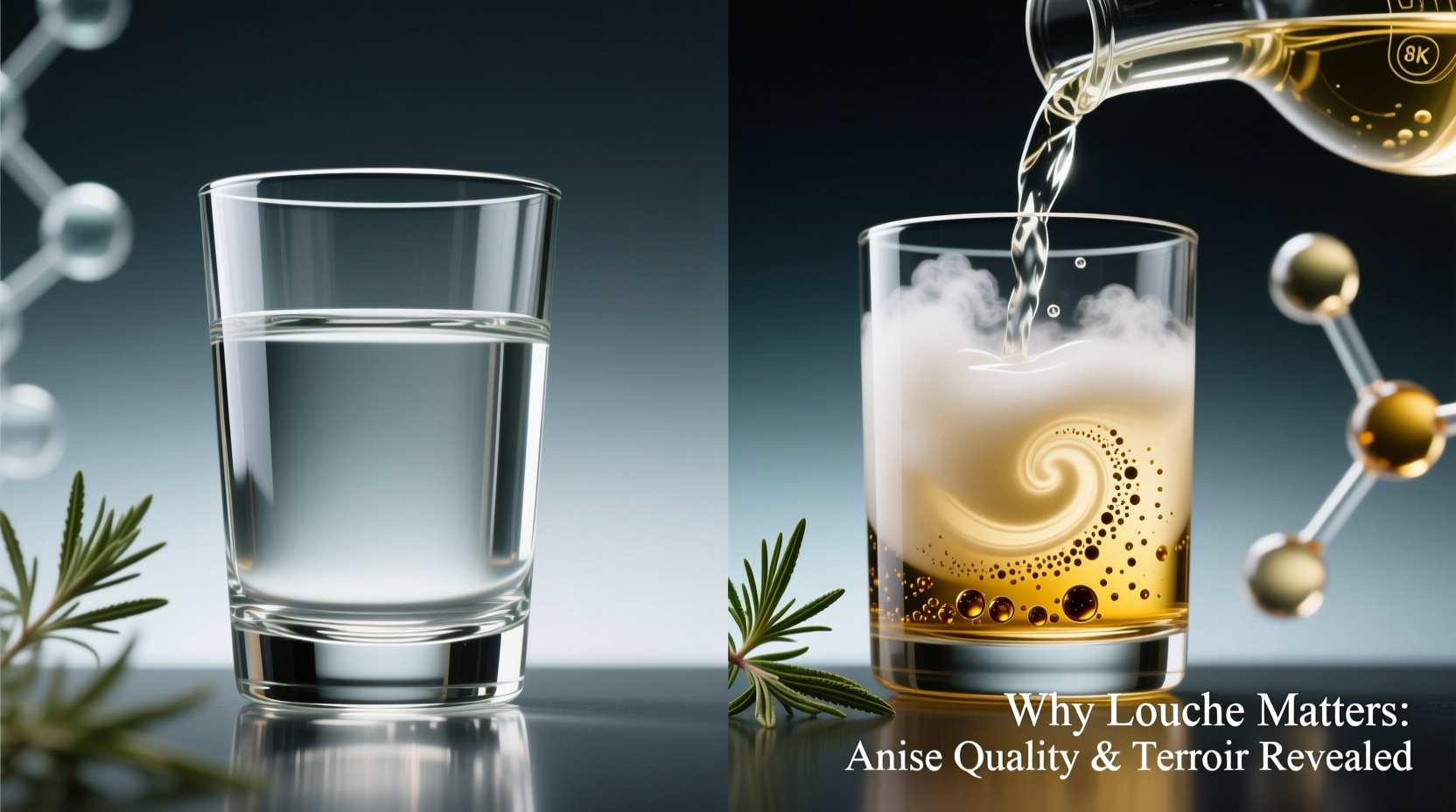
The louche is a colloidal emulsion—not a chemical reaction, but a physical phase transition. Anethole is highly soluble in high-proof ethanol (≥80% ABV), but nearly insoluble in water. In properly distilled absinthe, anethole exists in solution alongside other terpenes (e.g., estragole, limonene, pinene) extracted during maceration and distillation. When cold water is added, alcohol concentration drops below ~55% ABV, crossing the critical solubility threshold. Anethole molecules coalesce into nanoscale droplets—typically 100–500 nanometers in diameter—which scatter visible light via the Tyndall effect. The result is the soft, pearlescent cloudiness unique to louched absinthe.
This differs fundamentally from “neat” consumption—sipping undiluted absinthe straight from the bottle. Neat absinthe delivers intense, sharp, almost medicinal anise heat, with volatile top notes dominating. Without dilution, the full aromatic spectrum remains compressed; esters and heavier sesquiterpenes stay masked, and mouthfeel turns aggressively alcoholic and drying. More critically, neat pouring bypasses the louche entirely—erasing the very mechanism that unlocks aromatic diffusion, tempers ethanol burn, and enables nuanced flavor perception.
Tip: Never judge an absinthe’s complexity or balance neat. Its true character only emerges at 3:1 to 5:1 water-to-absinthe ratios—the range where louche formation is complete and aromatic compounds fully unfurl.Why Clouding Matters: Four Diagnostic Dimensions
The louche isn’t passive spectacle. It functions as a real-time quality assay across four interdependent dimensions:
- Botanical Integrity: Authentic grand wormwood (Artemisia absinthium) contains thujone, but also contributes camphoraceous and bitter-herbal terpenes that modulate anethole’s dominance. A well-balanced louche reflects this synergy—clouding evenly, without greasiness or separation. Weak or delayed clouding suggests insufficient wormwood or overreliance on isolated anise oil.
- Distillation Precision: Proper fractional distillation captures only the heart cut—where anethole, fenchone, and subtle wormwood volatiles co-distill cleanly. Heads or tails contamination introduces fusel oils or waxy esters that either inhibit clouding or create unstable, oily precipitates.
- Oil Solubility Profile: Not all anise-derived oils behave identically. Star anise oil contains higher anethole purity (80–90%) than green anise seed oil (75–85%), while fennel oil adds more estragole. A harmonious louche requires calibrated ratios—too much star anise yields brittle, fast-clouding emulsions; too much fennel creates sluggish, patchy louching.
- Proof & Stability: Absinthe must be bottled at sufficient strength (traditionally 45–72% ABV) to hold oils in solution. Underproofed bottlings may cloud prematurely in the bottle—or fail to louch fully upon dilution. Conversely, overproofed versions (e.g., >75% ABV) resist clouding until excessive water is added, delaying aromatic release.
What Louche Behavior Reveals About Anise Quality
Anise quality is rarely discussed in isolation—but it underpins everything. Commercial anise oil varies wildly in composition based on origin, harvest timing, and extraction method. High-grade green anise (Pimpinella anisum) from Bulgaria or Egypt offers balanced anethole with supporting monoterpenes (limonene, α-pinene) and trace phenylpropanoids that contribute depth and lift. Lower-grade oils—often from India or China—may be steam-distilled from immature seeds or blended with synthetic anethole, yielding flat, one-dimensional aroma and poor emulsion stability.
Observe how different anise sources affect the louche:
| Anise Source | Louche Onset | Cloud Texture | Aromatic Impact Post-Louche | Red Flag Indicators |
|---|---|---|---|---|
| Bulgarian green anise (cold-pressed) | Gradual, 2–3 seconds after water contact | Soft, uniform, opalescent | Layered: sweet licorice → herbal bitterness → floral lift | None |
| Star anise (Vietnam, solvent-extracted) | Immediate, aggressive clouding | Dense, slightly greasy, opaque white | Monolithic licorice, little nuance, lingering sweetness | Clouding before full water addition; oily film on surface |
| Synthetic anethole blend | Inconsistent—patchy or delayed | Thin, translucent, uneven | Harsh, medicinal, no herbal complexity | Clouding reverses if stirred; sediment forms at bottom |
| Fennel-dominant blend | Slow onset (>5 sec), incomplete | Bluish tint, hazy rather than creamy | Camphorous, minty, weak anise core | Separation into two layers within 60 seconds |
Crucially, anise quality doesn’t operate in isolation. Grand wormwood’s fenchone tempers anethole’s cloying potential; hyssop’s pinocamphone adds brightness; lemon balm’s citral lifts heaviness. A master distiller doesn’t simply add anise—they orchestrate a terpene ensemble where each component modifies the solubility, volatility, and sensory impact of the others. The louche is the visible conductor’s baton.
A Mini Case Study: The 2018 La Clandestine Rebatch
In early 2018, Swiss distillery La Clandestine released a limited rebatch of its classic verte absinthe. Initial batches showed textbook louche: slow, even clouding beginning at the meniscus, progressing downward like liquid marble, achieving full opacity at 4:1 dilution. But feedback from professional tasters noted diminished complexity—less pronounced wormwood bitterness, flatter finish. Distiller Nicolas Bousquet investigated. Lab analysis revealed the batch’s anise oil supplier had changed—substituting Bulgarian green anise with a cheaper Vietnamese star anise extract. Though anethole content was identical (88%), GC-MS showed near-zero limonene and α-pinene, and elevated estragole. The louche formed faster and denser—but lacked the fine particulate structure needed for sustained aromatic diffusion. Within weeks, Bousquet reverted to the original supplier and issued a public note: “The louche wasn’t broken. It was telling us the botanical story had changed.” This incident underscores that louche consistency is a non-negotiable benchmark for quality control—not aesthetic preference.
Expert Insight: Chemistry as Craft
“The louche is absinthe’s truth serum. You cannot fake stable, gradual, opalescent clouding with adulterated oils or imbalanced distillates. It demands botanical honesty, distillation discipline, and a deep understanding of terpene physics. When I evaluate a new absinthe, I watch the louche longer than I taste it.” — Dr. Élodie Vasseur, Master Distiller & Analytical Chemist, Distillerie Château de L’Étang (France)
How to Evaluate Louche Quality: A Step-by-Step Protocol
Assessing the louche meaningfully requires method—not improvisation. Follow this protocol using chilled, filtered water and a clear, tulip-shaped glass:
- Chill the absinthe: Store at 12–14°C (54–57°F) for 30 minutes. Cold temperature stabilizes oil solubility and slows clouding kinetics, revealing subtleties.
- Measure precisely: Pour 30ml absinthe into the glass. Use a graduated cylinder for water—start with 90ml (3:1 ratio).
- Controlled addition: Add water slowly (1ml/sec) down the side of the glass—not directly onto the spirit—to avoid turbulence masking true cloud formation.
- Observe onset: Note time (in seconds) from first water contact to visible clouding at the meniscus. Ideal: 1.5–3.5 seconds.
- Track progression: Watch direction and uniformity. Does clouding descend evenly? Or does it bloom erratically? Does opacity deepen gradually or jump abruptly?
- Assess texture: At full 4:1 dilution, tilt the glass. Does the cloud remain suspended, or does it separate into distinct layers? Does light pass through diffusely (good) or with streaks (poor emulsion)?
- Smell pre- and post-louche: Neat: note intensity and rawness. Post-louche: identify layered notes—sweetness, herbaceousness, bitterness, florality. Flat progression signals imbalance.
FAQ: Clarifying Common Misconceptions
Does a stronger louche mean higher thujone?
No. Thujone is water-soluble and remains in solution regardless of louche formation. A dense louche reflects high anethole concentration—not thujone levels. Some high-thujone absinthes (e.g., certain Swiss verts) louch lightly due to lower anise content and higher wormwood emphasis.
Can I “fix” a poor louche by adding sugar or herbs?
No. Sugar syrup may temporarily stabilize emulsions but masks structural flaws and violates traditional preparation. Adding herbs post-distillation introduces uncontrolled variables and risks microbial spoilage. A flawed louche indicates a fundamental issue in formulation or distillation—not a serving error.
Is cloudy absinthe always better than clear?
Not inherently—but clarity *before* dilution is essential. Authentic absinthe must be brilliantly clear when neat. Cloudiness in the bottle signals improper filtration, oil separation, or microbial growth. True quality resides in the *transformation*, not the endpoint alone.
Conclusion: Beyond Ritual, Into Revelation
The louche is not decoration. It is data. Every swirl of cloud carries information about soil, season, still design, cut points, and blending philosophy. When you watch water turn emerald elixir into swirling pearl, you’re witnessing the moment chemistry surrenders to craft—when hidden botanical relationships become visible, tangible, and aromatic. To choose neat over louched is to read only the title of a book; to ignore louche quality is to skip the footnotes that reveal authorial intent. In an era of mass-produced spirits marketed on packaging and provenance claims, absinthe’s louche remains one of the last unmediated, observable proofs of authenticity. It asks nothing of marketing departments or certification bodies—only attention, patience, and a willingness to see what the liquid itself is saying.
💬 Your observations shape the conversation. Next time you louch absinthe, note onset time, texture, and aroma shift—and share your findings. Real-world tasting data builds collective knowledge far more reliably than any label claim.