Modern dining is evolving—not just in how we eat, but in what we serve with. Consumers increasingly seek tableware that reflects their values: low environmental impact, long-term utility, and quiet sophistication. Yet “eco-friendly glassware��� remains a murky category. Many products tout recycled content while compromising on strength, clouding after three dishwashings, or bearing uneven weight and awkward proportions. Others prioritize elegance at the expense of sustainability—opting for delicate lead crystal with energy-intensive production and no end-of-life recyclability. The truth is, durable elegance and ecological integrity are not mutually exclusive. They’re achievable—but only when you know what to look for, where to look, and how to verify claims beyond marketing language.
Understanding What “Eco-Friendly Glassware” Really Means
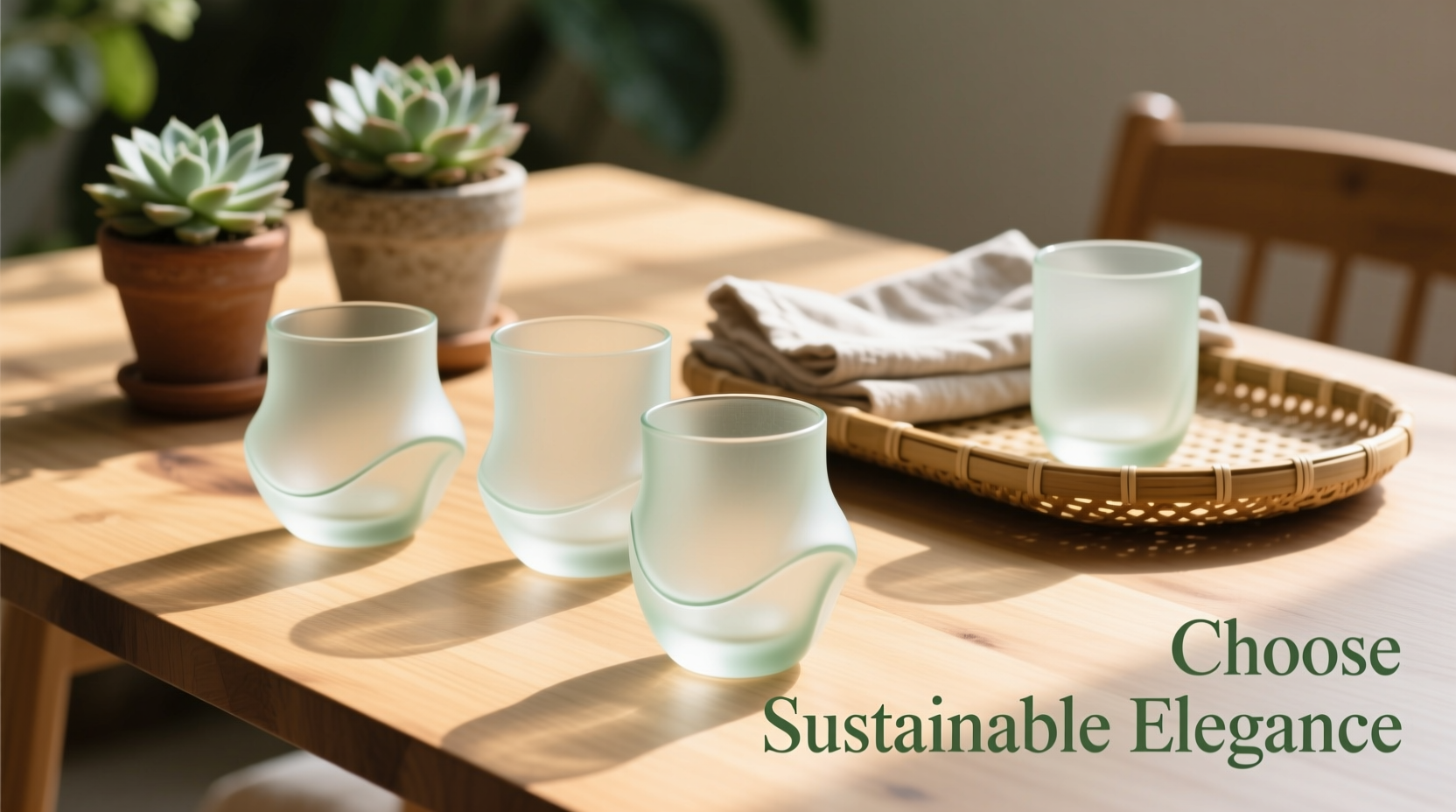
“Eco-friendly” is an unregulated term—and one frequently diluted by greenwashing. In glassware, authenticity hinges on three interlocking pillars: material origin, manufacturing footprint, and product longevity. Material origin includes the percentage and source of recycled content (post-consumer vs. pre-consumer), as well as whether raw materials like sand or soda ash are responsibly sourced. Manufacturing footprint encompasses energy use (especially furnace temperature and fuel type), water recycling rates, and emissions controls. Longevity—the most overlooked pillar—is arguably the most impactful: a glass that lasts 15 years and avoids replacement is inherently more sustainable than five glasses each lasting three years, regardless of recycled content.
Glass itself is infinitely recyclable without degradation, yet less than 33% of glass containers are recovered in the U.S., and recovery rates for tableware are near zero—because most curbside programs exclude drinking glasses due to differing melting points and contamination risks. This makes longevity not just a performance metric, but a sustainability imperative. As Dr. Lena Torres, Materials Scientist at the Glass Packaging Institute, explains:
“The greatest environmental savings in glassware come not from how it’s made—but how long it stays in use. A single high-performance tumbler used daily for a decade displaces over 200 disposable or short-lived alternatives. That’s embodied carbon avoided, not just recycled.” — Dr. Lena Torres, Materials Scientist, Glass Packaging Institute
Key Material Criteria: Beyond “Made with Recycled Glass”
Not all recycled glass is equal. The critical distinction lies in *post-consumer recycled (PCR) content*—glass collected from households and businesses after use—versus *pre-consumer* or *industrial scrap*, which carries far less environmental benefit. Look for transparency: reputable brands disclose PCR percentages (e.g., “40% post-consumer recycled glass”) and often certify this through third parties like SCS Global Services or UL Environment.
Equally important is glass composition. Soda-lime glass—the standard for most drinkware—is durable and widely recyclable but can be brittle if improperly annealed. Borosilicate glass (used in labware and premium cookware) offers superior thermal shock resistance and chemical stability, though its production requires higher temperatures. Newer innovations include “eco-soda-lime” formulations: standard soda-lime glass infused with up to 85% PCR content and optimized annealing cycles that reduce energy use by 12–18% without sacrificing clarity or strength.
Tip: Tap two glasses gently together. A clear, sustained ring indicates proper annealing and structural integrity; a dull thud suggests internal stress or inconsistent cooling—red flags for premature chipping or cracking.Durability Benchmarks: What to Test Before You Buy
Durability isn’t subjective—it’s measurable. Industry standards exist, yet few retailers share them. Here’s what matters in practice:
- Thermal Shock Resistance: Can it withstand pouring boiling water into a chilled glass? True borosilicate handles ≥120°C differentials; high-quality eco-soda-lime manages ≥70°C.
- Dishwasher Endurance: Not just “dishwasher safe,” but how many cycles before clouding, etching, or base wear? Reputable manufacturers test for ≥1,000 commercial dishwasher cycles (equivalent to ~3 years of daily home use).
- Edge & Rim Integrity: Machine-polished rims resist chipping far better than fire-polished or rough-cut edges. Look for a smooth, consistent bevel—no grittiness or micro-fractures visible under bright light.
- Weight Distribution: Elegant doesn’t mean fragile. The best eco-glassware feels balanced—not top-heavy or unnervingly light—with a stable base diameter relative to height (ideal ratio: base width ≥ 60% of total height).
Avoid assumptions based on thickness alone. A thick-walled, poorly annealed tumbler cracks easier than a precisely engineered, medium-weight one. Always check for independent testing data—not just marketing claims.
Elegance Redefined: Form, Finish, and Functional Beauty
Elegance in glassware is rooted in intentionality—not ornamentation. It emerges from clean lines, optical clarity, precise geometry, and tactile refinement. Eco-friendly pieces often excel here: because recycled glass can contain trace impurities, manufacturers committed to high aesthetics invest in advanced filtration and refining—resulting in exceptional clarity even at high PCR levels.
Consider these functional elegance markers:
- Optical Clarity: Hold the glass against a straight line (like a door frame). Distortion or waviness signals inconsistent thickness or poor annealing—both compromise both beauty and strength.
- Surface Finish: Machine-polished exteriors resist fingerprints and water spotting better than untreated surfaces. Some brands apply nano-silica coatings that repel lime scale—extending shine between washes.
- Proportion & Ergonomics: A tapered bowl improves aroma concentration for wine; a slight inward curve at the rim directs liquid smoothly. Even tumblers benefit from subtle contours that fit comfortably in hand and prevent slippage.
| Feature | Eco-Conscious Choice | Avoid |
|---|---|---|
| Rim Finish | Machine-polished, laser-beveled edge | Fire-polished (inconsistent, heat-affected zone), rough-cut |
| Base Design | Flat, fully fused base with chamfered underside | Pinched or folded base (stress point), uneven contact surface |
| Clarity Standard | ASTM C1422-compliant (≤0.5mm distortion at 30cm) | No published standard; “crystal-clear” without verification |
| Packaging | Recycled kraft paper, molded cellulose trays, soy-based ink | Plastic clamshells, PVC film, virgin cardboard |
Step-by-Step: How to Vet a Brand Before Purchase
Don’t rely on packaging or website copy. Follow this verification sequence before committing:
- Check the PCR Disclosure: Go to the product page or spec sheet. If it says “made with recycled glass” but omits the % and source (post-consumer vs. pre-consumer), assume it’s minimal or industrial scrap.
- Review Certifications: Look for SCS Recycled Content Certification, UL ECVP (Environmental Claim Validation Program), or B Corp status. These require annual audits—not one-time declarations.
- Assess Manufacturing Transparency: Does the brand name its factory partners? Do they publish energy/water metrics? Brands like Duralex (France) and Libbey (U.S.) publish annual sustainability reports with glass-specific KPIs.
- Examine Warranty & Repair Policy: A 5-year limited warranty covering thermal shock and breakage implies confidence in durability. Bonus points for take-back or trade-in programs—proof of circular commitment.
- Read Real User Reviews Critically: Filter for “long-term use” (12+ months). Note recurring comments about clouding, base wear, or chipping—not just first-impression praise.
Mini Case Study: The Shift at Oak & Ember Bistro
Oak & Ember, a sustainably focused bistro in Portland, replaced its entire glass program in 2022. Previously using imported crystal tumblers (30% recycled, no warranty), they switched to U.S.-made eco-soda-lime stemless wine glasses with 72% post-consumer content. The decision wasn’t just ethical—it was operational. Within six months, breakage dropped 41%, dishwasher cycle life increased from 300 to 1,200+, and staff reported fewer customer complaints about “thin” or “slippery” feel. Most tellingly, after two years, only 7 of 420 glasses required replacement—compared to 128 under the old program. Owner Maya Chen notes: “We didn’t sacrifice aesthetics. In fact, guests consistently compliment the ‘clean, modern weight’—and our dishroom manager loves the lack of etching. Sustainability became synonymous with reliability.”
What to Look For: A Practical Checklist
Your Eco-Glassware Selection Checklist:- ✓ Minimum 40% verified post-consumer recycled content (certified)
- ✓ Full annealing process confirmed (not just “tempered” or “heat-treated”)
- ✓ Dishwasher endurance rating ≥1,000 cycles (or 3+ years daily use)
- ✓ Machine-polished rim and base—no visible tool marks or micro-fractures
- ✓ Base width ≥60% of total height for stability
- ✓ Third-party certifications listed (SCS, UL, B Corp, or equivalent)
- ✓ Transparent manufacturing origin (country + facility name, if possible)
- ✓ Minimum 3-year warranty covering thermal shock and structural failure
FAQ
Does “lead-free crystal” mean it’s eco-friendly?
No. “Lead-free crystal” refers only to the absence of lead oxide—it says nothing about recycled content, energy use, or longevity. Many lead-free alternatives use barium or zinc oxide, which require similar high-temperature melting and offer no inherent sustainability advantage. Always verify PCR percentage and manufacturing transparency separately.
Can I recycle my eco-glassware when it’s worn out?
Technically yes—but practically, no, via municipal programs. Tableware glass has different chemical composition and melting points than container glass (bottles/jars), causing contamination in recycling streams. Instead, prioritize longevity: choose pieces with repair-friendly designs (e.g., modular stems) or support brands with take-back programs. One U.S. maker, Vireo Glass, grinds retired service ware into aggregate for architectural terrazzo—closing the loop meaningfully.
Are handmade glasses more sustainable than machine-made?
Not necessarily. Hand-blown glass uses significantly more energy per piece (individual furnace use, longer annealing times) and yields higher breakage rates during production (~18% vs. <2% for precision mold-blowing). While artisanal work supports craft economies, machine-made eco-glassware with high PCR content and optimized furnaces typically achieves lower per-unit carbon emissions—and greater consistency in durability and clarity.
Conclusion: Where Values and Everyday Refinement Meet
Choosing eco-friendly glassware that’s durable and elegant isn’t about compromise—it’s about calibration. It means recognizing that sustainability lives in the weight of a well-balanced tumbler held at breakfast, in the clarity of a wine glass that still sparkles after 500 dishwasher cycles, in the quiet confidence of knowing your purchase supported responsible resource use and avoided landfill-bound waste. These aren’t abstract ideals. They’re tangible qualities you can see, feel, and verify—when you know what to look for and refuse to accept vague promises.
The market is shifting. More manufacturers now balance PCR ambition with engineering rigor, and more designers treat sustainability as a creative constraint—not a concession. Your discernment accelerates that shift. Every time you choose a brand that discloses its recycled content, publishes its energy metrics, or stands behind its product with a multi-year warranty, you vote for a tableware future that is both conscientious and beautiful.
💬 Have you found a brand that nails the eco-elegant balance? Share your experience—including how it’s held up over time—in the comments below. Your real-world insight helps others make confident, values-aligned choices.