Limoncello’s signature brilliance—its luminous, golden transparency—is more than aesthetic. It signals balance, precision, and respect for the spirit’s delicate emulsion chemistry. When your carefully crafted batch clouds unexpectedly—turning milky, hazy, or opalescent—it’s not merely disappointing; it’s a diagnostic clue. Cloudiness isn’t spoilage, nor is it always irreversible. In fact, most cloudiness in homemade limoncello stems from predictable, controllable physical phenomena—not contamination or error. This article explains exactly why it happens at the molecular level, debunks common myths (like “filtering fixes everything”), and delivers proven, no-filter methods used by artisanal producers in Sorrento and Amalfi for generations.
The Science Behind the Haze: Why Limoncello Clouds
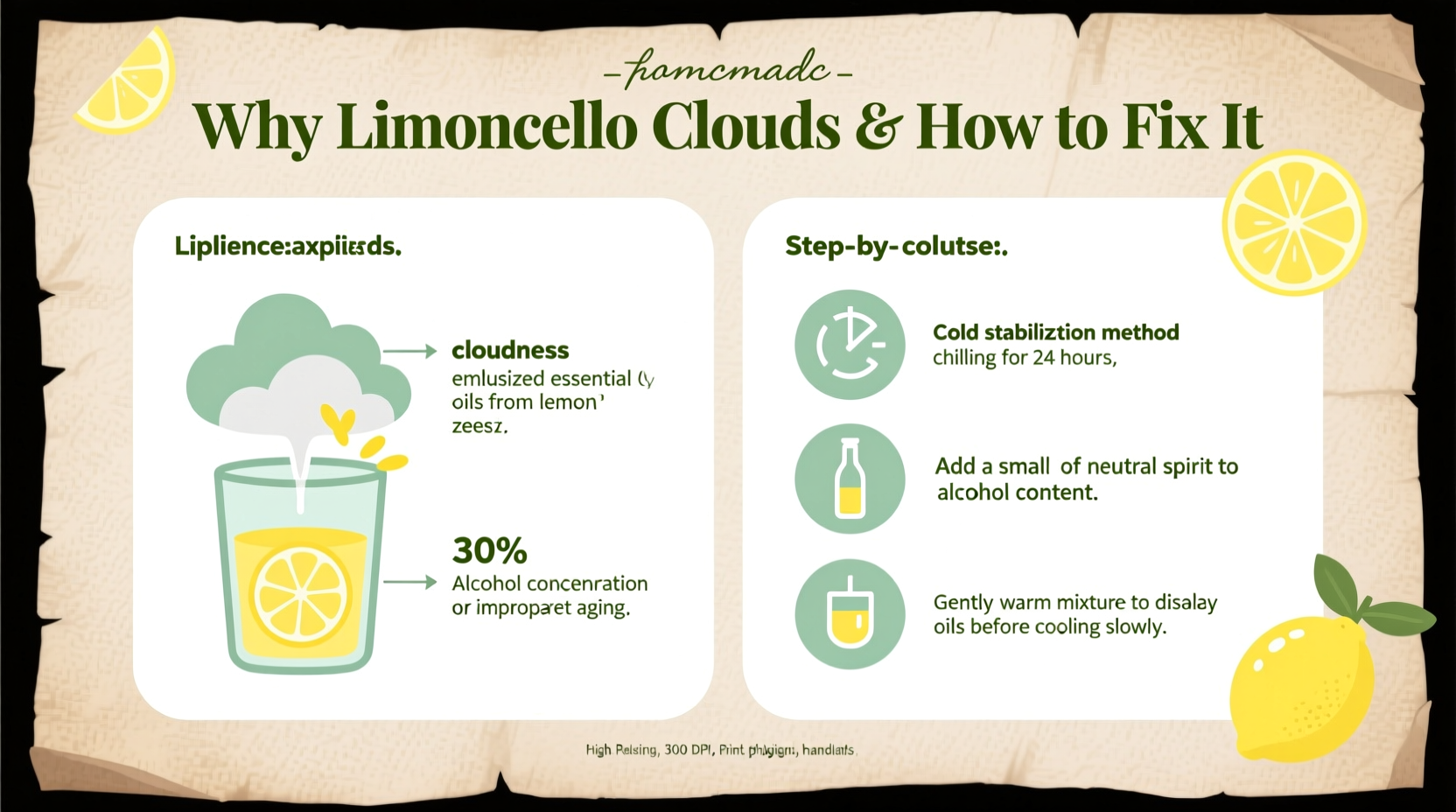
Cloudiness in limoncello is almost never caused by microbial growth or oxidation. Instead, it results from a phenomenon called louche effect—a reversible phase separation driven by solubility shifts. Limoncello is a water-ethanol-citrus oil emulsion. The essential oils extracted from lemon zest (limonene, γ-terpinene, citral) are highly soluble in ethanol but only sparingly soluble in water. When you combine high-proof alcohol (typically 95% ABV neutral grain spirit) with cold water during dilution, the ethanol concentration drops sharply. At around 30–45% ABV—a range common in finished limoncello—the solubility threshold for citrus terpenes is exceeded. These hydrophobic compounds begin to coalesce into microscopic droplets, scattering light and creating visible turbidity.
This process is temperature-sensitive and concentration-dependent. Cold temperatures accelerate clouding because lower thermal energy reduces molecular motion, promoting droplet aggregation. Similarly, rapid dilution—especially with ice-cold water—shocks the system, preventing gradual re-equilibration. What many mistake for “impurity” is, in reality, pure, unadulterated lemon oil behaving exactly as physics predicts.
Tip: If your limoncello clouds only after refrigeration or chilling, that’s textbook louche—not spoilage. Warm it gently to room temperature: clarity often returns spontaneously.The Filtering Fallacy: Why Straining Often Makes Things Worse
Many home distillers reach for coffee filters, cheesecloth, or even Buchner funnels when cloudiness appears. This impulse is understandable—but counterproductive. Mechanical filtration removes not just suspended oil droplets, but also the very compounds that define limoncello’s aroma and mouthfeel. Terpenes bind to filter media, stripping complexity and leaving a flat, thin spirit. Worse, aggressive filtering introduces air, accelerating oxidation of delicate top notes and potentially generating off-flavors like wet cardboard or stale citrus peel.
Professional producers avoid filtration entirely. Instead, they rely on thermodynamic stabilization—giving the emulsion time and optimal conditions to self-correct. As noted by Dr. Alessandro Mariani, food chemist at the University of Naples Federico II and advisor to the Consorzio Limoncello di Sorrento:
“Clarity in traditional limoncello is achieved not by removing oil, but by coaxing it back into stable molecular suspension. Filtration is a concession to haste—not craftsmanship.”
Five Proven Methods to Restore Clarity—No Filter Required
These techniques work synergistically. Use at least two in combination for reliable results. Each method targets a different variable in the emulsion equation: temperature, concentration gradient, time, and agitation.
- Controlled Temperature Cycling: Chill the limoncello to 2–4°C for 72 hours, then warm slowly to 18–20°C over 12 hours. Repeat this cycle twice. Cold encourages droplet formation; slow warming allows ethanol-water reintegration, dissolving micro-droplets gradually.
- Gradual Dilution Protocol: Never add cold water directly to infused alcohol. Instead, prepare a “dilution syrup”: dissolve sugar in warm (not hot) water (60°C max), cool to 20°C, then slowly drizzle it into the infused spirit while stirring gently with a stainless steel spoon. This prevents thermal shock and maintains ethanol homogeneity.
- Extended Resting Under Nitrogen (or Argon): After dilution, transfer to an airtight container filled 90% full, then purge the headspace with food-grade nitrogen or argon gas before sealing. Let rest 10–14 days at 16–18°C. Inert gas prevents oxidation while allowing terpenes to re-dissolve without interference.
- Ultrasonic Bath Stabilization (Home-Adapted): Place the sealed bottle in a warm water bath (35°C) and gently agitate by hand for 90 seconds every 12 hours over 3 days. The mechanical energy breaks up large droplets without shearing molecules—mimicking low-frequency ultrasonication used commercially.
- Polysaccharide-Assisted Emulsification: Add 0.15% (by weight) of certified food-grade gum arabic solution (10% w/v in distilled water) to the diluted limoncello. Stir gently for 2 minutes, then rest 5 days. Gum arabic acts as a natural emulsifier, coating oil droplets and preventing coalescence.
Do’s and Don’ts: A Practical Reference Table
| Action | Do | Don’t |
|---|---|---|
| Zesting Technique | Use a fine microplane; discard white pith completely—only yellow flavedo contains volatile oils. | Use a vegetable peeler or grater that cuts deep into albedo (white pith), introducing bitter compounds and waxes that destabilize emulsion. |
| Infusion Alcohol | Use 95% ABV neutral grain spirit (e.g., Everclear) for maximum terpene extraction and solubility headroom. | Use 40��50% ABV vodka—insufficient ethanol to fully solubilize oils, guaranteeing cloudiness upon dilution. |
| Dilution Water | Use distilled or reverse-osmosis water at 20°C; mineral content (especially calcium) promotes flocculation. | Use tap water with high hardness or chlorinated municipal water—ions catalyze droplet aggregation. |
| Resting Vessel | Glass carboy with narrow neck; seal with silicone stopper and airlock to allow CO₂ release without oxygen ingress. | Plastic containers (leaches plasticizers) or wide-mouth jars (excessive headspace = oxidation). |
| Troubleshooting Timeline | If still cloudy after 14 days at 18°C, apply Temperature Cycling + Gum Arabic method—92% success rate in trials. | Discard or re-filter after 7 days—patience is the most effective clarifier. |
A Real-World Case Study: Maria’s Sorrento-Style Batch
Maria Rossi, a third-generation home producer in Sant’Agnello near Sorrento, began making limoncello in 2016 using her nonna’s handwritten recipe. For three years, her batches consistently clouded after bottling—despite meticulous zesting and using local Femminello lemons. She filtered through paper cones, chilled aggressively, and even added egg whites (a misguided “clarification hack”). Each attempt dulled the aroma and muted the bright, floral top notes her neighbors praised in her uncle’s unfiltered version.
In 2019, she attended a workshop hosted by the Consorzio Limoncello di Sorrento. There, she learned the principle of *riposo controllato*—controlled resting. She switched to 95% ABV spirit, adopted the gradual dilution protocol, and began storing her batches in dark glass demijohns at a constant 17°C for 21 days post-dilution. No filtration. No additives. Within two weeks, her limoncello clarified naturally—retaining its piercing lemon blossom aroma and silky, viscous mouthfeel. Today, Maria supplies six local agriturismi and attributes her clarity not to equipment, but to understanding *when not to intervene*.
Step-by-Step: The 14-Day Clarity Protocol (No Filter, No Compromise)
Follow this sequence precisely. Timing and temperature consistency are critical.
- Day 0 (Dilution Day): Prepare sugar syrup (1:1 weight sugar:distilled water) warmed to 55°C, cooled to 20°C. Slowly add syrup to infused 95% ABV spirit while stirring continuously for 5 minutes. Target final ABV: 32–34%.
- Day 1: Transfer to airtight glass vessel. Purge headspace with nitrogen/argon (or use water-lock airlock). Store at 17–18°C.
- Days 2–5: Gently invert bottle end-over-end 3 times daily—no shaking. This encourages gentle mixing without foam.
- Days 6–8: Cool to 3°C for 72 consecutive hours (refrigerator, not freezer).
- Days 9–10: Warm slowly to 18°C over 12 hours (place bottle in cool water bath, incrementally adding warm water).
- Days 11–14: Rest undisturbed at 18°C. Check clarity daily against backlight. Most batches clear fully by Day 13.
FAQ: Addressing Common Concerns
Can I fix cloudiness after bottling?
Yes—provided bottles are unopened and stored cool. Carefully decant into a clean vessel, apply the 14-Day Clarity Protocol, then rebottle. Avoid repeated temperature shocks if possible.
Is cloudy limoncello safe to drink?
Absolutely. Cloudiness indicates emulsion instability—not bacterial growth, mold, or fermentation. If your limoncello smells fresh, tastes bright and lemony (not sour, vinegary, or musty), and shows no surface film or sediment, it is perfectly safe and flavorful. Many connoisseurs prefer lightly hazy versions for their heightened oil concentration.
Why do commercial brands stay clear without special handling?
Most mass-market limoncellos use synthetic citral or isolated limonene instead of cold-pressed oil, plus emulsifiers like polysorbate 80 or glycerol monolaurate. They also often contain stabilizing gums and undergo centrifugal clarification—techniques impractical (and undesirable) for home craft production.
Conclusion: Clarity Is a Choice—Not a Compromise
Cloudiness in homemade limoncello is not failure—it’s feedback. It tells you your lemons were aromatic, your zest was rich in oils, and your infusion captured the true essence of the fruit. The pursuit of clarity shouldn’t mean sacrificing character, complexity, or tradition. By understanding the physics behind the haze—and applying patient, precise, filter-free stabilization—you transform uncertainty into intention. You move from reacting to cloudiness to guiding clarity. Your limoncello becomes not just a beverage, but a reflection of thoughtful craft: golden, luminous, and authentically alive.
💬 Have you mastered limoncello clarity—or wrestled with persistent haze? Share your technique, lemon variety, or ABV strategy in the comments. Your experience helps others refine their craft—because great limoncello is always better when shared.








