Tungsten carbide has become a go-to material for modern watchmakers—prized for its scratch resistance, durability, and lustrous finish. As demand grows, brands have responded with distinct “men’s” and “women’s” tungsten watches. But beyond surface aesthetics, are these differences meaningful—or merely a reflection of gendered marketing strategies designed to segment the market? The answer lies in a blend of design practicality, cultural expectations, and subtle engineering choices.
Material Properties: The Foundation Is the Same
At their core, both men’s and women’s tungsten watches share identical material advantages. Tungsten carbide is approximately four times harder than steel, highly resistant to scratches, and maintains a polished sheen without frequent maintenance. It’s also hypoallergenic and corrosion-resistant, making it ideal for everyday wear across genders.
From a metallurgical standpoint, there is no inherent difference between the tungsten used in men’s versus women’s models. The alloy composition—typically 85–90% tungsten combined with nickel or cobalt binders—remains consistent. This means the fundamental benefits of longevity and resilience apply equally regardless of who wears the watch.
“Tungsten doesn’t discriminate. Its performance is purely physical, not gendered.” — Dr. Lena Patel, Materials Scientist at Precision Alloys Lab
Design & Aesthetic Differences: Function Meets Fashion
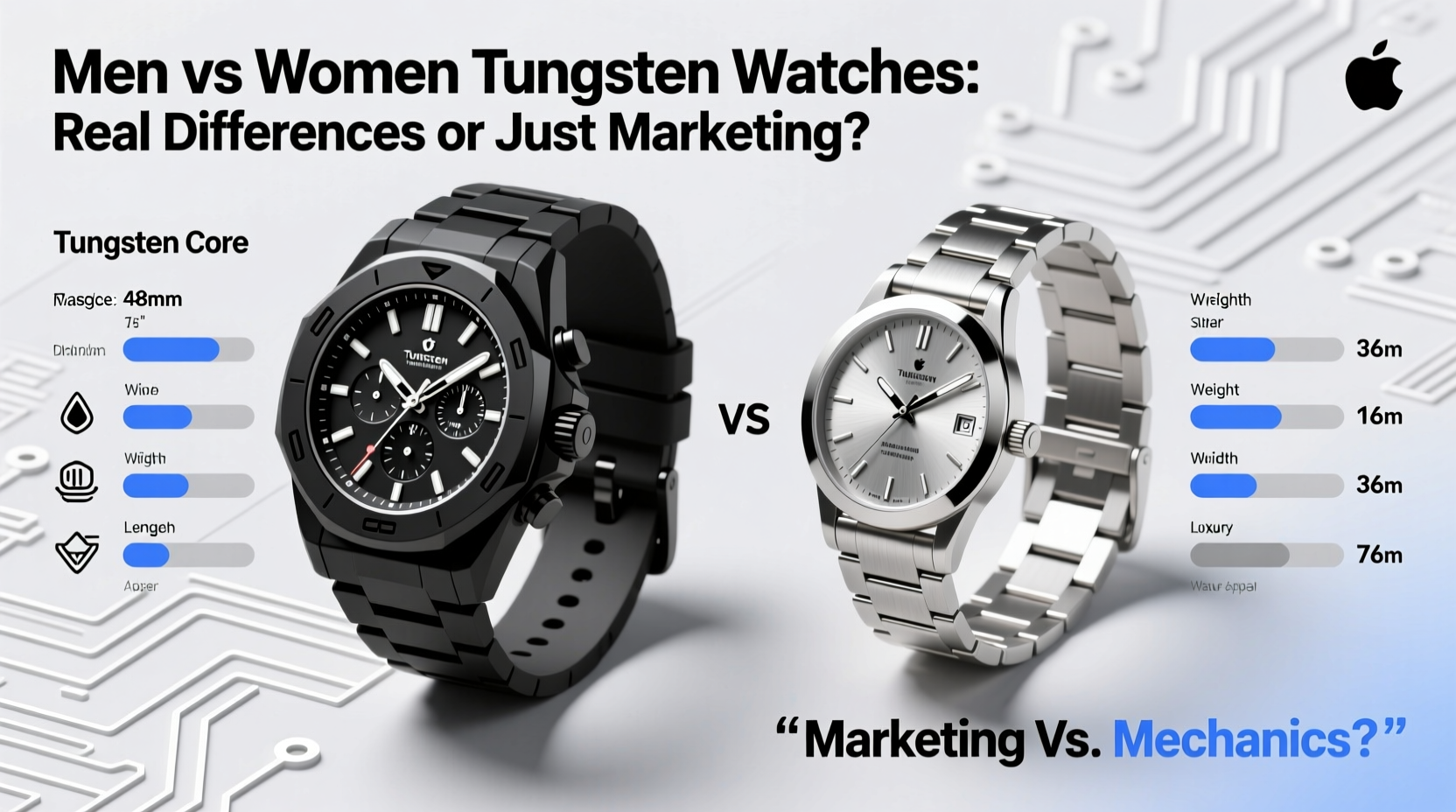
Where distinctions emerge is in design language. Men’s tungsten watches typically feature broader cases (40mm and above), thicker bezels, bolder dials, and heavier links. These characteristics align with traditional masculine ideals of strength and presence on the wrist.
In contrast, women’s models often emphasize elegance and subtlety. Cases are smaller (26–34mm), profiles are slimmer, and finishes may include rose gold plating, diamond accents, or mother-of-pearl dials. Some brands incorporate floral engravings or curved lugs to enhance femininity.
But here’s the catch: many of these features aren’t biologically determined—they’re culturally conditioned. A woman with larger wrists might find standard “women’s” sizes too small, while a man preferring minimalist style may gravitate toward sleeker designs marketed as feminine.
Tip: Don’t let gender labels limit your choice. Focus on case size, weight, and comfort rather than whether a model is labeled \"men’s\" or \"women’s.\"Size, Fit, and Wearability: Practical Considerations
Wrist anatomy varies more within genders than between them. Average male wrist circumference ranges from 6.5 to 7.5 inches, while female wrists average 5.5 to 6.5 inches—but overlap is significant. Many women exceed the upper end of the “female” range, and some men fall below it.
This variability makes rigid categorization impractical. A 38mm watch, often considered unisex or small for men, can look perfectly balanced on a slender wrist regardless of gender. Conversely, oversized “men’s” watches worn by women aren’t a fashion rebellion—they’re a logical response to limited sizing options in traditionally “feminine” lines.
Weight is another factor. Tungsten is dense (about twice the density of steel), so larger watches feel substantial. Women who prefer lightweight accessories may avoid chunky tungsten styles not because of gender norms, but due to comfort.
Watch Size vs. Wrist Proportion Guide
| Wrist Circumference | Recommended Case Diameter | Typical Marketing Label |
|---|---|---|
| 5.0 – 5.8 inches | 26 – 32mm | Women’s |
| 5.9 – 6.7 inches | 34 – 38mm | Unisex / Small Men’s |
| 6.8 – 7.6 inches | 40 – 44mm | Men’s |
| 7.7+ inches | 44mm+ | Large Men’s |
Marketing Tactics: How Gender Sells
Brands leverage gendered packaging, advertising, and product descriptions to guide purchasing decisions. Men’s tungsten watches are often described as “bold,” “rugged,” or “engineered for impact.” Women’s versions use terms like “elegant,” “delicate,” or “perfect for every occasion.”
Color plays a role too. Black, gunmetal, and silver dominate men’s collections. Rose gold, white ceramic inserts, and gemstone embellishments appear frequently in women’s lines. While these choices reflect trends, they also reinforce stereotypes about what each gender “should” wear.
Some companies even release nearly identical models under separate gender categories—with price discrepancies. In certain cases, a “women’s” version with minor cosmetic changes (like a thinner band or crystal embellishment) costs more despite using less material.
“It’s not about the watch—it’s about the story we tell around it. Gendered marketing creates perceived value where functional differences are minimal.” — Marcus Tran, Retail Strategy Consultant
Real-World Example: Breaking the Mold
Sophia Reyes, a mechanical engineer from Denver, initially dismissed tungsten watches as “too bulky” for her taste. After seeing a colleague wear a brushed black 40mm model, she tried one on—and loved the fit. “It felt secure, not overwhelming. I realized I’d been avoiding anything labeled ‘men’s’ out of habit, not preference.”
She now owns two tungsten timepieces: a 40mm black-ion plated model originally in the men’s collection and a 36mm rose gold variant marketed to women. Her decision was based on color, strap comfort, and dial readability—not gender tags.
Sophia’s experience reflects a growing trend: consumers prioritizing personal fit and aesthetic alignment over traditional segmentation.
Choosing the Right Watch: A Practical Checklist
Forget the label. Use this checklist to select a tungsten watch that suits you—regardless of gendered marketing:
- Measure your wrist: Use a tape measure to determine circumference for accurate sizing.
- Try before you buy: If shopping online, check return policies and consider retailers with physical stores.
- Evaluate lug-to-lug distance: Ensures the watch sits comfortably across your wrist.
- Consider weight: Tungsten is heavy; ensure the mass feels balanced, not cumbersome.
- Assess lifestyle needs: Do you need water resistance? Scratch-proof glass? Minimalist face?
- Ignore color stereotypes: Black isn’t just for men; rose gold isn’t just for women.
- Check movement type: Quartz offers accuracy and low maintenance; automatic appeals to enthusiasts.
Frequently Asked Questions
Can women wear men’s tungsten watches?
Absolutely. Many women prefer the bolder look and better availability of features like chronographs or GMT functions in men’s models. As long as the size and weight are comfortable, there’s no reason not to.
Are men’s tungsten watches more durable than women’s?
No. Durability depends on material composition and craftsmanship, not gender categorization. Both use the same tungsten carbide alloy and undergo similar manufacturing processes.
Why are some women’s tungsten watches more expensive?
Premium pricing often reflects added elements like diamonds, gold plating, or intricate detailing—not superior durability. Always compare specs and materials before assuming higher cost means better quality.
Conclusion: Look Beyond the Label
The divide between men’s and women’s tungsten watches is more nuanced than outright deception, yet heavily influenced by marketing conventions rather than technical necessity. While design differences exist—driven by average preferences in size, color, and ornamentation—these should inform choice, not dictate it.
The best watch is the one that fits well, matches your lifestyle, and resonates with your personal style—regardless of which section it occupies in a catalog. As gender norms continue to evolve in fashion and design, the future of tungsten watches may lean further into true unisex offerings: versatile, durable, and free from outdated labels.
🚀 Ready to redefine your style? Measure your wrist, test different sizes, and choose a tungsten watch based on fit and function—not marketing. Share your thoughts or experiences in the comments below.