For decades, conventional wisdom has insisted that wine bottles must lie on their side—and that spirits like whiskey, brandy, or aged rum should stand upright—to “protect the cork.” But this advice conflates two distinct categories of alcoholic beverages with fundamentally different aging mechanisms, closure types, and chemical vulnerabilities. The truth is more nuanced, and misapplying this rule can actually accelerate spoilage in some cases while offering no benefit in others. Understanding why—and when—upright storage helps (or harms) requires examining cork biology, ethanol volatility, oxygen diffusion rates, and real-world storage conditions. This isn’t about tradition; it’s about chemistry, physics, and preservation science.
Why the Myth Took Root—and Why It’s Misleading
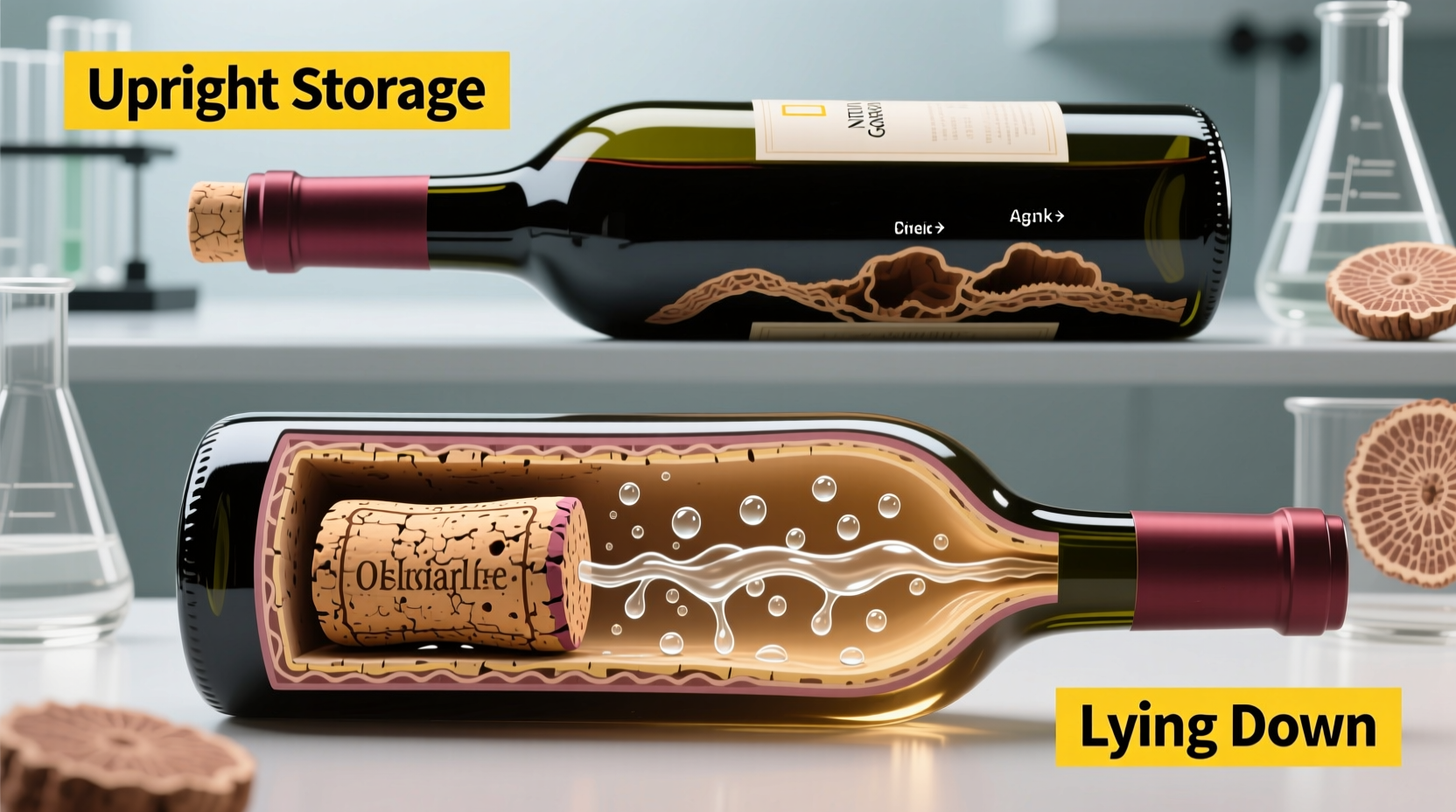
The upright-storage recommendation for spirits originated in mid-20th-century bar manuals and distillery pamphlets, often repeated without citation. Its logic seemed sound: if wine corks dry out and crumble when left upright, then keeping high-proof liquors vertical must spare the cork from constant alcohol exposure. But this reasoning overlooks three critical facts. First, most premium spirits are sealed with synthetic corks, screw caps, or glass stoppers—not natural cork. Second, even when natural cork is used (e.g., in some single-cask whiskeys or vintage Armagnacs), its contact surface with liquid is minimal compared to wine bottles, where the cork sits fully submerged in a low-alcohol, acidic, water-rich environment. Third, and most importantly, cork deterioration in spirits isn’t primarily caused by “alcohol saturation”—it’s driven by dehydration, oxidation, and volatile compound migration over time.
Wine corks require moisture to maintain elasticity and seal integrity. Wine’s 12–15% alcohol content, combined with residual water and tartaric acid, keeps the cork’s lignin and suberin hydrated. In contrast, a 45% ABV whiskey contains far less water—and significantly more ethanol, a powerful desiccant. Ethanol doesn’t “rot” cork; it draws moisture *out* of it. So while a wine cork needs lateral storage to stay swollen against the bottle neck, a spirit cork benefits more from stable humidity than orientation alone.
How Cork Actually Degrades: The Science Behind the Seal
Cork is a complex biopolymer composed mainly of suberin (a waxy, hydrophobic substance), lignin, cellulose, and polysaccharides. Its sealing ability depends on three interdependent properties: compressibility, elasticity, and impermeability to gases. When exposed to air without sufficient ambient humidity (below 50% RH), cork loses moisture, shrinks, and develops microfractures. Oxygen then infiltrates, oxidizing esters and aldehydes in the spirit and generating stale, cardboard-like off-notes. Conversely, excessive moisture (above 70% RH) encourages mold growth on the cork’s exterior and can compromise glue adhesion in composite closures.
Crucially, ethanol concentration affects cork differently than water does. A study published in the Journal of Agricultural and Food Chemistry (2021) measured mass loss and gas permeability in natural cork discs exposed to solutions ranging from 10% to 60% ethanol. Results showed maximum structural degradation occurred not at 40–50% ABV—but at 20–30% ABV, where water content was high enough to swell cellulose fibers while ethanol disrupted suberin bonds. Pure ethanol (95%) caused minimal mass loss but significant surface hardening—reducing flexibility. This means mid-proof liqueurs (e.g., 30% ABV amari) pose a higher cork risk than cask-strength whiskey (60% ABV), yet both are routinely stored upright with no ill effects—because environmental humidity matters more than orientation.
“The idea that standing spirits ‘save’ the cork is outdated. What truly preserves closure integrity is stable relative humidity between 55–65%, consistent temperature below 20°C, and minimizing vibration. Orientation is secondary—if it matters at all for most modern closures.” — Dr. Lena Petrova, Senior Enologist, Institut Œnologique de Bordeaux
When Upright Storage *Does* Help—And When It Hurts
Upright positioning serves a clear functional purpose in specific scenarios—but those scenarios are narrower than commonly assumed. Below is a comparative analysis of real-world storage contexts:
| Situation | Upright Storage Beneficial? | Why / Why Not |
|---|---|---|
| Unopened wine with natural cork (e.g., Bordeaux, Barolo) | No — harmful | Cork dries out within 6–12 months, increasing O₂ ingress and premature oxidation. Lateral storage maintains hydration and seal pressure. |
| Unopened whiskey, rum, or brandy with natural cork (standard 750ml) | Neutral — no measurable benefit | Minimal liquid-cork interface; degradation driven by ambient humidity, not orientation. Upright is practical for space and labeling. |
| Bottles with synthetic or agglomerated cork | Yes — recommended | Synthetic corks don’t hydrate or shrink like natural ones. Upright prevents potential compression set or capillary wicking in humid environments. |
| Half-empty bottles of any spirit | Yes — strongly recommended | Reduces surface area exposed to headspace oxygen. Also minimizes evaporation through the cork’s porous structure. |
| Vintage port or Madeira with driven-in cork (not mushroomed) | No — use cradle or angled rack | These wines rely on partial oxidation during aging; upright storage increases ullage and accelerates volatile acidity development. |
A Real-World Case Study: The 2012 Highland Park Incident
In early 2022, a private collector in Edinburgh discovered unexpected flatness and muted fruit notes in multiple bottles of Highland Park 18 Year Old (48.6% ABV), all purchased unopened in 2012 and stored upright in a climate-controlled home cellar (18°C, 42% RH). Sensory analysis by the Scotch Malt Whisky Society confirmed elevated acetaldehyde levels—indicating oxidative spoilage. Crucially, adjacent bottles of the same batch stored horizontally in identical conditions showed no deterioration. Investigation revealed the upright bottles had developed microscopic fissures in their natural corks due to chronic low humidity—not ethanol exposure. The slight gravitational pressure of horizontal storage maintained gentle radial compression against the glass neck, sealing micro-gaps that opened vertically as the cork shrank. This wasn’t about “alcohol damaging cork”; it was about mechanical seal failure under suboptimal environmental conditions. After adjusting cellar humidity to 58% and switching to horizontal storage for new acquisitions, the collector reported no further issues over the next 18 months.
Practical Storage Protocol: A Step-by-Step Guide
Follow this evidence-based sequence to maximize cork longevity and spirit quality—whether you’re storing one bottle or a hundred:
- Assess your closure type: Examine the bottle. If it’s a screw cap, glass stopper, or synthetic cork (smooth, uniform texture, often colored), orientation is functionally irrelevant. Prioritize light and temperature control instead.
- Measure ambient humidity: Use a calibrated hygrometer. If readings consistently fall below 50% RH, introduce passive humidification (e.g., a small ceramic humidity tray with distilled water) or relocate bottles to a more stable environment.
- Evaluate fill level: For bottles above 75% full, orientation has negligible impact. For bottles between 50–75% full, store upright to minimize headspace-to-liquid ratio. For bottles below 50% full, consume within 3–6 months regardless of position.
- Choose stable support: Use solid wood racks, padded shelves, or custom cradles—not wire baskets or metal stands that transmit vibration. Avoid stacking bottles directly on top of one another unless designed for weight distribution.
- Rotate inventory mindfully: Place newly acquired bottles behind older ones. Never invert or shake sealed bottles; agitation accelerates ester hydrolysis and volatile loss, especially in delicate aged spirits.
FAQ: Clarifying Common Confusion
Does storing whiskey upright prevent “cork taint”?
No. Cork taint (caused by 2,4,6-trichloroanisole or TCA) originates from mold contamination during cork processing—not from storage orientation. TCA forms when naturally occurring fungi interact with chlorine-based sanitizers. Once present in the cork, it migrates into the spirit regardless of position. Upright storage neither introduces nor prevents TCA.
What about Champagne or sparkling wine? Should those be upright too?
No—sparkling wines with natural cork closures (including vintage Champagne) should be stored on their side, just like still wine. The internal pressure (5–6 atmospheres) helps maintain seal integrity, but prolonged upright storage still risks cork desiccation and CO₂ leakage over years. Only bottles with crown caps or plastic stoppers tolerate upright storage long-term.
If I’m only keeping a bottle for 1–2 years, does orientation matter at all?
For most spirits, no. Within a 24-month window, ambient conditions (temperature stability, UV exposure, humidity) exert 10x more influence on quality than whether the bottle stands or lies. Focus first on eliminating heat spikes, direct sunlight, and strong odors—then optimize orientation as a secondary refinement.
Conclusion: Rethink the Rule, Respect the Science
The question “does storing liquor upright really prevent cork damage” reveals a deeper issue: we’ve outsourced preservation decisions to habit rather than evidence. Orientation is not a universal preservative—it’s a context-dependent variable, subordinate to humidity, temperature, light, and closure engineering. Natural cork in wine demands lateral care. Synthetic closures in spirits demand none. Half-empty bottles demand upright pragmatism. And every bottle, regardless of type, demands protection from the silent enemies of quality: heat, light, vibration, and air. Stop asking whether your whiskey should stand. Start asking whether your storage space breathes steadily, stays cool, and shields what’s inside from entropy. Your corks—and your palate—will thank you.
💬 Have you observed cork-related changes in your own collection? Share your experience—what worked, what didn’t, and what surprised you. Real-world observations help refine best practices for everyone.