In crowded cities, tourist hotspots, and public transit systems, personal safety extends beyond awareness of your surroundings—it includes how you carry your belongings. Among the most popular hands-free accessories are crossbody bags and belt bags (also known as fanny packs). Both offer convenience and style, but when it comes to protection against pickpockets, they differ significantly in vulnerability. Understanding these differences can help you make smarter choices about what to wear—and where—to keep your valuables secure.
Pickpocketing remains one of the most common forms of theft in urban environments. According to INTERPOL, major travel hubs like train stations, markets, and festivals see thousands of reported cases annually, many involving tourists with poorly secured bags. While no accessory is completely theft-proof, design, placement, and usage habits dramatically affect risk levels. This article compares crossbody bags and belt bags across multiple security dimensions, drawing on expert advice, traveler experiences, and functional design analysis.
Design and Placement: How Location Affects Risk
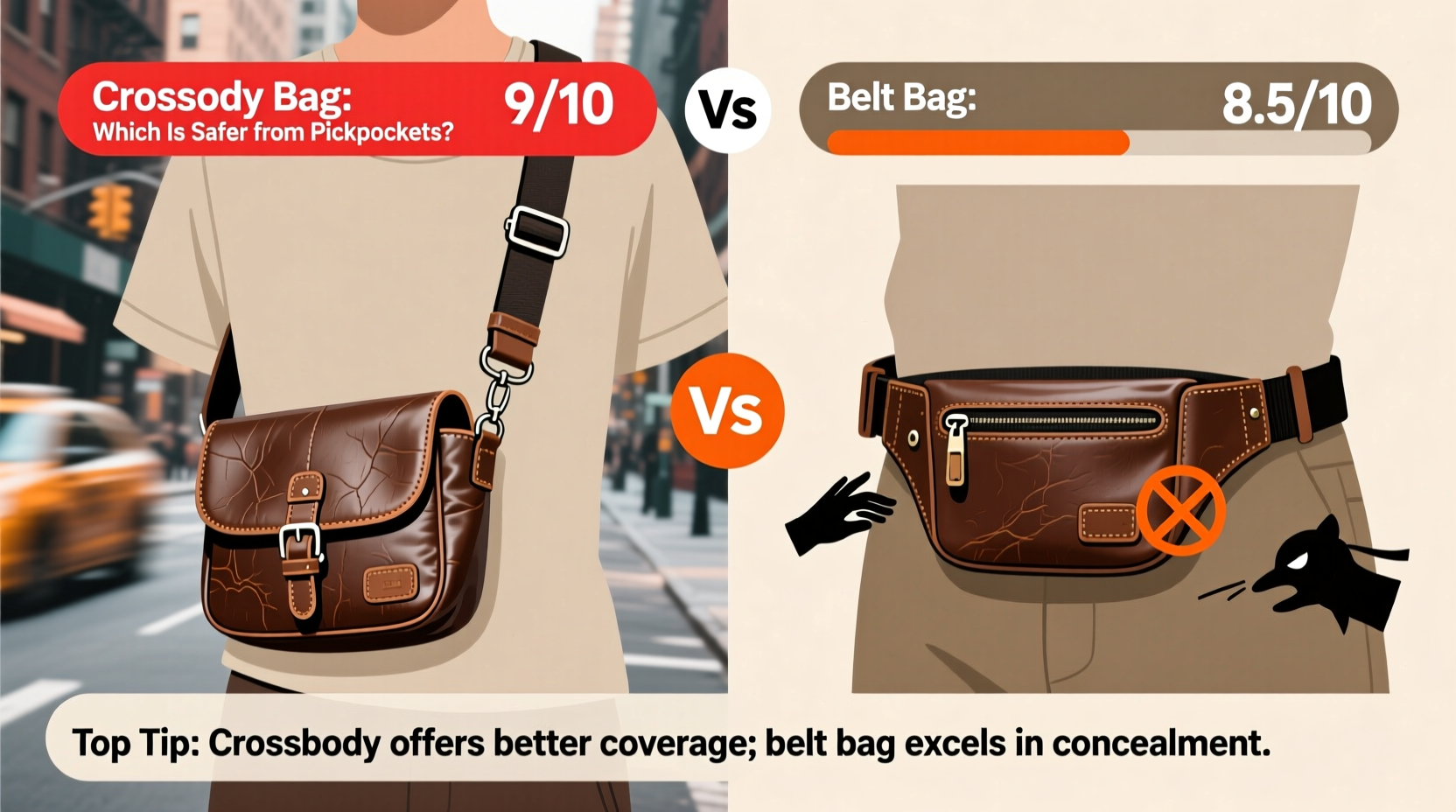
The position of a bag on your body plays a crucial role in determining its exposure to opportunistic thieves. Crossbody bags typically hang diagonally across the torso, resting on one hip or near the lower back. Belt bags wrap around the waist and sit at the front, side, or back of the hips.
Crossbody bags, especially those worn behind the body or loosely over one shoulder, create easy access points. A skilled pickpocket can slice open a seam or unzip a compartment without the wearer noticing—particularly in dense crowds. In contrast, a belt bag worn in front places all contents within direct line of sight and under constant physical feedback from movement.
Security experts emphasize visibility and tactile awareness as key deterrents. “When your bag is in front of you, every tug, shift, or pressure change is immediately noticeable,” says Maria Lopez, a travel safety consultant with over a decade of experience training international travelers. “That micro-second of sensation often prevents theft before it happens.”
Tip: Always wear your belt bag in front when navigating high-risk areas—even if it feels less stylish.Access Points and Theft Vulnerabilities
Both bag types vary widely in construction quality and closure mechanisms, but structural tendencies influence their susceptibility.
Crossbody bags often feature long zippers, soft materials, and external pockets designed for quick access. Unfortunately, this convenience translates into higher risk. The length of the strap also allows the bag to swing freely, making it easier for someone to pull it slightly away from your body and manipulate zippers unnoticed. Additionally, many models have magnetic or snap closures that require minimal force to open.
Belt bags, particularly modern anti-theft versions, are increasingly built with locking zippers, RFID-blocking compartments, and slash-resistant straps. Because they’re compact and close-fitting, there’s less room for a thief to insert tools or work stealthily. Front-worn models also benefit from constant visual monitoring—you’re more likely to catch someone reaching toward your waist than behind your back.
A notable weakness of belt bags arises when worn at the back. Positioned out of sight, they become nearly as vulnerable as poorly worn crossbody styles. Thieves operating in Europe and Southeast Asia frequently target rear-facing fanny packs using small blades to cut through thin fabric or unzip hidden compartments.
“Front is function. Back is folly.” — David Tran, Urban Security Analyst
Comparative Analysis: Key Security Factors
| Feature | Crossbody Bag | Belt Bag |
|---|---|---|
| Visibility | Moderate (side/back view) | High (when worn in front) |
| Tactile Awareness | Low to moderate | High (close to core) |
| Access Difficulty | Moderate (long zippers, swinging motion) | High (compact, limited manipulation space) |
| Slash Resistance | Varies; straps often weak point | Better in premium models |
| User Adjustment Frequency | Frequent (sliding, readjusting) | Rare (once set, stays put) |
| Theft Risk (Front Wear) | Medium | Low |
| Theft Risk (Back Wear) | High | High |
This comparison shows that while both bags can be risky if misused, the belt bag has inherent advantages when worn correctly. Its smaller size limits storage capacity—but also reduces incentive for theft and minimizes blind spots.
Real-World Scenario: A Tourist in Barcelona
Lena, a first-time visitor to Barcelona, carried a sleek leather crossbody bag during her visit to La Rambla. She wore it behind her back while taking photos near street performers. Within minutes, she noticed her phone was missing. Surveillance footage later showed a man casually brushing past her, slipping his hand beneath the bag flap, and removing the device in under four seconds.
Two days later, after purchasing a nylon belt bag recommended by her hostel staff, Lena wore it across her front while visiting Park Güell. She recalled feeling someone bump into her, but instinctively tightened her grip on the bag. No items were lost.
Her experience reflects a broader trend. In cities like Barcelona, Rome, and Bangkok, local authorities and tourism boards now actively recommend front-carry belt bags over traditional shoulder or crossbody styles. Some even distribute free anti-theft pouches to arriving tourists.
Tip: Treat any bag worn behind your back as unsecured—regardless of brand, price, or material.Best Practices for Maximum Safety
No bag is immune to theft, but adopting smart habits significantly reduces risk. Below is a step-by-step guide to minimizing vulnerability regardless of which style you choose.
- Wear the bag in front whenever possible. This applies even to crossbody bags. Let it rest against your stomach in crowded areas.
- Use lockable zippers or zipper clips. Simple luggage locks or zip ties prevent unauthorized opening.
- Distribute valuables. Keep only essentials in your day bag; store backups in inner clothing pockets.
- Avoid dangling straps or loose flaps. These attract attention and provide leverage for snatching.
- Choose bags with reinforced materials. Look for ripstop fabric, cut-resistant mesh, and steel-thread straps.
- Stay alert during distractions. Pickpockets often work in teams—one creates a diversion while another steals.
- Check your bag regularly. Even with precautions, periodic checks reinforce awareness.
Anti-Theft Features Checklist
- ✅ Concealed zippers (under flaps or seams)
- ✅ Lockable main compartment
- ✅ Slash-resistant body and strap material
- ✅ RFID-blocking card slots
- ✅ Minimal external pockets
- ✅ Adjustable fit that hugs the body
- ✅ Bright interior lining (easier to spot contents)
Brands like Pacsafe, Nomatic, and Peak Design specialize in such features, offering hybrid models that blend belt and crossbody functionality with advanced security engineering.
When Context Matters: Choosing Based on Environment
Your choice between a crossbody and a belt bag should depend not just on fashion, but on context. Consider the following scenarios:
- Urban commuting: A front-mounted belt bag offers speed, security, and ease of access at turnstiles or bike rides.
- Tourism in high-theft zones: Opt for a compact, front-worn belt bag with locking zippers. Avoid anything that swings or dangles.
- All-day comfort with multiple items: A crossbody may carry more, but only if worn tightly in front and equipped with anti-theft features.
- Nightlife or concerts: Belt bags reduce grab-and-run risks in packed venues. Crossbody bags are more likely to be snatched in mosh pits or dance floors.
For maximum adaptability, some travelers use both: a minimalist belt bag for phones and cards during exploration, and a larger crossbody stored safely in accommodation for longer outings requiring extra gear.
“The safest bag is the one you never forget you're wearing.” — Sarah Kim, Founder of SecureTravel Lab
Frequently Asked Questions
Can a crossbody bag ever be safe from pickpockets?
Yes—but only if worn tightly across the chest with the bag positioned in front of your body. Choose models with locking zippers, minimal external pockets, and cut-resistant straps. Never let it hang behind your back or swing freely at your side.
Are belt bags suitable for women and men equally?
Absolutely. Modern belt bags are gender-neutral in design and function. Many brands offer adjustable waistbands and sleek profiles that suit various body types and outfits. Their security benefits apply universally, regardless of gender.
Do anti-theft technologies really work?
They significantly reduce risk but aren’t foolproof. Features like locking zippers, RFID shielding, and slash-resistant fabric make theft more difficult and time-consuming—critical factors since most pickpockets operate quickly and avoid confrontation. However, vigilance remains essential.
Final Thoughts: Prioritizing Security Without Sacrificing Style
The debate between crossbody bags and belt bags isn’t just about aesthetics—it’s about practical defense against an ever-present threat. While crossbody bags remain popular for their classic look and carrying capacity, they demand careful handling to stay secure. Belt bags, once dismissed as outdated, have evolved into intelligent, ergonomic solutions tailored for modern urban life.
Ultimately, the safest option is the one that keeps your belongings visible, tactile, and inaccessible to opportunists. Worn correctly—with zippers locked and positioned in front—a belt bag provides superior protection. But even a well-chosen crossbody can serve safely if used mindfully.
Security starts with awareness. By rethinking how and where you carry your essentials, you take control of your personal safety in unpredictable environments. Whether you're navigating subway platforms, festival grounds, or foreign streets, your bag should be an ally—not a liability.
💬 What’s your go-to bag for city travel? Share your favorite model and safety hacks in the comments to help others stay protected on the move.