In recent years, functional fashion has surged in popularity, with both cargo vests and utility shirts emerging as go-to staples for urban explorers, outdoor enthusiasts, and style-conscious individuals alike. At the heart of this trend lies a shared emphasis on practicality—specifically, pocket functionality. But when it comes to maximizing accessible storage while maintaining a polished aesthetic, how do these two garments compare?
Both pieces evolved from military and workwear roots, where carrying tools, maps, or personal items without relying on bags was essential. Today, they’ve been reimagined through modern tailoring and fabric innovation, making them viable options not just for hiking trips but also for city commutes and casual outings. The key differentiator? How their pocket systems are designed, distributed, and integrated into daily wear.
This article dissects the structural advantages, ergonomic considerations, and stylistic flexibility of cargo vests and utility shirts to determine which truly delivers superior pocket functionality in real-world scenarios.
Design Philosophy and Pocket Architecture
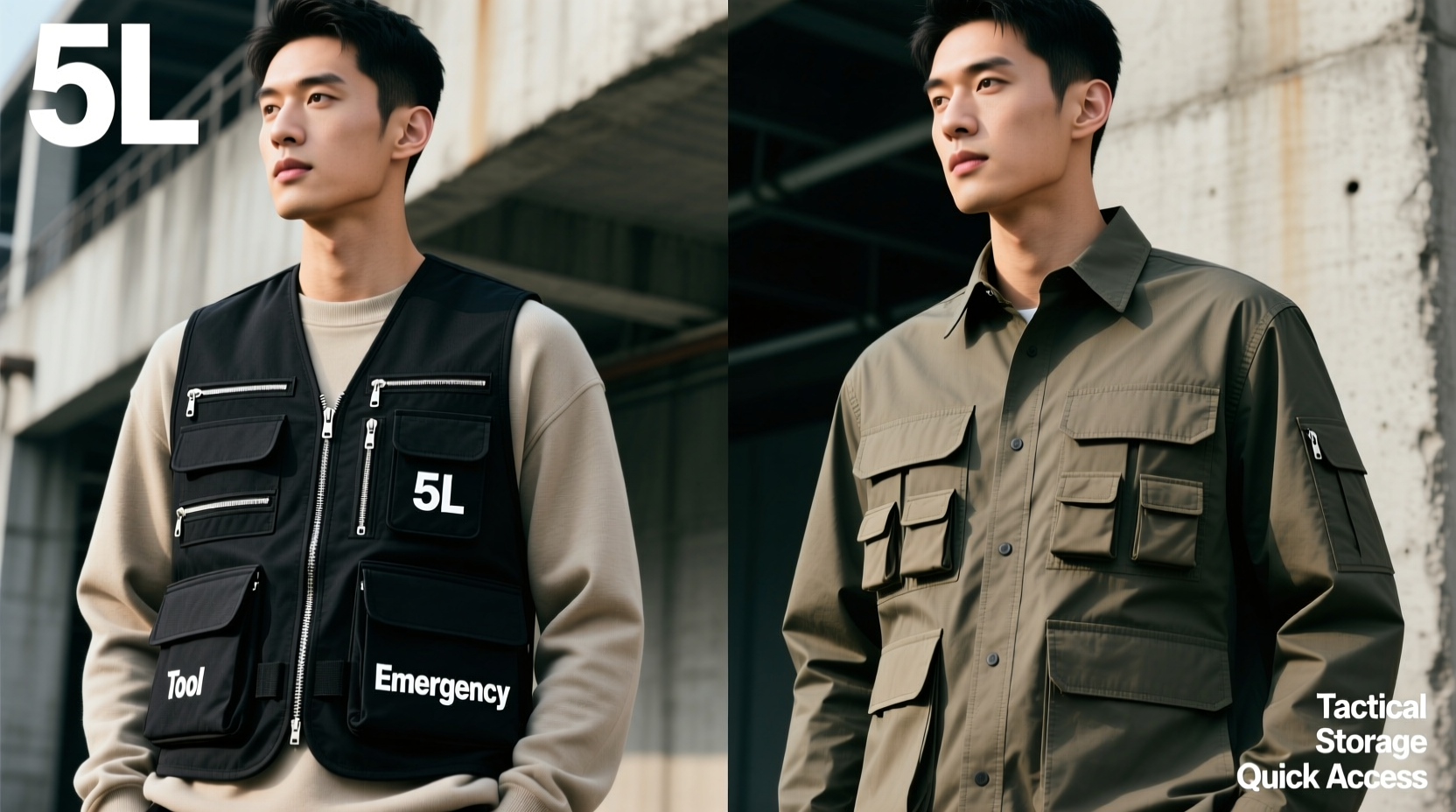
The fundamental difference between a cargo vest and a utility shirt begins with their base structure. A cargo vest is sleeveless and worn over other garments, functioning primarily as an outer layer. In contrast, a utility shirt is a standalone upper-body garment with sleeves, typically worn as a primary layer or under a jacket.
This distinction shapes how pockets are placed and accessed:
- Cargo Vests feature multiple external pockets, usually positioned across the chest, sides, and lower back. These are often box-pleated or expandable, offering high capacity. Some designs include hidden inner pockets for valuables.
- Utility Shirts integrate pockets directly into the shirt’s front panel—typically two large chest pockets with flap closures. Additional pockets may appear on the sleeves, shoulders, or even along side seams, depending on the model.
Because vests sit atop clothing, their pockets remain unobstructed by arm movement or torso bending. This allows for consistent access regardless of body motion. Utility shirts, however, must accommodate natural flexion; reaching forward or raising arms can stretch or shift pocket contents, especially if overfilled.
Tip: When testing pocket usability, simulate real actions like reaching into a backpack or checking your phone—this reveals how well each garment maintains accessibility during movement.Comparative Pocket Functionality: Capacity, Accessibility, Security
To assess which garment offers greater pocket functionality, we evaluate three core criteria: storage capacity, ease of access, and item security.
| Feature | Cargo Vest | Utility Shirt |
|---|---|---|
| Average Pocket Count | 6–10 (including internal) | 2–5 (mainly chest + optional sleeve) |
| Total Accessible Volume | High – pockets not compressed by arm movement | Moderate – limited by shirt fit and fabric stretch |
| Access Speed | Fast – all pockets face forward, easy reach | Slower – requires lifting arm or adjusting torso |
| Security of Contents | Good – many have zippers or magnetic flaps | Fair – flap buttons can loosen; prone to bouncing open |
| Ergonomic Load Distribution | Excellent – weight rests on shoulders and chest | Poor – uneven strain on fabric near seams |
The data shows that cargo vests outperform utility shirts in nearly every functional category. Their elevated pocket placement reduces interference from body mechanics, and their rigid construction supports heavier loads without sagging. Utility shirts, while sleeker and more versatile as standalone pieces, compromise on load-bearing efficiency due to reliance on lightweight cotton or blended fabrics.
“Pocket functionality isn’t just about quantity—it’s about intelligent placement. Vests win because they treat pockets as tools, not afterthoughts.” — Marcus Lin, Industrial Apparel Designer at Trailform Gear
Real-World Use Case: Urban Commuting & Outdoor Exploration
Consider Alex, a freelance photographer based in Portland, Oregon. His typical day involves walking 8–10 miles across the city, capturing street scenes, attending client meetings, and occasionally hiking forest trails on weekends. He rotates between a waxed-cotton utility shirt and a technical nylon cargo vest depending on the task.
On weekdays, he opts for the utility shirt. It layers well under a wool blazer, looks professional in meetings, and holds his phone, notebook, and pens in its dual chest pockets. However, he notes that crossing bridges or climbing stairs causes items to shift. “I’ve dropped my lens cap twice because the flap didn’t stay closed,” he says. “And when I raise my arm to take a photo overhead, the right pocket pulls down awkwardly.”
During weekend shoots in Forest Park, Alex switches to the cargo vest. Worn over a moisture-wicking base layer, it carries spare batteries, a mini tripod, snacks, and a compact rain cover. “Everything has its place,” he explains. “I can jog up a hill and not worry about things falling out. Plus, the side pockets let me stash gloves or a map without blocking my camera bag’s shoulder strap.”
This case illustrates a broader pattern: utility shirts excel in low-intensity, appearance-focused environments, while cargo vests dominate in dynamic, gear-heavy situations.
Styling Versatility and Layering Potential
Despite the cargo vest’s functional edge, the utility shirt holds strong in terms of sartorial adaptability. It can be dressed up with chinos and boots for a rugged-modern look or worn open over a tee for a relaxed vibe. Its shirttail allows tucking, which maintains a clean silhouette—something most vests cannot offer.
Vests, by nature, are statement layers. They draw attention to the torso and work best when balanced with minimalist underlayers. Pairing a bulky cargo vest with a patterned button-down or thick sweater risks visual clutter. Yet, when styled correctly—with slim tees, neutral tones, and streamlined bottoms—they project intentionality and preparedness.
Layering also affects pocket usability. A utility shirt tucked under a jacket may render its pockets inaccessible unless the outer layer has sufficient venting or is left open. Conversely, a cargo vest is designed to be the outermost functional layer, ensuring all compartments remain within reach.
Tip: For maximum versatility, choose a cargo vest with removable or foldable pockets—this allows you to scale down functionality when aesthetics matter more than utility.Step-by-Step Guide: Choosing Based on Your Needs
Selecting between a cargo vest and a utility shirt shouldn’t hinge on trends alone. Follow this decision-making process to match the garment to your lifestyle:
- Assess Your Daily Carry: List what you carry regularly—phone, wallet, keys, notebook, multitool, etc. If total volume exceeds 3 liters, lean toward a vest.
- Evaluate Movement Demands: Do you walk long distances, cycle, or engage in physical tasks? High mobility favors vests due to unrestricted access.
- Determine Dress Code Requirements: Office or formal settings may favor the subtlety of a utility shirt. Creative or casual workplaces accommodate vests more easily.
- Test Layering Combinations: Try both garments over your common outfits. Does the vest bunch under your coat? Does the shirt’s collar clash with your usual jackets?
- Check Closure Types: Prioritize secure fastenings—magnetic snaps, zipper backups, or storm flaps—if you’re active. Basic button flaps on shirts may not suffice.
- Consider Washability and Durability: Nylon or ripstop vests generally withstand frequent washing better than cotton utility shirts, which may shrink or fade.
By following these steps, you move beyond aesthetics and make a choice grounded in practicality.
Expert Insights on Functional Fashion Trends
The rise of “pocketcore” fashion reflects deeper cultural shifts. Consumers increasingly value self-reliance, minimalism, and preparedness—values embodied by garments that reduce dependency on handbags or backpacks.
“We’re seeing a return to purpose-driven design. People don’t want accessories that look busy—they want ones that actually work.” — Lena Patel, Senior Editor at *Field & Form* magazine
Patel notes that brands like Arc'teryx, Outlier, and Buck Mason have responded by refining pocket ergonomics—adding angled entries for easier hand insertion, using gripper linings to prevent slippage, and engineering load-bearing panels to distribute weight evenly.
Interestingly, hybrid models are emerging: utility shirts with vest-like pocket expansion, and vests with detachable sleeves. These innovations suggest the future lies not in choosing one over the other, but in blending their strengths.
Frequently Asked Questions
Can I wear a cargo vest in professional settings?
Yes, but selectively. Opt for minimalist designs in dark neutrals (charcoal, olive, black) made from structured fabrics like cotton-twill or technical blends. Pair with tailored trousers and a simple crewneck to avoid looking overly tactical.
Do utility shirts stretch out if I carry too much?
Yes. Cotton-based utility shirts lack elasticity and can permanently distort around pocket areas if consistently overloaded. To preserve shape, limit carried weight to under 2 pounds and avoid sharp or heavy objects.
Which is better for travel?
Cargo vests generally perform better during air or train travel. With TSA-friendly layouts (zippered pockets at chest level), they allow quick access to passports, tickets, and headphones without removing layers. Utility shirts require more fumbling and risk missing items during security checks.
Final Verdict: Which Offers More Pocket Functionality?
When judged strictly on pocket functionality—capacity, accessibility, security, and load management—the cargo vest is the superior choice. Its architecture prioritizes utility without compromise, offering more pockets, better weight distribution, and consistent access during motion. It excels in active, unpredictable environments where readiness matters.
The utility shirt, while stylish and adaptable, functions more as a hybrid piece—part fashion item, part tool carrier. Its pocket system is adequate for light daily carry but struggles under heavier loads or rigorous use. It shines in contexts where appearance and comfort outweigh raw functionality.
Ultimately, the decision depends on your priorities. If you value being prepared, mobile, and efficient, invest in a well-designed cargo vest. If you prefer subtle utility woven into everyday wear, a premium utility shirt will serve you well.
Conclusion: Make Function Work for You
Fashion doesn’t have to sacrifice function—and vice versa. Whether you choose a cargo vest or a utility shirt, the goal is to equip yourself with gear that enhances, rather than hinders, your daily life. By understanding how each garment handles pocket functionality, you can make informed decisions that align with your routine, environment, and personal style.
🚀 Ready to upgrade your carry game? Audit your current wardrobe, identify your top three carried items, and test one of these garments for a week. Share your experience—what worked, what didn’t—and help others find their perfect functional fit.








