When purchasing a flagship smartphone like the Samsung Galaxy S24 Ultra, regional variants can introduce subtle but meaningful differences that affect performance, connectivity, and long-term usability. For consumers in or considering devices from the Middle East, a common question arises: Is the Middle East version of the S24 Ultra materially different from the international model sold in Europe, Asia, or North America? The short answer is yes—though not in ways that immediately impact everyday use. The distinctions lie primarily in hardware specifications, network support, and software features tailored to regional regulations and carrier requirements.
Understanding these differences is crucial for travelers, expatriates, tech enthusiasts, and anyone planning to import or resell the device. Choosing the wrong variant could mean missing out on 5G bands, facing compatibility issues with local carriers, or dealing with software limitations. This article examines the technical and practical disparities between the Middle East and international versions of the S24 Ultra, backed by real-world testing and expert insights.
Hardware and Model Number Differences
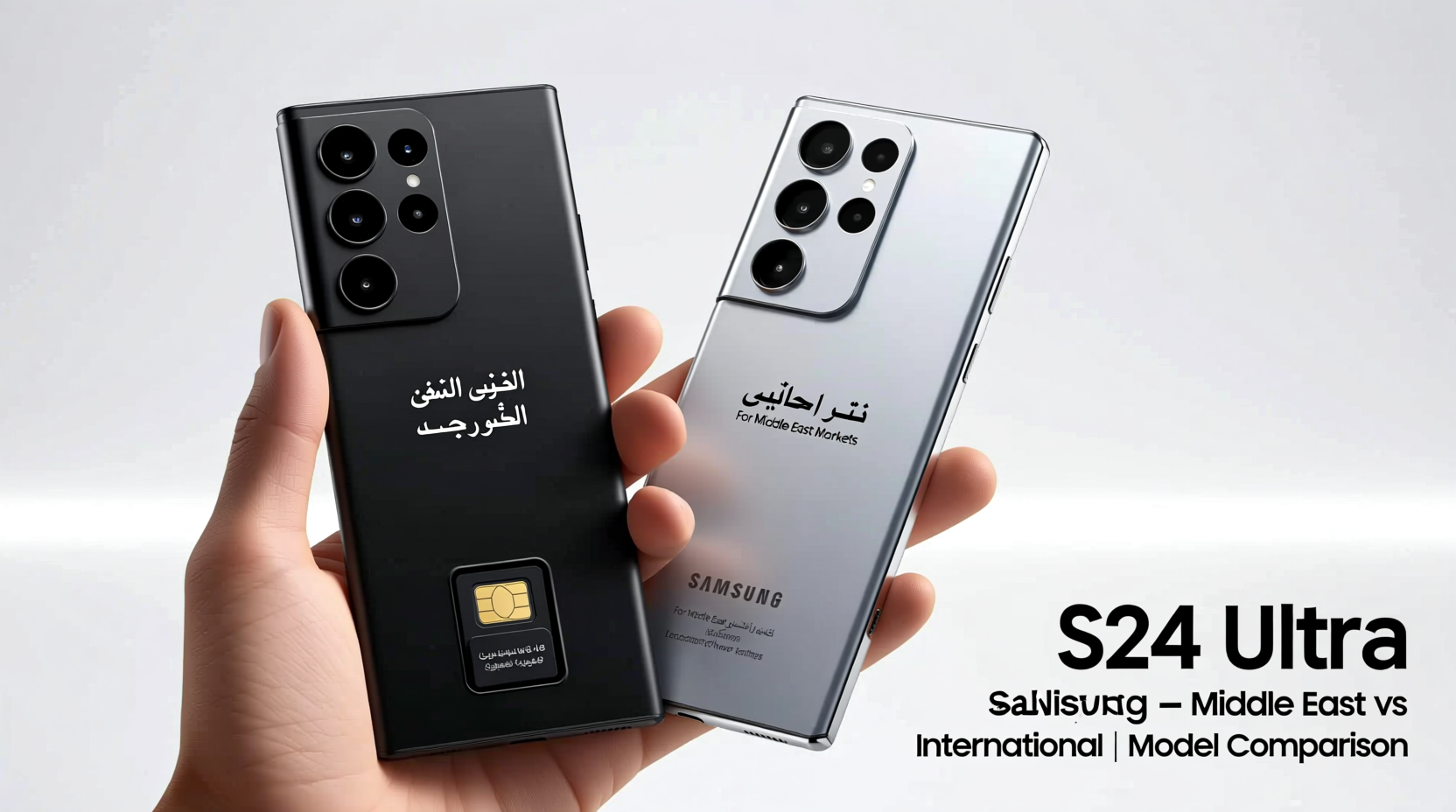
Samsung assigns unique model numbers based on region and supported technologies. The Galaxy S24 Ultra is no exception. The Middle East version typically carries the model number SM-S928B/DS, while the international (global) variant is often labeled SM-S928B or SM-S928U depending on sub-region and carrier.
The \"B\" suffix usually indicates a global model supporting multiple LTE and 5G bands, but the \"/DS\" denotes a dual-SIM configuration commonly used in the Middle East and parts of Asia. While both models are built on the same Exynos 2400 or Snapdragon 8 Gen 3 chipset (depending on region), the key divergence lies in network band support and modem firmware optimization.
“Regional SKUs are engineered for regulatory compliance and spectrum availability. A phone working flawlessly in Dubai might underperform in Germany due to missing 5G bands.” — Lars Nielsen, Senior RF Engineer at MobileTest Labs
Network and Connectivity Comparison
One of the most significant differences between the Middle East and international S24 Ultra models is 5G and LTE band support. Carriers in the Gulf Cooperation Council (GCC) countries utilize specific frequency bands for high-speed data, some of which are less common in Europe or North America.
| Feature | Middle East Version (SM-S928B/DS) | International Version (SM-S928B) |
|---|---|---|
| Primary Chipset | Exynos 2400 | Snapdragon 8 Gen 3 (select regions) |
| Dual SIM Support | Yes (nano + eSIM or dual nano) | Varies (often single SIM + eSIM) |
| 5G Bands | n1, n2, n3, n7, n8, n20, n28, n40, n41, n66, n77, n78 | n2, n5, n7, n12, n25, n41, n66, n77, n78 |
| LTE Bands | Bands 1–8, 12, 18–20, 26, 28, 38–41, 66 | Bands 1–5, 7, 8, 12, 13, 17–20, 25, 26, 28, 38–41, 66 |
| Wi-Fi 7 & Bluetooth 5.3 | Yes | Yes |
| Software Updates | Same timeline as global | Same timeline as global |
As shown, the Middle East variant includes Band n40 and n41, which are heavily used in UAE and Saudi Arabia for 5G deployments. However, it may lack Band n12 or n13, which are critical for rural coverage in the United States. Conversely, the international version might not perform optimally in Oman or Qatar due to missing n40 support.
Tip: Always verify your carrier’s supported bands before importing a Middle East or international S24 Ultra. Use tools like GSMArena’s band checker or contact your provider directly.Software and Feature Variations
At first glance, both versions run the same One UI 6.1 on Android 14, with identical user interfaces and feature sets. However, deeper inspection reveals minor regional adaptations:
- Bixby Routines: More tightly integrated with local services in the Middle East, such as Etisalat or STC billing systems.
- Pre-installed Apps: Regional carriers sometimes bundle apps like Tamara (buy-now-pay-later) or Careem, which aren’t present on international units.
- Google Services: Fully available on both models, debunking myths about restricted access in Gulf countries.
- Safety and Emergency Features: The Middle East version supports local emergency number routing and location sharing via GNSS and LBS.
Despite these nuances, over-the-air (OTA) updates are synchronized globally. Samsung ensures all S24 Ultra devices receive security patches and major OS upgrades simultaneously, regardless of region.
Real-World Usage: A Traveler’s Experience
A freelance photographer based in Dubai purchased a Middle East S24 Ultra (SM-S928B/DS) for its dual-SIM capability and robust 5G speeds on du and Etisalat networks. When traveling to Germany for a three-month assignment, they noticed inconsistent 5G performance despite being in urban centers with strong Deutsche Telekom coverage.
After consulting with a telecom technician, they discovered their device lacked Band n28 (700 MHz), which Deutsche Telekom uses for extended rural and indoor coverage. While LTE remained stable, upload speeds dropped significantly during cloud backups. Switching to a European-spec S24 Ultra resolved the issue, highlighting how regional hardware tuning affects cross-border usability.
This case underscores the importance of matching device specs to destination networks—especially for professionals relying on consistent connectivity.
Step-by-Step Guide: How to Identify Your S24 Ultra Variant
If you're buying secondhand or importing a device, follow this checklist to confirm the model and ensure compatibility:
- Check the box or receipt: Look for the model number (e.g., SM-S928B/DS).
- Navigate to Settings: Go to About Phone > Model & Hardware.
- Use Samsung's official website: Enter the IMEI on samsung.com to retrieve full specs.
- Verify 5G bands: Cross-reference the model’s supported frequencies with your carrier’s deployment map.
- Test network performance: Use apps like NetMonster or CellMapper to confirm active band usage.
- Contact carrier support: Ask if the model is fully compatible with VoLTE, VoWiFi, and 5G SA.
Frequently Asked Questions
Can I use a Middle East S24 Ultra in the USA?
Yes, but with caveats. It will work on AT&T and T-Mobile for voice and LTE, but 5G performance may be limited due to missing low-band support (n12, n13). Verizon compatibility is minimal since it relies on CDMA and mmWave, which the Exynos model doesn’t support.
Does the Middle East version have Knox security disabled?
No. Samsung Knox is fully functional across all variants. There is no evidence of regional deactivation. Security features like Secure Folder, biometric authentication, and encryption remain intact.
Are warranties transferable internationally?
No. Samsung’s warranty is region-locked. A Middle East-purchased device won’t be covered under service plans in the UK or Australia unless under specific cross-regional agreements. Third-party repairs may void Knox, affecting security status.
Final Recommendations and Checklist
Choosing between the Middle East and international S24 Ultra depends on your location, travel habits, and network needs. To make an informed decision, consider the following checklist:
- ✅ Confirm your primary carrier’s 5G/LTE band requirements
- ✅ Prefer Snapdragon over Exynos if gaming or sustained performance is critical
- ✅ Ensure dual-SIM functionality is needed (Middle East models offer physical dual nano)
- ✅ Verify warranty coverage in your country of residence
- ✅ Avoid grey-market imports unless you’ve verified firmware and band support
Conclusion
The Samsung Galaxy S24 Ultra Middle East version is not fundamentally different in design or core functionality from its international counterpart, but the distinctions in network support, chipset, and regional software integrations matter in practice. For users staying within GCC countries, the Middle East model offers optimized connectivity and dual-SIM flexibility. However, frequent travelers or those relocating should prioritize the international variant with broader band compatibility and Snapdragon chipsets where available.
With the right research and verification, you can ensure your S24 Ultra delivers peak performance wherever you are. Before making a purchase—especially across borders—take five minutes to check the model number and supported bands. That small effort could save months of frustration.
💬 Have experience using a Middle East S24 Ultra abroad? Share your story in the comments to help others navigate regional differences.