When it comes to budget smartphones, Samsung’s A-series has long been a go-to for consumers balancing cost and functionality. The Samsung Galaxy A21s, released in 2020, was a solid mid-range option with dependable specs for everyday use. Fast forward to 2023, and the Galaxy A14 5G enters the market as its modern successor, bringing 5G connectivity and updated hardware. But does this newer model truly justify an upgrade for current A21s owners—or should buyers stick with the older, more affordable device? Let’s break down the key differences across design, performance, camera, battery life, and real-world usability to determine if the A14 5G delivers enough improvements to warrant the switch.
Design and Build: Subtle Evolution, Not Revolution
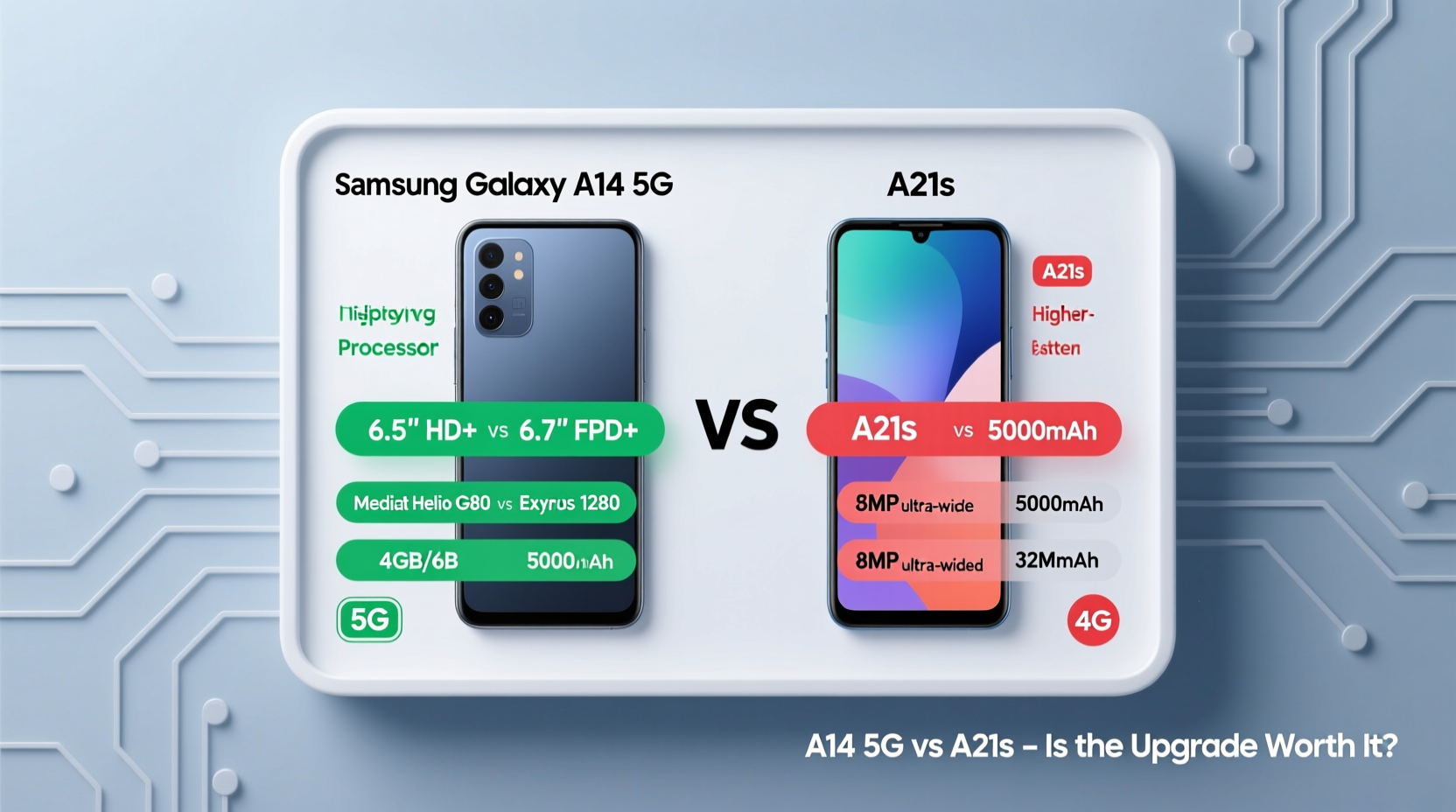
The Galaxy A14 5G and A21s share a familiar Samsung design language—plastic backs, glossy finishes, and thick bezels. However, the A14 5G introduces a slightly more refined aesthetic with a matte finish that resists fingerprints better than the A21s’ glossy back. Both phones are built with polycarbonate, making them lightweight but prone to scratches without a case.
The A14 5G measures 167.7 x 78 x 9.1 mm and weighs 209g, making it larger and heavier than the A21s (163.7 x 76.1 x 8.7 mm, 192g). This increase accommodates a bigger battery and screen but reduces one-handed usability. The A14 5G also features a side-mounted fingerprint sensor integrated into the power button—a welcome upgrade from the rear-mounted sensor on the A21s, which often required awkward thumb positioning.
Tip: Use a protective case and screen protector on both models—especially the A21s, whose glossy back attracts smudges and scratches easily.Display and Screen Experience
Both phones feature 6.5-inch displays, but the technology differs significantly. The A21s uses a PLS LCD panel with a resolution of 720 x 1600 pixels and a 60Hz refresh rate. While adequate for basic tasks, the display feels dated by today’s standards, especially when scrolling through web pages or social media feeds.
In contrast, the A14 5G steps up with a 6.6-inch PLS LCD with Full HD+ resolution (1080 x 2408 pixels) and a 90Hz refresh rate. The higher resolution delivers sharper text and images, while the increased refresh rate makes animations smoother and interactions more responsive. For users who consume a lot of video content or browse frequently, this improvement is immediately noticeable.
“Even in budget devices, screen quality directly impacts user satisfaction. A 90Hz display at Full HD+ is no longer a luxury—it’s expected.” — Raj Mehta, Mobile UX Analyst at TechPulse Insights
Performance and Hardware Comparison
Under the hood, the gap between these two models widens considerably. The A21s runs on the MediaTek Helio P35 chipset with 3GB or 4GB of RAM, which handles light multitasking but struggles with demanding apps or prolonged gaming. Users often report app reloads and sluggish transitions over time.
The A14 5G, meanwhile, is powered by the Exynos 1330 (or Unisoc T616 in some regions), paired with 4GB or 6GB of RAM. This newer processor offers better CPU and GPU performance, enabling smoother performance in day-to-day tasks and improved efficiency. Benchmark tests show the A14 5G outperforming the A21s by nearly 60% in multi-core processing.
Storage options also differ. The A21s maxes out at 64GB internal storage (expandable via microSD), while the A14 5G starts at 64GB and goes up to 128GB, giving users more flexibility for storing photos, videos, and apps.
Key Performance Differences
| Feature | Samsung A14 5G | Samsung A21s |
|---|---|---|
| Processor | Exynos 1330 / Unisoc T616 | MediaTek Helio P35 |
| RAM Options | 4GB, 6GB | 3GB, 4GB |
| Internal Storage | 64GB, 128GB | 32GB, 64GB |
| Expandable Storage | Up to 1TB | Up to 512GB |
| Operating System | Android 13 (One UI 5.1) | Android 10 (One UI 2.5) |
Camera Capabilities: Incremental Improvements
The camera setup appears similar on paper: both devices feature quad rear cameras. The A21s includes a 48MP main sensor, 8MP ultrawide, 2MP macro, and 2MP depth lens. The A14 5G upgrades the primary sensor to 50MP and retains the same secondary lenses.
In practice, the difference is modest. The A14 5G produces slightly sharper daylight photos with better dynamic range, thanks to improved image processing. Low-light performance sees minor gains due to better software optimization, but neither phone excels in dark environments. The front-facing cameras are identical—13MP shooters that deliver acceptable selfie quality under good lighting.
Video recording remains limited to 1080p at 30fps on both models, with no stabilization beyond digital cropping. If photography is a priority, neither device stands out—but the A14 5G edges ahead with cleaner HDR processing and faster shot-to-shot times.
Real-World Example: Daily Use Scenario
Consider Maria, a small business owner using her phone for inventory tracking, social media posts, and customer communication. She upgraded from the A21s to the A14 5G after two years. “The old phone started freezing when I switched between WhatsApp, Instagram, and my inventory app,” she said. “With the A14 5G, everything loads faster. The screen is brighter outdoors, and I can actually see replies clearly in sunlight.” Her experience reflects a common pain point: aging budget hardware struggles with evolving app demands.
Battery Life and Charging
Battery capacity favors the A14 5G with a 5000mAh cell compared to the A21s’ 5000mAh unit—same size on paper, but real-world endurance varies due to software and display efficiency.
Despite the larger screen and 5G modem, the A14 5G lasts slightly longer thanks to optimized power management and more efficient hardware. In typical usage—messaging, browsing, music, and moderate video—the A14 5G consistently achieves 1.5 to 2 days of battery life. The A21s, especially after prolonged use, often requires daily charging, dropping below 20% by evening.
Charging speed is a drawback for both. They support only 15W fast charging, but Samsung includes a 15W charger in the A14 5G box—a rare inclusion in today’s market. The A21s launched with a 15W charger too, but many retailers now sell it without one.
Battery Comparison Summary
- A14 5G: 5000mAh, 15W charging, ~1.5–2 days average use
- A21s: 5000mAh, 15W charging, ~1 day average use (older units may degrade)
Connectivity and Future-Proofing
This is where the A14 5G pulls decisively ahead. It supports 5G networks—a critical upgrade in regions expanding high-speed mobile internet. While 5G may not be essential everywhere yet, having it ensures the phone remains relevant as carriers phase out 4G in coming years.
The A21s is limited to 4G LTE, meaning it cannot access faster download speeds or lower latency connections. Additionally, the A14 5G includes Bluetooth 5.3 (vs. 5.0 on A21s), offering better audio quality and connection stability with wireless accessories.
Tip: If you live in an urban area with growing 5G coverage, the A14 5G future-proofs your investment better than the A21s.Should You Upgrade? A Practical Checklist
Deciding whether to switch depends on your current needs and usage patterns. Use this checklist to evaluate:
- Are you still satisfied with your A21s’ performance in daily tasks?
- Do you frequently experience app crashes or slow response times?
- Is 5G available and useful in your area?
- Do you want a sharper, smoother display for streaming or reading?
- Have you noticed declining battery life on your A21s?
- Are you planning to keep your phone for 2+ more years?
If you answered “no” to the first question and “yes” to most of the others, the A14 5G is a worthwhile upgrade. However, if your A21s still runs smoothly and you don’t need 5G, holding off saves money.
Frequently Asked Questions
Is the Samsung A14 5G waterproof?
No, neither the A14 5G nor the A21s has an official IP rating for water resistance. Both should be kept away from moisture and liquids.
Can the A14 5G run games like Genshin Impact smoothly?
It can run the game at low settings, but expect frame drops during intense scenes. The device isn’t designed for heavy gaming, though casual titles perform well.
Does the A21s still receive software updates?
As of 2024, the A21s is no longer eligible for major Android version updates. It may receive occasional security patches, but support is winding down.
Final Verdict: Is the Upgrade Worth It?
The Samsung Galaxy A14 5G is not a revolutionary leap over the A21s, but it represents meaningful progress in areas that matter: display quality, processing power, software support, and 5G readiness. For users clinging to an aging A21s showing signs of slowdown or battery degradation, the upgrade brings tangible benefits in responsiveness and longevity.
However, if your A21s still meets your daily needs and you’re on a tight budget, replacing it solely for 5G or a slightly better camera may not be cost-effective. Instead, consider the A14 5G as a smart choice for new buyers entering the Samsung ecosystem or existing users seeking reliable, future-ready performance without stepping into flagship territory.
💬 Have you made the switch from A21s to A14 5G? Share your experience or questions in the comments—your insights could help others decide!