The smartphone market has evolved into a battleground between legacy dominance and disruptive innovation. On one side, Apple’s iPhone 12 Mini remains a benchmark for compact iOS excellence. On the other, the Nothing Phone (1) bursts in with bold design, Glyph Interface flair, and Android customization. But beyond aesthetics and marketing buzz, how do these two truly stack up? Is the Nothing Phone (1) a genuine contender, or does the iPhone 12 Mini still reign supreme?
This isn’t just about specs on paper—it’s about daily usability, ecosystem loyalty, software longevity, and that intangible feeling of ownership. Let’s break it down with real-world context.
Design & Build: Minimalism vs. Statement-Making
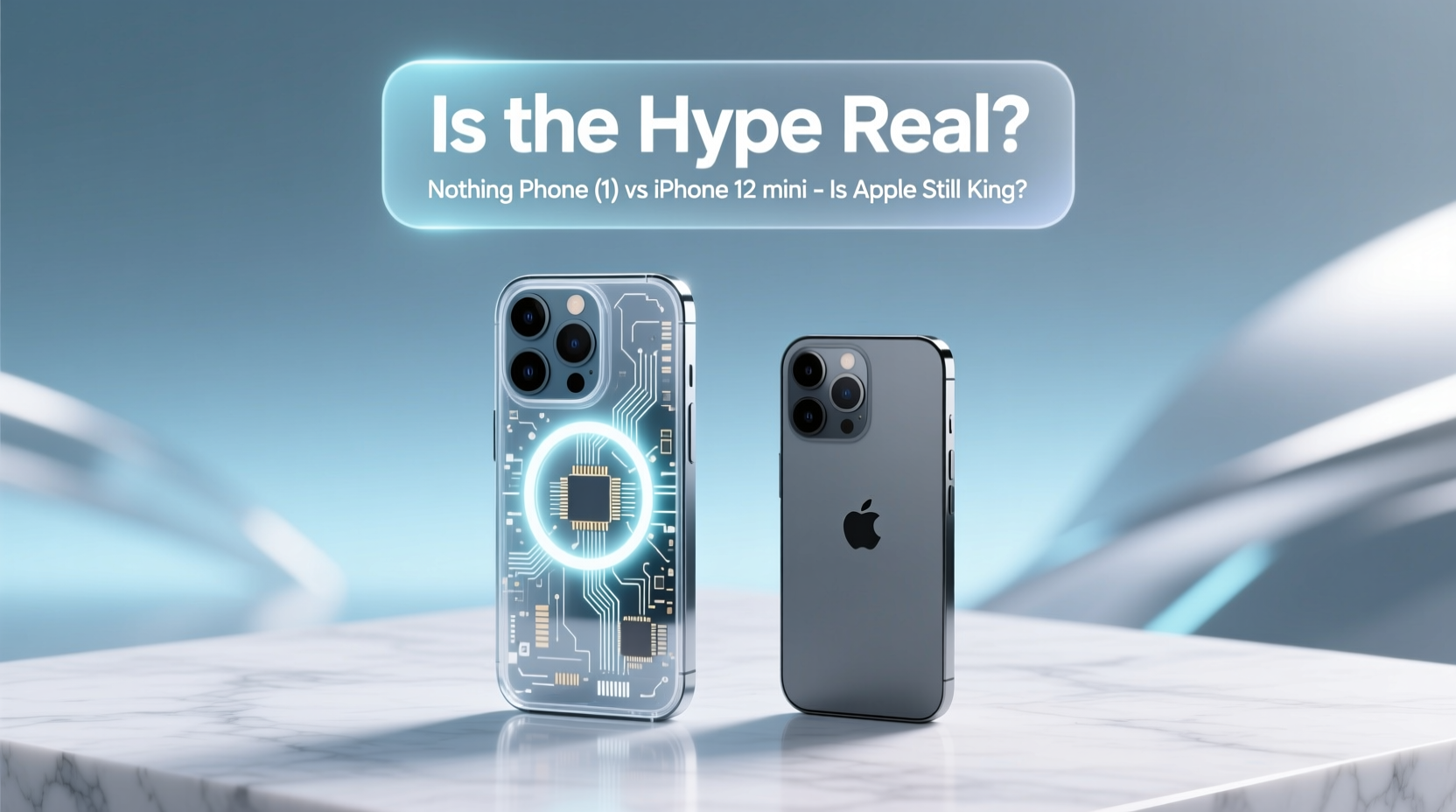
The iPhone 12 Mini continues Apple’s tradition of surgical precision in design. Its flat aluminum edges, Ceramic Shield front, and IP68 rating deliver a premium, no-nonsense feel. At 135 grams, it’s featherlight and fits comfortably in one hand—ideal for those tired of phablets.
In contrast, the Nothing Phone (1) makes a statement. The transparent back with visible internals and the illuminated Glyph Interface across the rear aren’t just gimmicks—they redefine how phones can express personality. While some may find it flashy, others appreciate the transparency (literally) and futuristic vibe. It’s heavier at 193 grams and slightly bulkier, but the polycarbonate build keeps it durable without sacrificing style.
Tip: If pocketability and one-handed use are priorities, the iPhone 12 Mini wins. For expressive design and visual flair, Nothing takes the crown.Performance & Software Experience
Under the hood, the iPhone 12 Mini runs on Apple’s A14 Bionic chip—a 5nm powerhouse that still outperforms most mid-range Android processors in 2024. Paired with iOS 17 (and likely iOS 18), it offers buttery-smooth performance, excellent app optimization, and five years of guaranteed updates.
The Nothing Phone (1) uses the Qualcomm Snapdragon 778G+, a solid mid-tier SoC. It handles everyday tasks well—social media, streaming, multitasking—but lags behind the A14 in sustained workloads and gaming. However, its clean Android 13-based Nothing OS 1.5 (upgradable to OS 2.5) provides a bloat-free, near-stock experience with subtle customizations like Glyph reactions and dark mode system-wide sync.
iOS offers unmatched ecosystem integration—AirDrop, iMessage, Handoff, and iCloud. Nothing OS focuses on simplicity and transparency, avoiding aggressive data tracking. Privacy advocates may lean toward Nothing, while Apple users benefit from seamless device synergy.
“Software support isn’t just about features—it’s about trust. Apple guarantees six years of updates. Many Android OEMs don’t even promise three.” — David Kim, Mobile Analyst at TechPulse Insights
Camera Comparison: Consistency vs. Potential
The iPhone 12 Mini’s dual-camera system (12MP wide + 12MP ultra-wide) delivers reliable results in nearly every lighting condition. Apple’s computational photography—Smart HDR, Deep Fusion, Night mode—is mature and consistent. Colors are natural, dynamic range is excellent, and video recording supports Dolby Vision HDR at 4K/30fps, a feature still rare among competitors.
The Nothing Phone (1) features a dual setup: 50MP main (Sony IMX766) + 50MP ultra-wide. On paper, this looks superior. In practice, photos often lack fine detail and exhibit inconsistent processing—especially in low light. HDR handling can be erratic, and skin tones sometimes skew unnatural. Video tops out at 4K/30fps without advanced stabilization or log profiles.
While Nothing has improved camera firmware over time, it hasn’t closed the gap with Apple’s refined imaging pipeline. The iPhone simply produces more trustworthy results day after day.
Real-World Example: Street Photography Test
Jamie, a freelance photographer in London, tested both devices during a weekend shoot in Camden Market. Using the iPhone 12 Mini, she captured vibrant street scenes with accurate white balance and minimal noise, even under mixed indoor lighting. With the Nothing Phone (1), several shots required post-processing due to oversharpening and purple fringing. “The iPhone just worked,” she said. “I didn’t have to second-guess the output.”
Battery Life & Charging: Efficiency vs. Speed
The iPhone 12 Mini packs a 2,227mAh battery—small by today’s standards. Yet, thanks to iOS optimization and the efficiency of the A14 chip, it lasts a full day for moderate users. Heavy usage pushes it toward a recharge by late afternoon. It supports 20W wired charging (charger not included) and 15W MagSafe wireless charging.
The Nothing Phone (1) comes with a 4,500mAh battery—nearly double the capacity. This translates to 1.5 to 2 days of light use and solid endurance under normal loads. It charges quickly via 33W USB-C, reaching 50% in about 30 minutes. No wireless charging, though.
| Feature | iPhone 12 Mini | Nothing Phone (1) |
|---|---|---|
| Battery Capacity | 2,227 mAh | 4,500 mAh |
| Charging Speed | 20W Wired, 15W Wireless | 33W Wired, No Wireless |
| Estimated Daily Use | 1 Day (Moderate) | 1.5–2 Days (Light) |
| Fast Charge Time (50%) | ~40 mins | ~30 mins |
Ecosystem & Longevity: The Hidden Decider
This is where the divide widens. Apple’s ecosystem locks in users with seamless integration across Macs, iPads, AirPods, and Apple Watch. Messages, FaceTime, iCloud Photos, and Continuity features create a frictionless experience that’s hard to replicate.
Nothing, being a new player, lacks an ecosystem. You get a phone and accessories—if you’re lucky. There’s no tablet, smartwatch, or laptop on the horizon yet. While Nothing Ear (a) earbuds pair easily, they don’t offer the same level of integration as AirPods.
Update longevity is another critical factor. The iPhone 12 Mini will likely receive iOS updates until 2026 or beyond. Nothing promises three major OS updates and four years of security patches—respectable, but not on par with Apple’s track record.
Checklist: Choosing Between Them
- ✅ Need tight Apple ecosystem integration? → iPhone 12 Mini
- ✅ Prefer compact size and one-handed comfort? → iPhone 12 Mini
- ✅ Want faster charging and longer battery life? → Nothing Phone (1)
- ✅ Value unique design and customization? → Nothing Phone (1)
- ✅ Prioritize camera consistency and video quality? → iPhone 12 Mini
- ✅ Looking for affordable flagship alternative with modern features? → Nothing Phone (1)
Frequently Asked Questions
Is the Nothing Phone (1) worth buying in 2024?
Yes, if you want a stylish, fast-charging Android phone with clean software and don’t mind mid-tier performance. It’s especially appealing at discounted prices now, typically under $300. However, consider newer models like the Nothing Phone (2) for better cameras and updates.
Can the iPhone 12 Mini still perform well today?
Absolutely. The A14 chip ensures smooth performance for daily tasks, social apps, and even light gaming. iOS optimization keeps it responsive. As long as you’re okay with limited battery life and no 5G (in some regions), it remains a compelling small phone option.
Does the Glyph Interface on the Nothing Phone (1) serve any real purpose?
Beyond notifications and charging animations, its utility is limited. Some users love the aesthetic; others see it as a battery-draining novelty. It doesn’t replace functionality—you still need to pick up the phone to interact. Fun, but not essential.
Final Verdict: Hype vs. Legacy
The Nothing Phone (1) is undeniably cool. It brings freshness to a stagnant Android market, challenges design norms, and delivers strong battery life with rapid charging. But \"cool\" doesn’t always mean \"complete.\" Its camera, performance, and ecosystem fall short of Apple’s holistic offering.
The iPhone 12 Mini, while older, represents refinement. It excels in areas that matter most to many users: reliability, camera quality, software support, and ecosystem cohesion. It’s not flashy, but it’s dependable—the antithesis of hype-driven tech.
So, is the hype around Nothing real? Partially. It’s a promising start from a brand with vision. But when it comes to overall performance, longevity, and user experience, Apple still wears the crown—especially for those already invested in its world.
💬 Where do you stand? Are you drawn to bold innovation or proven reliability? Share your thoughts on whether design disruption can dethrone ecosystem excellence.