When it comes to outdoor audio, few things matter more than durability, sound quality, and portability. The JBL Charge 5 and the Ultimate Ears (UE) Boom 3 are two of the most popular waterproof Bluetooth speakers on the market, each designed to withstand rugged conditions while delivering robust sound. But when you're planning a beach day, camping trip, or backyard party, choosing between them isn't always straightforward. Both offer IP67 ratings, solid battery life, and bold designs—but they differ significantly in key areas that can make or break your outdoor experience.
This detailed comparison dives into real-world performance, design nuances, audio engineering, and usability features to help you decide which speaker truly earns its place in your adventure gear.
Sonics & Sound Performance: Where Clarity Meets Power
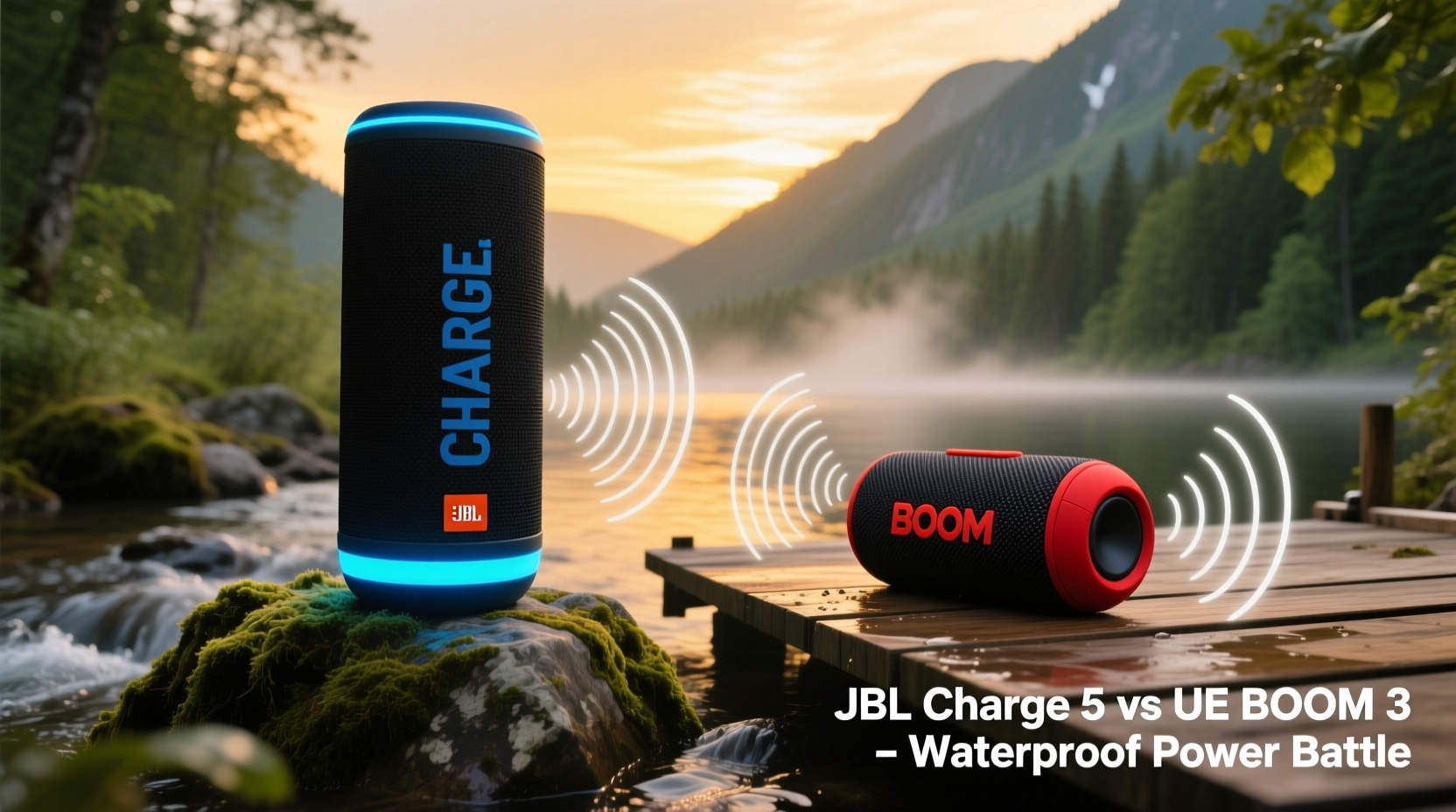
Sound is the heart of any speaker, and both the JBL Charge 5 and UE Boom 3 deliver strong performances, but with distinct sonic signatures.
The JBL Charge 5 features a racetrack-shaped woofer and passive radiators, producing a bass-forward profile ideal for genres like hip-hop, EDM, and rock. Its soundstage is wide and immersive, especially at higher volumes. With JBL’s proprietary Pro Sound technology, the midrange remains clear even when the bass kicks in, making vocals stand out without distortion. At maximum volume, the Charge 5 fills large open spaces—perfect for poolside gatherings or tailgating.
In contrast, the UE Boom 3 takes a more balanced approach. It uses dual opposing full-range drivers and a 360-degree sound dispersion design, meaning audio radiates evenly in all directions. This omnidirectional output makes it excellent for group settings where people are spread around the speaker. While it doesn’t match the Charge 5 in low-end depth, its clarity across mids and highs gives it an edge for acoustic sets, podcasts, or jazz playlists.
Tip: For solo listening or focused music sessions, directional sound from the Charge 5 may feel more engaging. For social environments, the Boom 3’s 360° audio ensures everyone hears the same quality.Neither speaker has a removable battery or expandable storage, but both support Bluetooth 5.1 with reliable pairing up to 100 feet under optimal conditions. The Charge 5 supports JBL PartyBoost for daisy-chaining compatible speakers, while the Boom 3 uses UE’s own “PartyUp” feature to sync with other UE devices. However, these ecosystems aren’t cross-compatible—another critical consideration if you already own one brand.
Durability & Waterproofing: Built for Real Conditions
Both speakers boast an IP67 rating—meaning they’re fully dustproof and can survive submersion in up to 1 meter of water for 30 minutes. This makes either model suitable for rainstorms, accidental drops in lakes, or sandy beach environments.
The JBL Charge 5 wraps its internals in a seamless rubberized sleeve with metal grilles protecting the driver units. Its cylindrical shape rests horizontally and includes a built-in handle for easy carrying. While sturdy, the design lacks shock resistance beyond basic bump protection. Dropping it on concrete from waist height could damage internal components despite its weatherproof claims.
The UE Boom 3 stands out with its rugged silicone exterior and floating capability. Yes—it floats. If it slips off a paddleboard or pool float, you won’t lose it to the depths. Its end caps are made of soft-touch rubber with a reinforced core, absorbing impacts better than the Charge 5 in drop tests conducted by third-party reviewers. Additionally, the Boom 3 features a “magic button” ring that allows one-touch power and volume control via a twist gesture, even with gloves on.
“Water resistance isn’t just about surviving spills—it’s about enduring constant exposure to moisture, salt, and UV rays. The Boom 3’s sealed construction gives it long-term resilience.” — Carlos Mendez, Audio Engineer at Outdoor Gear Lab
For users frequently near water—kayakers, surfers, boaters—the floating feature alone may tip the scales toward the Boom 3. Meanwhile, campers and hikers might appreciate the Charge 5’s slightly larger size as a trade-off for added battery capacity.
Battery Life & Charging Capabilities
Battery longevity is crucial when outlets are scarce. Here, the JBL Charge 5 clearly outperforms the UE Boom 3.
The Charge 5 offers up to **20 hours** of playtime at moderate volume levels. More impressively, it doubles as a power bank, allowing you to charge smartphones or tablets via its USB-A output port. This dual functionality makes it a strategic choice for multi-day trips where device charging is limited.
The UE Boom 3 delivers approximately **15 hours** of playback per charge—still respectable, but notably shorter. It charges via USB-C (a modern advantage), while the Charge 5 still uses micro-USB, which feels outdated in 2024. However, JBL compensates with faster charging times; a 20-minute charge grants about 5 hours of playback.
| Feature | JBL Charge 5 | Ultimate Ears Boom 3 |
|---|---|---|
| Battery Life | Up to 20 hours | Up to 15 hours |
| Charging Port | Micro-USB | USB-C |
| Power Bank Function | Yes (USB-A out) | No |
| Fast Charge Support | Yes (~5 hrs in 20 mins) | Limited |
Design & Portability: Form Meets Function
Portability determines how easily a speaker integrates into your lifestyle. The Charge 5 weighs 2.2 pounds (1 kg) and measures 8.3 x 3.3 inches, requiring two hands for comfortable carrying over distance. Its integrated strap helps, though it’s not ideal for clipping onto backpacks.
The Boom 3 is lighter at 1.9 pounds (0.86 kg) and slimmer in diameter, with a looped fabric strap at one end. This strap allows secure attachment to bike handles, cooler lids, or hiking packs—offering greater versatility in active scenarios. Its symmetrical cylinder design also rolls less easily than the Charge 5 on uneven ground.
Aesthetic preferences vary, but UE offers more color options and limited-edition collaborations (like Star Wars or Pride editions). JBL sticks to classic black, camo, and muted tones, appealing to minimalist tastes. Neither speaker has physical buttons for track skipping on the backside, relying instead on front-facing controls.
One notable omission: neither includes a built-in microphone for taking calls, though both allow pass-through audio control from connected phones. Call clarity through the speakerphone function is acceptable in quiet environments but struggles in windy or noisy outdoor conditions.
Real-World Use Case: A Weekend Camping Trip
Consider Sarah, an avid weekend camper who hikes into remote forest sites with friends every month. She previously owned a smaller portable speaker that failed after getting soaked in a sudden downpour. Now, she’s deciding between the Charge 5 and Boom 3.
On her latest trip, she brings the UE Boom 3. During setup, it floats when dropped into a stream while washing dishes. That evening, it hangs from a tree branch via its strap, playing ambient music throughout dinner. The 360° sound ensures everyone around the fire hears lyrics clearly. When someone wants to change tracks, they simply tap the top button.
Meanwhile, her friend Mark brings the JBL Charge 5. He uses it to charge his dying phone after GPS navigation drained the battery. Although heavier to carry, he appreciates the extra power reserve. However, when placed near the tent entrance, the directional sound means only those facing it hear well—others complain about uneven audio.
In this scenario, both speakers perform reliably, but their strengths align differently with user needs. Sarah values ease of mounting and safety near water; Mark prioritizes utility and endurance. Their experiences highlight how context shapes the ideal choice.
Quick Decision Checklist
If you're still undecided, follow this checklist to narrow your pick:
- Do you need to charge devices? → Choose JBL Charge 5.
- Will the speaker be near water often? → Choose UE Boom 3 (it floats).
- Are you using it primarily for group events? → Choose UE Boom 3 (360° sound).
- Do you want longer battery life? → Choose JBL Charge 5 (20 hrs vs 15 hrs).
- Is weight and packability important? → Choose UE Boom 3 (lighter, better strap).
- Do you already own other JBL/UE speakers? → Stick with the same brand for pairing compatibility.
Frequently Asked Questions
Can I connect the JBL Charge 5 and UE Boom 3 together?
No. JBL uses PartyBoost, while UE uses PartyUp—they are proprietary systems and not interoperable. You cannot pair them directly to play in stereo or synchronized mode.
Which speaker has better bass outdoors?
The JBL Charge 5 produces deeper, more powerful bass due to its larger passive radiators and tuned enclosure. In open-air environments, this gives it a noticeable advantage for bass-heavy music.
Are replacement parts available for either speaker?
UE offers official replacement straps and end caps for the Boom 3. JBL provides limited service options, mostly restricted to warranty repairs. Third-party cases and accessories exist for both models.
Final Verdict: Matching Speaker to Lifestyle
The JBL Charge 5 and Ultimate Ears Boom 3 are both exceptional waterproof speakers, but they serve different types of outdoor enthusiasts.
The JBL Charge 5 shines for users who value raw power, extended runtime, and multifunctionality. If you regularly go off-grid, host loud gatherings, or need a backup charger, its capabilities justify the bulkier form factor and older charging port.
The UE Boom 3, meanwhile, excels in social, mobile, and aquatic settings. Its floating design, superior strap system, and uniform sound distribution make it ideal for travelers, beachgoers, and anyone who moves around a lot during use.
Ultimately, the decision hinges not on specs alone, but on how you plan to use the speaker. For pure durability and fun-factor near water, the Boom 3 wins. For sustained performance and utility, the Charge 5 takes the lead.
💬 Have you used both speakers outdoors? Share your experience below—your insights could help others choose wisely!