As we move deeper into 2025, Valve’s Steam Deck has firmly established itself as a leader in the handheld PC gaming space. With two distinct models available—the original LCD version and the upgraded OLED model—consumers are faced with a critical decision: is the older, more affordable LCD model still a smart buy? Or has the OLED variant rendered it obsolete?
The answer isn’t as straightforward as “newer is better.” While the OLED model introduced significant improvements in display quality, battery life, and thermal management, the LCD version remains widely available, often at discounted prices. For budget-conscious gamers or those who prioritize raw processing power over visual refinement, the LCD model may still hold appeal. But how does it truly stack up when every other upgrade points toward OLED dominance?
Display Quality: The Core Difference
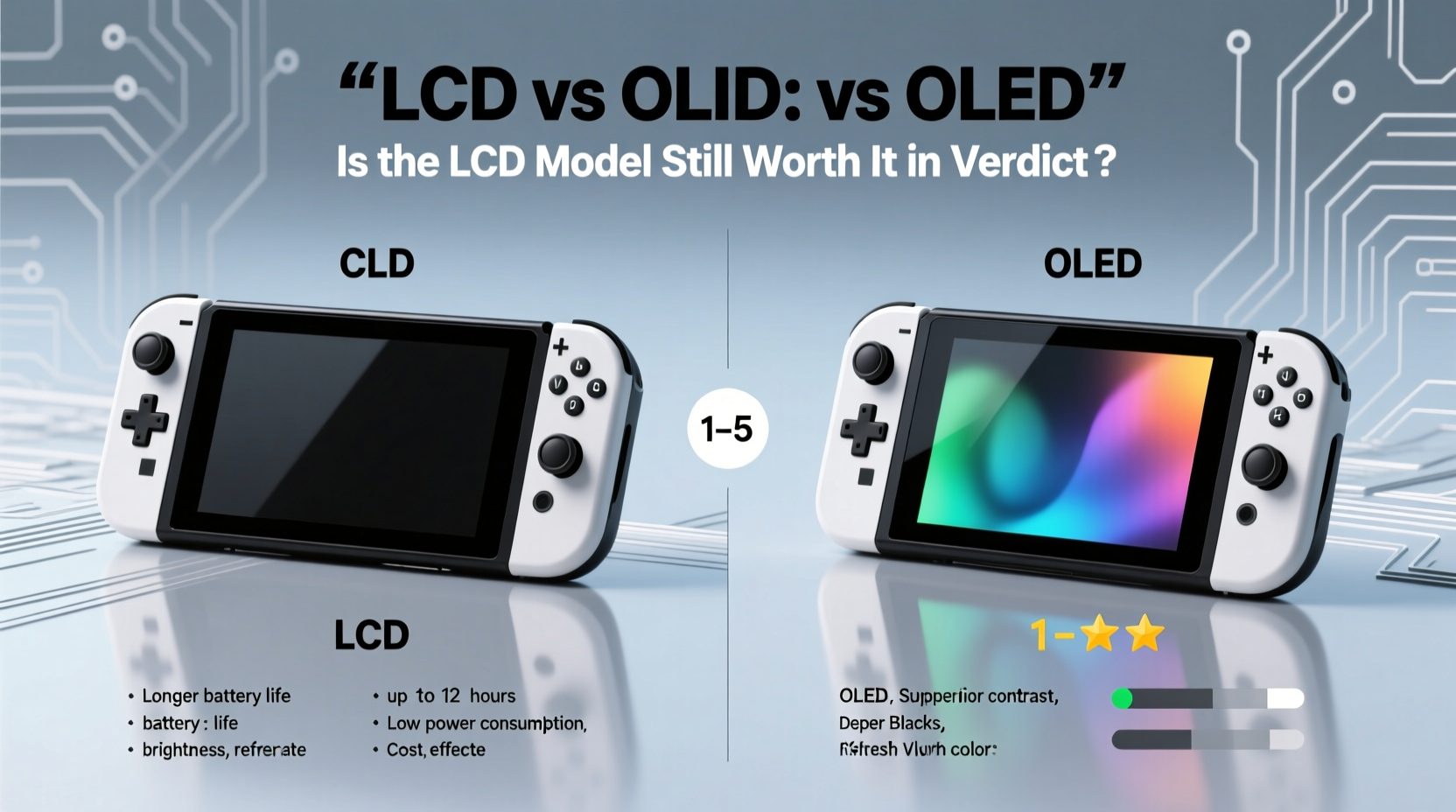
The most immediate and noticeable difference between the two models lies in the screen technology. The original Steam Deck uses a 6-inch LCD panel with a resolution of 1280x800, capable of 60Hz refresh rates. It delivers decent color accuracy and brightness for indoor use but struggles in direct sunlight and lacks deep blacks due to the nature of LCD backlighting.
In contrast, the OLED model features a 6-inch organic light-emitting diode display with the same resolution but vastly superior contrast ratios. Because each pixel emits its own light, blacks are true black, colors pop with greater vibrancy, and HDR content benefits from enhanced dynamic range. Even without an increase in resolution, the visual leap is striking.
Tip: If you frequently play in bright environments, the OLED’s improved brightness and anti-reflective coating offer a tangible advantage over the LCD.However, it's important to note that many games on the Steam Deck are played at reduced resolutions or frame rates due to hardware limitations. In these cases, the display’s inherent quality matters less than stability and performance consistency. For players focused on emulation, indie titles, or older AAA games, the LCD’s screen may be perfectly adequate.
Battery and Thermal Performance
One of the most impactful upgrades in the OLED model is its redesigned internal layout and cooling system. Valve replaced the dual-fan setup with a single, larger fan and repositioned internal components to improve airflow. This results in quieter operation and lower sustained temperatures during extended gaming sessions.
The OLED also benefits from a larger 50Wh battery (up from 40Wh), translating to roughly 30–50% more playtime depending on usage. In real-world testing, this means an extra hour or two of gameplay for most titles, especially when paired with conservative CPU/GPU clock settings.
The LCD model, while functional, tends to throttle more aggressively under load. Its smaller battery limits high-performance gaming to around 1.5 to 2 hours for demanding titles like God of War or Elden Ring. Casual users playing lighter games may not notice this limitation, but power users will quickly hit endurance walls.
“Thermal efficiency isn’t just about comfort—it directly impacts performance sustainability. The OLED’s design allows for longer peak output before throttling kicks in.” — Jordan Lee, Handheld Gaming Analyst at TechPulse
Performance and Hardware Comparison
At their core, both models share the same custom AMD APU: a 4-core/8-thread Zen 2 CPU and RDNA 2 GPU with 8 compute units. There are no differences in raw processing power. Any performance gap comes down to thermal headroom and sustained boost clocks, not silicon-level advantages.
That said, the OLED’s improved cooling enables slightly higher average clock speeds over time. Benchmarks show a consistent 5–10% performance uplift in long sessions, particularly in CPU-heavy games. This doesn't mean the OLED runs every game faster, but it maintains target frame rates more reliably.
Storage configurations remain similar across both lines, with options ranging from 64GB eMMC to 512GB NVMe SSD. However, the OLED model ships exclusively with faster storage media—even the base 64GB version uses UFS 3.1 flash, whereas the original LCD model used slower eMMC in its cheapest tier.
| Feature | Steam Deck LCD | Steam Deck OLED |
|---|---|---|
| Display | 6\" LCD, 1280x800, 60Hz | 6\" OLED, 1280x800, 60Hz |
| Battery Capacity | 40Wh | 50Wh |
| Cooling System | Dual small fans | Single large fan + optimized airflow |
| Base Storage Type | eMMC (slower) | UFS 3.1 (faster) |
| Wi-Fi | Wi-Fi 5 | Wi-Fi 6E |
| Speakers | Average stereo | Larger chambers, richer bass |
| Auto-Brightness | No | Yes (ambient light sensor) |
The inclusion of Wi-Fi 6E on the OLED model is another underappreciated upgrade. It enables faster download speeds from local networks, smoother cloud streaming via services like GeForce NOW, and reduced latency in online multiplayer games when connected to compatible routers.
Real-World Use Case: Two Gamers, Two Choices
Consider Alex and Taylor, both looking to buy their first Steam Deck in early 2025.
Alex is a college student on a tight budget. They primarily play retro emulated games, indie platformers, and older RPGs. Their usage is mostly at home, near a charging outlet. After researching, they find a refurbished LCD model for $249—$150 cheaper than the entry-level OLED. Despite knowing about the OLED’s advantages, Alex chooses the LCD version. Over six months, they enjoy hundreds of hours of gameplay with no major issues. The screen is fine indoors, battery lasts long enough for commutes, and performance meets expectations.
Taylor, on the other hand, travels frequently and wants the best possible handheld experience. They play modern ports and demand smooth 30fps experiences anywhere. Willing to invest $349 for the OLED model, they appreciate the brighter screen on trains, longer battery during flights, and quieter fan noise in quiet spaces. For them, the premium is justified by daily usability gains.
This contrast illustrates that “worth” is highly contextual. The LCD model isn’t broken or obsolete—it’s simply outclassed in key areas that matter more to some users than others.
When the LCD Model Still Makes Sense
Despite the OLED’s superiority, there are clear scenarios where purchasing the LCD version remains rational in 2025:
- Budget constraints: If your limit is under $300, the OLED may be out of reach. Refurbished or used LCD models can be found for $200–$275.
- Indoor-only use: Without frequent exposure to sunlight, the OLED’s display advantages are less impactful.
- Light gaming load: Emulation, 2D games, and older titles don’t stress the system enough to expose thermal weaknesses.
- Future resale plans: Some buyers prefer starting with the LCD, upgrading later, and reselling the original unit with minimal depreciation loss.
Additionally, third-party accessories and software tweaks can mitigate some LCD shortcomings. Installing undervolting profiles through tools like DeckDash can extend battery life. Applying matte screen protectors reduces glare. Using external battery packs compensates for shorter runtime.
Step-by-Step: How to Decide Which Model Fits You
- Assess your budget. Determine the maximum you’re willing to spend. If it’s below $300, the OLED may not be feasible unless buying used.
- Evaluate your primary games. Check benchmarks for your most-played titles. Are they GPU-intensive? Do they run well on the LCD’s typical 8–15W TDP?
- Consider your environment. Will you play outdoors, on public transit, or in dimly lit rooms? Brightness and reflectivity matter more in mobile scenarios.
- Test battery needs. Estimate average session length. If you need more than 2 hours unplugged for AAA titles, OLED’s 50Wh battery becomes essential.
- Determine upgrade timeline. If you plan to keep the device for 3+ years, investing in the longer-lasting OLED build quality makes sense.
- Check availability. As of 2025, Valve no longer manufactures the LCD model. All new units are OLED. Used or open-box LCD decks may carry hidden wear.
FAQ: Common Questions About LCD vs. OLED in 2025
Can the LCD model run the same games as the OLED?
Yes. Both models have identical processors and GPU capabilities. Game compatibility and maximum performance potential are the same. Differences arise only in sustained performance due to thermal and power delivery improvements in the OLED.
Is the OLED screen prone to burn-in?
Potential exists, but Valve implemented several safeguards: auto-hiding UI elements, screen dimming during idle, and aggressive pixel shifting. Most users report no burn-in after 1+ years of regular use. Avoid leaving static menus open for hours to minimize risk.
Should I upgrade from my LCD to the OLED?
If you're satisfied with your current experience, an upgrade isn’t urgent. However, if you’ve struggled with battery life, overheating, or screen visibility, the OLED addresses all three pain points meaningfully.
Final Verdict: Who Should Buy What
In 2025, the Steam Deck OLED is objectively the better device. It improves upon nearly every aspect of the original: display, battery, audio, thermals, and connectivity. For anyone purchasing new, the OLED should be the default choice.
Yet, the LCD model retains relevance—not because it outperforms, but because it still performs well within reasonable expectations. For learners, casual gamers, or those repurposing the device as a portable Linux machine, the LCD offers proven functionality at a lower cost.
The key is aligning expectations with reality. Buying an LCD today means accepting trade-offs: dimmer screen, shorter battery, louder fans, and older Wi-Fi. But if those compromises fit your lifestyle, and the savings free up funds for games or accessories, it’s a valid path.
Conclusion
The evolution of the Steam Deck reflects a maturing market where incremental innovation delivers real user benefits. While the OLED model sets a new standard, the LCD version hasn’t vanished from relevance—it’s transitioned into a legacy option with enduring utility.
Ultimately, value isn’t solely defined by specs. It’s shaped by personal needs, financial flexibility, and how you intend to use the device. Whether you choose the vibrant clarity of OLED or the proven economy of LCD, what matters most is that you’re getting back into gaming—wherever you are.
🚀 Ready to make your move? Assess your priorities, test games you love, and choose the Steam Deck model that fits your life—not just the one with the best reviews. Your next adventure is waiting.