In today’s fast-moving smartphone market, older models like the Samsung Galaxy J5 Prime and Motorola Moto G4 often resurface in secondhand listings and budget discussions. Released in 2016, both phones were solid mid-range options in their time. But nearly a decade later, are they still viable for daily use? More specifically, if you're choosing between the Samsung J5 Prime and the Moto G4 (or its successor, the G4 Plus), which one deserves your attention — or should you skip both entirely?
This comparison isn’t just about nostalgia. For users on tight budgets, travelers needing a backup phone, or those helping younger family members get online, these devices sometimes appear as affordable entry points. But affordability means little if the phone can’t handle basic tasks reliably.
Performance: Hardware That Aged Differently
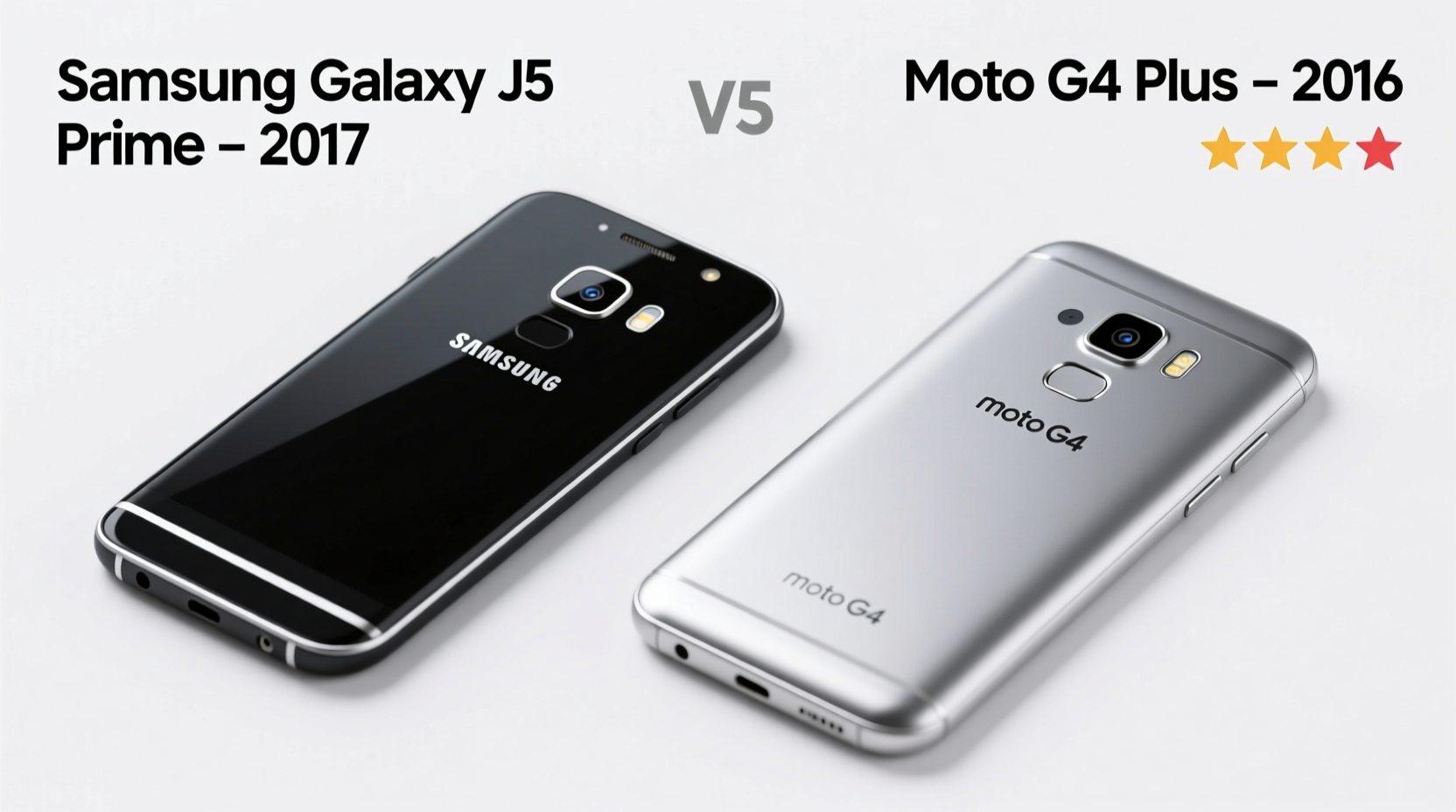
The core difference between these two phones lies in how their hardware has aged under modern usage patterns.
The Samsung J5 Prime runs on an Exynos 7570 chipset with 2GB of RAM and 16GB of storage. While this was decent for light multitasking in 2016, it struggles today with even modest app loads. Opening WhatsApp, browsing Chrome tabs, and switching between apps results in noticeable lag. The lack of expandable storage beyond microSD is also limiting, especially since system updates and apps now consume far more space than before.
The Moto G4, powered by a Qualcomm Snapdragon 617, offers slightly better multi-core performance and smoother UI transitions. With 2GB or 3GB variants available (depending on region), it handles background processes more efficiently. Motorola’s near-stock Android experience contributes significantly here — less bloatware means more usable memory and fewer crashes.
Tip: If considering either device, opt for the version with at least 3GB RAM and 32GB storage — rare but occasionally found used.Software & Security: The Hidden Dealbreaker
One critical factor often overlooked is software support. Both phones launched with Android 6.0 Marshmallow and received updates up to Android 7.0 Nougat. No further official security patches have been issued since 2018.
Running outdated Android versions exposes users to known vulnerabilities. Modern banking apps, messaging platforms, and even Google services are increasingly dropping support for pre-Android 8.0 devices. As of 2024, many apps simply won’t install or function properly on these phones.
“Devices stuck on Android Nougat or earlier are effectively offline in today’s ecosystem. They can't securely authenticate, update apps, or protect user data.” — David Lin, Mobile Security Analyst at OpenFirmware Group
While custom ROMs like LineageOS offer hope, installing them requires technical skill and voids any remaining warranty. For average users, this isn’t a practical solution.
Display, Battery, and Daily Usability
Let’s break down the key user-facing features that affect day-to-day experience.
| Feature | Samsung J5 Prime | Moto G4 |
|---|---|---|
| Display Size & Type | 5.0” HD Super AMOLED | 5.5” Full HD IPS LCD |
| Battery Capacity | 2400 mAh | 3000 mAh |
| Charging | Micro USB, no fast charging | Micro USB, Turbo Charging supported |
| Rear Camera | 13 MP, f/1.9 | 13 MP, f/2.0 with PDAF |
| Fingerprint Sensor | Yes (front-mounted) | No |
| Water Resistance | No | No |
The J5 Prime wins on display technology — its AMOLED panel delivers deeper blacks and better contrast than the G4’s IPS screen. However, the smaller size and lower resolution make media consumption less immersive. The G4’s larger, sharper display suits video streaming and reading better despite the older LCD tech.
Battery life favors the Moto G4. Its 3000 mAh cell lasts a full day with moderate use, while the J5 Prime often needs midday charging — especially if running multiple background apps. Turbo Charging on the G4 also reduces downtime significantly.
Real-World Example: Can Either Phone Handle Basic Tasks in 2024?
Consider Maria, a college student looking for a secondary phone to use during library study sessions. She wants something cheap that can run WhatsApp, Google Docs, YouTube, and her university’s learning portal.
She buys a refurbished Samsung J5 Prime for $35. Initially, it works — until she installs Chrome and tries opening a PDF in Docs. The phone freezes. After restarting, she notices several apps failing to load. WhatsApp notifications arrive hours late. Eventually, she can’t log into her school’s portal because the browser doesn’t support modern TLS encryption protocols.
She switches to a used Moto G4 (3GB model) for $45. It performs noticeably better. Pages load faster, multitasking is smoother, and videos play without constant buffering. Still, she hits a wall when trying to install TikTok — the app refuses to run on Android 7.0.
This scenario illustrates a growing reality: even functional hardware becomes obsolete due to software constraints.
What Should You Do? A Practical Checklist
If you’re seriously considering either phone, follow this checklist to avoid frustration:
- Evaluate your actual needs: Are you using this for emergencies only, or as a primary device?
- Check app compatibility: Try installing the 3–5 apps you use most. Will they run?
- Test responsiveness: Swipe through menus, open browsers, switch apps. Does it feel sluggish?
- Verify OS version: Anything below Android 8.0 will face increasing restrictions.
- Assess battery health: On used units, degraded batteries may not last half a day.
- Consider total cost: Spending $40 on a dying phone might be worse than saving $60 for a newer budget model.
Modern Alternatives Worth Considering
Rather than choosing between two outdated options, consider what you can get today for slightly more:
- Motorola Moto E (2023): Starts at $149, runs Android 13, supports 4 years of updates.
- Redmi A2/A3: Around $80, includes Android 12 Go Edition, decent battery, and improved performance.
- Refurbished iPhone SE (1st gen): Often under $100, receives iOS updates longer than Android counterparts.
These devices outperform both the J5 Prime and Moto G4 in every category — processing speed, app compatibility, camera quality, and long-term reliability.
Frequently Asked Questions
Can I still use WhatsApp on the Samsung J5 Prime or Moto G4?
As of early 2024, WhatsApp officially dropped support for devices running Android 4.1 to 7.0. This includes both the J5 Prime and Moto G4. While the app may remain installed, new installations fail, and existing ones may stop syncing messages or lose functionality over time.
Which phone has better build quality?
The J5 Prime feels more premium thanks to its metal unibody design and compact form. The Moto G4 uses polycarbonate, which is durable but prone to scratches. Neither has water resistance, so caution is needed around moisture.
Is rooting or installing custom ROMs a good workaround?
Possibly, but not recommended for casual users. Custom ROMs like LineageOS can bring newer Android versions, but installation risks bricking the device. Driver limitations and poor optimization mean performance gains are inconsistent.
Final Verdict: Move On from These Models
The Samsung J5 Prime and Moto G4 were excellent phones in their era. But technology evolves, and so do user expectations. Today, neither device meets minimum standards for secure, reliable smartphone use.
The J5 Prime’s fingerprint sensor and AMOLED screen give it a slight edge in user convenience, but its weaker processor and smaller battery limit longevity. The Moto G4 offers better overall performance and battery life, but lacks biometric security and faces the same software obsolescence.
If your budget allows even a small increase, investing in a current-gen entry-level phone saves money and frustration in the long run. These older models may seem like bargains, but their inability to run modern apps safely makes them poor value.
💬 Have experience using older phones in 2024? Share your story or tips in the comments — your insight could help someone avoid a costly mistake.