
In an age where smartphones are essential to daily life, how we charge them matters. Samsung has long been a leader in fast charging technology, offering speeds up to 45W on select Galaxy models. But as consumers grow more aware of battery health, a critical question emerges: Is Samsung’s fast charging really worth the convenience, or does slow charging preserve battery life more effectively?
The debate isn’t just about speed versus longevity—it’s about understanding lithium-ion battery chemistry, usage patterns, and real-world trade-offs. This article dives deep into the science, practical implications, and user experience behind fast and slow charging, helping you make an informed decision.
How Lithium-Ion Batteries Work—and Why Charging Speed Matters
Lithium-ion batteries, used in nearly all modern smartphones including Samsung devices, operate by moving lithium ions between the anode and cathode. During charging, ions move from the cathode to the anode; during discharge, they return. The rate at which this happens affects both performance and degradation.
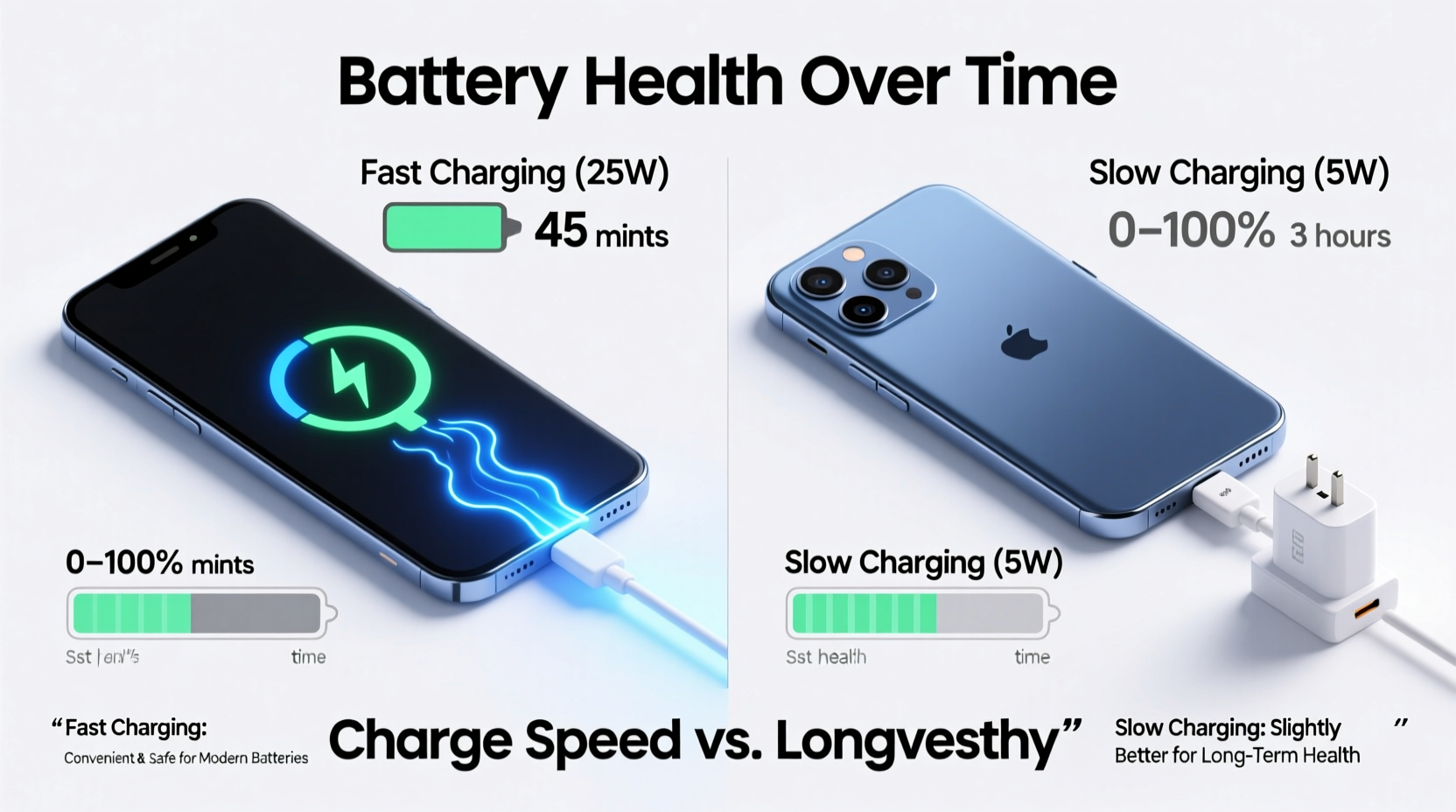
Fast charging forces more current into the battery in a shorter time. While convenient, this generates more heat and increases internal stress. Over time, repeated exposure to high voltage and temperature accelerates chemical aging, leading to reduced capacity and shorter overall lifespan.
According to Dr. Venkat Srinivasan, a leading battery scientist at Argonne National Laboratory:
“Every time you fast charge, you’re trading off a little bit of battery cycle life for convenience. It’s not inherently bad, but frequency and conditions matter.” — Dr. Venkat Srinivasan, Battery Research Director
Heat is the primary enemy. Temperatures above 30°C (86°F) during charging can significantly degrade electrolytes and form resistive layers inside the cell. Samsung includes thermal management systems and adaptive charging algorithms, but physics still applies.
Fast Charging vs. Slow Charging: A Practical Comparison
To understand the real-world differences, consider a side-by-side comparison of typical behaviors with a Samsung Galaxy S23 Ultra, which supports 45W fast charging.
| Factor | Fast Charging (45W) | Slow Charging (10–15W) |
|---|---|---|
| Time to 50% Charge | ~15 minutes | ~45 minutes |
| Full Charge Time | ~60 minutes | ~120 minutes |
| Battery Temperature Rise | Moderate to high (up to 38°C) | Minimal (under 30°C) |
| Degradation After 500 Cycles* | ~18–22% capacity loss | ~10–14% capacity loss |
| User Convenience | High – ideal for quick top-ups | Lower – requires planning |
*Based on controlled lab studies simulating daily charging over ~1.5 years.
The data shows a clear trade-off: fast charging saves time but contributes to faster battery wear. However, the extent depends heavily on usage habits and environmental factors.
When Fast Charging Makes Sense—And When It Doesn’t
Not all charging scenarios are equal. Context determines whether fast charging is worth the cost to battery health.
Tip: Use fast charging when you need a quick boost before leaving home or after realizing your phone is low. Avoid using it overnight or when the device is already warm.Here are common situations where each method shines:
- Use Fast Charging When:
- You’re in a hurry and need 30–50% in under 20 minutes.
- Your phone is cool and not running intensive apps.
- You’re using the original Samsung charger and cable (ensures safety and efficiency).
- Choose Slow Charging When:
- Charging overnight or while working at a desk.
- The phone feels warm or is exposed to direct sunlight.
- You want to maximize long-term battery health over convenience.
Real Example: The Business Traveler’s Dilemma
Meet James, a sales executive who travels weekly. His Galaxy S24 frequently drops below 20% during flights and meetings. He used to plug in with his 45W charger every evening, getting a full charge by morning. After one year, he noticed his battery drained much faster and only held 82% of its original capacity.
His technician recommended switching strategies: use fast charging only once per week for a full top-up, and otherwise rely on 15W charging during work hours. Within six months, battery drain stabilized, and he reported longer sustained performance.
James didn’t eliminate fast charging—he optimized it. That’s the key for most users.
Maximizing Battery Longevity: A Step-by-Step Guide
You don’t have to choose between speed and battery life permanently. With smart habits, you can balance both. Follow this timeline to protect your Samsung phone’s battery without sacrificing convenience.
- Enable Adaptive Charging (Settings > Battery > Adaptive Charging): Lets the phone learn your routine and delay full charges until you wake up, reducing time spent at 100%.
- Charge Between 20% and 80%: Avoid letting the battery drop below 20% or stay at 100% for extended periods.
- Use Fast Charging Early in the Day: If needed, fast charge in the morning when the battery is cool and you’re preparing for the day.
- Switch to Slower Chargers at Night: Use a 10W or 15W charger instead of 25W+ for overnight sessions.
- Avoid Charging Under Pillows or Covers: Poor ventilation traps heat. Always charge on a hard, flat surface.
- Update Software Regularly: Samsung often rolls out battery optimization improvements through updates.
Frequently Asked Questions
Does fast charging damage my Samsung phone immediately?
No. Fast charging won’t cause immediate damage. Modern Samsung phones include safeguards like voltage regulation, temperature monitoring, and charge throttling. Damage occurs gradually over hundreds of cycles due to heat and stress, not from a single session.
Is wireless charging better or worse than fast charging?
Wireless charging is generally slower and generates more heat than wired fast charging, especially on non-cooled surfaces. While convenient, it may be harder on battery life if used frequently at high power (e.g., 15W). For best results, use wired charging for speed and efficiency, and reserve wireless for casual daytime top-ups.
Can I extend my battery’s life by always using slow charging?
Yes. Consistently using slower charging (5W–15W) reduces heat and electrical stress, slowing degradation. Users who primarily slow-charge often report retaining over 90% battery capacity after two years. However, this requires planning and access to chargers throughout the day.
Final Verdict: Balance Speed and Longevity Wisely
Samsung’s fast charging is undeniably useful. Going from 0% to 50% in 15 minutes can rescue your day when you’ve forgotten to charge overnight. But that convenience comes at a cost—accelerated battery aging, especially when used daily under suboptimal conditions.
Slow charging, meanwhile, is gentler on the battery and promotes longer lifespan. It’s ideal for overnight use or when time isn’t a factor. However, relying solely on slow charging may not suit everyone’s lifestyle.
The truth lies in moderation. You don’t have to abandon fast charging—just use it strategically. Think of it like espresso: great when you need a boost, but not something you should consume all day, every day.
🚀 Take control of your battery health today. Audit your charging habits, enable adaptive features, and mix fast and slow charging based on your needs. Your phone—and its battery—will thank you two years from now.