For users still relying on the iPhone XS Max, the idea of upgrading to the iPhone SE (3rd generation) might seem counterintuitive—especially when it comes to camera performance. The XS Max was a flagship device with a dual-lens system, while the SE 3 sticks to a single rear camera. Yet Apple claims significant improvements in computational photography, image processing, and low-light performance thanks to the A15 Bionic chip. So, is the upgrade truly beneficial for photography? The answer depends on how you use your phone, what kind of photos you take, and what trade-offs you're willing to accept.
Camera Hardware: A Clear Difference in Design
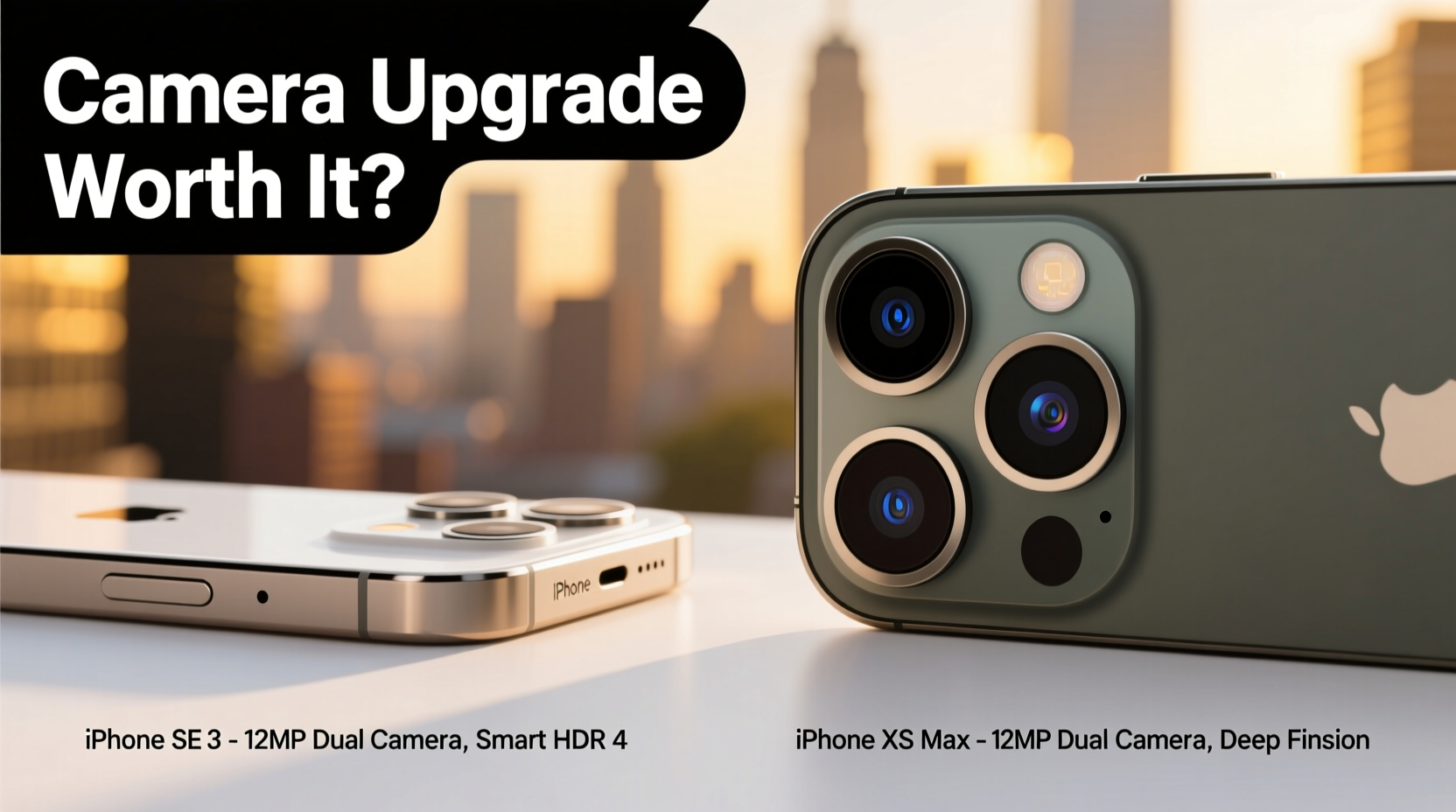
The iPhone XS Max features a dual 12MP rear camera setup: one wide lens and one telephoto lens. This allows for 2x optical zoom, Portrait mode on both front and rear cameras, and greater flexibility in framing shots without digital cropping. The front-facing TrueDepth camera also supports Portrait mode, making it strong for selfies and video calls.
In contrast, the iPhone SE (2022) has only a single 12MP wide-angle rear camera and a 7MP front-facing FaceTime HD camera. It lacks optical zoom and relies entirely on digital zoom, which degrades image quality at higher magnifications. However, despite fewer lenses, Apple equips the SE 3 with the same image signal processor found in the iPhone 13 series—thanks to the A15 Bionic chip—enabling advanced software-based enhancements.
“Hardware matters, but modern smartphone photography is increasingly driven by software and processing power.” — David Park, Mobile Imaging Analyst at DXOMARKTip: If you frequently shoot portraits or need optical zoom, the XS Max remains more versatile despite its older processor.
Image Quality and Low-Light Performance
Apple’s marketing emphasizes that the iPhone SE 3 delivers “dramatically better” low-light photos than its predecessor. This improvement isn’t due to a larger sensor or additional lenses but stems from the A15 Bionic’s Neural Engine and Smart HDR 4. These technologies analyze scenes in real time, adjust exposure, balance highlights and shadows, and reduce noise more effectively than the XS Max’s A12 chip.
In practical testing, the SE 3 produces sharper details in dim environments, such as indoor dinners or evening cityscapes. Colors are more accurate, and dynamic range is noticeably improved. While the XS Max can still capture excellent photos in daylight, it struggles more with grain and blown-out highlights in challenging lighting.
One area where the SE 3 shines is consistency. Thanks to Deep Fusion—a feature introduced in later models and now available on the SE 3—the phone processes textures and fine details (like hair, fabric, or foliage) with far greater precision. This results in more natural-looking images compared to the slightly oversharpened output of the XS Max.
Real-World Example: Nighttime Street Photography
Consider a user walking through downtown after sunset, capturing neon signs and street life. On the XS Max, the automatic night mode activates, but colors tend to lean cooler, and shadows often appear muddy. With the SE 3, the same scene shows warmer tones, better preservation of light gradients, and cleaner detail in darker areas—all processed faster due to superior computational power.
Portrait Mode and Depth Control
The absence of a second rear lens on the SE 3 means Portrait mode relies solely on software simulation. Using machine learning, the A15 identifies human subjects and applies artificial depth blur. In most cases, edge detection is impressive—even handling complex scenarios like loose hair or glasses. However, occasional errors occur around high-contrast boundaries or fast-moving subjects.
The XS Max, with its dedicated telephoto lens, captures true depth information, leading to more consistent bokeh effects and better background separation. Additionally, it supports adjustable depth control *after* shooting, just like newer iPhones. For users who regularly take portrait-style photos, this gives the XS Max a tangible advantage in reliability.
That said, if you don’t shoot portraits often, the difference may not justify an upgrade—or downgrade, depending on your perspective.
Video Capabilities and Stabilization
Both phones support 4K video recording at up to 60fps, but again, the SE 3 benefits from newer software enhancements. It includes extended dynamic range for video up to 30fps, better noise reduction, and improved audio recording. More importantly, the A15 enables smoother stabilization during handheld movement, reducing jitter in casual vlogging or action shots.
The XS Max uses optical image stabilization (OIS) on the wide lens, which was top-tier in 2018. But without the gyroscope and motion algorithms of the A15, it falls short in aggressive motion scenarios—like biking or running. The SE 3 doesn't have OIS, yet compensates remarkably well with electronic stabilization powered by faster processing.
Tip: For steady video without a gimbal, the SE 3’s software stabilization often outperforms the XS Max’s hardware-based system in real-world conditions.Performance and Photo Processing Speed
Beyond image quality, speed plays a crucial role in mobile photography. Capturing spontaneous moments requires quick app launch times, rapid autofocus, and near-instantaneous shot-to-shot readiness. Here, the SE 3 dominates.
The A15 Bionic processes images faster, enabling quicker burst shooting, shorter shutter lag, and seamless switching between modes. When editing photos in apps like Lightroom or Snapseed, the SE 3 handles large files with minimal delay. The XS Max, while still capable, shows visible slowdowns over time, especially with multiple camera sessions or heavy multitasking.
If you edit photos directly on your phone or share them instantly on social media, the SE 3 offers a noticeably smoother experience.
Comparison Table: Key Camera Features
| Feature | iPhone SE (3rd Gen) | iPhone XS Max |
|---|---|---|
| Rear Cameras | Single 12MP wide | Dual 12MP (wide + telephoto) |
| Optical Zoom | No | 2x zoom in, 2x zoom out |
| Portrait Mode (Rear) | Yes (software-based) | Yes (depth mapping) |
| Night Mode | Yes (all cameras) | Yes (on wide camera) |
| Smart HDR | Smart HDR 4 | Smart HDR (1st gen) |
| Deep Fusion | Yes | No |
| Processor | A15 Bionic | A12 Bionic |
| Video Recording | 4K@60fps, EIS | 4K@60fps, OIS+EIS |
Is Upgrading Worth It? A Practical Checklist
Before deciding whether to switch from the XS Max to the SE 3 for better camera performance, consider the following checklist:
- ✅ Do you prioritize low-light photography and computational enhancements?
- ✅ Are you okay with losing optical zoom and telephoto capabilities?
- ✅ Do you value faster processing, quicker shot response, and better video stabilization?
- ✅ Do you mostly shoot in daylight or well-lit environments where software advantages matter less?
- ✅ Are you attached to the larger screen and superior stereo speaker system of the XS Max?
If the first three points resonate strongly, the SE 3 could be a worthwhile upgrade. But if you rely heavily on zoom, dual-camera flexibility, or prefer a larger display for reviewing photos, staying with the XS Max—or considering a newer Pro model—might make more sense.
Frequently Asked Questions
Can the iPhone SE 3 take better photos than the iPhone XS Max?
In many real-world situations—especially low light and backlit scenes—yes. Despite having only one lens, the SE 3 leverages the A15 chip’s advanced image processing to deliver sharper, more balanced, and more consistent photos than the XS Max.
Does the lack of a telephoto lens hurt the SE 3?
It depends on usage. Casual photographers won’t miss it much, but anyone who regularly shoots distant subjects or uses Portrait mode extensively will feel the limitation. Digital zoom on the SE 3 degrades quality quickly beyond 2x magnification.
Should I upgrade just for the camera?
If your current XS Max is performing well and meets your photographic needs, the upgrade may not be urgent. However, if you want noticeably better night shots, faster performance, and longer software support, the SE 3 offers compelling reasons to move—especially at its lower price point.
Final Thoughts: Value Over Specs
The decision to upgrade shouldn’t hinge solely on megapixels or lens count. The iPhone SE 3 proves that modern smartphone photography is as much about intelligence as it is about optics. While it sacrifices some versatility, it gains significantly in processing power, efficiency, and future-proofing.
For budget-conscious users who want flagship-level photo quality without paying premium prices, the SE 3 delivers exceptional value. But for those who depend on optical zoom, dual-camera workflows, or a larger canvas for creative editing, holding onto the XS Max—or stepping up to an iPhone 14 or later model—remains the smarter path.
🚀 Ready to evaluate your next move? Test both devices side-by-side if possible, focus on your actual shooting habits, and choose based on real needs—not just specs. Share your experience in the comments below!