For years, Apple enthusiasts have debated whether a compact smartphone can deliver a full flagship experience. The iPhone 14 Mini and iPhone 14 present a modern take on this dilemma: nearly identical internals wrapped in two very different form factors. One fits comfortably in one hand; the other offers more screen real estate and longer battery life. But which model truly serves your lifestyle better? Choosing between them isn’t just about preference—it’s about understanding what you’re gaining and what you’re giving up.
The iPhone 14 Mini carries the legacy of Apple’s compact line, appealing to users who value portability and single-handed use. Meanwhile, the standard iPhone 14 caters to those who want a balanced blend of size, performance, and endurance. Despite sharing the same A15 Bionic chip (with a slight variation), camera system, and software features, these phones diverge significantly in key areas that impact daily usability.
Battery Life: The Most Noticeable Compromise
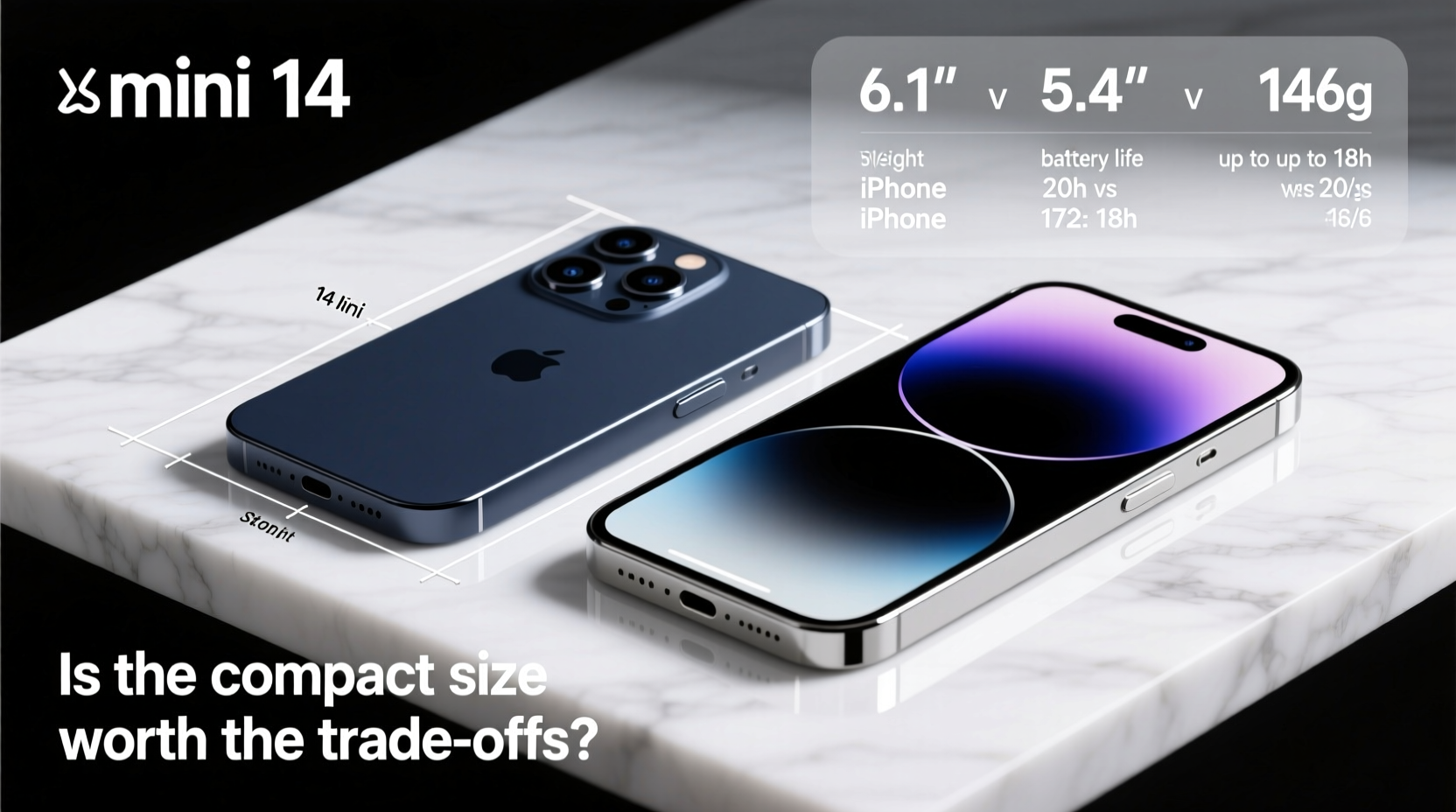
The most significant trade-off with the iPhone 14 Mini is battery life. Due to its smaller chassis, Apple had to fit a much smaller battery—around 2,406 mAh compared to the iPhone 14’s 3,279 mAh. In real-world usage, this translates to roughly 14–16 hours of mixed use for the Mini, while the standard iPhone 14 can last 20–24 hours under similar conditions.
For light users who charge overnight and don’t stream video frequently, the Mini may suffice. However, heavy users—those who rely on GPS navigation, social media scrolling, or podcast listening throughout the day—will likely need to recharge by mid-afternoon. This limitation becomes especially apparent when traveling or during workdays without easy access to outlets.
Tip: Enable Low Power Mode early in the day if you're using the iPhone 14 Mini and anticipate being away from a charger.Display and Usability: Size Matters More Than You Think
The iPhone 14 Mini features a 5.4-inch Super Retina XDR display, while the iPhone 14 has a 6.1-inch version of the same panel. Both offer excellent color accuracy, HDR support, and peak brightness of 1,200 nits. However, the difference in screen size affects everything from typing comfort to media consumption.
Watching videos or reading long articles feels noticeably tighter on the Mini. Text appears smaller, and touch targets are closer together, increasing the chance of mis-taps. While some users appreciate the denser interface, others find it cramped over time. Gamers and multitaskers will particularly feel the constraint—split-screen apps aren't supported on iOS in the same way as Android, so screen real estate goes almost entirely to single-app use.
On the flip side, the Mini excels in ergonomics. It slips easily into tight pockets, requires less stretching to reach top corners, and is far more manageable when used one-handed. For users with smaller hands or those who prioritize pocketability, this remains a compelling advantage.
Camera Performance: Nearly Identical, But Not Quite Equal
Both models feature dual-camera systems: a 12MP main sensor and a 12MP ultra-wide lens. They share the same computational photography features—Photographic Styles, Night mode, Deep Fusion, and Smart HDR 4. Video recording supports Dolby Vision up to 4K at 60fps.
However, the larger body of the iPhone 14 allows for slightly better thermal management during extended photo or video sessions. More importantly, Apple allocates marginally more power to image signal processing on the standard model due to superior heat dissipation. While this doesn’t result in visibly sharper photos in everyday shots, professionals may notice reduced noise in low-light videos recorded over several minutes.
“Compact design shouldn’t come at the cost of core functionality. The Mini delivers great photos, but sustained performance favors larger devices.” — David Lin, Mobile Imaging Engineer at DXOMARK
Detailed Comparison Table
| Feature | iPhone 14 Mini | iPhone 14 |
|---|---|---|
| Screen Size | 5.4 inches | 6.1 inches |
| Battery Life (Video Playback) | Up to 17 hours | Up to 20 hours |
| Weight | 140 grams | 172 grams |
| Starting Storage | 128GB | 128GB |
| Charging Speed | 20W wired (approx. 50% in 30 min) | 20W wired (approx. 50% in 30 min) |
| Price (Launch) | $699 | $799 |
Real-World Example: Commuter vs. Creator
Consider two users: Sarah, a city commuter who walks 45 minutes each way daily and values phone accessibility in crowded subways, and James, a freelance photographer who shoots reels for clients and edits on-the-go.
Sarah finds the iPhone 14 Mini ideal. She checks messages, listens to audiobooks, and navigates transit—all tasks well-suited to one-handed operation. Even with moderate battery drain, she charges at home each night and rarely runs below 20%.
James, however, struggles with the Mini. During a shoot, he records multiple 4K clips, reviews footage, and backs up files—all power-intensive actions. By midday, his Mini is near empty. He switches to the iPhone 14 and immediately notices improved stamina and cooler operation during export.
This contrast highlights how personal usage patterns dictate which device performs better—even when specs appear similar.
Checklist: Choosing Between iPhone 14 Mini and iPhone 14
- ✅ Do you prioritize pocketability and one-handed use?
- ✅ Are you a light-to-moderate user who charges nightly?
- ✅ Do you dislike large phones that require both hands?
- ❌ Do you often run out of battery before bedtime?
- ❌ Do you record long videos, play graphics-heavy games, or edit media?
- ❌ Do you struggle with small touch targets or prefer larger text?
If you answered “yes” to the first three, the Mini could be perfect. If the bottom three resonate more, the standard iPhone 14 is the smarter choice.
Frequently Asked Questions
Does the iPhone 14 Mini have the same processor as the iPhone 14?
Yes, both use a version of the A15 Bionic chip. However, the iPhone 14 includes an extra GPU core (5-core vs. 4-core in the Mini), which improves graphics performance slightly—though not dramatically in everyday tasks.
Is the iPhone 14 Mini still being produced?
No. Apple discontinued the Mini line after the iPhone 14 series, meaning there is no iPhone 15 Mini. If you're buying new, the iPhone 14 Mini is only available through third-party retailers or refurbished channels.
Can I expect the same software updates on both models?
Absolutely. Both devices launched with iOS 16 and are expected to receive updates through at least 2028. Software longevity is identical regardless of size.
Final Verdict: Is the Smaller Size Worth It?
The iPhone 14 Mini is a niche product—a rare compact flagship in an era of ever-growing screens. Its appeal lies in unmatched portability and ergonomic comfort. But that convenience comes at a tangible cost: shorter battery life, a less immersive display, and slightly throttled performance under load.
The standard iPhone 14, meanwhile, strikes a more universal balance. It’s not excessively large, yet offers meaningful gains in endurance and usability. For most people, especially those who rely on their phone throughout the day, the extra inch makes a bigger difference than anticipated.
If you’ve spent years longing for a smaller iPhone, the Mini delivers that dream with few compromises beyond battery. But if you’re simply curious about downsizing, try holding one in person before deciding. Many users discover they miss the breathing room of a larger display once they switch.
💬 Have you made the switch from iPhone 14 to 14 Mini—or vice versa? Share your experience and help others decide whether size is worth the sacrifice.