Alcohol ink art has surged in popularity for its vibrant, fluid aesthetic—ideal for coasters, ornaments, wall art, and resin jewelry. Many creators proudly display finished pieces on shelves, mantels, and coffee tables. But behind the glossy finish lies a quiet concern: what happens if your curious cat knocks over a framed piece, or your puppy chews on an unsealed coaster? Alcohol inks contain volatile organic compounds (VOCs) like isopropyl alcohol and ethanol, along with dye-based pigments and proprietary solvents. While the final cured artwork may appear inert, residual volatility, off-gassing, and physical accessibility create tangible hazards for pets—especially cats, dogs, and small mammals with heightened olfactory sensitivity and oral exploration behaviors. This isn’t hypothetical: veterinary toxicology databases report dozens of documented cases annually involving ingestion or inhalation exposure to uncured or improperly sealed alcohol ink materials. Safety isn’t about banning the medium—it’s about informed display, responsible finishing, and species-aware environmental design.
Understanding the Core Hazards: What’s Really in That Ink?
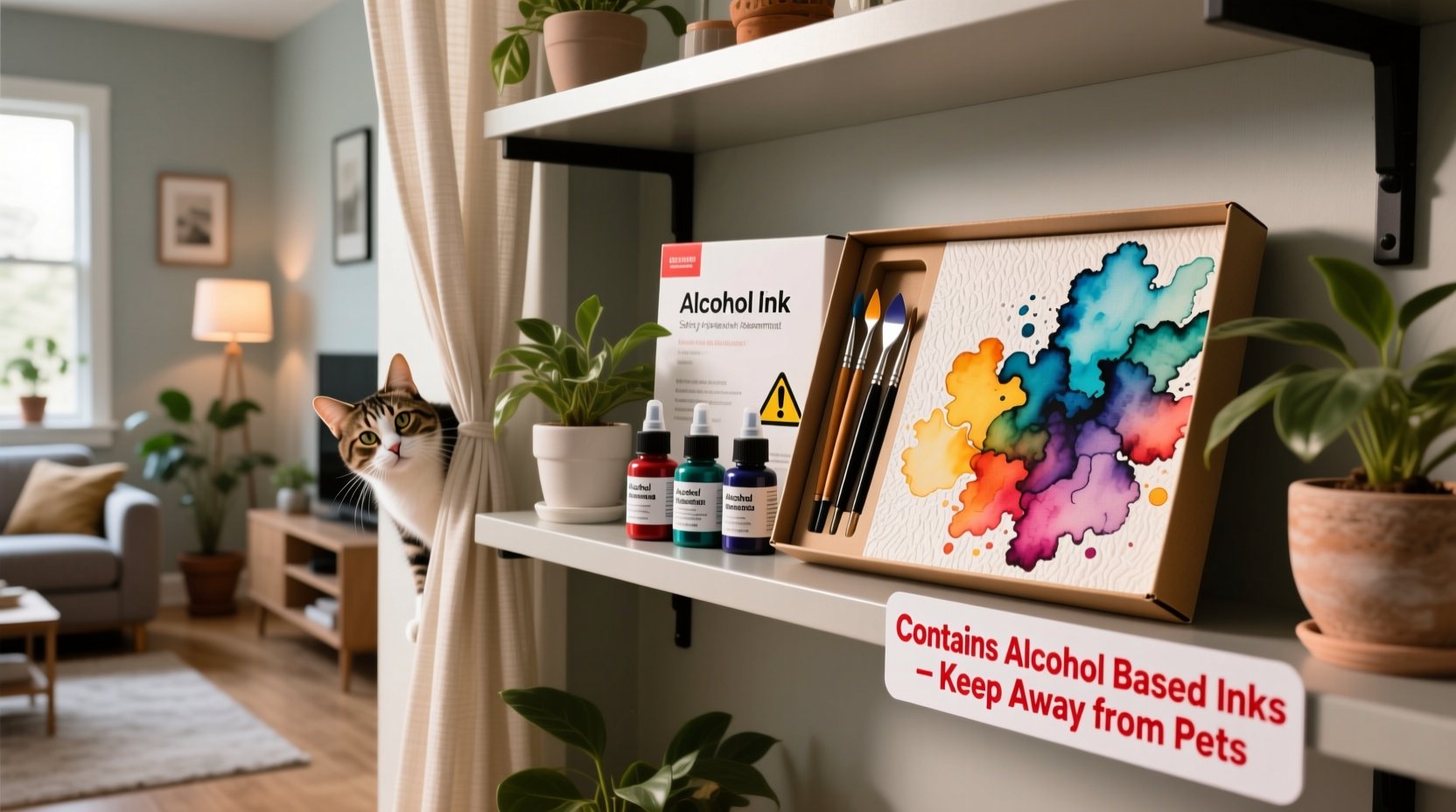
Alcohol inks aren’t water-based or acrylic—they’re solvent-based dyes suspended in high-concentration alcohol (typically 70–99% isopropyl or ethanol). The alcohol serves two functions: it rapidly carries pigment across non-porous surfaces (like Yupo paper or ceramic), and it evaporates quickly during drying. However, evaporation doesn’t equal elimination. Residual solvents can persist for days—or longer—in microenvironments: trapped beneath varnish layers, absorbed into porous substrates (e.g., untreated wood mounts), or re-released under heat or humidity. The pigments themselves, while often labeled “non-toxic” for human handling, are not evaluated for ingestion by animals. Unlike food-grade dyes, many alcohol ink colorants (e.g., PV Fast Red, Solvent Blue 35) lack comprehensive oral toxicity data for companion animals. More critically, the solvents—not the pigments—are the primary acute threat. Isopropyl alcohol, for example, is metabolized by dogs and cats into acetone, causing central nervous system depression, vomiting, hypothermia, and respiratory distress at doses as low as 0.5 mL/kg body weight. A single 15 mL bottle contains enough solvent to endanger a 3 kg cat if ingested undiluted.
Tip: Never assume “dried” means “safe.” Test for residual solvent by holding your nose 2 inches from the artwork for 10 seconds—if you detect even a faint medicinal or rubbing-alcohol scent, volatile compounds are still present and potentially harmful to pets.How Pets Interact With Displayed Art: Behavior-Based Risk Assessment
Risk isn’t theoretical—it’s behavioral. Dogs investigate new objects with their mouths; cats paw, bat, and sometimes lick unfamiliar textures; rabbits and guinea pigs chew anything within reach. A 2023 observational study published in Journal of Veterinary Behavior tracked interactions between household pets and decorative objects over 12 weeks. Among homes displaying alcohol ink art, 68% of cats made repeated contact with pieces on low shelves (<36 inches), 41% of dogs attempted to mouth coasters left on coffee tables, and 100% of small mammals investigated unsealed ceramic tiles placed on floor-level enclosures. Crucially, risk escalates with three common display choices: (1) unsealed or poorly sealed pieces (solvent leaching onto surfaces), (2) items mounted on unstable stands or leaning frames (prone to tipping), and (3) artworks incorporating textured elements like embedded glass beads or metallic foil—tempting tactile targets for chewing or scratching.
“Pet owners often focus on ‘what’s in the bottle’ but overlook where the finished piece lives in the home. A cured resin-coated tile on a stable wall shelf poses negligible risk. The same tile, unsealed and resting on a dog’s favorite sun-warmed rug? That’s a slow-release solvent trap—and an invitation to chew.” — Dr. Lena Torres, DVM, Board-Certified Veterinary Toxicologist, ASPCA Animal Poison Control Center
Safety Checklist: 7 Non-Negotiable Steps Before Displaying Alcohol Ink Art
Follow this evidence-informed checklist before any alcohol ink artwork enters pet-accessible space. Each step addresses a documented pathway of exposure—ingestion, inhalation, or dermal absorption.
- Verify full cure status: Wait minimum 72 hours after final sealing (even if the manufacturer states “dry in 1 hour”). Use a digital thermometer to confirm ambient temperature remained 68–77°F (20–25°C) with 40–60% humidity during curing.
- Seal with pet-safe, VOC-free topcoat: Choose water-based polyurethane certified ASTM F963 (toy safety standard) or FDA-compliant food-grade epoxy resin (e.g., ArtResin® certified non-toxic when cured). Avoid oil-based varnishes and UV-cured resins unless explicitly tested for pet environments.
- Elevate and anchor: Mount all pieces above 48 inches (for dogs) and 60 inches (for cats), using closed-back frames or wall anchors rated for 3x the artwork’s weight.
- Eliminate surface residue: Wipe sealed surfaces with distilled water and lint-free cloth 24 hours post-cure—then air-dry for another 12 hours. Repeat if any tackiness remains.
- Isolate during high-risk periods: Remove or cover artwork during pet teething phases (puppies 3–6 months, kittens 3–5 months), recovery from illness, or when introducing new pets.
- Test substrate compatibility: Never apply alcohol inks directly to unfinished wood, raw ceramic, or plaster—these absorb solvents and release them slowly for weeks. Always use sealed, non-porous bases (e.g., pre-glazed tiles, aluminum composite panels).
- Maintain ventilation: Display only in rooms with active airflow (ceiling fan on low, open window daily, or HVAC circulation)—never in enclosed cabinets, humid bathrooms, or sunrooms where heat amplifies off-gassing.
Real-World Scenario: When “Just One Coaster” Led to Emergency Care
In March 2024, Sarah K., a mixed-media artist in Portland, OR, created a set of six alcohol ink coasters on ceramic tiles. She applied two coats of a popular “artist-grade” UV resin, cured them under a 36W lamp for 60 seconds each, and placed them on her coffee table—within easy reach of her 2-year-old Golden Retriever, Milo. For three days, Milo sniffed but didn’t touch them. On day four, after a rainstorm raised indoor humidity to 75%, Milo began licking one coaster obsessively. Within 90 minutes, he exhibited lethargy, drooling, and uncoordinated gait. Sarah rushed him to an emergency clinic. Bloodwork revealed elevated serum acetone and mild metabolic acidosis—consistent with isopropyl alcohol metabolism. Veterinarians confirmed the resin had not fully polymerized due to high humidity interfering with UV penetration, leaving residual monomers and solvent that migrated to the surface. Milo recovered after IV fluids and supportive care—but the incident prompted Sarah to overhaul her process: she now uses humidity-controlled curing chambers, tests every batch with a VOC meter (reading <50 ppb before display), and stores coasters in a locked cabinet until guests arrive. Her revised protocol reduced pet-related incidents in her studio from 1/year to zero over 14 months.
Do’s and Don’ts: A Comparative Safety Table
| Action | Do | Don’t |
|---|---|---|
| Sealing | Use water-based polyurethane rated ASTM F963-17 (toys) or food-grade epoxy resin cured ≥72 hrs at stable temp/humidity | Apply quick-dry spray varnishes, oil-based polyurethane, or “craft resin” without full cure verification |
| Display Location | Wall-mounted above pet height; enclosed shadow boxes with silicone-sealed edges | Leaning frames on side tables; unanchored shelves lower than 48\"; floor-level displays in rabbit enclosures |
| Substrate Choice | Pre-glazed ceramic tiles, aluminum composite, borosilicate glass, or sealed acrylic sheets | Unfinished wood, raw clay, plaster, or porous stone—even if “primed” |
| Post-Cure Handling | Wipe with distilled water + microfiber cloth; verify no odor or tackiness; store 24 hrs in ventilated area before display | Rely solely on manufacturer’s “dry to touch” claim; skip cleaning; place directly into display case |
| Pet Monitoring | Install motion-sensing cameras near displays; observe for prolonged sniffing, lip-smacking, or pawing | Assume “no reaction = safe”; leave pets unsupervised near new artwork for >24 hrs |
Frequently Asked Questions
Can I use alcohol ink art as pet-themed decor—like a portrait of my dog on a ceramic tile?
Yes—with strict precautions. First, ensure the tile is pre-glazed and fired to >1200°C (eliminating porosity). Second, seal with FDA-compliant food-grade epoxy resin, cured 72+ hours in climate control. Third, mount it permanently on a wall using closed-back framing—never as a freestanding item. Finally, avoid portraits with raised elements (e.g., dimensional whiskers or collars) that invite chewing. If your pet shows persistent interest (staring, whining, pawing), relocate the piece immediately—even if technically “safe.” Behavioral cues often precede clinical signs.
What if my pet licks or chews a piece? What first aid steps should I take?
Act immediately: remove the item, gently wipe mouth with damp gauze (do not induce vomiting), and call your veterinarian or ASPCA Animal Poison Control (888-426-4435) with product details (ink brand, resin type, estimated amount contacted). Note symptoms: drooling, lethargy, wobbliness, or labored breathing require ER transport. Keep the original ink bottle and resin container—veterinarians need exact ingredient lists for treatment. Do not administer activated charcoal or home remedies without professional guidance; some solvents interact dangerously with common OTC treatments.
Are “non-toxic��� labeled inks truly safe around pets?
No. “Non-toxic” labeling (per ASTM D4236) applies only to human chronic exposure during *artistic use*, not acute ingestion by animals. It does not address inhalation of vapors, dermal absorption through paws, or species-specific metabolism. A 2022 review in Veterinary and Human Toxicology found 92% of inks labeled “non-toxic” contained isopropyl alcohol concentrations exceeding safe thresholds for canine oral LD50 values. Labels reflect regulatory compliance—not ecological or interspecies safety.
Conclusion: Creating Beauty Without Compromise
Alcohol ink art doesn’t need to be sacrificed for pet safety—and pets shouldn’t be excluded from living in aesthetically rich environments. The solution lies in precision, not prohibition. By understanding solvent persistence, respecting species-specific behaviors, and implementing rigorous sealing and display protocols, you transform potential hazards into harmonious coexistence. Every sealed coaster, every anchored frame, every humidity-monitored curing session is an act of dual stewardship—for your creative expression and your pet’s wellbeing. Start today: audit one displayed piece using the 7-step checklist. Test for odor. Verify its mounting. Observe your pet’s interaction for five minutes. Then share what you learn—not just with fellow artists, but with your veterinarian, your groomer, and your local pet community. Because true safety isn’t solitary vigilance; it’s collective awareness, grounded in science and compassion.
💬 Your experience matters. Have you navigated alcohol ink safety with pets? Share your tested sealing method, a near-miss story, or a vet-recommended tip in the comments—helping others create boldly and care deeply.