
Surfactants are among the most quietly influential substances in modern science and daily life. Found in everything from laundry detergents to lung tissue, their ability to reduce surface tension makes them indispensable across industries. Despite their ubiquity, many people remain unaware of how surfactants work or why they’re so essential. Understanding their core functions reveals not only how we clean clothes or treat respiratory conditions but also how nature itself manages fluid interactions at microscopic levels.
What Is a Surfactant?
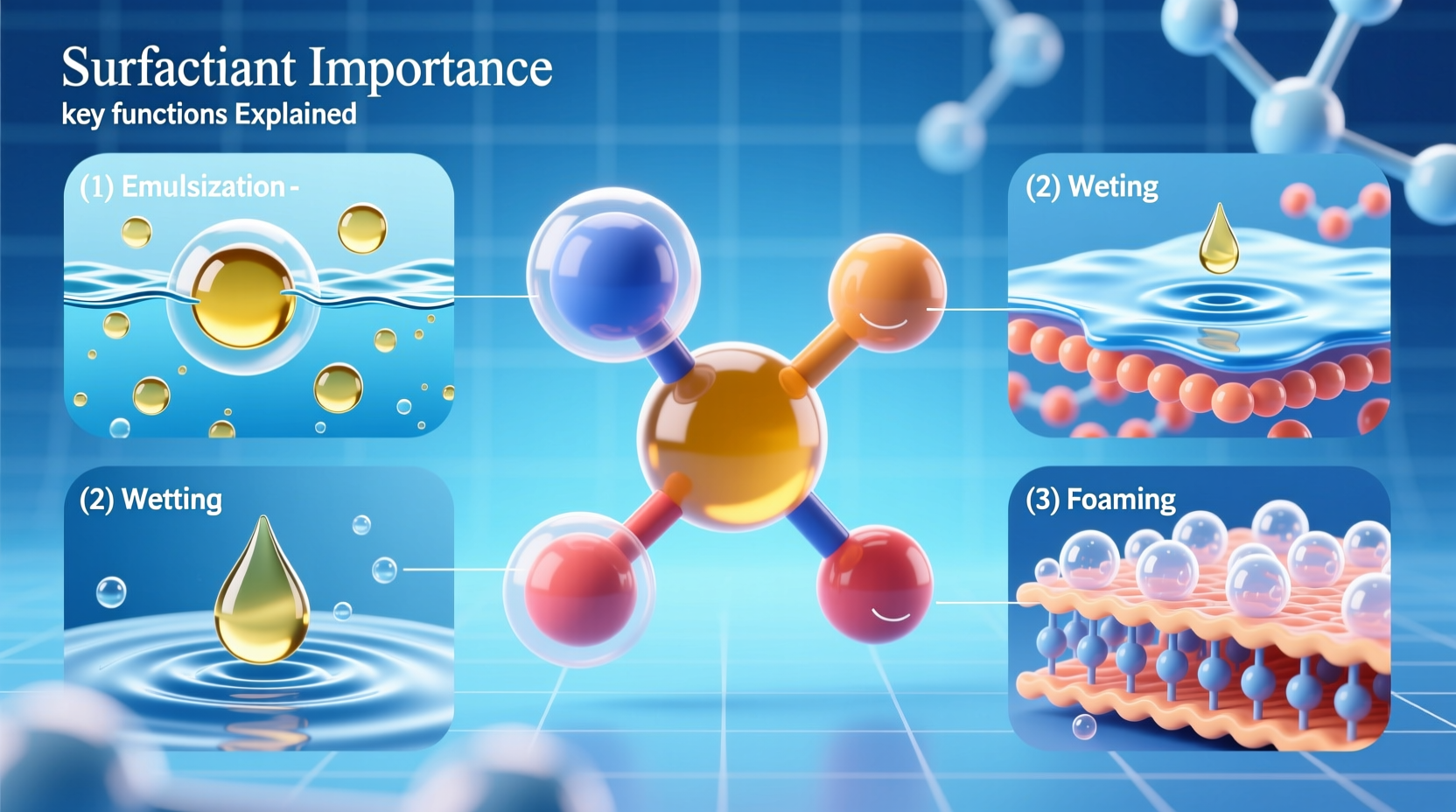
The term “surfactant” is a contraction of “surface-active agent.” These compounds possess a unique molecular structure: one end is hydrophilic (water-attracting), and the other is hydrophobic (water-repelling, but oil-attracting). This dual nature allows surfactants to interact effectively with both water and oils, making them ideal mediators in environments where these two typically don’t mix.
When introduced into a system like water mixed with grease, surfactants position themselves at the interface between oil and water. The hydrophobic tail embeds into the oily phase while the hydrophilic head remains in the aqueous phase. This arrangement lowers the surface tension of water, enabling it to spread more easily and penetrate surfaces. More importantly, it helps emulsify oils, suspending them in water so they can be rinsed away.
“Surfactants are the unsung heroes of interfacial chemistry—they make the impossible possible by bridging immiscible worlds.” — Dr. Lena Patel, Colloid Chemist, University of Manchester
Key Roles of Surfactants in Cleaning Products
In household and industrial cleaning, surfactants perform several critical tasks:
- Emulsification: Breaks down grease and oil into tiny droplets that disperse in water.
- Wetting: Reduces water’s surface tension, allowing it to spread and soak into fabrics or surfaces more efficiently.
- Suspension: Keeps dirt particles separated from cleaned surfaces, preventing redeposition.
- Foaming (in some cases): Enhances user perception of cleaning power, though foam isn't always necessary for effectiveness.
For example, in laundry detergents, surfactants surround fabric fibers, lifting stains by encapsulating oily residues in micelles—tiny spherical structures that trap dirt in their center and carry it away during rinsing. Without this mechanism, water alone would simply roll off oily stains without removing them.
Biological Importance: Pulmonary Surfactant in Lungs
One of the most vital natural applications of surfactants occurs in human physiology—specifically in the lungs. Pulmonary surfactant, produced by type II alveolar cells, coats the inner lining of air sacs (alveoli) and prevents them from collapsing during exhalation.
Without surfactant, the high surface tension of water within the alveoli would cause these delicate structures to collapse due to capillary forces—a phenomenon known as atelectasis. By reducing surface tension, pulmonary surfactant stabilizes the alveoli, ensuring efficient gas exchange and reducing the work of breathing.
This function is especially crucial in newborns. Premature infants often lack sufficient surfactant production, leading to respiratory distress syndrome (RDS). In such cases, synthetic or animal-derived surfactants are administered directly into the lungs to support breathing until natural production begins.
Mini Case Study: Neonatal Respiratory Support
In 2021, a preterm infant born at 29 weeks gestation developed severe breathing difficulties shortly after birth. Chest X-rays revealed classic signs of RDS: ground-glass appearance and low lung volume. Within minutes, medical staff administered porcine-derived surfactant via endotracheal tube. Over the next few hours, oxygen requirements dropped significantly, and lung compliance improved. This rapid response underscored the life-saving role of exogenous surfactant therapy in neonatal intensive care.
Industrial and Environmental Applications
Beyond biology and home use, surfactants play pivotal roles in various industrial processes:
| Industry | Application | Function |
|---|---|---|
| Oil Recovery | Enhanced Oil Recovery (EOR) | Reduces interfacial tension between oil and water, helping extract trapped crude oil from rock pores. |
| Pharmaceuticals | Drug delivery systems | Improves solubility of poorly water-soluble drugs through micelle formation. |
| Agriculture | Pesticide formulations | Helps sprays adhere to waxy plant surfaces and penetrate insect exoskeletons. |
| Environmental Cleanup | Oil spill remediation | Disperses oil slicks into smaller droplets, accelerating microbial degradation. |
In enhanced oil recovery, for instance, surfactants are injected underground to mobilize residual oil that conventional methods leave behind. This can increase extraction rates by up to 20%, significantly extending the productive life of oil fields.
Types of Surfactants and Their Properties
Surfactants are classified based on the charge of their hydrophilic head group:
- Anionic: Negatively charged heads (e.g., sodium lauryl sulfate). Common in shampoos and dishwashing liquids. Effective cleaners but can be harsh on skin.
- Cationic: Positively charged heads (e.g., benzalkonium chloride). Often used as disinfectants or fabric softeners due to their antimicrobial properties.
- Nonionic: No charge (e.g., alcohol ethoxylates). Gentle and stable in hard water; widely used in laundry detergents and cosmetics.
- Amphoteric: Can carry either positive or negative charges depending on pH (e.g., cocamidopropyl betaine). Mild and often combined with anionics to reduce irritation.
The choice of surfactant depends on the intended application, environmental impact, biodegradability, and compatibility with other ingredients.
Tip: For eco-friendly cleaning products, look for biodegradable, plant-based surfactants like alkyl polyglucosides (APGs).Step-by-Step: How Surfactants Work at the Molecular Level
Understanding the action of surfactants involves observing what happens when they are introduced into a contaminated aqueous environment:
- Contact: Surfactant molecules disperse into water.
- Migration: They move toward interfaces—such as between water and oil droplets or solid surfaces.
- Orientation: Hydrophobic tails anchor into oil or dirt; hydrophilic heads remain in water.
- Emulsification: Agitation breaks oil into small droplets surrounded by surfactant layers (micelles).
- Stabilization: Micelles repel each other due to their charged outer layer, preventing coalescence.
- Removal: Suspended micelles are rinsed away with water.
This process is fundamental not only in dishwashing but also in industrial degreasing, textile processing, and even firefighting foams.
FAQ
Can surfactants harm the environment?
Some synthetic surfactants, particularly non-biodegradable ones like alkylphenol ethoxylates, can persist in waterways and disrupt aquatic ecosystems. However, many modern formulations use readily biodegradable alternatives derived from coconut oil, sugar, or cornstarch, minimizing ecological impact.
Are all soaps surfactants?
Yes, traditional soaps are a type of surfactant made from fatty acids and alkali. However, not all surfactants are soaps—many synthetic surfactants (like those in liquid hand washes) differ chemically and perform better under hard water conditions.
Do surfactants dry out skin?
Some strong surfactants, especially anionics like sodium lauryl sulfate, can strip natural oils and disrupt the skin barrier if used excessively. Formulations now often include moisturizing agents or milder surfactants to counteract this effect.
Checklist: Choosing the Right Surfactant for Your Needs
- ✅ Identify the primary purpose: cleaning, emulsifying, dispersing, or wetting?
- ✅ Consider the environment: hard water, acidic/alkaline conditions?
- ✅ Evaluate safety: is it suitable for skin contact or food-related surfaces?
- ✅ Check biodegradability and environmental impact.
- ✅ Test compatibility with other ingredients in your formulation.
- ✅ Optimize concentration—more isn’t always better.
Conclusion
Surfactants may operate behind the scenes, but their influence spans from the microscopic world of alveoli to global energy production. Whether enabling a detergent to lift grease or keeping a premature baby’s lungs open, their ability to mediate between opposing phases—oil and water, air and tissue—is nothing short of transformative. As science advances, new bio-based and smart-responsive surfactants promise even greater efficiency and sustainability.
💬 Now that you understand the science behind surfactants, how will you apply this knowledge—whether in choosing greener products, understanding medical treatments, or innovating in your field? Share your thoughts below.








