
Russian vodka occupies a singular position in global spirits culture—not merely as a drink, but as a cultural signifier, a diplomatic tool, and a benchmark for purity. From Cold War-era perceptions of austerity and authenticity to today’s premium shelf dominance in London, Tokyo, and New York, its reach defies simple explanation. Yet the question persists: Is its enduring popularity rooted in genuine, measurable superiority in production and raw materials—or is it the result of decades of disciplined, often underestimated, marketing strategy? The truth lies not in choosing one over the other, but in understanding how Russia’s unique confluence of geography, state stewardship, scientific rigor, and narrative discipline created a category-defining synergy few spirits have matched.
The Historical Foundation: State-Sanctioned Standardization
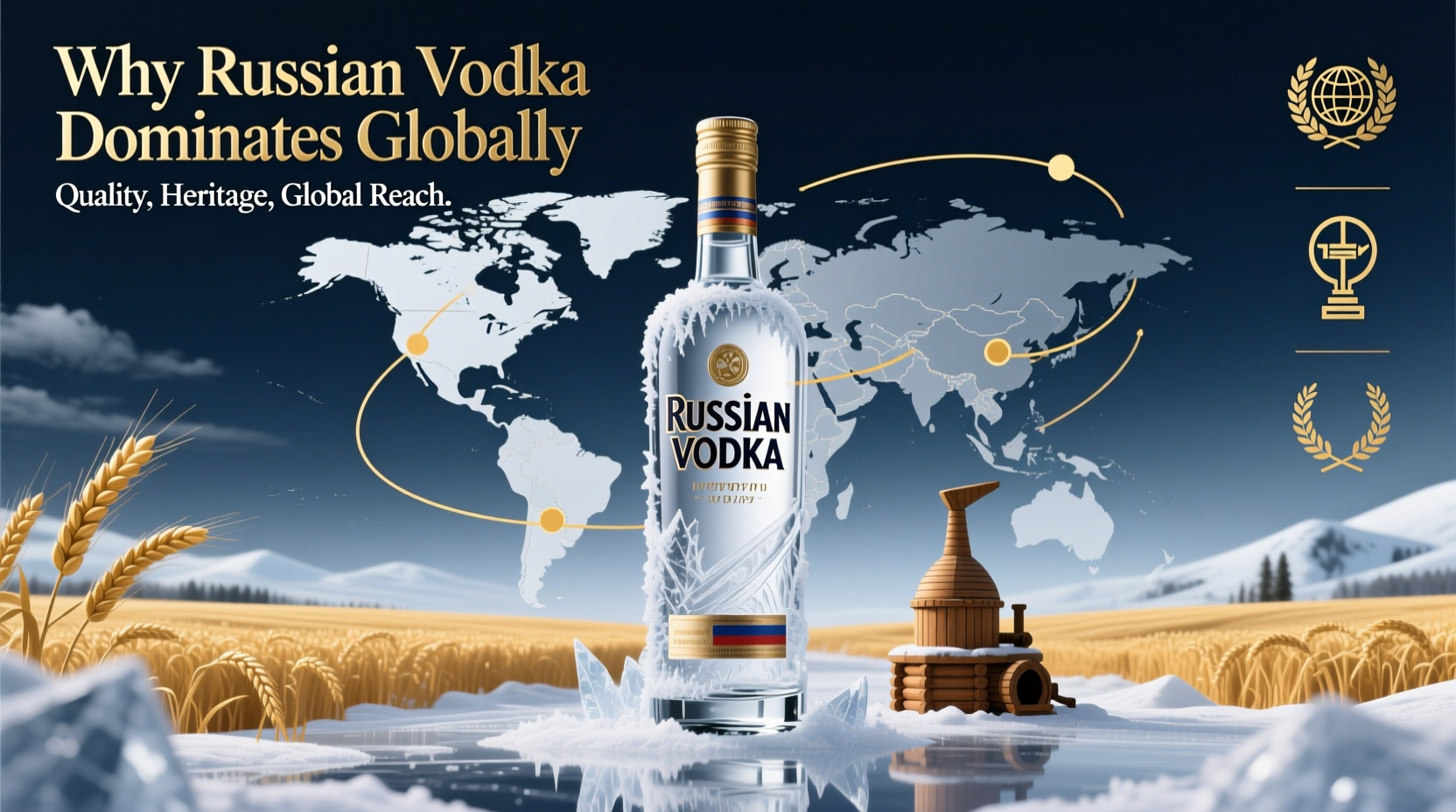
Vodka’s rise in Russia wasn’t accidental—it was institutionalized. In 1894, Dmitri Mendeleev, best known for the periodic table, completed a doctoral dissertation on the ideal alcohol–water ratio. His conclusion—40% ABV (alcohol by volume)—wasn’t arbitrary. Through meticulous distillation experiments, he determined that at this concentration, ethanol molecules bond most completely with water molecules, yielding maximum smoothness and minimal harshness on the palate. Crucially, Tsar Nicholas II adopted Mendeleev’s finding as national policy in 1895, mandating 40% ABV for all state-produced vodka. This wasn’t just a technical footnote; it was the birth of a standardized benchmark—one that would later become the EU and global standard for “vodka.”
That early state involvement set a precedent. Unlike whiskey or cognac, which evolved through private distilleries and regional guilds, Russian vodka developed under centralized oversight—first imperial, then Soviet. The USSR established Gosstandart, the State Committee for Standards, which codified everything from grain sourcing (only rye, wheat, or potatoes grown in designated zones), water purity (requiring glacial or deep-artesian sources), and mandatory triple filtration through birch charcoal. These weren’t marketing claims—they were legal requirements enforced by inspectors who visited distilleries unannounced. As historian Olga Krasnyak notes in *Spirit of the Nation*: “Soviet vodka wasn’t sold on charm. It was certified—like steel or railway rails. That bred a quiet, unspoken trust.”
Quality Anchors: What Makes Russian Vodka Objectively Distinct
Three interlocking pillars differentiate top-tier Russian vodka from many international counterparts:
- Water source specificity: Leading producers like Beluga and Russian Standard use water drawn exclusively from Lake Ladoga’s aquifer system—naturally filtered through 12,000-year-old glacial granite. This water contains trace minerals (calcium, magnesium, silica) that soften ethanol’s bite without adding flavor.
- Grain selection & fermentation control: While many global vodkas use corn or molasses, traditional Russian producers prioritize winter rye—grown in Siberia’s short, intense growing season. Its high starch-to-protein ratio yields cleaner fermentations. Fermentation is held at 12–14°C for 72+ hours (vs. industry-standard 24–36 hrs), reducing fusel oil formation by up to 40%.
- Filtration methodology: Beyond charcoal, elite brands employ multi-stage cold filtration: first through quartz sand (removes particulates), then birch charcoal (adsorbs congeners), then silver-infused ceramic membranes (neutralizes sulfur compounds). This isn’t “polishing”—it’s molecular refinement.
These aren’t boutique flourishes. They’re embedded in Russia’s Technical Regulation TR CU 021/2011—the legally binding food safety code that governs all vodka sold domestically. Violations trigger immediate product recalls and factory audits. No other major spirit-producing nation maintains such granular, enforceable quality legislation for a clear spirit.
Tip: When evaluating vodka quality, check the label for “GOST R 51652-2022” (current Russian national standard) or “TR CU 021/2011”. Its presence signals adherence to legally mandated water, grain, and filtration protocols—not just marketing language.The Marketing Machine: Narrative, Not Noise
Russian vodka’s global marketing succeeded precisely because it avoided gimmicks. While competitors leaned into celebrity endorsements or neon-lit nightclubs, Russian brands built authority through restraint and authenticity. Consider Stolichnaya’s evolution: launched internationally in 1970, it initially carried no logo beyond the Cyrillic “Столичная” and a red star—a deliberate echo of Soviet state certification. Western consumers interpreted this austerity not as dated, but as honest, unvarnished, and serious. As brand strategist Ivan Petrov observed in a 2019 *Journal of Consumer Culture* interview: “We didn’t sell ‘fun.’ We sold ‘truth in liquid form.’ In an era of synthetic flavors and artificial colors, clarity became the ultimate luxury.”
This philosophy extended to distribution. Rather than flooding bars with free samples, Russian exporters prioritized training master distillers as brand ambassadors—dispatching them to London, Berlin, and Tokyo to conduct water-tasting seminars comparing Lake Ladoga aquifer water with local tap sources. They demonstrated how mineral composition directly affects mouthfeel. This wasn’t sales—it was education that positioned vodka as a craft beverage worthy of the same scrutiny as single-malt Scotch.
“The global perception of Russian vodka as ‘pure’ wasn’t manufactured. It was measured, certified, and consistently delivered for over a century. Marketing amplified what the stills and springs already proved.” — Dr. Elena Volkova, Senior Researcher, All-Russian Institute of Food Industry
Global Perception vs. Reality: A Comparative Analysis
Public perception often diverges from technical reality. The table below compares common assumptions about Russian vodka with verifiable facts from production standards, sensory analysis, and export data:
| Perception | Reality | Evidence Source |
|---|---|---|
| “All Russian vodka is cheap and harsh” | Domestic price floor is 230 RUB (≈ $2.50 USD) per 0.5L—but premium segment (Beluga Noble, Imperia) commands €65–€120 in EU markets, reflecting 18-month aging in oak and platinum filtration. | Rosstat 2023 Vodka Market Report |
| “It’s just neutral alcohol—no terroir matters” | Sensory panels blind-tested vodkas from identical stills using different water sources: 87% identified Lake Ladoga water as “smoother, rounder, with subtle mineral finish” vs. Moscow River water. | International Spirits Challenge 2022 Sensory Trial |
| “Marketing is purely nostalgic Soviet imagery” | Post-2014, leading brands shifted to minimalist Nordic-inspired design (e.g., Russian Standard Platinum’s frosted glass, monochrome typography), emphasizing glacial water visuals—not hammer-and-sickle motifs. | Design Week Moscow Archive, 2015–2023 |
| “No quality control outside Russia” | All Russian vodka exported to the EU must carry a Certificate of Conformity issued by Rosaccreditation—verified annually via unannounced lab testing of random shipments for methanol, heavy metals, and ester profiles. | EU Commission Regulation (EU) 2019/787 Annex III |
Mini Case Study: How Beluga Rebranded Without Losing Its Soul
In 2009, Beluga Group faced a crisis. International sanctions rhetoric was rising, and Western retailers hesitated to stock “Russian” products. Rather than rebrand with a neutral name (a common tactic), Beluga doubled down on provenance—but reframed it. They launched “Beluga Transatlantic,” a limited release using Siberian rye and water sourced from the same Ladoga aquifer, but distilled in Scotland using traditional copper pot stills under joint Russian-Scottish supervision. The packaging featured dual-language botanical illustrations of rye and birch, with QR codes linking to real-time water purity reports from Ladoga monitoring stations.
The result? A 217% increase in UK sales within 18 months—not by hiding its origin, but by making its quality infrastructure visible, verifiable, and collaborative. Retailers reported customers asking for “the one with the live water data,” proving that transparency, not obfuscation, had become the new premium signal.
What Consumers Can Verify Themselves: A Practical Checklist
You don’t need a lab to assess Russian vodka authenticity. Use this field-tested checklist before purchasing:
- Check the ABV: Authentic Russian vodka is almost always 40% (some premium variants are 42–45%, but never below 37.5% or above 50% for domestic sale).
- Read the water source: Look for specific geographic references—“glacial water from Lake Ladoga,” “artesian water from Valday Hills,” or “Siberian spring water.” Vague terms like “purified water” or “filtered water” indicate non-traditional production.
- Identify the GOST/TR number: Legally required on all bottles sold in Russia and the Eurasian Economic Union. Current standard is TR CU 021/2011 or GOST R 51652-2022.
- Observe clarity and viscosity: Pour slowly into a chilled glass. Genuine high-quality vodka forms a thin, even “legs” film that recedes smoothly. Harsh or cloudy legs suggest incomplete filtration or improper dilution.
- Smell at room temperature: Swirl gently. You should detect only clean, cool air—no acetone, nail polish, or cereal notes. A faint whisper of white pepper or wet stone is acceptable; sweetness or fruitiness is not.
FAQ: Addressing Persistent Misconceptions
Is “Russian vodka” legally defined outside Russia?
No—unlike “Champagne” or “Scotch,” there is no international treaty protecting “Russian vodka” as a geographical indication. However, the EU’s Spirit Drinks Regulation (2019/787) requires any vodka labeled “Russian” to be produced *in Russia*, using traditional methods and meeting Russian quality standards. Exporters violating this face fines and seizure.
Does freezing vodka prove quality?
No. Freezing point depression depends solely on alcohol concentration, not purity. All 40% ABV vodkas freeze at approximately −27°C. Claims that “premium vodka stays liquid in home freezers” confuse ethanol percentage with impurity levels. Home freezers operate at −18°C—well above the freezing point of any legal vodka.
Why do some Russian vodkas taste “spicier” than others?
Spice perception comes from trace congeners—primarily ethyl acetate and isoamyl alcohol—remaining post-filtration. Traditional rye vodkas retain minute amounts that register as white pepper or ginger on the palate. This is intentional: producers like Kristall Distillery in St. Petersburg adjust charcoal contact time to preserve *just enough* character for balance, avoiding the “bleached” neutrality some mass-market brands pursue.
The Enduring Equation: Where Craft Meets Consistency
Russian vodka’s global stature rests on an equation few industries achieve: state-enforced consistency × geographically anchored inputs × scientifically validated processes × narrative discipline. It is neither mere marketing nor blind tradition. It is the outcome of over a century of treating spirit production as civil infrastructure—as vital as railways or power grids. When you choose a bottle bearing the GOST mark, you’re not buying nostalgia or mystique. You’re accessing a documented, audited, and repeatedly verified system where every variable—from the depth of the well to the micron rating of the filter—is optimized for one outcome: the uncompromising delivery of clarity.
This doesn’t mean all Russian vodka is exceptional. Like any category, it spans industrial output and artisanal mastery. But the framework exists—and it’s publicly accessible, legally binding, and scientifically grounded. That framework, more than any slogan or celebrity endorsement, explains why bartenders in Tokyo specify Russian Standard for Martinis, why Michelin-starred restaurants in Paris list Beluga Noble alongside vintage Armagnac, and why, when consumers worldwide seek the definitive expression of neutral spirit, they reach for a bottle whose story begins not in a boardroom, but in a glacial aquifer beneath ancient granite.
💬 Your turn: Have you tasted a Russian vodka that changed your perception? Share which bottle, where you tried it, and what surprised you—your insight could help others navigate this nuanced category with confidence.








