
Every December, a familiar scene unfolds in homes across the Northern Hemisphere: a perfectly decorated Christmas tree stands tall—until a blur of fur launches from the sofa, claws unsheathed, tail high, and sends ornaments clattering to the floor. Your cat isn’t being “naughty.” They’re responding to instinct, environment, and unmet needs in ways that feel urgent and rewarding—to them. Understanding the behavior is the first step toward resolving it—not with punishment, but with empathy, environmental design, and feline psychology. This isn’t about training a cat to ignore temptation; it’s about redesigning the holiday space so curiosity, play drive, and vertical impulse are safely channeled elsewhere.
The Instincts Behind the Assault
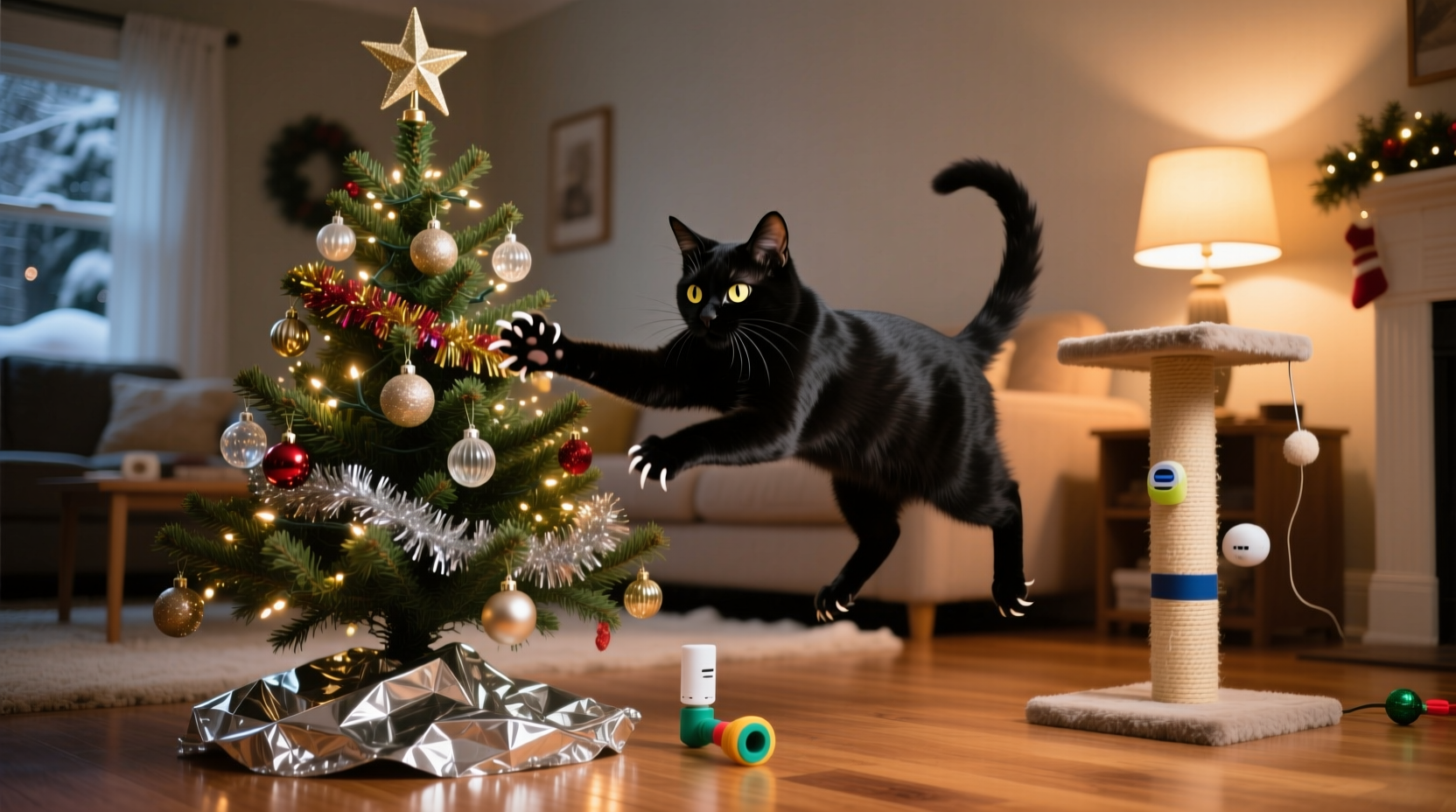
Cats don’t climb Christmas trees to ruin your decor. They climb because the tree triggers at least three deeply wired biological imperatives: predation, exploration, and territorial assertion. A tall, asymmetrical, moving object—especially one adorned with dangling, reflective, or rustling ornaments—is a multisensory invitation to investigate. The scent of pine resin mimics natural outdoor stimuli, while the faint swaying (from drafts or foot traffic) activates the same neural pathways that respond to prey movement. Dr. Sarah Heath, a UK-based veterinary behaviorist and Fellow of the Royal College of Veterinary Surgeons, explains:
“The Christmas tree is, from a cat’s perspective, the ultimate ‘novel vertical landscape’—a combination of height, texture, motion, and scent that overrides routine inhibition. It’s not mischief. It’s evolutionary logic playing out in your living room.”
This behavior peaks in cats under five years old—especially those with high prey drive or limited environmental enrichment—but even senior cats may test boundaries when routine shifts dramatically during the holidays. Importantly, stress can amplify the behavior: changes in household schedule, guests, or new scents (candles, pine wreaths, unfamiliar foods) lower a cat’s threshold for impulsive action. What looks like playful pouncing may, in fact, be displacement behavior—a way to release anxiety through physical output.
Why Common Fixes Fail (And What to Do Instead)
Spraying water, yelling, or using citrus-scented deterrents rarely work long-term—and often backfire. Cats associate the aversive stimulus (e.g., a spray bottle) with *you*, not the tree, damaging trust. Citrus sprays may deter some cats initially, but many quickly habituate—or worse, learn to avoid only the sprayed zones, leaving untouched branches as prime targets. Similarly, wrapping the trunk in aluminum foil or double-sided tape creates temporary barriers but ignores motivation. Once the barrier is removed (or the cat learns to step over it), the behavior resumes—often more intensely due to frustration.
Effective intervention requires addressing root causes, not symptoms. That means simultaneously reducing the tree’s appeal *and* increasing the appeal of alternatives—while ensuring safety remains non-negotiable. Below is a comparison of common approaches versus evidence-informed alternatives:
| Traditional Approach | Why It Fails | Better Alternative |
|---|---|---|
| Placing the tree in a closed-off room | Creates isolation stress; cats often escalate scratching at doors or vocalize persistently | Use baby gates with cat-sized gaps blocked, or install a freestanding pet barrier that allows visual access but prevents entry |
| Hanging ornaments low on the tree | Increases temptation and risk of ingestion or injury; encourages pawing and batting | Hang all ornaments above 3 feet (90 cm); reserve the bottom 24 inches for sturdy, non-breakable decorations only |
| Using tinsel or ribbon as “fun” decor | Tinsel is a leading cause of linear foreign body obstruction in cats; ribbons pose entanglement and ingestion risks | Eliminate tinsel entirely; use wide, woven fabric garlands secured tightly with zip ties—not tape or glue |
| Leaving the tree lit overnight | Warm lights attract cats seeking warmth; flickering LEDs mimic prey movement; cords pose electrocution risk | Use only UL-listed LED lights with cool-touch bulbs; unplug tree lights whenever no adult is supervising |
| Reprimanding after the fact | Cats don’t connect delayed consequences with prior actions; increases fear and undermines human–cat bond | Redirect *in the moment*: toss a toy *away* from the tree, then reward calm attention to the toy with praise or a treat |
A Step-by-Step Plan to Deter Climbing (Without Stress)
Success hinges on consistency over seven to ten days—the time most cats need to form new associations. Follow this sequence precisely:
- Prep the Tree Zone (Day 1): Clear a 3-foot radius around the base. Remove rugs, cords, and low-hanging décor. Place a textured mat (like a coir doormat) directly under the trunk—its rough surface discourages paw contact.
- Install Vertical Alternatives (Day 2): Position two or three tall, stable cat trees or wall-mounted shelves *within 6 feet* of the tree—but angled away from it. Cover them with soft fleece or faux fur; add a small amount of silvervine or catnip to boost initial interest.
- Introduce Scheduled Play (Days 3–7): Conduct two 15-minute interactive play sessions daily—one 30 minutes before dusk (peak cat activity) and one 60 minutes before bedtime. Use wand toys that mimic birds or rodents; end each session with a small meal or treat to reinforce calm post-play satisfaction.
- Modify Tree Access (Day 4): Secure the tree to a wall stud using a flexible, breakaway tree strap (not rope or wire). Wrap the lowest 18 inches of trunk in smooth, rigid plastic tubing (e.g., PVC pipe cut lengthwise)—cats dislike the lack of grip and cold surface.
- Consistent Redirection (Ongoing): When you see your cat approach the tree, calmly say “No” *once*, then immediately toss a favorite toy toward their alternative perch. Praise and treat only when they engage with the toy—not when they stop approaching the tree.
Real-World Success: How Maya Stopped Her Maine Coon’s Midnight Ascents
Maya, a veterinary technician in Portland, Oregon, faced nightly chaos every December. Her 3-year-old Maine Coon, Atlas, would scale her 7-foot Fraser fir by midnight, shaking ornaments loose and chewing on pine needles. She tried foil, citrus oil, and even a motion-activated air canister—each escalating his fixation. On December 3rd, she shifted strategy: she anchored the tree to a ceiling joist, installed a 6-foot cat tower 4 feet left of the tree with a heated pad inside, and began twice-daily play sessions using a feather-on-a-string. Crucially, she stopped reacting to his early-morning circling—instead, she’d quietly place a puzzle feeder filled with kibble beside his tower at 5:30 a.m. Within five days, Atlas was sleeping on the tower’s top platform. By Day 10, he ignored the tree unless Maya deliberately dangled a toy near its base—and even then, he’d glance, yawn, and return to grooming. “He wasn’t defying me,” Maya reflected. “He was asking for structure. Once I gave him predictable outlets, the tree just… lost its magic.”
What to Avoid: A Critical Safety Checklist
Your cat’s well-being—and your peace of mind—depends on eliminating hazards before the first ornament goes up. Use this checklist before finalizing your tree setup:
- ✅ All electrical cords are fully enclosed in rigid cord covers or run through baseboard channels—no exposed wiring within 3 feet of the floor
- ✅ No glass, ceramic, or mercury-containing ornaments are placed below 36 inches
- ✅ Water reservoir is covered with a secure, weighted tree skirt or fitted lid—preventing ingestion of stagnant water (which breeds bacteria and mold)
- ✅ Artificial trees are certified flame-retardant; real trees are watered daily and inspected for dryness (browning needles = fire hazard)
- ✅ No edible decorations (popcorn strings, candy canes, chocolate) are used—these pose choking, toxicity, or gastrointestinal blockage risks
- ✅ Cat-safe plants (poinsettias, holly, mistletoe, amaryllis) are kept completely out of reach—many are toxic if chewed
Frequently Asked Questions
Will a fake tree stop the climbing?
No—not inherently. While some cats dislike the synthetic texture of certain artificial trees, many find the crinkly plastic branches or metallic frame even more intriguing than natural pine. The key isn’t material, but stability, height, and sensory novelty. A wobbly fake tree may actually encourage climbing as cats test its movement. Prioritize sturdiness and anchoring over type.
Can I use a commercial cat repellent spray near the tree?
Most over-the-counter sprays rely on citronella, peppermint, or bitter apple—all of which have inconsistent efficacy and potential respiratory irritation risks, especially in multi-cat homes or households with asthmatic humans. Safer, more reliable options include motion-activated deterrents with ultrasonic tones (tested safe for cats and humans) or placing citrus peels *outside* the tree zone—not on branches—to create a subtle olfactory boundary.
My cat only climbs when I’m not home. How do I manage that?
This suggests boredom or separation-related anxiety—not just play drive. Install a pet camera with treat-dispensing capability and program it to release a small kibble reward every 20 minutes while you’re away. Pair this with leaving an unwashed t-shirt with your scent near their preferred perch. Most importantly, ensure the tree area is physically inaccessible during unsupervised hours—use a freestanding barrier or close the door to that room entirely.
Conclusion: Reframe the Problem, Reclaim the Season
Your cat’s fascination with the Christmas tree isn’t a flaw in their character—it’s a testament to their vitality, intelligence, and undimmed wild instincts. Rather than seeing climbing as defiance, recognize it as communication: your cat is saying, “This space is exciting, uncertain, and full of opportunity—and I need help navigating it safely.” With thoughtful environmental adjustments, consistent redirection, and respect for feline needs, you can preserve both your tree’s integrity and your cat’s confidence. You won’t eliminate curiosity—but you can guide it. You won’t suppress instinct—but you can satisfy it. And in doing so, you’ll transform December’s annual battle into a shared, calmer celebration: one where pine needles stay on the tree, ornaments remain intact, and your cat naps peacefully—on their own perch, exactly where they belong.
💬 Have a tip that worked for your tree-climbing cat? Share your real-world solution in the comments—your experience could help dozens of other households enjoy a safer, saner holiday season.








