That sharp, throat-tightening “burn” when you sip a whiskey isn’t just an unavoidable side effect of drinking spirits—it’s a nuanced sensory signal shaped by chemistry, physiology, and craftsmanship. Many assume higher proof automatically means more burn, or that older whiskies mellow out entirely. Neither is universally true. In reality, the perception of burn—technically known as chemesthesis, the irritation of trigeminal nerve endings—is influenced by a delicate interplay of ethanol concentration, congener profile, wood interaction, dilution history, and even the drinker’s own biology. Understanding why one 52% ABV bourbon stings while a 60% cask-strength single malt feels surprisingly rounded reveals far more about distillation philosophy and maturation science than simple alcohol math.
The Alcohol Content Myth: Proof Alone Doesn’t Dictate Burn
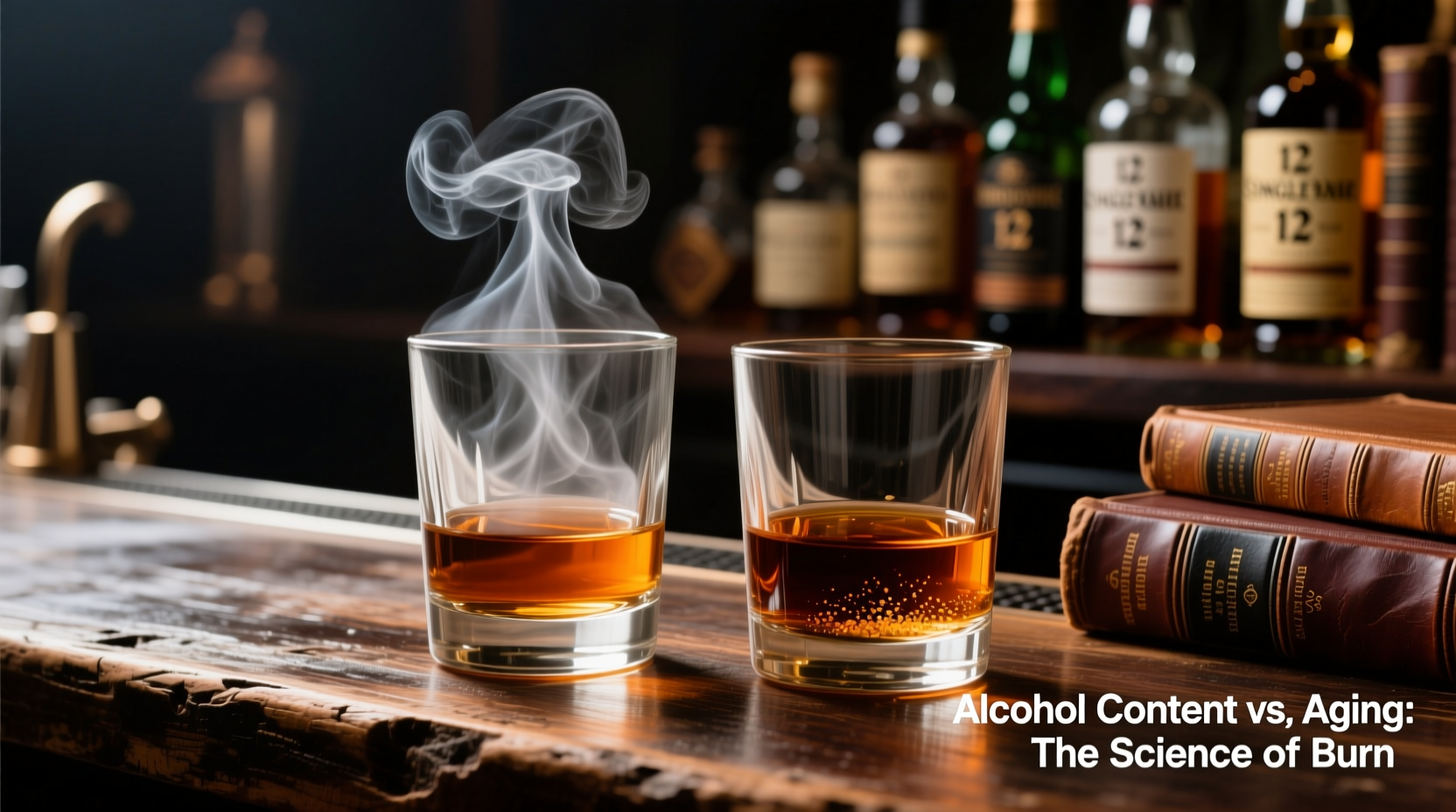
Yes, ethanol is the primary irritant—the molecule directly stimulating pain receptors in the mouth, throat, and nasal passages. But its impact isn’t linear. A whiskey at 46% ABV can feel hotter than one at 54% ABV if the latter has been carefully reduced with mineral-rich spring water and rested for months, allowing ethanol molecules to cluster more evenly in solution. Conversely, a hastily diluted 43% ABV whisky may retain aggressive, unbound ethanol “spikes” that trigger sharper neural responses.
What matters more than raw ABV is ethanol solvation: how well the alcohol integrates with water and congeners (flavor compounds like esters, aldehydes, and fatty acids). During slow dilution and post-dilution maturation—common practice among Japanese and Irish distillers—the ethanol-water matrix reorganizes, reducing surface tension and smoothing sensory impact. This explains why many Japanese whiskies at 48–50% ABV deliver remarkable softness, while some American rye whiskies at 45% ABV carry surprising heat: their high-rye mash bills generate elevated levels of fusel oils and acetaldehyde, which amplify ethanol’s irritating effect.
Tip: Try the “water test”: Add one drop of room-temperature water to a small dram, swirl gently, and wait 30 seconds before tasting. If burn recedes significantly, the ethanol wasn’t fully integrated—and the whisky likely benefits from careful dilution.Aging’s Real Role: Not Just Time, But Transformation
Aging doesn’t simply “soften” whiskey by waiting. It drives three simultaneous chemical processes that reshape burn perception: extraction, oxidation, and esterification. In new charred oak barrels—standard for bourbon—the first 2–3 years see aggressive extraction of tannins, lignin derivatives, and volatile phenols. These compounds can accentuate ethanol’s bite, especially in hot-climate warehouses where rapid expansion forces spirit deeper into wood, pulling out harsher elements.
After year four, oxidation begins to dominate. Oxygen seeping through barrel staves reacts with aldehydes and alcohols, forming smoother, heavier esters like ethyl octanoate (apple-like) and isoamyl acetate (banana). These esters don’t reduce ABV—but they coat mucous membranes, creating a lubricating effect that physically buffers ethanol contact. That’s why many Speyside single malts aged 12–18 years in refill hogsheads (used barrels with less active wood) taste rounder than younger, more extractive sherried expressions—even at identical proofs.
Critical nuance: Over-aging can reintroduce burn. Whiskies aged beyond 25 years in first-fill sherry casks often develop excessive oak lactones and oxidized vanillin derivatives that create a drying, astringent finish—a different kind of “burn” rooted in tannin fatigue, not ethanol.
Congeners: The Hidden Amplifiers of Heat
If ethanol is the match, congeners are the kindling. These naturally occurring byproducts of fermentation and distillation vary dramatically by mash bill, yeast strain, fermentation time, and still configuration. They don’t just add flavor—they modulate irritation.
- Fusel oils (isoamyl alcohol, propanol): Produced during hot, fast fermentations. Highly volatile and pungent; intensify throat burn and contribute to “hot” hangovers.
- Acetaldehyde: A green-apple note at low levels, but harsh and solvent-like above threshold. Common in young, unbalanced whiskies and poorly managed fermentations.
- Ethyl carbamate: Formed during aging from urea and ethanol. Banned in many markets above 120 ppb due to toxicity concerns—and also contributes to sharp, lingering heat.
- Long-chain fatty acid esters (e.g., ethyl palmitate): Waxy, creamy, mouth-coating. These suppress burn perception by forming protective films on oral tissue.
Distilleries control congener profiles deliberately. Springbank in Campbeltown uses partial triple distillation and long fermentations (110+ hours) to elevate fruity esters while suppressing fusels. Their 12-year-old at 46% ABV delivers rich texture with minimal burn—whereas a young, high-fermentation-temperature Tennessee sour mash whiskey at 40% ABV may sting noticeably due to elevated acetaldehyde and fusel load.
“Burn isn’t a flaw—it’s data. When a cask-strength whisky bites, it’s telling you something about its fermentation health, cut points, and wood interaction. Our job is to listen, then guide that energy toward complexity—not erase it.” — Dr. Emma Thorne, Master Distiller, GlenAllachie Distillery
Real-World Example: The Highland Park 12 vs. Ardbeg Uigeadail Comparison
Consider two iconic Islay whiskies, both bottled at cask strength but delivering wildly different heat experiences:
Highland Park 12 Year Old (43% ABV, chill-filtered): Matured in a mix of refill bourbon and first-fill sherry casks. Its relatively low proof suggests mildness—but many newcomers report surprising warmth. Why? The Orkney climate yields slow, cool maturation, preserving volatile sulfur compounds from the local peat. These sulfides (dimethyl sulfide, etc.) interact synergistically with ethanol, lowering the detection threshold for burn. The chill-filtration further strips away fatty esters that would otherwise buffer the sensation.
Ardbeg Uigeadail (54.2% ABV, non-chill-filtered): Matured in ex-bourbon and first-fill sherry casks, bottled without reduction or filtration. Despite being 11 percentage points stronger, it consistently reads as smoother, richer, and less aggressively hot. Its secret lies in Ardbeg’s unusually long fermentation (over 130 hours), which generates abundant fruity esters, and the generous proportion of deeply charred, active sherry casks that contribute glycerol and long-chain esters. These compounds create viscosity and mouthfeel that physically mitigate ethanol contact.
This contrast proves that ABV is only one variable—and sometimes, the least informative one—when predicting burn.
Practical Decision Framework: What Actually Reduces Perceived Burn
Rather than chasing lower ABV or older age statements, focus on production markers that reliably correlate with smoother delivery. Use this checklist when selecting or evaluating whiskies:
- ✅ Non-chill-filtered: Retains natural fatty acids and esters that coat the palate.
- ✅ Distilled using longer fermentations (look for distilleries advertising >96-hour ferments).
- ✅ Matured in a high proportion of refill casks (gentler wood influence, fewer harsh tannins).
- ✅ Bottled after post-dilution resting (often indicated by phrases like “married in tank for 6 months” on labels).
- ✅ Contains sherry cask influence—not for sweetness alone, but for glycerol and ester contribution.
Avoid these red flags if minimizing burn is a priority:
- ❌ Chill-filtration without disclosure (common in budget blends).
- ❌ “Young grain” or “high-rye” labels without age statements (often indicates aggressive, unbalanced distillation).
- ❌ Bottlings labeled “unpeated” but sourced from heavily peated stock (sulfur compounds remain, amplifying heat).
- ❌ ABV ending in .1 or .2 (suggests rushed, last-minute dilution rather than integrated reduction).
Comparative Analysis: How Production Choices Shape Burn Perception
| Factor | High-Burn Risk Profile | Low-Burn Risk Profile |
|---|---|---|
| Fermentation | Short (<72 hrs), warm (32°C+), high-gravity wort | Long (>96 hrs), cool (18–22°C), open-air fermentation |
| Distillation | Narrow cut points, high reflux, fast run-off | Wide feints cut, low reflux, slow spirit run-off |
| Maturing Cask | First-fill virgin oak, hot-climate warehouse | Refill hogsheads, cool-climate dunnage warehouse |
| Reduction | Chill-filtered, diluted with distilled water days before bottling | Non-chill-filtered, diluted with mineral spring water, rested ≥3 months |
| Aging Duration | 2–4 years in active wood (peak tannin extraction) | 12–22 years with balanced wood renewal (ester dominance) |
FAQ
Does adding ice always reduce burn?
No—and it can backfire. Ice rapidly chills the spirit, numbing taste receptors but also causing ethanol and water to separate microscopically. This creates transient pockets of concentrated alcohol that hit the throat more intensely. Better alternatives: one small cube allowed to melt slowly, or a precise 1:1 dilution with room-temperature water.
Can I train myself to perceive less burn over time?
Yes—through neuroplasticity, not tolerance. Regular, mindful sipping (not gulping) trains the trigeminal system to distinguish between ethanol irritation and complex spice notes (cinnamon, clove, black pepper). Start with lower-congener whiskies (e.g., Lowland grain or Irish pot still), focus on mouthfeel before swallow, and note how burn evolves across multiple sips. Within 4–6 weeks, many report heightened sensitivity to texture and diminished reactive burn.
Why do some “smooth” branded whiskies still burn on the finish?
They’re often engineered for front-palate appeal—loaded with sweet caramel and vanilla from heavy char and added spirit caramel (E150a)—but lack mid-palate body. Without sufficient esters or fatty acids to sustain coating, ethanol reasserts itself on the finish. True smoothness requires balance across the entire taste arc, not just initial sweetness.
Conclusion
Whiskey’s burn is neither a flaw to be masked nor a badge of honor to be endured—it’s a diagnostic language spoken by ethanol, wood, yeast, and time. Dismissing it as mere “alcohol heat” overlooks the artistry behind every bottle: the distiller’s choice to ferment longer for silkiness, the cooper’s decision to toast rather than char for gentler tannins, the blender’s patience in marrying casks until ethanol finds its place in the ensemble. Next time you feel that familiar prickle, pause. Ask not “how strong is it?” but “what story is this heat telling me?” Then reach for water—not to dull the message, but to hear it more clearly. Your palate will grow sharper, your appreciation deeper, and your pours more intentional.
💬 Your experience matters. Have you tasted a high-ABV whisky that surprised you with its softness—or a low-proof dram that packed unexpected heat? Share the bottle, the context, and what you learned in the comments. Let’s decode burn, together.








