Video games have evolved from simple pixelated distractions into deeply immersive digital worlds capable of holding players’ attention for hours on end. While many enjoy gaming as a form of relaxation or entertainment, others find themselves returning again and again—sometimes to the point where it feels hard to stop. This isn’t by accident. Behind the scenes, game designers leverage well-established psychological principles to create experiences that are not just fun, but compelling, rewarding, and often habit-forming.
The addictive nature of certain games stems from more than just engaging storylines or flashy graphics. It’s rooted in human psychology: how our brains respond to rewards, progress, social interaction, and unpredictability. Understanding these mechanisms reveals not only why games can feel so hard to put down but also how they mirror behaviors seen in other areas of life—from social media use to gambling.
The Psychology of Reward Systems
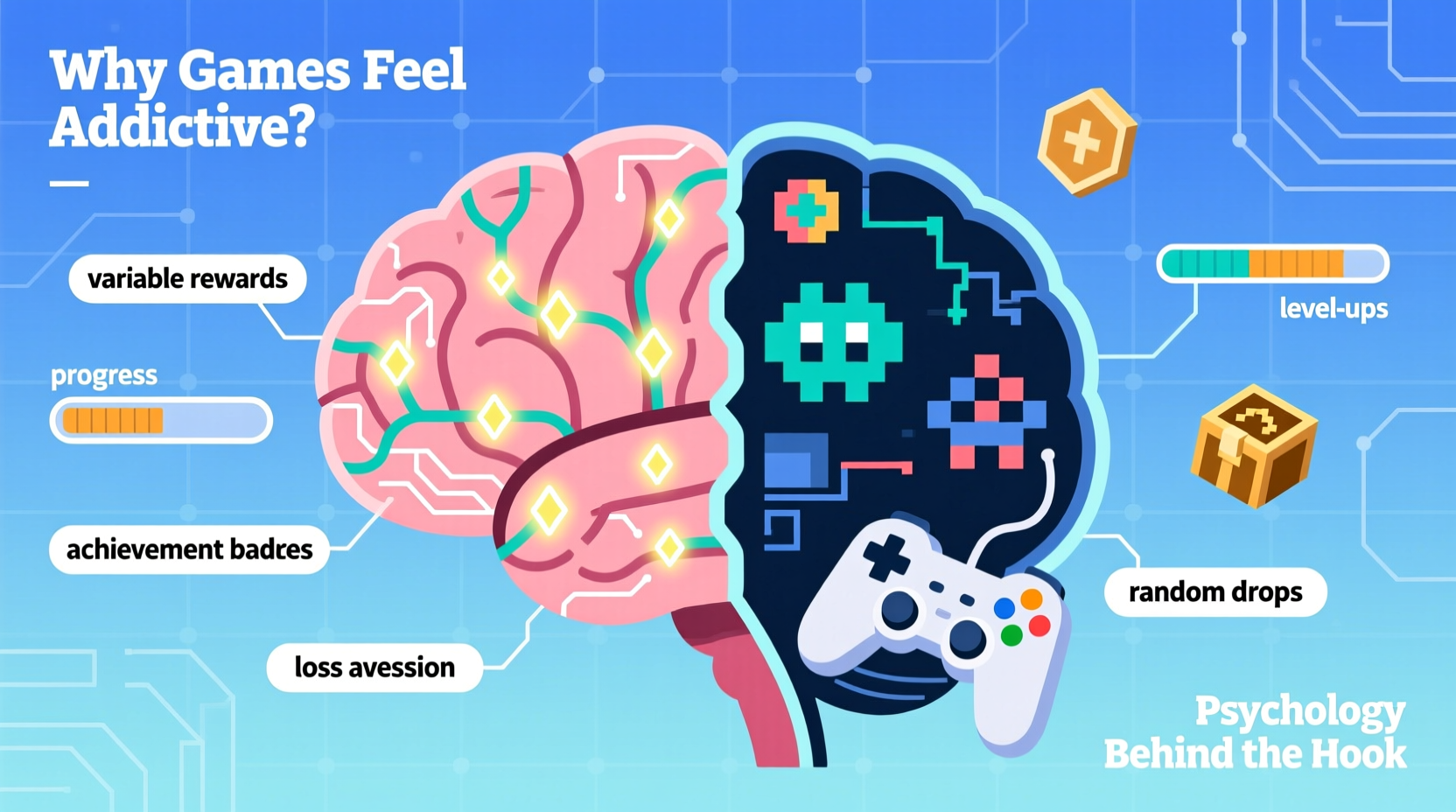
At the heart of most addictive video games lies a carefully engineered reward system. These systems tap directly into the brain’s dopamine pathways—the same neural circuits involved in motivation, pleasure, and reinforcement learning. When a player completes a quest, levels up, or earns rare loot, the brain releases dopamine, creating a sense of satisfaction and encouraging repetition of the behavior.
Game developers use variable ratio reinforcement schedules—a concept from behavioral psychology—to maximize this effect. In this model, rewards are delivered unpredictably. For example, opening a loot box might yield a powerful weapon one time and common items the next. Because the player never knows when the next big reward will come, they keep playing, much like someone pulling the lever on a slot machine.
Tip: If you're concerned about excessive play, set time limits before starting a session—especially in games with random rewards.This unpredictability is far more effective at sustaining engagement than fixed rewards (e.g., getting a prize every 10th win). B.F. Skinner, the pioneering psychologist who studied operant conditioning, demonstrated that unpredictable rewards produce the highest and most persistent rates of behavior. Modern games apply this insight masterfully.
Progression and the Illusion of Mastery
Another key psychological driver is the perception of progress. Games often structure advancement through visible milestones: experience bars, skill trees, achievement badges, and level-ups. Each of these provides tangible feedback that the player is improving—even if the actual challenge hasn’t increased significantly.
This taps into what psychologists call “the progression principle”: people are more motivated when they can see clear evidence of forward movement. A 2011 study published in the Journal of Consumer Research found that individuals are more engaged when they believe they’re making steady progress toward a goal, even if the goal is arbitrary.
In games like Candy Crush or Fortnite, players may lose multiple times but still feel encouraged by small wins—unlocking a new character skin, completing a daily challenge, or advancing to the next world. The illusion of mastery keeps them invested, even when real skill development plateaus.
| Psychological Principle | How It's Used in Games | Example Game |
|---|---|---|
| Variable Rewards | Loot drops, randomized drops, surprise bonuses | Diablo IV |
| Social Proof | Leaderboards, friend activity feeds | Call of Duty: Warzone |
| Loss Aversion | Daily login streaks, time-limited events | Animal Crossing: New Horizons |
| Goal Gradient Effect | Visible progress bars, nearing level-up | World of Warcraft |
| Endowed Progress | Starting partway through a reward track | Overwatch Battle Pass |
Social Connection and Belonging
Humans are inherently social creatures, and many modern games exploit this need for connection. Multiplayer modes, guilds, cooperative missions, and in-game chat systems foster a sense of community. Players aren’t just playing a game—they’re maintaining relationships, earning status, and contributing to group success.
When someone logs into Destiny 2 to join their fireteam or participates in a raid with friends, the motivation isn’t purely about gameplay—it’s about not letting the team down. Social accountability increases commitment. Missing a scheduled event might mean disappointing others, which triggers guilt or FOMO (fear of missing out).
“Online gaming communities function like micro-societies. Players derive identity, purpose, and emotional support from their roles within them.” — Dr. Sarah Thompson, Cognitive Psychologist specializing in digital behavior
This dynamic mirrors real-world social structures. Being recognized as a top player, receiving praise in a clan chat, or unlocking a title that broadcasts status all fulfill deep-seated psychological needs for belonging and esteem.
A Real Example: The Case of ‘Eve Online’
In the massively multiplayer online game Eve Online, players build empires, wage interstellar wars, and form complex political alliances. One infamous incident in 2014 involved a betrayal known as “The CFC Heist,” where a trusted alliance member stole over $300,000 worth of in-game assets (valued in real money due to player-driven economies).
What made this event remarkable wasn’t just the scale—it was the emotional fallout. Players reported genuine grief, anger, and shock. Some quit the game entirely. Others organized revenge campaigns lasting months. The depth of investment shows how virtual achievements and relationships can carry real psychological weight.
This case illustrates that addiction isn’t always about compulsion or loss of control. Sometimes, it’s about meaning. When a game offers purpose, camaraderie, and consequence, stepping away feels less like quitting a pastime and more like leaving behind a part of one’s identity.
The Role of Escapism and Emotional Regulation
For many players, video games serve as a form of emotional regulation—an escape from stress, anxiety, or monotony. Immersive environments allow users to temporarily inhabit another reality, assuming roles of power, competence, or adventure that may be absent in daily life.
During periods of personal difficulty—such as unemployment, isolation, or mental health struggles—games can provide a safe space to regain a sense of agency. Completing tasks in a game gives immediate feedback and closure, unlike real-life challenges that may lack clear solutions or timelines.
However, this coping mechanism can become problematic when reliance grows. If someone consistently turns to gaming to avoid negative emotions rather than addressing root causes, the behavior shifts from healthy recreation to avoidance-based dependency.
Tip: Reflect on your motivations. Are you playing to relax and connect, or to escape discomfort? Awareness is the first step toward balanced usage.Checklist: Signs Your Gaming Habits May Be Unhealthy
- You frequently play longer than intended
- You neglect responsibilities (work, school, chores) to play
- You feel irritable or anxious when unable to play
- You hide or minimize your gaming time from others
- You continue playing despite negative consequences
- You use gaming to cope with sadness, loneliness, or stress
If three or more of these apply regularly, it may be time to reassess your relationship with gaming.
Design Tactics That Encourage Prolonged Play
Game developers employ numerous subtle design techniques to increase engagement and retention. These are not inherently malicious—but understanding them helps players make informed choices.
1. Infinite Scroll Mechanics
Games like Clash Royale or Genshin Impact use endless progression loops. Just as you finish one campaign arc, a new season, event, or update appears. There’s no natural endpoint, making it difficult to “finish” and walk away.
2. Sunk Cost Fallacy Exploitation
Players invest significant time, money, or emotion into characters, accounts, or gear. The thought of abandoning that progress feels wasteful, even if enjoyment has diminished. This cognitive bias keeps people playing long after the fun has faded.
3. Fear of Missing Out (FOMO)
Limited-time events, exclusive skins, and seasonal battle passes create urgency. “Log in now or lose access forever” messages pressure players into daily check-ins, turning casual play into obligation.
4. Autoplay and Seamless Transitions
Many games eliminate natural stopping points. Instead of ending a level with a clear pause, they auto-load the next challenge or prompt immediate replay. This reduces friction and decision-making, making it easier to keep going.
“Modern games are designed like behavioral engines. They don’t just entertain—they optimize for continued engagement.” — Dr. Mark Liu, UX researcher at the Center for Digital Habit Studies
FAQ: Common Questions About Gaming and Addiction
Is gaming addiction officially recognized?
Yes. In 2018, the World Health Organization (WHO) included “Gaming Disorder” in the 11th Revision of the International Classification of Diseases (ICD-11). It’s defined as a pattern of gaming behavior characterized by impaired control, prioritization over other activities, and continuation despite negative consequences—lasting at least 12 months.
Can casual gaming be harmful?
Not necessarily. Most people play without developing problematic habits. However, even moderate gaming can become disruptive if it interferes with sleep, relationships, or productivity. Context and balance matter more than duration alone.
Are some games more addictive than others?
Yes. Games with high-frequency rewards, social dependencies, and open-ended progression tend to be more engaging—and potentially more habit-forming. Mobile games, live-service titles, and multiplayer online battle arenas (MOBAs) often rank highest in player retention metrics.
Conclusion: Mindful Engagement Over Avoidance
Recognizing the psychological forces behind addictive game design doesn’t mean we should reject gaming altogether. Video games offer creativity, connection, challenge, and joy. The issue arises not from playing, but from playing unconsciously—without awareness of how and why we’re being influenced.
By understanding the mechanics of reward schedules, social bonding, and emotional escape, players can reclaim agency. Set boundaries. Ask yourself what you’re gaining from each session. Celebrate the fun without falling prey to manipulation.
🚀 Take control of your gaming habits today. Reflect, set intentions, and play with purpose—not because the game wants you to, but because you truly want to.








