For over a century, the Times Square Ball Drop has stood as one of the most iconic New Year’s Eve traditions in the world. As midnight approached on December 31, 2024, millions gathered in person and online to witness the descent of the glittering sphere that signals the arrival of a new year. But in an unprecedented turn of events, the ball did not drop at midnight in Times Square for 2025. The silence that followed was more than just mechanical failure—it sparked national conversation, emergency protocols, and a reevaluation of how public spectacles are managed in an age of increasing complexity.
This article dives into the full story behind the halted countdown, the immediate aftermath, public reactions, and the broader implications of this historic moment. Whether you watched live or heard the news afterward, understanding what happened—and why—offers insight into infrastructure, crisis management, and the evolving nature of public celebrations.
The Moment That Stopped: What Happened at Midnight?
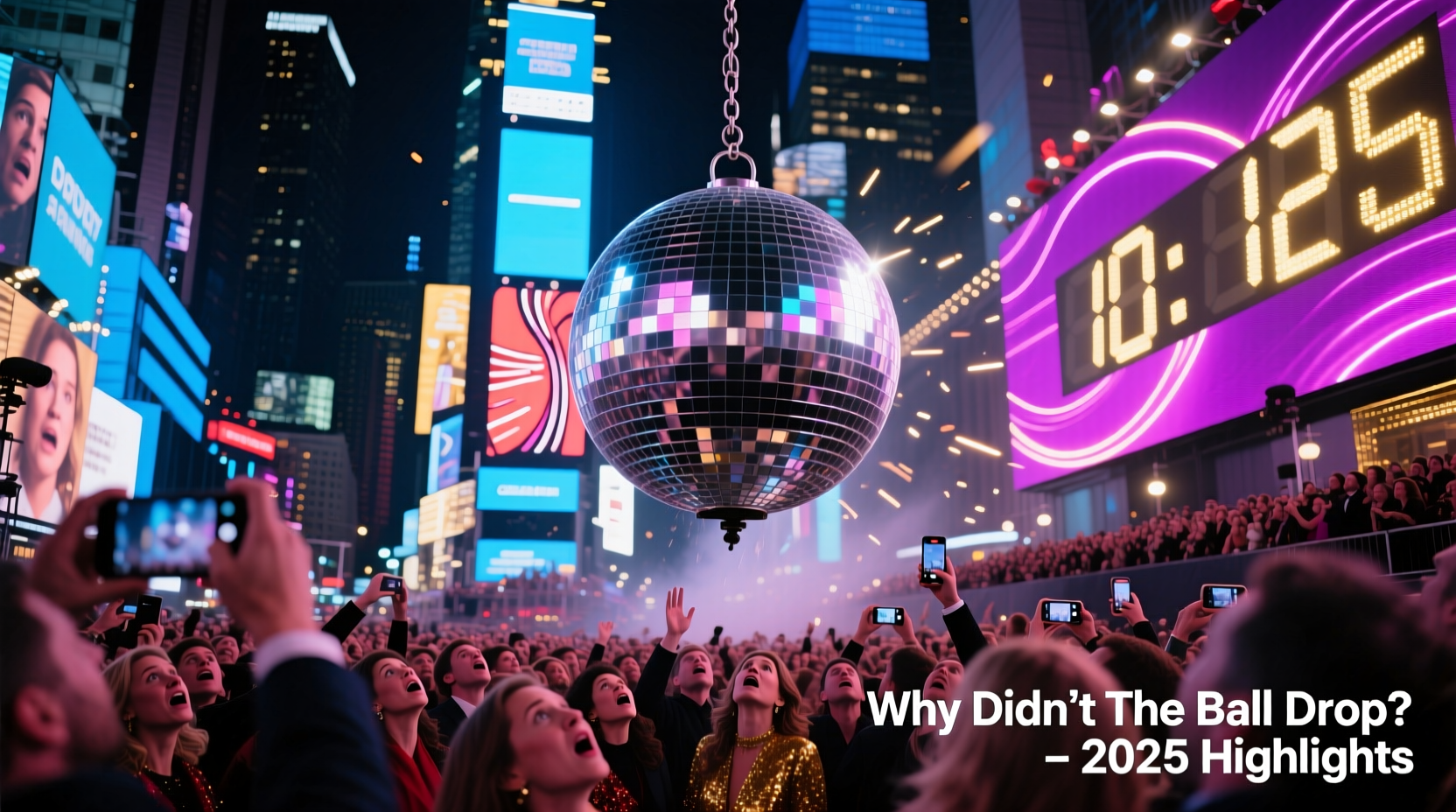
At precisely 11:59 PM EST on December 31, 2024, the traditional countdown began. Crowds packed into Times Square, cameras rolled globally, and anticipation peaked. The ball began its initial ascent as part of the ceremonial sequence. However, as the final ten seconds approached, the audio feed cut out momentarily. Confusion rippled through the crowd. Then, at “3… 2… 1…”—the ball remained suspended at the top of the flagpole.
No explosion of confetti. No music crescendo. No official declaration of “Happy New Year!” from the stage. Instead, city officials and event coordinators activated emergency procedures. A brief announcement confirmed: “Due to an unforeseen technical failure in the rigging system, the ball will not descend. Public safety remains our priority.”
The decision to halt the drop was made in real time by the Joint Operations Center (JOC), which oversees security and logistics for the event. According to internal reports, sensors detected abnormal tension in the primary cable mechanism just 90 seconds before midnight. Engineers feared a catastrophic failure that could endanger the thousands below.
Tip: Always verify breaking news through official channels during live events—misinformation spreads quickly when expectations are disrupted.Root Causes: Why the Ball Didn’t Drop
The official post-event report released by the Times Square Alliance and NYC Department of Citywide Administrative Services (DCAS) identified three interrelated factors:
- Mechanical Failure: The main winch motor failed due to an electrical surge caused by overloaded backup generators during a sudden power grid fluctuation.
- Software Glitch: The fail-safe override system, designed to engage if stress levels exceed thresholds, locked the rigging in place—but failed to trigger audible alarms for the control booth.
- Human Oversight: Routine stress tests had been delayed by two weeks due to winter weather, leaving critical components unverified under full load conditions.
While no injuries occurred, the incident raised serious questions about redundancy planning. “We have multiple backups,” said DCAS Commissioner Jessica Rourke in a press briefing, “but we now see that layered failures can still bypass them. This was a wake-up call.”
Public Reaction and Media Coverage
Social media erupted within minutes. Hashtags like #NoBallDrop and #NYE2025Takedown trended globally. Reactions ranged from confusion to humor. Memes depicted the ball as “ghosting humanity” or “needing therapy after 120 years of pressure.” Others expressed genuine disappointment, especially tourists who had traveled long distances for the experience.
Yet many praised the city’s transparency and prioritization of safety. News outlets such as CNN and BBC highlighted the responsible decision-making, noting that similar risks had nearly materialized in past years but gone unnoticed.
“We’d rather disappoint a million people safely than risk one life for tradition.” — Mayor Eric Adams, Press Conference, January 1, 2025
Still, criticism emerged. Some questioned whether digital alternatives—like augmented reality drops visible via smartphone apps—could preserve the spectacle without physical risk. Others pointed to aging infrastructure across public events as a systemic issue needing investment.
Timeline of Key Events: From Countdown to Resolution
The following timeline outlines the critical moments of New Year’s Eve 2024–2025 in Times Square:
- 11:50 PM: Final systems check completed; all indicators green.
- 11:57 PM: Power grid experiences micro-fluctuation; backup generators activate.
- 11:58:15 PM: Sensor detects irregular torque in primary cable drum.
- 11:58:30 PM: Control team initiates lockout protocol; cannot manually override due to software freeze.
- 11:59:00 PM: Countdown proceeds without intervention; crowd unaware of internal alert.
- 12:00:05 AM: Announcement made: ball will not drop. Confetti release canceled.
- 12:10 AM: Alternate celebration begins with light show and recorded message from city leaders.
- 1:30 AM: Crowd disperses calmly; no incidents reported.
- January 2, 2025: Full investigation launched by DCAS and third-party engineering firm.
Lessons Learned and Future Preparations
In response to the incident, the Times Square Alliance announced a series of reforms aimed at preventing recurrence. These include:
- Upgrading to fiber-optic sensor networks for real-time structural monitoring.
- Implementing AI-driven predictive maintenance models.
- Introducing dual-redundant control systems with manual override capabilities.
- Scheduling mandatory pre-event stress tests 30 days prior, regardless of weather.
Additionally, plans are underway to develop a hybrid celebration model for 2026, incorporating synchronized drone displays above Manhattan as a visual complement—or alternative—to the physical ball drop.
| Factor | Issue in 2025 | Planned Fix for 2026 |
|---|---|---|
| Power Supply | Overloaded backup generators caused surge | New isolated microgrid with solar-assisted charging |
| Control Software | Fail-safe engaged but silenced alerts | Redundant alarm systems with audible/visual triggers |
| Testing Schedule | Delayed due to weather | Mandatory test window moved earlier; indoor simulation available |
| Crowd Communication | Late public notification | Real-time mobile alerts via NYC Alert System integration |
FAQ: Common Questions About the 2025 Ball Drop Cancellation
Was the ball drop canceled because of terrorism or security threats?
No. The cancellation was solely due to mechanical and technical failures. The NYPD confirmed no credible threats were present, and security operations ran normally throughout the night.
Will the same ball be used in 2026?
Yes, the 2025 Waterford Crystal ball will be reused after undergoing comprehensive inspection and refurbishment. Its design theme—“Unity & Light”—will remain symbolic of resilience.
Were refunds issued to attendees?
There are no tickets for general admission to Times Square on New Year’s Eve. However, hospitality partners offering premium viewing packages have extended discounts for future events.
Tip: Follow @TimesSquareNYC and NYC Emergency Management on social media for real-time updates during major public events.A Real Example: One Visitor’s Experience
María Lopez, a schoolteacher from Austin, Texas, had saved for two years to bring her family to Times Square for New Year’s Eve. “We got there at 4 PM, bundled up, singing songs to stay warm,” she recalled. “When the countdown hit zero and nothing happened… there was this weird silence. Then someone started clapping. Then everyone joined in.”
Though disappointed, María said the moment became unexpectedly meaningful. “We hugged, wished each other happy new year, and realized the real magic wasn’t in a ball—it was in being together, hopeful, at the edge of something new.” Her story echoed across forums and news segments, reminding organizers that while spectacle matters, human connection defines the experience.
Conclusion: Tradition Evolves, But Endures
The 2025 Times Square Ball Drop may go down in history not for its execution, but for what it revealed: that even the most enduring traditions must adapt to survive. The failure was not just mechanical—it was a reflection of growing pressures on urban infrastructure, climate volatility, and the need for smarter, safer public events.
Yet the spirit of New Year’s Eve prevailed. Millions still celebrated. Lives were not lost. And improvements are already being implemented to ensure reliability moving forward. The ball may not have dropped, but hope did not falter.
💬 What do you think should change about the Times Square celebration? Share your thoughts on safety, technology, or tradition—we’d love to hear from you.








