
Cork is one of nature’s most remarkable renewable materials—harvested from the bark of the Mediterranean cork oak without harming the tree, regenerating every 9–12 years. Yet despite its eco-credentials, an estimated 70% of natural wine corks in the U.S. still end up in landfills, where they degrade slowly and release methane under anaerobic conditions. That’s not sustainability—it’s missed opportunity. Fortunately, a growing network of municipal initiatives, nonprofit collection hubs, and corporate take-back programs now makes cork recycling accessible, practical, and genuinely impactful. This article cuts through the confusion: it explains how cork recycling works, where to find verified programs in your region, what qualifies (and what doesn’t), and precisely how to prepare and submit your corks—step by step. No fluff. No assumptions. Just actionable, geographically grounded guidance backed by real infrastructure data and on-the-ground experience.
Why Cork Recycling Matters—Beyond the “Green” Label
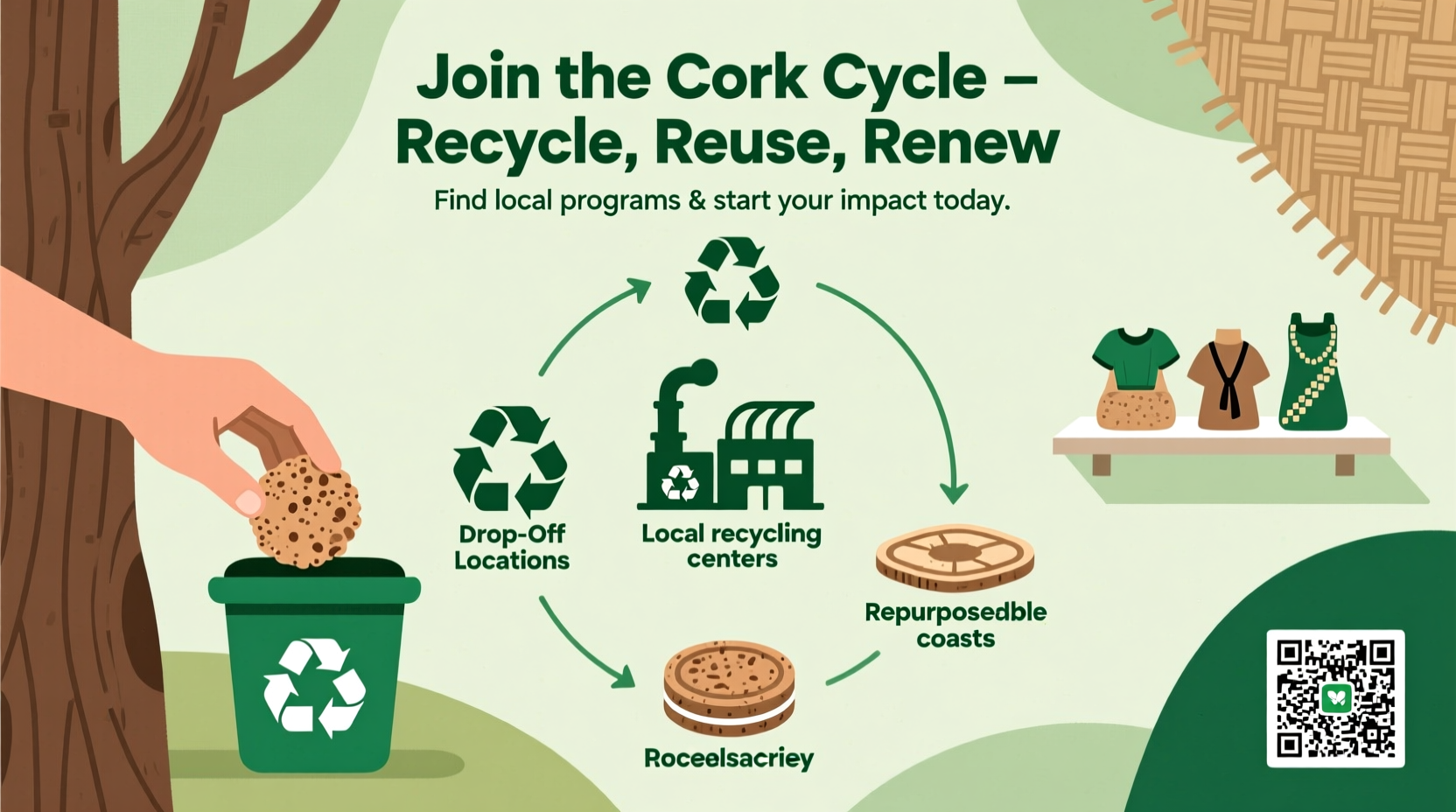
Cork isn’t just biodegradable—it’s carbon-negative during growth. A single mature cork oak sequesters up to 14 times more CO₂ than it emits during harvesting and processing. But that climate benefit collapses when used corks are landfilled. In landfill conditions, organic matter decomposes without oxygen, producing methane—a greenhouse gas 28 times more potent than CO₂ over a 100-year horizon. Recycling closes that loop: ground cork becomes insulation board, acoustic panels, gasket material, or even new flooring—diverting waste while displacing petroleum-based alternatives.
Unlike plastic or aluminum, cork requires no chemical reprocessing. Mechanical grinding preserves its cellular structure and insulating properties. And because it’s lightweight and stable, shipping costs and emissions remain low—even for cross-country collection. That’s why programs like ReCork and Cork ReHarvest report average transportation emissions of just 0.03 kg CO₂e per kilogram of collected cork.
“Cork recycling is among the lowest-barrier circular economy actions available to consumers. It demands no behavior change beyond consistent collection—and delivers measurable carbon and material benefits at scale.” — Dr. Sofia Mendes, Senior Materials Scientist, European Cork Institute
How to Find Verified Programs Near You (No Guesswork Required)
Not all “cork recycling” listings are equal. Some websites list defunct drop-off points; others promote mail-in services with hidden fees or vague eligibility rules. To identify trustworthy options, follow this three-tier verification method:
- Check municipal solid waste (MSW) directories: Visit your city or county’s official waste management website and search “organics,” “specialty recycling,” or “hard-to-recycle items.” As of 2024, 42 U.S. municipalities—including Portland (OR), Austin (TX), and Madison (WI)—list cork as accepted at designated transfer stations or community collection events.
- Use the ReCork Locator Map: ReCork (a nonprofit launched in 2008) operates the largest verified network in North America, with over 1,200 active drop-off locations—including Whole Foods Market stores, Sur La Table, and select wine shops. Their map (recork.org/locations) is updated weekly and filters by ZIP code, distance, and whether the site accepts only natural corks or also composite/synthetic stoppers (it does not—see table below).
- Verify nonprofit partnerships: Organizations like Cork Forest Conservation Alliance (CFCA) and Cork ReHarvest partner directly with regional wineries and co-ops. If you live near a wine-producing area—Napa, Sonoma, Willamette Valley, Finger Lakes, or Central Coast—contact local wineries directly. Over 68% of CFCA-partnered wineries accept public cork donations during business hours.
What Counts—and What Doesn’t: The Cork Acceptance Checklist
Confusion about acceptable materials is the top reason participation fails. Not all corks are created equal—and mis-sorted corks contaminate entire batches. Use this checklist before dropping off or mailing:
- ✅ Natural cork stoppers: Solid, uncoated, beige-to-tan cylinders from wine bottles (most common). May have branding or laser etching.
- ✅ Cork coasters, trivets, or small craft pieces: 100% natural cork, no glue, no backing, no paint.
- ✅ Unused cork sheets or scraps: From DIY projects or packaging inserts—clean and dry.
- ❌ Synthetic corks: Made from plastic polymers (often bright red, black, or blue; squeezes flat and rebounds slowly).
- ❌ Composite corks: Layers of cork dust bonded with glue or resin—usually segmented, gritty to sand, or labeled “agglomerated.”
- ❌ Corks with foil capsules, wire cages, or glue residue: Remove foil and wire first. Rinse off sticky residue if possible.
- ❌ Cork mixed with rubber, silicone, or metal: Includes champagne stoppers with mushroom-shaped tops and embedded wires.
| Material Type | Acceptable? | Why or Why Not |
|---|---|---|
| Natural wine cork (uncoated) | Yes | 100% pure cork; ideal for grinding into technical applications. |
| Agglomerated cork (glued granules) | No | Binders interfere with mechanical processing; contaminates batches. |
| Synthetic “cork” (plastic) | No | Non-biodegradable; melts at high temps, damaging grinding equipment. |
| Cork yoga mat | No | Contains rubber backing, dyes, and adhesives—not separable at scale. |
| Cork bulletin board (backed with fiberboard) | No | Composite material; cannot be mechanically separated economically. |
A Real-World Example: How Portland, Oregon, Scaled Community Participation
In 2021, Portland’s Bureau of Planning and Sustainability partnered with ReCork and local wine retailer Cork & Cap to pilot a neighborhood-level cork drive. They installed 12 clearly labeled, weather-resistant collection bins at libraries, farmers’ markets, and community centers—each with bilingual signage explaining acceptable materials and linking to a QR code for the ReCork map.
The initiative didn’t rely on awareness alone. Volunteers hosted “Cork Sorting Saturdays” at three high-traffic locations, offering gloves and small mesh bags for home collection. They demonstrated how to distinguish natural from synthetic corks using the “squeeze-and-hold” test (natural cork compresses and holds shape briefly; synthetic rebounds instantly). Within six months, collection rose from 87 lbs/month to 1,420 lbs/month. By 2023, the program expanded citywide—and inspired similar efforts in Eugene and Salem.
Key insight: Success hinged on tactile education and frictionless access—not just information. Residents weren’t asked to change habits; they were given tools to integrate recycling into existing routines—like grabbing a reusable bag at the library or stopping by the market.
Your Step-by-Step Participation Guide
Follow this sequence exactly. Skipping steps leads to rejection—or worse, unintentional contamination.
- Collect consistently: Keep a dedicated, ventilated container (e.g., a clean coffee can with holes punched in the lid) in your kitchen or pantry. Avoid plastic bags—they trap moisture and encourage mold.
- Sort rigorously: Before adding each cork, perform the two-second test: pinch firmly. If it springs back immediately → synthetic → discard in trash. If it yields and holds compression for 1–2 seconds → natural → keep.
- Clean minimally: Rinse corks only if visibly soiled with wine residue. Air-dry fully on a rack (never in direct sun). Do not use soap, vinegar, or bleach—residues interfere with binding in recycled products.
- Prepare for drop-off: Place dried corks loosely in a paper bag or cardboard box (no plastic). Label clearly: “Natural Cork Only.” If mailing via ReCork, use their free pre-paid label (available at recork.org/mail) and ship in a reused box lined with newspaper.
- Confirm receipt: At drop-off sites, ask for a receipt or photo confirmation. For mail-ins, track your package. ReCork provides quarterly impact reports showing total pounds diverted and CO₂ saved—opt in during sign-up.
Frequently Asked Questions
Can I recycle cork from olive oil or spirits bottles?
Yes—if the stopper is 100% natural cork. Many premium olive oil and craft spirit producers use natural corks identical to wine stoppers. Apply the same squeeze test and cleaning protocol. Avoid corks with wax seals unless the wax is fully removable by gentle scraping.
What happens to my corks after collection?
ReCork grinds corks into fine granulate, then binds them with bio-based resins to create dense, durable panels used in construction (underlayment, wall insulation) and consumer goods (shoe soles, handbag linings). Cork ReHarvest partners with manufacturers like Wicanders to produce certified sustainable flooring. Less than 0.5% of collected material is rejected—primarily due to synthetic contamination.
I live in a rural area with no nearby drop-off. Is mail-in cost-effective?
Yes—for quantities over 5 lbs. ReCork’s free shipping label covers standard ground transit. At current rates, shipping 10 lbs costs $4.20 commercially—but ReCork absorbs it entirely. For smaller amounts (<2 lbs), wait until you’ve collected enough or coordinate with neighbors to fill one box. Their system rewards volume: every 10 lbs diverted equals ~1.2 kg CO₂e avoided.
Conclusion: Your Cork Is Not Waste—It’s a Resource Waiting for Purpose
You don’t need a backyard compost bin or solar panels to participate in the circular economy. You need a coffee can, 30 seconds to test a cork, and one intentional trip to a verified drop-off point—or a reused box and a printer. Sustainable cork recycling is uniquely democratic: it asks little but delivers much—reducing landfill burden, conserving ancient forests, and supporting green manufacturing jobs across Portugal, Spain, Italy, and the U.S. Every natural cork you divert is a vote for systems that honor regeneration over extraction. Start today—not when you have “enough,” but with the very next bottle you open. Then tell a friend. Share your drop-off photo on social media with #CorkCycle. Because real sustainability isn’t measured in grand gestures. It’s built, grain by grain, cork by cork.
💬 Found a program near you—or started your own cork collection habit? Share your ZIP code and experience in the comments. Let’s map the next wave of community-led recycling together.








