Obtaining a driver’s license in California is a necessary milestone for residents who want the freedom and flexibility of driving legally. Whether you’re a first-time applicant, relocating from another state, or renewing after a lapse, navigating the Department of Motor Vehicles (DMV) process can feel overwhelming. With long wait times, strict documentation rules, and multiple testing requirements, preparation is key. This comprehensive guide walks you through every stage—from eligibility to final issuance—with practical advice, official requirements, and strategies to avoid common pitfalls.
Eligibility and Basic Requirements
To qualify for a California driver’s license, applicants must meet several criteria set by the DMV. These vary slightly depending on age, residency status, and whether the license is original, renewed, or transferred from another state.
- You must be at least 16 years old to apply for a provisional license (with restrictions), and 18 for a full Class C license.
- You must be a California resident.
- You must provide proof of identity, Social Security Number (if assigned), and two proofs of California residency.
- You must pass vision, knowledge, and driving skill tests unless exempt.
Non-U.S. citizens may also apply but must provide valid immigration documents such as a passport with I-94 record or Employment Authorization Document (EAD).
Tip: Schedule your DMV appointment online early—wait times for in-person visits often exceed three weeks without one.Step-by-Step Process to Get Your License
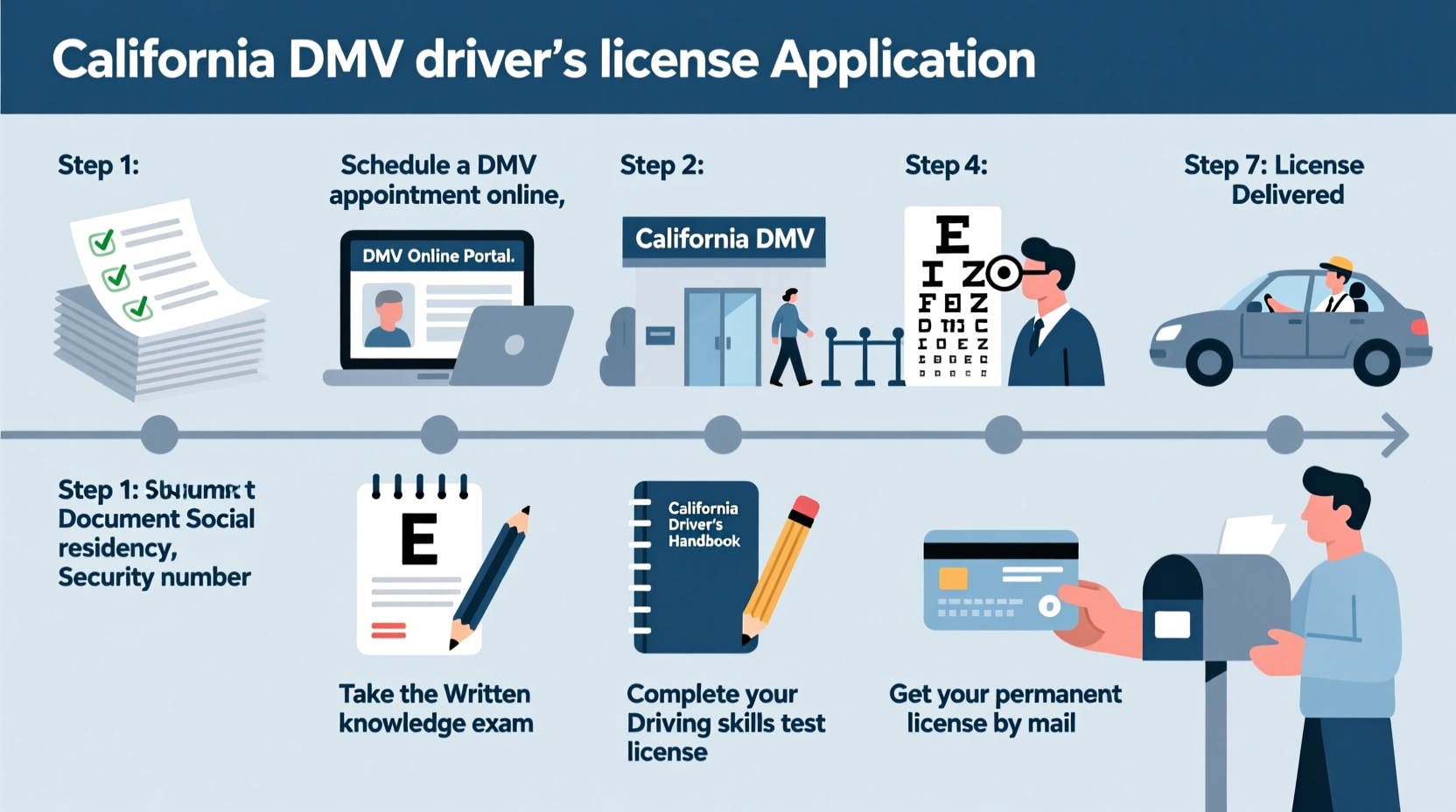
The journey to getting your California driver’s license involves several structured steps. Follow this timeline to stay organized and minimize delays.
- Determine your license type: Most adults apply for a Class C license (non-commercial vehicles). Other classes include motorcycle (Class M), commercial (Class A/B), or instruction permits (Learner’s Permit).
- Gather required documents: Bring originals—no photocopies accepted—for identity, SSN, and residency verification.
- Complete the DL 44 application form: Available online or at DMV offices. Minors need parental consent.
- Schedule a DMV appointment: Use the California DMV website to book a visit for written and driving tests.
- Pass the vision exam: Minimum requirement is 20/40 acuity in each eye with or without correction.
- Take the knowledge (written) test: Covers road signs, traffic laws, and safe driving practices.
- Complete behind-the-wheel training (if under 18): Requires 50 hours of supervised driving, including 10 at night.
- Pass the driving (behind-the-wheel) test: Evaluates vehicle control, lane usage, parking, and response to traffic signals.
- Pay all applicable fees: Includes application, written test, and driving test charges.
- Receive your temporary license: Issued immediately upon passing; permanent card arrives by mail within 2–3 weeks.
Required Documents Checklist
One of the most common reasons for DMV delays is incomplete documentation. Use this checklist to ensure you bring everything needed.
Checklist: What You Need to Apply- ✅ Completed DL 44 Application Form (signed)
- ✅ Proof of Identity (e.g., U.S. passport, birth certificate)
- ✅ Proof of Social Security Number (SSN card, W-2, pay stub)
- ✅ Two Proofs of California Residency (e.g., utility bill, lease agreement, bank statement)
- ✅ Parental consent form (if under 18)
- ✅ Valid learner’s permit (if applying for provisional license)
- ✅ Payment for fees (cash, card, check—varies by location)
Fees and Costs Breakdown
Understanding the financial commitment helps avoid surprises at the counter. All fees are subject to change; verify current rates on the official DMV site.
| Service | Fee (as of 2024) |
|---|---|
| New Driver’s License (Class C) | $38 |
| Knowledge Test Fee | Included in application |
| Driving Test Fee | $38 (one free retest if failed) |
| Learner’s Permit | $38 |
| Out-of-State License Transfer | $38 + $7 processing fee |
Note: If you're under 17.5 years old, you must hold a learner’s permit for at least six months before scheduling the driving test.
Preparing for the Knowledge and Driving Tests
Success on both exams requires focused study and practice. The knowledge test consists of 46 multiple-choice questions; you must answer 38 correctly (83%) to pass.
Study resources include:
- California Driver Handbook – Free PDF on DMV website
- Official DMV practice tests (available online)
- Third-party apps like “DMV Written Test” or “Driver’s Ed
For the behind-the-wheel test, evaluators look for:
- Proper mirror and shoulder checks before lane changes
- Smooth acceleration and braking
- Correct stopping distance at stop signs and red lights
- Safe parallel parking (within 18 inches of curb)
- Awareness of pedestrians and cyclists
“Many applicants fail not because they can’t drive, but because they overlook small details like signaling early enough or checking blind spots.” — Carlos Mendez, Certified DMV Examiner (Ret.)
Real Example: Maria’s Path to Her First License
Maria, a 17-year-old high school student in Fresno, began the licensing process by studying the CA Driver Handbook during winter break. She completed her 50-hour parent-supervised driving log and scheduled her learner’s permit test online. After passing the knowledge exam on her first try, she practiced driving weekly with her father for five months.
She scheduled her behind-the-wheel test through the DMV portal but missed her appointment due to car trouble. Rescheduling added a two-week delay. On her second attempt, she passed—thanks to practicing parallel parking in a quiet neighborhood the day before. Three weeks later, her laminated license arrived in the mail.
Her advice? “Don’t rush. Practice more than you think you need to, especially in real traffic. And always double-check your appointment date.”
Common Mistakes to Avoid
Even well-prepared applicants run into avoidable issues. Be mindful of these frequent errors:
| Do’s | Don’ts |
|---|---|
| Bring original documents only | Don’t bring photocopies or digital versions |
| Arrive 15 minutes early for appointments | Don’t show up late—appointments may be canceled |
| Ensure your vehicle is clean, insured, and registered | Don’t use a car with dashboard warning lights |
| Wear corrective lenses if needed | Don’t assume you’ll pass the vision test without glasses |
Frequently Asked Questions
Can I transfer my out-of-state license to California?
Yes. New residents have 10 days to obtain a CA license. You’ll need to surrender your current license, pass a vision exam, and possibly the knowledge test. A driving test is usually waived unless your license has expired or there are concerns about your driving history.
What if I fail the driving test?
You get one free retake within 12 months. If you fail again, you must reapply and pay the application fee. Most examiners provide feedback on why you failed—use it to improve before rescheduling.
Can I apply for a Real ID-compliant license?
Yes. As of October 1, 2025, federal identification (like boarding planes or entering federal buildings) will require a Real ID or other acceptable ID. To get a Real ID, you must provide additional documents: a second proof of residency and, if name differs from ID, a legal name change document.
Final Steps and Receiving Your License
After passing the driving test, the DMV will issue a temporary paper license valid for 60 days. Your permanent plastic license will be mailed to your verified California address. It includes your photo, signature, and compliance designation (standard or Real ID).
If you don’t receive your license within three weeks, contact the DMV using your transaction number. Ensure your mailing address is correct—P.O. boxes are not accepted for license delivery.
Conclusion
Earning your California driver’s license is more than a bureaucratic task—it’s a gateway to independence, employment opportunities, and everyday convenience. By understanding the steps, preparing thoroughly, and avoiding common missteps, you can navigate the DMV process efficiently and confidently. Whether you're a teenager earning your first permit or an adult establishing residency, taking the time to get it right pays off in the long run.
💬 Have questions about your specific situation? Share your experience or ask for advice in the comments—helping others navigate the DMV is how we build smarter, safer drivers across California.








