
When you're deep in the wilderness, a dead phone can mean more than just missing social media updates—it could compromise safety, navigation, and emergency communication. For campers, hikers, and outdoor enthusiasts, keeping devices charged is non-negotiable. The two most common solutions are solar powered chargers and traditional power banks. But which one delivers better reliability when it matters most? The answer isn't always straightforward and depends on your trip length, environment, and usage patterns.
This article breaks down the strengths and limitations of both technologies, evaluates real-world performance, and provides actionable insights to help you make an informed decision based on actual field conditions—not marketing claims.
How Solar Powered Chargers Work in the Wild
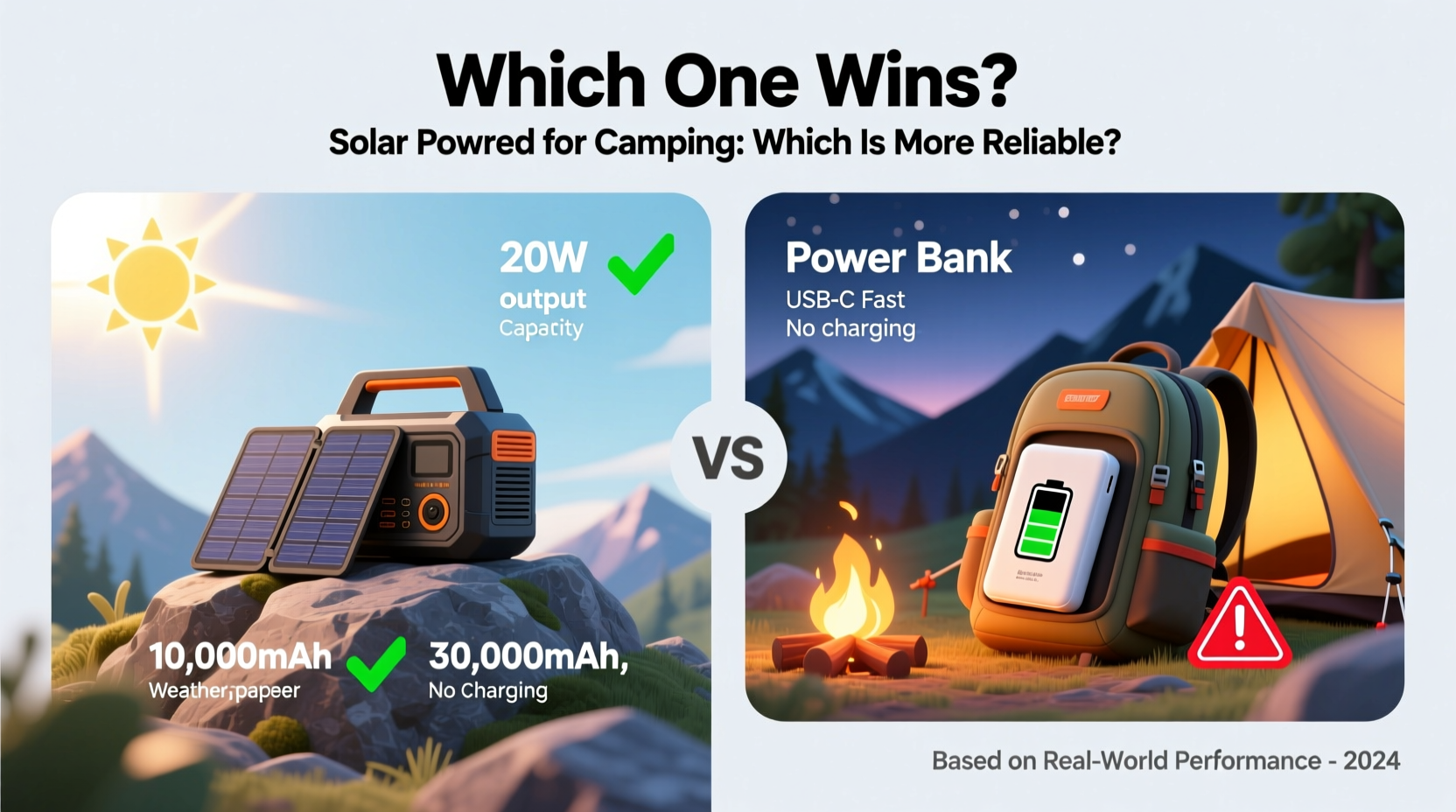
Solar powered chargers convert sunlight into electrical energy using photovoltaic cells. Most portable models are lightweight, foldable panels with USB outputs that connect directly to your devices or charge internal batteries. They’re marketed as eco-friendly, infinitely rechargeable, and ideal for off-grid adventures. In theory, they offer unlimited power as long as the sun shines.
In practice, efficiency varies dramatically. A typical 20-watt solar panel might take 6–8 hours of direct sunlight to fully charge a smartphone, assuming optimal positioning and no cloud cover. Dust, angle, temperature, and shading all reduce output. Early morning and late afternoon light produce significantly less energy due to lower solar intensity.
Many modern solar chargers include built-in battery storage, allowing users to collect energy during the day and use it at night. However, this adds weight and complexity. Pure solar-to-device models without internal batteries require constant sun exposure—making them impractical during storms or in forested areas with heavy canopy cover.
Tip: Angle your solar panel toward the sun every few hours to maximize absorption—especially between 10 a.m. and 2 p.m., when solar irradiance peaks.The Reliability of Power Banks in Remote Conditions
Power banks are essentially portable lithium-ion or lithium-polymer batteries. They store electricity generated from wall outlets or car chargers before your trip. Their main advantage is consistency: what you pack is what you get. A 20,000mAh power bank will reliably deliver approximately four full charges to an average smartphone, regardless of weather or terrain.
High-quality models feature multiple USB ports, fast charging (e.g., USB-C PD), rugged casings, and even built-in flashlights or displays showing remaining capacity. Unlike solar chargers, they work in rain, shade, or at night. You can charge devices inside your tent during a storm or while navigating under thick tree cover.
However, their Achilles’ heel is finite capacity. Once drained, they’re useless unless recharged—something impossible in remote backcountry settings. This makes them best suited for short trips (1–3 days) or as backup units paired with other charging methods.
“On multi-day treks, I never rely solely on solar. It’s too unpredictable. I bring a high-capacity power bank as my primary source and use solar only to extend its life.” — Daniel Reyes, Wilderness Guide & Outdoor Educator
Direct Comparison: Solar Charger vs Power Bank
| Feature | Solar Powered Charger | Power Bank |
|---|---|---|
| Energy Source | Sunlight (renewable) | Pre-charged grid electricity (finite) |
| Charging Time (Smartphone) | 5–10 hours (sun-dependent) | 1–2 hours (consistent) |
| Weather Resilience | Poor (clouds, rain, shade reduce output) | Excellent (works in any condition) |
| Lifespan | 3–5 years (panel degradation over time) | 2–4 years (battery cycle limits) |
| Weight & Portability | Moderate to high (bulky when unfolded) | Low to moderate (compact designs available) |
| Best For | Long trips, sunny climates, eco-conscious users | Short trips, unreliable sunlight, urgent charging |
| Maintenance Needs | Cleaning panels, proper storage, sun tracking | Occasional full discharge/recharge cycles |
Real-World Scenario: A 7-Day Backpacking Trip in the Pacific Northwest
Jenna, an experienced backpacker, planned a week-long solo trek through Olympic National Park. She needed her GPS device, headlamp, and phone charged for navigation and emergency signaling. Her original plan relied on a 25-watt foldable solar charger. On day one, skies were clear, and she managed to top up her phone by 60%. But by day two, persistent drizzle and dense forest cover reduced solar input to nearly zero. By day four, her devices were below 20%, and she had no way to recharge.
She adapted by switching to a dual-strategy approach on future trips: carrying a 26,800mAh power bank as her primary source and pairing it with a smaller 10-watt solar panel to trickle-charge the bank during daylight hikes. This hybrid method ensured she maintained at least 50% reserve throughout her journey—even during overcast stretches.
Her experience highlights a critical insight: solar alone is rarely sufficient for extended trips in variable climates. Combining it with a power bank increases redundancy and overall reliability.
Step-by-Step: Choosing the Right Charging Strategy for Your Camping Style
- Assess Trip Duration: For trips under 72 hours, a high-capacity power bank is usually enough. For longer expeditions, consider solar or a hybrid system.
- Evaluate Terrain and Climate: Open deserts or alpine zones with consistent sun favor solar. Forested, coastal, or mountainous regions with frequent clouds do not.
- Calculate Device Power Needs: List all devices and their battery capacities. Multiply by daily usage frequency to estimate total watt-hours needed per day.
- Select Based on Redundancy: Never depend on a single charging method. Use a power bank as your baseline and solar as supplemental.
- Test Before You Go: Simulate real conditions at home. Charge devices using your gear in partial shade or low light to gauge realistic performance.
Hybrid Approach: Getting the Best of Both Worlds
The most reliable solution for serious campers isn’t choosing between solar and power banks—it’s combining them. A growing number of adventurers use a high-capacity power bank as their primary energy reservoir and deploy a solar charger to replenish it during daylight hours. This setup offers several advantages:
- Stability: The power bank ensures immediate, fast charging regardless of weather.
- Sustainability: Solar extends the usable life of the power bank, reducing dependence on pre-charged capacity.
- Redundancy: If one component fails, the other may still function.
For example, a 20,000mAh power bank charged halfway by a 15-watt solar panel over three sunny days can effectively double its output. Even in suboptimal conditions, a few hours of indirect sunlight can add 10–20% to the bank’s charge—often enough to send an emergency message or navigate back to trailheads.
Frequently Asked Questions
Can solar chargers work on cloudy days?
Yes, but at greatly reduced efficiency—typically 10% to 30% of their rated output. Modern panels can still generate some power under diffused light, but don’t expect rapid charging. Thick storm clouds or heavy tree cover may block usable sunlight entirely.
How long do power banks last in storage?
Lithium-based power banks retain charge for 3–6 months when stored properly. To maximize lifespan, keep them at 50% charge in a cool, dry place. Avoid extreme temperatures, which degrade battery health quickly.
Are solar chargers worth it for weekend campers?
For occasional weekend trips, a solar charger is often overkill. A quality power bank fully charged before departure will likely suffice. Solar becomes more valuable on multi-day or expedition-style trips where resupply isn’t possible.
Essential Checklist: Picking Your Camping Charger
- ✅ Determine total device power requirements (in mAh or Wh)
- ✅ Match capacity to trip length (add 25% buffer)
- ✅ Prioritize durability: look for IP67 or rugged casing ratings
- ✅ Verify compatibility with your devices (USB-C, PD, Qi wireless)
- ✅ Consider weight-to-output ratio (watts per ounce)
- ✅ Test charging speed under real conditions before relying on it
- ✅ Pack backup cables and a multi-port adapter if traveling with a group
Final Verdict: Which Is More Reliable?
When judged purely on reliability—defined as consistent, predictable performance under diverse outdoor conditions—the power bank wins. It delivers stable output regardless of weather, location, or time of day. Its limitations are known and manageable: finite capacity and the need for pre-trip charging.
Solar powered chargers, while appealing for their renewable nature, are inherently less dependable. Their performance fluctuates with environmental factors beyond your control. Relying solely on solar is risky, especially in temperate or unpredictable climates.
That said, dismissing solar entirely would be shortsighted. When used as a supplement to a robust power bank, solar adds resilience and extends operational range. It transforms a finite resource into a semi-renewable one, giving you peace of mind on extended journeys.
The most reliable strategy isn’t choosing one over the other—it’s using both intelligently. Let the power bank be your foundation. Use solar to stretch its life. And always carry more capacity than you think you’ll need.
💬 What’s your go-to charging setup for camping? Share your experiences, favorite gear, or lessons learned in the wild—we’d love to hear how you stay powered off the grid.








