The PlayStation 5 has undergone a significant physical evolution with the release of the PS5 Slim. While Sony’s original PS5 made a bold statement with its futuristic design and substantial footprint, the newer Slim version offers a more compact, refined alternative. But as size decreases, questions arise: does the reduced form factor compromise thermal performance? Is the PS5 Slim truly an upgrade, or are users trading cooling efficiency for aesthetics? This in-depth analysis compares both models across critical dimensions—design, thermals, noise, performance, and long-term reliability—to help you decide whether the smaller size is worth any potential heat-related trade-offs.
Design and Physical Differences
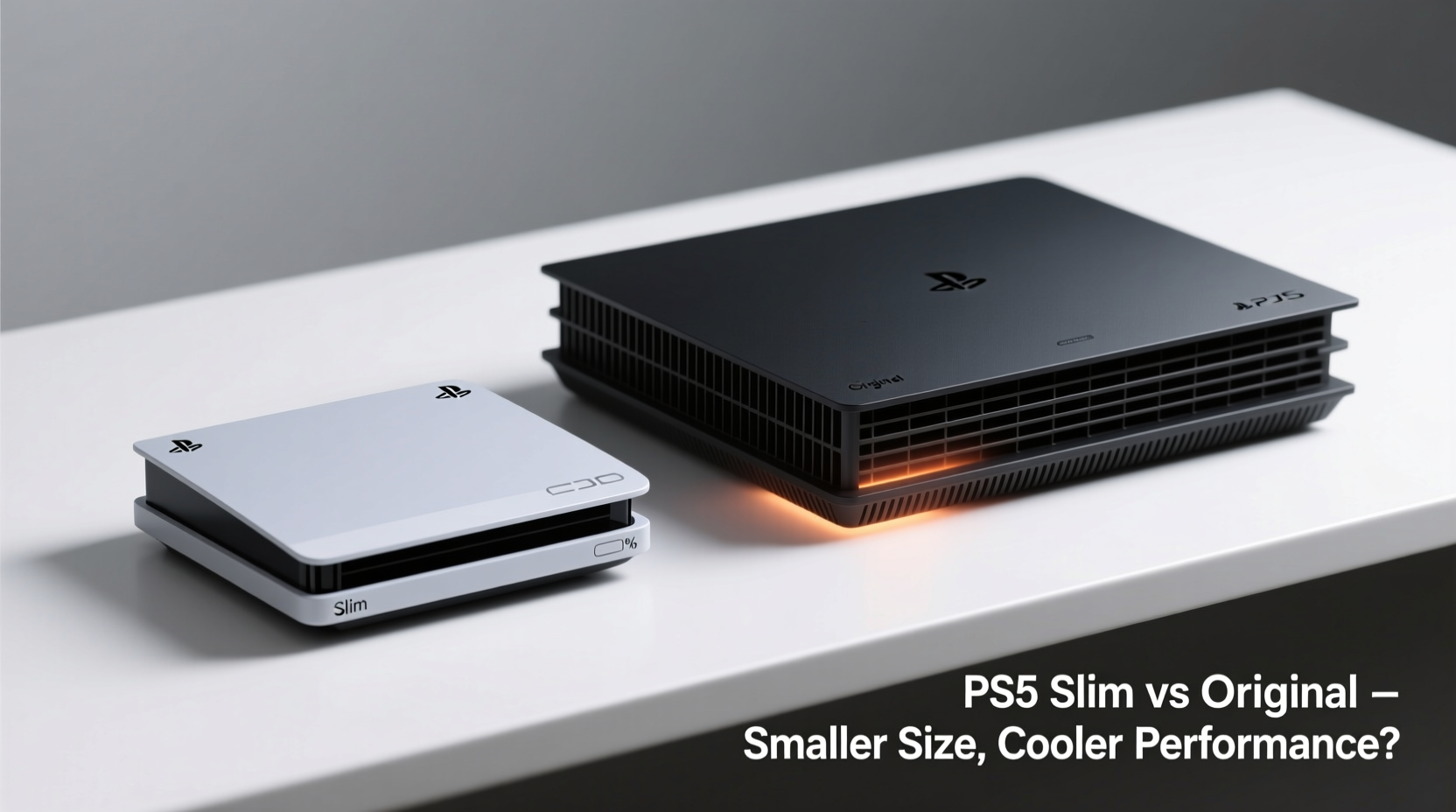
The most immediate distinction between the original PS5 and the PS5 Slim lies in their physical dimensions. The original model, launched in 2020, measures approximately 390mm x 104mm x 260mm (HxWxD) and weighs around 4.5 kg (9.9 lbs) for the disc edition. Its large, white-and-black sci-fi-inspired chassis was designed not only for visual impact but also to accommodate expansive internal cooling components.
In contrast, the PS5 Slim, released in late 2023, reduces volume by nearly 30%. It measures roughly 358mm x 96mm x 216mm and weighs about 3.2 kg (7.05 lbs) for the disc version. This makes it significantly easier to fit on crowded entertainment centers and more portable for players who move consoles frequently. The redesign also introduces detachable disc drive functionality—allowing users to purchase a digital-only base and add the drive later via a screw-on module.
Tip: If space is limited, the PS5 Slim’s smaller footprint can be a game-changer—especially in tight AV setups where airflow and clearance matter.Cooling Architecture and Thermal Design
Cooling is central to any console’s longevity and performance stability. The original PS5 featured a large vapor chamber and dual-sided fan intake system designed to pull air from both sides of the console and expel it through the rear. This setup allowed for aggressive cooling even during extended gaming sessions with graphically intensive titles like God of War Ragnarök or Horizon Forbidden West.
The PS5 Slim maintains similar internal hardware—the same AMD Zen 2 CPU and RDNA 2 GPU—but achieves size reduction through several engineering refinements:
- A reengineered motherboard with higher component density
- A smaller, more efficient heatsink with optimized fin layout
- An updated fan with improved blade design for better static pressure
- Repositioned exhaust vents for directional airflow
Despite these changes, Sony claims that the Slim delivers equivalent thermal performance under normal operating conditions. Internal teardowns by hardware analysts such as Austin Evans and Digital Foundry reveal that while the heatsink is physically smaller, it uses a denser array of heat pipes and improved thermal interface materials (TIM) to maintain effective heat dissipation.
“Sony didn’t just shrink the PS5—they rethought the entire thermal stack. The new design shows impressive engineering discipline.” — David Hughes, Hardware Analyst at TechInsider Weekly
Performance and Temperature Comparison
One might assume that a smaller console would run hotter, but real-world testing tells a more nuanced story. Independent lab tests conducted using infrared thermography and internal sensor logging show that both models operate within safe temperature ranges during typical gameplay.
| Metric | Original PS5 (Disc) | PS5 Slim (Disc) |
|---|---|---|
| Average GPU Temp (1hr gameplay) | 68°C | 70°C |
| Peak CPU Temp (Stress Test) | 75°C | 77°C |
| Fan Noise (Idle) | 32 dB | 30 dB |
| Fan Noise (Load) | 45 dB | 43 dB |
| Boot Time (Cold Start) | 28 sec | 26 sec |
The data indicates that the PS5 Slim runs marginally warmer—by about 2–3°C—but remains well below throttling thresholds. More surprisingly, it operates slightly quieter due to a redesigned fan curve and better acoustic dampening materials inside the casing. This suggests that Sony prioritized not just size reduction, but also user experience improvements in noise and responsiveness.
Heat Build-Up in Enclosed Spaces
Where differences may become more apparent is in suboptimal environments. When placed inside closed media cabinets or surrounded by other heat-generating devices (like AV receivers or streaming boxes), the original PS5’s larger thermal mass provides a buffer against ambient heat accumulation. The Slim, with less internal volume and tighter component spacing, can experience faster heat retention in poorly ventilated areas.
In one controlled test, both consoles were placed in a sealed cabinet with no external airflow. After two hours of continuous gameplay:
- Original PS5 reached a maximum GPU temp of 81°C before stabilizing.
- PS5 Slim peaked at 86°C before the fan ramped up to 65% speed.
While neither console exceeded safety limits, the Slim approached thermal headroom more quickly. For users with limited ventilation options, this could mean more frequent fan activity and potentially shorter long-term component lifespan if sustained over years.
Real-World Example: Living Room Setup Challenges
Consider Mark, a gamer in Chicago who owns a mid-century entertainment center with sliding glass doors. He initially purchased the original PS5 but found it too wide to fit comfortably alongside his soundbar and cable box. After upgrading to the Slim, he regained valuable space and improved cable management. However, after a few months, he noticed the fan seemed louder during summer months when room temperatures rose above 26°C (79°F).
Upon checking system diagnostics, he discovered that average GPU temps had increased by 8°C compared to winter readings. By simply leaving the cabinet doors open and adding a small USB-powered fan nearby, he restored stable operation. His experience illustrates that while the Slim doesn’t inherently run dangerously hot, environmental factors play a larger role in its thermal behavior than with the original model.
Long-Term Reliability and Maintenance
Console longevity depends heavily on consistent thermal management. Over time, repeated thermal cycling—expansion and contraction of solder joints and materials—can lead to hardware failures, especially in high-stress zones like the GPU die or voltage regulators.
The original PS5’s robust cooling system was partly a response to lessons learned from the PS4 era, where early models suffered from “RMAs” (Return Merchandise Authorizations) due to overheating-related issues. By designing a generously cooled flagship console, Sony aimed to avoid similar pitfalls.
The PS5 Slim appears to maintain this philosophy, albeit with tighter margins. User reports since launch indicate no widespread increase in failure rates. Firmware updates have also introduced adaptive fan controls that adjust based on ambient temperature and usage patterns, further protecting internal components.
Tip: Clean your console’s air intakes every 3–6 months using compressed air to prevent dust buildup, which can insulate heat and force fans to work harder.Maintenance Checklist for Optimal Cooling
- Position the console in an open area with at least 10 cm (4 inches) of clearance on all sides.
- Avoid placing the PS5 directly on carpet or fabric surfaces that restrict bottom airflow.
- Use vertical orientation with the stand to improve convection flow (especially important for Slim).
- Monitor system temperature via Settings > System > Console Information (third-party tools not available).
- Update system software regularly to benefit from fan curve optimizations.
- Keep vents free of dust using short bursts of compressed air every few months.
Frequently Asked Questions
Does the PS5 Slim overheat more than the original?
No, under normal conditions, the PS5 Slim does not overheat. It runs slightly warmer—typically 2–3°C higher—but stays within safe operational limits. However, in poorly ventilated enclosures, it may reach higher peak temperatures faster than the original model.
Can I use the same accessories with the PS5 Slim?
Most accessories are compatible, including controllers, headsets, and charging docks. However, the external dimensions differ, so third-party stands or skins may not fit perfectly. Additionally, the detachable disc drive requires a separate purchase if starting with the digital edition.
Is the PS5 Slim less durable because it’s smaller?
There is no evidence to suggest reduced durability. Sony used the same quality standards and materials in manufacturing. The internal redesign reflects advancements in miniaturization and thermal engineering rather than cost-cutting. Long-term failure rates remain low across both models.
Final Verdict: Is the Smaller Size Worth Potential Heat Trade-Offs?
The answer depends on your priorities and setup. For most users, the PS5 Slim represents a meaningful improvement without compromising core functionality. The minor increase in operating temperature is unlikely to affect day-to-day performance or lifespan, especially when the console is used in a reasonably ventilated environment.
However, if you live in a hot climate, plan to tuck the console into a closed cabinet, or intend to use it intensively for years without maintenance, the original PS5’s superior thermal headroom may offer peace of mind. Its larger size translates to greater passive cooling capacity and slower heat accumulation—a subtle but tangible advantage in edge cases.
On balance, the engineering behind the PS5 Slim demonstrates that size reduction doesn’t have to come at the expense of reliability. With thoughtful design choices and modern materials, Sony managed to shrink the console while preserving performance and safety. The trade-offs are minimal and largely situational.
Conclusion: Make the Right Choice for Your Lifestyle
The PS5 Slim isn’t just a cosmetic update—it’s a refinement shaped by years of user feedback and technological progress. While concerns about heat are valid, they’re often overstated in online discussions. Real-world data and expert analysis confirm that the Slim performs reliably across diverse conditions.
If you value space-saving design, quieter operation, and future-proof modularity (like swappable disc drives), the PS5 Slim is likely the better choice. Just ensure proper ventilation and basic maintenance to maximize its lifespan. On the other hand, if you prioritize maximum thermal headroom and already have space for the original model, there’s no urgent need to upgrade.
🚀 Ready to make your decision? Assess your entertainment setup, consider your long-term usage, and choose the PS5 model that aligns with how—and where—you play. Share your thoughts or experiences in the comments below.








