When planning a camping trip, reliable off-grid power is no longer a luxury—it’s a necessity. Whether you’re charging cameras, running a mini-fridge, or keeping your phone alive for emergencies, choosing the right power source makes all the difference. Two popular options dominate the market: portable power stations and solar generators. While they often appear similar, their capabilities, longevity, and device support vary significantly. Understanding these differences helps you decide which system will keep more gear powered for longer in the wild.
Understanding the Core Differences
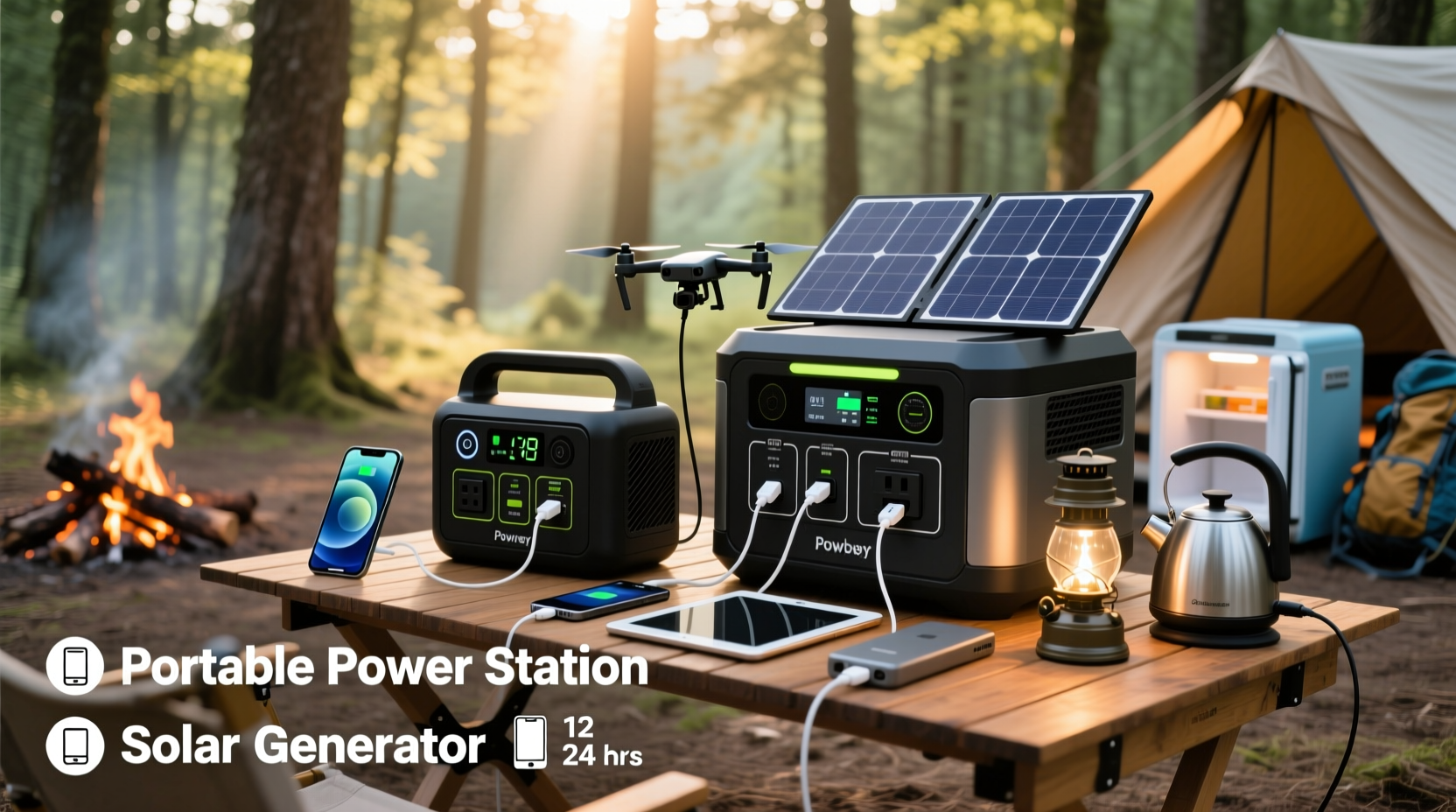
The terms “portable power station” and “solar generator” are frequently used interchangeably, but technically, they refer to different components of an energy system. A portable power station is a self-contained battery unit with built-in AC outlets, USB ports, and sometimes DC inputs. It stores energy but does not generate it. In contrast, a solar generator typically refers to a complete setup that includes solar panels, a charge controller, and a battery (often a power station). The key distinction lies in energy sourcing: one may rely solely on grid charging, while the other integrates renewable solar input.
This difference becomes critical during extended trips where access to electrical outlets is nonexistent. A standalone power station charged at home has a finite energy supply. Once depleted, it cannot recharge unless plugged into a wall or paired with external solar panels. A true solar generator system, however, can replenish its charge daily using sunlight—extending usable runtime indefinitely under optimal conditions.
“Many campers assume their power station is ‘solar-ready,’ but without actual solar panels and proper exposure, they’re just carrying a high-capacity battery with a short shelf life in the field.” — Jordan Lee, Off-Grid Energy Consultant
Capacity and Runtime: How Long Can Each Power Devices?
Battery capacity, measured in watt-hours (Wh), determines how much energy a unit can store. Most portable power stations range from 300Wh to 2,000Wh. For example, a 1,000Wh unit can theoretically run a 100-watt device for 10 hours. However, real-world performance is affected by inverter efficiency, temperature, and depth of discharge.
Solar generators, when properly configured, outperform isolated power stations over time—not necessarily because they have larger batteries, but because they regenerate energy. Consider two scenarios:
- Scenario A: A camper uses a 1,000Wh power station to run a 50W cooler, a 20W fan, and charge phones (10W total). Total load: 80W. Without recharging, this setup lasts about 8–9 hours (factoring in 10% inverter loss).
- Scenario B: Another camper uses the same 1,000Wh station but pairs it with a 200W solar panel. On a sunny day, the panel generates ~600Wh (assuming 3 peak sun hours). This offsets usage and potentially extends operation beyond 24 hours—even powering additional devices like lights or a small projector.
The advantage isn’t raw storage—it’s sustainability. Over multiple days, a solar-integrated system maintains higher average charge levels, allowing continuous use of more devices for longer durations.
Tip: Always oversize your solar panel input by 20–30% to account for cloud cover, angle inefficiency, and dust.Comparison Table: Key Performance Metrics
| Feature | Portable Power Station | Solar Generator System |
|---|---|---|
| Energy Source | Pre-charged (grid only) | Solar + optional grid |
| Recharge During Use | No (unless solar panel added) | Yes, during daylight |
| Max Device Runtime (1,000Wh model) | 8–12 hours (typical mixed load) | Indefinitely, with sufficient sun |
| Ideal For | Weekend trips, car camping near vehicles | Extended backcountry trips, remote locations |
| Portability | High (compact, integrated) | Moderate (panels add bulk) |
| Initial Cost | $$ | $$$ (panels increase cost) |
Real-World Example: A 3-Day Mountain Camping Trip
Mark, an avid backpacker, planned a three-day solo trek into the Sierra Nevada. He needed to power a satellite communicator (5W), LED lantern (7W), drone (charged twice at 60Wh each), and camera batteries (30Wh total). His total estimated consumption: ~170Wh.
He tested two setups:
- Option 1: A 500Wh portable power station (Jackery Explorer 500), charged fully before departure. No solar input.
- Option 2: The same station, but connected to a 100W foldable solar panel during daylight hours.
In Option 1, Mark conserved power carefully. By day three morning, the station was at 12%, enough for emergency signaling but unable to charge the drone again. In Option 2, despite similar usage, the solar panel restored ~280Wh over three days (averaging 90Wh per day). The battery never dropped below 45%, and he had surplus power to run a small speaker for an hour.
The outcome illustrates a broader truth: even moderate solar input transforms a finite power reserve into a renewable resource. For multi-day excursions, especially beyond vehicle reach, solar integration dramatically increases functional device count and operational duration.
Step-by-Step Guide: Maximizing Device Runtime on a Camping Trip
To get the most out of either system, follow this practical sequence:
- Calculate your total power needs. List every device, its wattage, and expected daily usage. Multiply watts by hours to get watt-hours (Wh) per device. Sum them up.
- Select a power station with 25–30% more capacity than needed. This buffer accounts for inefficiencies and unexpected usage.
- If camping beyond two days, invest in compatible solar panels. Ensure voltage and connector compatibility (e.g., MC4, XT60).
- Set up panels at optimal angles. Face them directly toward the sun, adjusting every few hours if possible. Morning and midday are most productive.
- Use devices during peak generation. Run high-draw appliances like kettles or blenders when the sun is strongest to leverage direct solar input.
- Monitor battery levels and prioritize essential gear. Turn off unused devices and avoid deep discharges below 20% to prolong battery lifespan.
Which Powers More Devices Longer? The Verdict
For short trips—under 48 hours—a high-capacity portable power station is often sufficient. It’s simpler, lighter, and requires no setup beyond plugging in devices. However, as trip length increases, so does the advantage of solar integration.
A solar generator system, defined as a power station plus solar panels, enables continuous operation. It doesn’t just store more energy; it harvests new energy daily. This means you can safely power more devices—like CPAP machines (30–60W), electric grills (800W+), or projectors (100W)—without fear of sudden shutdowns.
Moreover, solar systems offer greater resilience. If weather delays your return or a device fails and needs extra charging, solar input provides a safety net. Grid-dependent units offer no such flexibility once drained.
That said, solar effectiveness depends on environment. In dense forests, rainy climates, or winter months with limited daylight, solar gains diminish. In those cases, a larger power station or supplemental charging method (e.g., car adapter) may be preferable.
Frequently Asked Questions
Can I use a portable power station with solar panels later?
Yes, most modern power stations include solar input ports (typically 12–60V DC). As long as your solar panel matches the voltage requirements and connector type, you can add solar capability anytime. Check manufacturer specifications before purchasing panels.
Do solar generators work on cloudy days?
They do, but at reduced efficiency—typically 10–30% of rated output. Monocrystalline panels perform best in low light. Even on overcast days, you can gain meaningful charge, especially with prolonged exposure.
Is a solar generator worth the extra cost?
For occasional weekend campers, a basic power station may suffice. But if you regularly spend 3+ days off-grid, value energy independence, or plan remote adventures, the added cost pays off in extended usability, device support, and peace of mind.
Checklist: Choosing the Right System for Your Needs
- ☐ Determine trip length: under 2 days → power station; 3+ days → consider solar
- ☐ Calculate total watt-hour needs across all devices
- �� Choose a battery with at least 30% excess capacity
- ☐ Verify solar compatibility if planning off-grid recharging
- ☐ Select appropriately sized solar panel (aim for 100–200W for 500–1000Wh stations)
- ☐ Pack cables, adapters, and a sun exposure plan
- ☐ Test the full system at home before departure
Conclusion: Power Smarter, Camp Longer
The choice between a portable power station and a solar generator ultimately hinges on duration, location, and energy demands. For brief outings near civilization, a power station delivers simplicity and reliability. But when you're deep in nature, far from outlets, and need to power multiple devices over several days, a solar generator proves superior—not by storing more, but by sustaining power through renewal.
Technology has made clean, quiet, off-grid electricity accessible to every camper. The real question isn't whether you need power—it's how wisely you use it. By matching your system to your trip profile and embracing solar where possible, you unlock longer stays, richer experiences, and greater freedom in the wild.
💬 Ready to upgrade your camping power setup? Share your experience or ask questions in the comments—let’s build a smarter outdoor community together.








