
Core strength and muscle toning are central goals for many fitness enthusiasts, whether they're recovering from injury, improving posture, or seeking a leaner physique. Two of the most popular mind-body disciplines—Pilates and yoga—are often praised for their ability to sculpt the midsection and enhance overall stability. But when it comes to building deep core strength and achieving visible toning, how do they compare? While both practices emphasize breath, alignment, and control, their philosophies, movements, and outcomes differ in meaningful ways. Understanding these differences can help you make an informed decision about which method aligns best with your fitness objectives.
The Core: What It Really Means
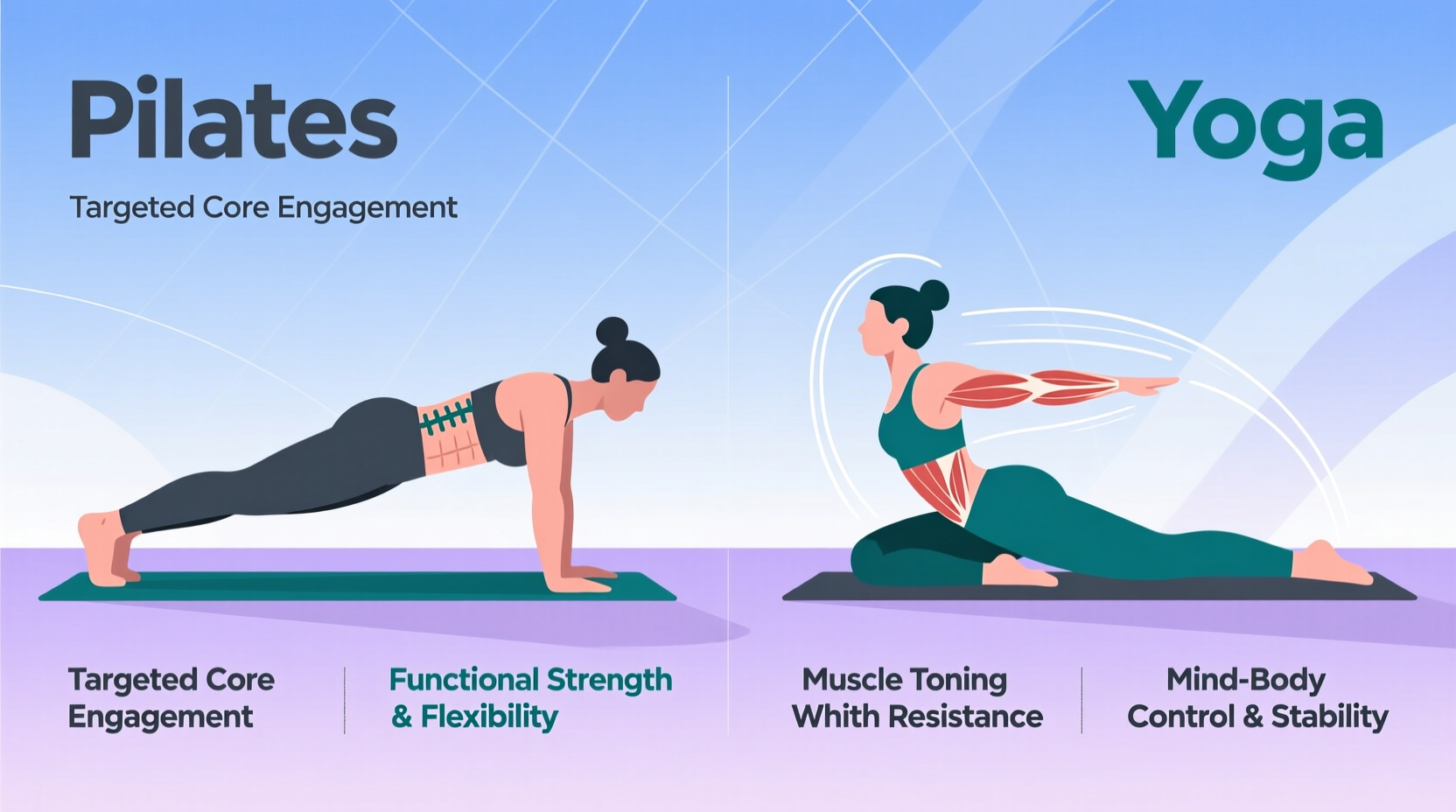
The term “core” is often misunderstood as just referring to abdominal muscles. In reality, the core includes a network of muscles that stabilize the spine and pelvis: the transverse abdominis, obliques, rectus abdominis, multifidus, diaphragm, pelvic floor, and erector spinae. A strong core supports everything from athletic performance to daily posture and lower back health.
Toning, meanwhile, refers to increasing muscle definition through resistance and controlled movement, usually paired with reduced body fat. Neither Pilates nor yoga involves heavy weights, but both use bodyweight resistance, precision, and repetition to build endurance and definition. The key lies in how each system activates and challenges the deep stabilizing muscles.
Pilates: Precision Engineered for Core Activation
Invented by Joseph Pilates in the early 20th century, this method was originally designed to rehabilitate injured soldiers and dancers. Its foundation lies in controlled, low-impact movements that emphasize alignment, breath, and muscular engagement—especially of the deep core.
Pilates exercises such as the \"hundred,\" \"roll-up,\" \"saw,\" and \"teaser\" are specifically engineered to isolate and fatigue the abdominal wall. Unlike traditional crunches, these movements require sustained contraction of the transverse abdominis—the deepest layer of the core—which acts like a natural corset. This focus on stabilization over momentum makes Pilates exceptionally effective for functional strength.
Tip: Engage your core by imagining pulling your navel toward your spine before initiating any Pilates movement. This pre-activation ensures deeper muscle recruitment.Mat-based Pilates relies entirely on bodyweight and leverage, while equipment-based (Reformer) sessions add springs and resistance to increase intensity. Reformer workouts, in particular, allow for progressive overload—a principle essential for muscle toning—by adjusting tension levels over time.
“Pilates doesn’t just strengthen the abs; it teaches you how to use them properly in every movement.” — Romana Kryzanowska, Certified Pilates Master Trainer
Yoga: Balance, Flexibility, and Foundational Core Engagement
With roots in ancient Indian philosophy, yoga integrates physical postures (asanas), breathwork (pranayama), and meditation. While not all styles prioritize core development equally, several forms—including Vinyasa, Ashtanga, and Power Yoga—demand significant abdominal engagement.
Poses like Plank, Chaturanga, Boat Pose (Navasana), and Crow Pose rely heavily on core stability to maintain balance and form. Holding these positions builds endurance in the rectus abdominis and obliques. However, unlike Pilates, yoga often integrates core work within broader sequences focused on flow, flexibility, and breath coordination.
For example, transitioning from Downward Dog to Chaturanga in a Sun Salutation requires precise control of the abdominal wall to prevent sagging in the lower back. Over time, consistent practice strengthens the entire kinetic chain, including the deep core. Yet, because yoga emphasizes holistic wellness over isolated muscle training, its impact on targeted toning may be less direct than Pilates.
Styles That Build Core Strength in Yoga
- Vinyasa Flow: Dynamic transitions challenge core stability throughout class.
- Ashtanga: A structured series with repetitive core-intensive poses.
- Power Yoga: High-intensity variant focusing on strength and endurance.
- Iyengar: Uses props to perfect alignment, enhancing muscle activation.
Comparative Analysis: Pilates vs Yoga for Core and Toning
To evaluate which discipline excels at core strength and toning, consider four key factors: muscle isolation, resistance level, repetition structure, and measurable outcomes.
| Factor | Pilates | Yoga |
|---|---|---|
| Muscle Isolation | High – targets deep core muscles with precision | Moderate – engages core within full-body movements |
| Resistance & Intensity | Adjustable via reformer springs; progressive overload possible | Limited to bodyweight; intensity varies by style |
| Repetition & Fatigue | Frequent repetitions with focus on endurance and burn | Held poses build endurance but fewer reps per session |
| Toning Results | Faster visible definition due to targeted work | Gradual toning, more dependent on overall body composition |
| Mind-Body Connection | Strong emphasis on control and alignment | Deep integration of breath, movement, and awareness |
This comparison shows that Pilates generally offers a more direct path to core strengthening and muscle definition. Its systematic approach allows instructors to progressively challenge clients, making it ideal for those seeking measurable improvements in abdominal tone and spinal support.
Real-World Example: A Six-Week Transformation
Samantha, a 34-year-old office worker, struggled with lower back pain and weak abdominal muscles after two pregnancies. She began attending two weekly Pilates mat classes and one Reformer session. Each class included 15–20 minutes of dedicated core work, with cues to engage her transverse abdominis during every exercise.
By week three, she noticed improved posture and reduced back discomfort. After six weeks, her waistline had visibly tightened, and she could perform full planks for two minutes without shaking. When she tried switching to a Vinyasa yoga class, she found the core demands less consistent. “I felt stretched and centered,” she said, “but not as challenged in my abs.”
Her experience reflects a common trend: individuals seeking rapid, targeted improvement in core strength often achieve faster results with Pilates.
When Yoga Excels: Holistic Strength and Functional Stability
While Pilates may win in targeted core development, yoga offers unique advantages for long-term toning and neuromuscular control. Balancing poses like Warrior III, Half Moon, and Eagle require micro-adjustments governed by the deep core. These subtle corrections improve proprioception—the body’s ability to sense position in space—which enhances everyday movement efficiency.
Additionally, yoga promotes parasympathetic nervous system dominance, reducing cortisol levels. Since high cortisol is linked to abdominal fat storage, regular yoga practice may indirectly support a leaner midsection by managing stress-related weight gain.
Moreover, advanced arm balances (e.g., Side Crow, Eight-Angle Pose) demand extraordinary core engagement combined with upper-body strength. Though these are not beginner-friendly, they represent peak functional toning achievable through dedicated yoga practice.
Step-by-Step Guide to Choosing the Right Practice
Deciding between Pilates and yoga depends on your goals, lifestyle, and physical condition. Follow this five-step process to determine the best fit:
- Define Your Goal: Are you aiming for visible abdominal definition, injury recovery, or general wellness? Pilates is optimal for targeted toning; yoga suits those seeking balance and mental clarity.
- Assess Your Current Fitness Level: Beginners often find Pilates easier to start due to its linear progression. Yoga requires more flexibility and balance initially.
- Evaluate Time Commitment: Both require consistency. Aim for 2–3 sessions per week. Pilates may deliver quicker physical feedback, aiding motivation.
- Consider Access and Cost: Mat Pilates and yoga can be done at home. Reformer studios are more expensive and location-dependent.
- Try Both for Four Weeks: Alternate weeks or combine them. Many studios offer introductory passes. Track changes in strength, posture, and comfort.
Frequently Asked Questions
Can I build visible abs with Pilates alone?
Yes, especially when combined with a balanced diet and cardiovascular exercise. Pilates develops deep abdominal muscles and improves posture, which flattens the stomach. However, visible six-pack abs also depend on body fat percentage, which requires nutritional management.
Is yoga enough for core strength if I’m already fit?
For maintenance and moderate improvement, yes—particularly in dynamic styles like Power Yoga. But if you’re rehabbing an injury or training for athletic performance, supplementing with Pilates can provide more specific core conditioning.
Which is better for lower back pain?
Pilates is widely recommended by physical therapists for lumbar rehabilitation due to its focus on spinal alignment and deep stabilizers. However, restorative and Iyengar yoga can also alleviate back pain by releasing tension and improving posture.
Checklist: How to Maximize Core Results in Either Practice
- ✅ Activate your core at the start of every session
- ✅ Focus on quality over quantity—perfect form beats speed
- ✅ Breathe deeply and consistently to support intra-abdominal pressure
- ✅ Attend classes with certified instructors who cue proper engagement
- ✅ Incorporate at least two core-focused sessions per week
- ✅ Pair your practice with whole foods and hydration for optimal muscle definition
Conclusion: Aligning Practice With Purpose
There is no universal answer to whether Pilates or yoga is better for core strength and toning—it depends on what you want to achieve. If your primary goal is to build a strong, defined midsection with measurable progress, Pilates offers a more targeted, science-backed approach. Its emphasis on precision, repetition, and progressive resistance makes it a top choice for athletes, postpartum women, and anyone rehabilitating core dysfunction.
On the other hand, yoga cultivates a resilient, integrated core through dynamic balance and breath-connected movement. It may take longer to see visible toning, but the benefits extend beyond aesthetics to include mental calm, joint mobility, and sustainable strength.
The smartest path forward might not be choosing one over the other, but integrating both. Use Pilates to build foundational power and definition, then apply that strength in yoga’s fluid, mindful environment. Together, they create a balanced formula for a stronger, leaner, and more capable body.
🚀 Ready to transform your core? Start with one Pilates session this week and track how your body responds. Share your journey in the comments—your experience could inspire someone else to begin theirs.








