
When planning international travel, one of the first questions people ask is: Which passport should I bring — the passport book or the passport card? And more importantly, do I actually need both? The answer isn’t always straightforward. While both documents prove U.S. citizenship and identity, they serve different purposes and come with distinct advantages and restrictions. Understanding these differences can save time, money, and even prevent travel disruptions at borders.
The U.S. Department of State introduced the passport card in 2008 as a cost-effective, convenient alternative to the traditional passport book for specific types of travel. However, confusion persists about where each is accepted and whether carrying both offers meaningful benefits. This guide breaks down the key distinctions, practical applications, and strategic considerations so you can make an informed decision before your next trip abroad.
What Is a Passport Book?
The standard U.S. passport book is a blue-covered document issued by the U.S. Department of State. It contains multiple pages for visas, entry/exit stamps, and other immigration endorsements from foreign countries. Passport books are recognized globally and are required for nearly all forms of international air travel.
Available in two sizes — 28-page and 52-page — the passport book is ideal for frequent travelers who anticipate needing multiple visa stamps or extended stays across several countries. It’s valid for 10 years for adults (16 and older) and 5 years for minors under 16.
Because it’s universally accepted, the passport book remains the gold standard for international identification and travel authorization. Whether flying to Asia, taking a cruise to South America, or backpacking through Europe, this document opens doors worldwide.
What Is a Passport Card?
The passport card is a wallet-sized ID that looks similar to a driver’s license. Like the passport book, it confirms U.S. citizenship and identity but comes with significant limitations on how and where it can be used for international travel.
Issued by the same authority — the U.S. Department of State — the passport card was designed primarily for land and sea border crossings between the U.S., Canada, Mexico, the Caribbean, and Bermuda. It cannot be used for international air travel.
Despite its compact size and lower cost, the passport card includes advanced security features such as RFID chips protected by shielding material to prevent unauthorized scanning. It’s also accepted as proof of citizenship for domestic flights within the U.S., making it a viable REAL ID alternative after May 7, 2025, when enhanced identification will be required for boarding commercial flights.
Tip: If you frequently drive to Canada or Mexico for work or family visits, the passport card offers a convenient, durable option that fits easily in your wallet.Key Differences: Passport Card vs Passport Book
| Feature | Passport Book | Passport Card |
|---|---|---|
| Size | Standard booklet (credit card-sized cover) | Wallet-sized (same dimensions as a credit card) |
| Cost (First-Time Adult) | $130 application fee + $35 execution fee = $165 | $65 application fee + $35 execution fee = $100 |
| Renewal Cost | $110 by mail | $65 by mail |
| Validity | 10 years (adults), 5 years (minors) | 10 years (adults), 5 years (minors) |
| Air Travel | Yes – global access | No – not permitted |
| Land Border Crossings | Yes – with Canada, Mexico, Caribbean, Bermuda | Yes – same regions |
| Sea Port Entries | Yes – including closed-loop cruises | Yes – only on approved routes to select destinations |
| Visa Pages | Yes – up to 52 pages available | No – no space for visas or stamps |
| Domestic Flight ID | Yes – accepted nationwide | Yes – compliant with REAL ID Act |
This comparison highlights that while the passport card is cheaper and more portable, its utility is limited geographically and by mode of transport. The passport book, though bulkier and more expensive, provides maximum flexibility and global acceptance.
Do You Really Need Both?
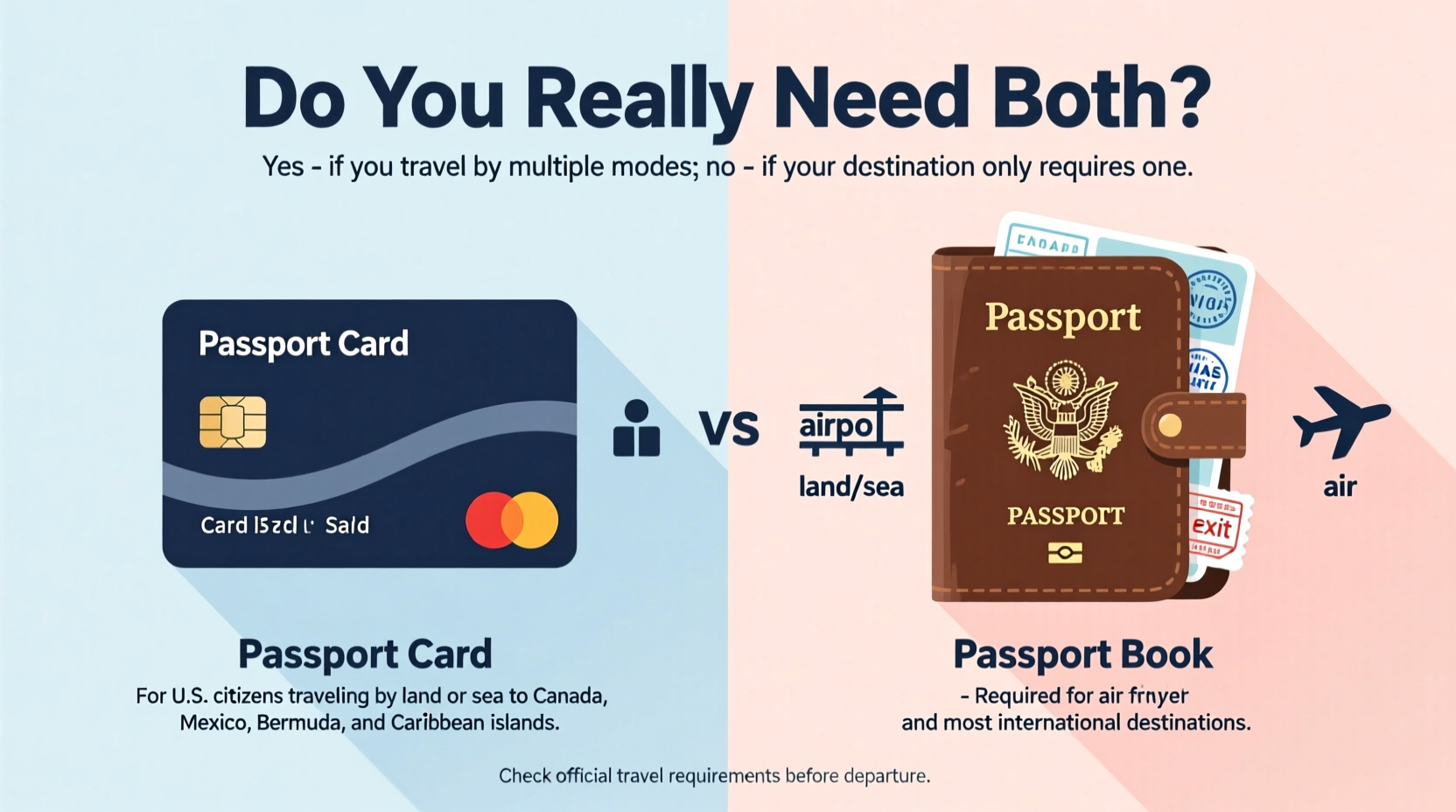
For most travelers, the answer is no — you don’t *need* both. However, there are scenarios where owning both documents offers tangible benefits.
If you only plan to fly internationally, the passport book alone suffices. But if you regularly cross the Canadian or Mexican border by car — perhaps for work, shopping, or visiting family — the passport card becomes a practical companion. Its durability and convenience make it easier to carry daily without risking damage to your passport book.
Additionally, some people choose to keep their passport book safely stored at home and rely solely on the passport card for land and sea trips to nearby countries. This reduces wear and tear on the book and minimizes the risk of loss or theft during routine border crossings.
“Carrying a passport card for land travel helps preserve the condition of your passport book, which you’ll want in pristine shape for international flights.” — Sarah Nguyen, International Travel Advisor and Former Consular Officer
Mini Case Study: Frequent Commuter to Canada
James lives in Buffalo, New York, just 20 minutes from the Peace Bridge crossing into Fort Erie, Ontario. He visits his sister twice a month and often shops for groceries and prescriptions in Canada due to lower prices. Initially, he used his passport book for every trip, but after spilling coffee on it during a winter commute, he had to pay for an expedited replacement.
After that incident, James applied for a passport card. Now, he keeps his passport book locked in a fireproof safe at home and uses the card for all land crossings. When he finally took a flight to Paris last year, he simply retrieved his passport book for the airline check-in. For him, having both documents wasn’t necessary for compliance, but it improved convenience and peace of mind.
Step-by-Step Guide: Choosing the Right Option for Your Needs
- Assess your upcoming travel plans. Are you flying overseas? Staying within North America? Taking a cruise?
- Determine your primary mode of transportation. Air travel requires a passport book. Land or sea trips may allow for a passport card.
- Check destination requirements. Verify whether your destination accepts the passport card for entry — currently limited to Canada, Mexico, the Caribbean, and Bermuda via land or sea.
- Consider frequency of border crossings. If you cross land borders often, the passport card adds convenience.
- Evaluate budget and renewal timelines. The card costs less upfront and to renew, but only supplements—not replaces—the book.
- Decide whether dual ownership makes sense. If yes, apply for both. If not, prioritize the passport book for maximum flexibility.
- Apply early. Standard processing takes 8–11 weeks; expedited service is 5–7 weeks. Delays are common during peak seasons.
Common Misconceptions About Passport Cards
- Misconception 1: “The passport card is a second-class document.”
Reality: It’s fully government-issued and legally equivalent to the book for eligible travel methods and regions. - Misconception 2: “It’s only for emergencies.”
Reality: It’s intended for regular, repeated use in specific contexts — especially land border crossings. - Misconception 3: “You can upgrade a card to a book later.”
Reality: They are separate documents. You must apply and pay for each individually. - Misconception 4: “Cruise lines prefer the card over the book.”
Reality: Most major cruise lines accept either for closed-loop cruises, but always confirm with your carrier.
When the Passport Card Falls Short
There are clear situations where the passport card is insufficient:
- Flying to any international destination — including Canada or the Caribbean — requires a passport book.
- Traveling beyond North America and the immediate Caribbean region is impossible with only a card.
- If you need a visa for your destination (e.g., China, India, Russia), the card cannot accommodate visa stamps.
- In rare cases of emergency evacuation or unexpected international transfers, airlines and embassies require a passport book.
Furthermore, some countries may question the legitimacy of the passport card at border control, particularly outside North America. While technically valid for entry when arriving by land or sea from the U.S., unfamiliarity among foreign officials could lead to delays. Carrying a passport book eliminates such risks.
FAQ: Common Questions About Passport Cards and Books
Can I use a passport card instead of a passport book for a cruise?
Yes — but only for “closed-loop” cruises that begin and end at the same U.S. port and visit destinations like Mexico, Canada, or the Caribbean. If your cruise embarks from one city and disembarks in another (e.g., Miami to Vancouver), you must have a passport book.
Is the passport card safer than the book?
Both are secure, but the passport card includes an RFID chip with privacy shielding to prevent electronic skimming. The passport book also has an RFID chip in newer versions, typically protected by a metal-lined cover. Neither is significantly more vulnerable when used properly.
Can children use passport cards?
Yes. Minors under 16 can apply for both passport books and cards. The same rules apply: cards are acceptable for land and sea travel to Canada, Mexico, the Caribbean, and Bermuda. All children traveling internationally must have their own passport — none can be included in a parent’s document.
Final Checklist: What You Should Do Now
- Confirm your next trip’s destination and transportation method.
- Determine if air travel is involved — if yes, you need a passport book.
- If you frequently drive across the northern or southern U.S. border, consider adding a passport card.
- Check expiration dates — many countries require at least six months of validity beyond your return date.
- Apply or renew early — avoid last-minute stress and potential trip cancellations.
- Store your passport book securely if using a card for routine crossings.
- Keep digital copies of both documents in a secure cloud storage system.
Conclusion: Make the Smart Choice Based on How You Travel
The choice between a passport card, a passport book, or both ultimately depends on your travel habits and future plans. The passport book is essential for anyone who flies internationally or ventures beyond North America. The passport card is a smart, economical supplement for those who cross land borders regularly. Together, they offer a balanced approach — combining global access with everyday convenience.
You don’t need both to comply with regulations, but having both can enhance efficiency, protect your primary travel document, and streamline border experiences. Evaluate your lifestyle, anticipate upcoming trips, and make a decision that supports both your current needs and long-term adventures.
🚀 Ready to prepare for your next journey? Review your passport status today — apply, renew, or add a card before your next trip. A little planning now ensures smooth travels later.








