Order a highball—tequila, mezcal, or raicilla—with soda water, lime, and ice at a thoughtful bar today, and you’re not just tasting spirit: you’re tasting geography. Not in the abstract sense of “Mexican heritage,” but in the precise, mineral-laced language of volcanic slopes, coastal fog banks, and limestone fissures where agave roots grip the earth. Mezcal and raicilla both emerge from the broader family of agave spirits, yet they occupy distinct sensory territories—especially when served long, chilled, and effervescent. In the highball format, where dilution and temperature mute complexity and amplify volatility, terroir doesn’t merely influence flavor—it becomes the dominant voice. Distillation method matters, yes—but in this context, it’s secondary to where the plant grew, how long it waited, and what the land whispered into its piña.
The Highball as a Terroir Amplifier
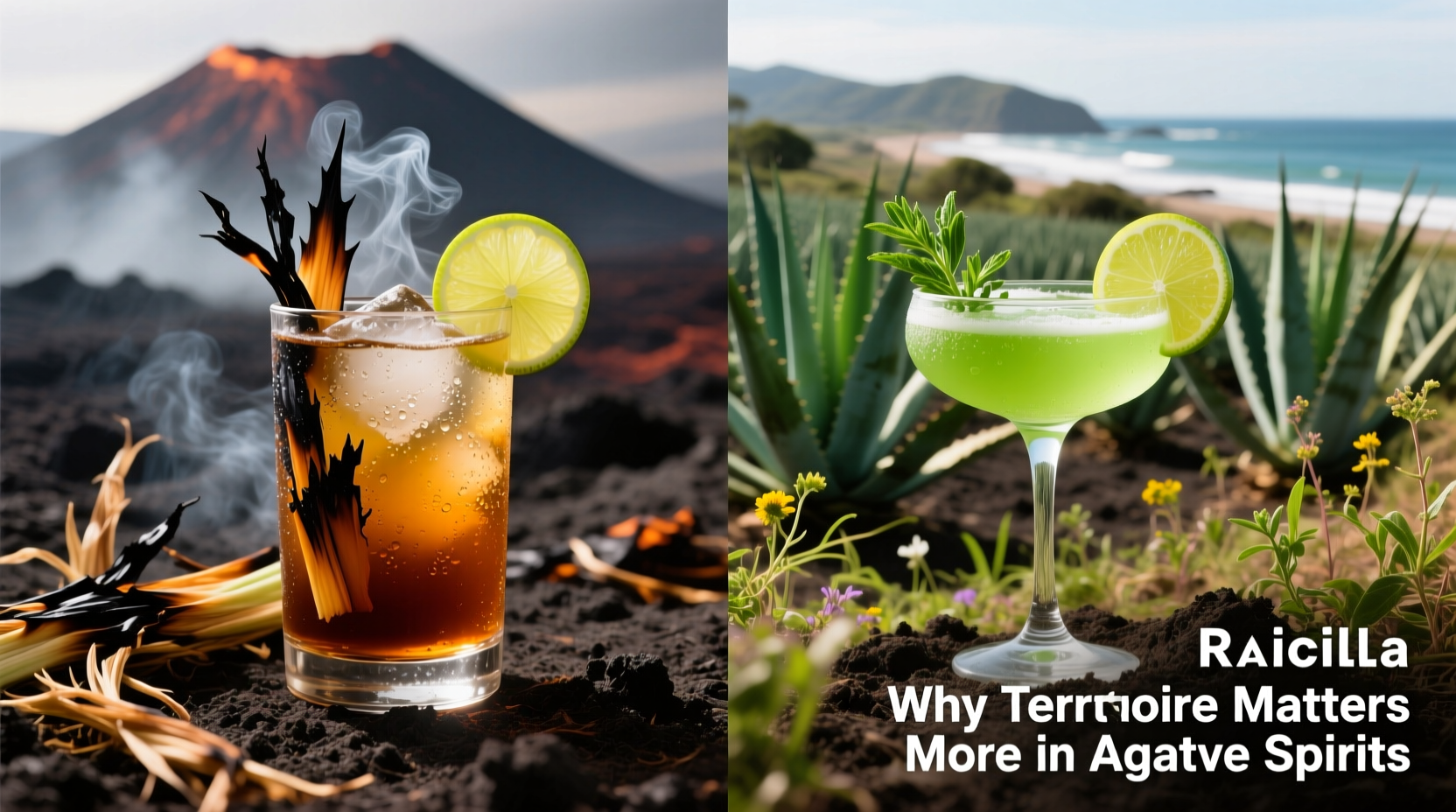
Unlike sipping spirits neat—where smoke, alcohol heat, and congeners dominate—the highball is a reductive format. Carbonation lifts volatile esters and aldehydes; cold temperatures suppress harsh fusel notes while highlighting bright top notes; dilution softens tannins and opens aromatic pathways. This makes the highball unusually transparent: flaws become obvious, and subtleties—like the saline whisper of coastal espadín or the petrichor-dampened funk of mountain-grown raicilla—rise to the surface with startling clarity.
Consider two otherwise identical highballs: one made with Oaxacan mezcal from San Juan del Río (elevation 1,500 m, clay-loam soil over granite), the other with raicilla from Boca de Tomatlán (elevation 300 m, sandy volcanic ash near the Pacific). Even if both are distilled in copper pot stills, aged zero days, and bottled at 45% ABV, their highballs diverge dramatically—not because of process, but because the agave absorbed different minerals, endured different drought cycles, and expressed different stress metabolites. The first yields a highball with crisp minerality, green herb lift, and a chalky finish; the second delivers oceanic salinity, overripe banana esters, and a briny, almost oyster-shell finish.
Tip: For terroir-forward highballs, serve at 4–6°C (not colder) and use large, dense ice cubes—slow melt preserves aromatic integrity without over-diluting delicate top notes.Mezcal: Terroir Through the Lens of Scale and Regulation
Mezcal is governed by a Denomination of Origin (DO) covering nine Mexican states, with Oaxaca producing over 90% of certified output. Its DO mandates specific agave species (over 30 permitted), traditional production methods (roasting in earthen pits, fermentation in wood or stone, double-distillation in copper or clay), and geographic provenance. But critically, the DO also enforces *regional typicity*: a mezcal labeled “San Luis Potosí” must reflect that state’s dominant agaves (like Agave americana var. littoralis) and its limestone-rich, semi-arid highlands.
This regulatory scaffolding creates an implicit terroir taxonomy. For example:
- Santiago Matatlán (Oaxaca): Valley floor, alluvial soils, warm days/cool nights → Espadín expresses black pepper, roasted pineapple, and wet river stone.
- Tlacolula Valley (Oaxaca): Higher elevation, volcanic tuff, seasonal mist → Tobalá shows dried fig, cedar resin, and flinty austerity.
- San Luis Potosí (Zacatecas border): Arid plateau, caliche soils, extreme diurnal shifts → Cuishe reveals medicinal mint, burnt sugar, and dusty mesquite.
In highballs, these distinctions sharpen. A San Luis Potosí cuishe mezcal gains structural tension against soda water—its aridity translates as a clean, almost tannic grip on the palate. Meanwhile, a coastal Guerrero mezcal made from Agave maximiliana (a rare, wild agave) carries iodine and sea spray notes that bloom in carbonation, transforming the drink into something evocative of chilled oysters with lime.
Raicilla: Unregulated Terroir, Raw and Immediate
Raicilla occupies a different plane—both legally and sensorially. Produced primarily in Jalisco’s Sierra Madre Occidental, it lacks formal DO status (though a petition for recognition has been pending since 2021). Historically illicit and still largely artisanal, raicilla production is defined less by regulation and more by inherited knowledge passed through families in remote villages like La Madera, El Cajón, and Boca de Tomatlán. This informality allows terroir to express itself with minimal mediation.
Raicilla’s agave sources are intensely local: Agave maximiliana (coastal), Agave lechuguilla (arid highland), and Agave inaequidens (mid-elevation pine-oak forest). Each grows in isolation, absorbing microclimatic signatures no law could codify. A raicilla from El Cajón—perched at 1,800 meters amid pine forests and morning fog—will taste of damp moss, crushed pine needles, and wild mountain strawberries. That same agave, harvested 30 km west in a sun-baked canyon, develops baked agave sweetness, cumin seed, and dry clay dust.
“Raicilla doesn’t have appellations—it has addresses. You don’t say ‘raicilla from Jalisco.’ You say ‘raicilla from the north-facing slope above Los Verdes, harvested after the first October rain.’ That’s how precise the land speaks.” — Rodrigo Gómez, third-generation raicillero and co-founder of Raicilla del Mar
In highballs, this precision becomes revelatory. A coastal raicilla highball tastes like biting into a fresh sea grape with a splash of citrus—bright, saline, fleeting. A highland raicilla highball, meanwhile, unfolds slowly: initial pine bitterness gives way to honeyed agave and finishes with cool, stony length. Neither is “better”—but each asserts its origin with unmediated authority.
Terroir vs. Process: Why Distillation Plays Second Fiddle in Highballs
It’s tempting to credit smokiness, barrel aging, or still type for flavor differences between mezcal and raicilla. Yet in highballs—where smoke dissipates rapidly and oak tannins are muted by dilution—these factors recede. What remains is the foundational character imprinted during the agave’s growth: its sugar profile, its concentration of isoamyl acetate (banana ester), its levels of geosmin (earthy compound), and its mineral uptake (calcium, magnesium, potassium).
A comparative table illustrates how terroir dominates over process in this format:
| Factor | Impact in Neat Serving | Impact in Highball | Relative Influence on Final Profile |
|---|---|---|---|
| Agave Species & Maturity | Strong: Defines core sweetness, texture, and vegetal tone | Very Strong: Determines aromatic lift, acidity, and finish persistence | ★★★★★ |
| Soil Composition & Altitude | Moderate: Influences body and minerality | Very Strong: Drives salinity, flintiness, floral lift, or fruit ester intensity | ★★★★★ |
| Roasting Method (Pit vs. Oven) | Very Strong: Primary source of phenolic complexity | Moderate: Smoke dissipates quickly; only residual char and caramel notes remain | ★★★☆☆ |
| Distillation Vessel (Clay vs. Copper) | Strong: Affects sulfur notes, congener retention | Weak: Most volatile sulfides volatilize in carbonation; copper’s polishing effect is diluted | ★☆☆☆☆ |
| Aging (Ancestral vs. Reposado) | Strong: Adds vanilla, oak, oxidative depth | Negligible: Oak tannins bind with carbonation; vanilla notes flatten without alcohol warmth | ★☆☆☆☆ |
This hierarchy explains why two mezcals distilled identically—one from Oaxacan valley floor, one from highland Sierra Norte—produce radically different highballs. It also clarifies why raicilla, often fermented longer and distilled once in rustic copper, can outperform more “refined” mezcals in this format: its raw, site-specific expression cuts through dilution with unmatched fidelity.
Practical Guide: Building a Terroir-First Highball
Creating a highball that honors agave terroir isn’t about complexity—it’s about intentionality. Follow this sequence to let place speak clearly:
- Choose your agave first, not your brand. Identify the region and agave species: e.g., “wild tobala from San Baltazar Chichicápam, Oaxaca” or “maximiliana raicilla from Boca de Tomatlán, Jalisco.” Research harvest season—late-harvest agaves (November–January) offer riper, more ester-driven profiles ideal for highballs.
- Select complementary modifiers. Avoid heavy syrups or bitters that mask terroir. Use only fresh citrus juice (no pre-squeezed), and choose garnishes that echo the land: a sprig of local oregano for highland mezcal, a sea salt rim for coastal raicilla, or a single black peppercorn for volcanic-soil expressions.
- Control dilution rigorously. Stir spirit with ice for precisely 15 seconds before straining into a tall glass with one large cube (2” x 2”). Top with 90 ml chilled, high-quality soda water (low sodium, high CO₂ volume). Over-stirring or using crushed ice blurs terroir signals.
- Serve immediately—in a narrow, tulip-shaped highball glass. This shape concentrates aromas upward, allowing you to smell the soil, not just the alcohol. Avoid wide-mouth glasses that disperse volatile terroir compounds.
- Taste deliberately: three sips, spaced 30 seconds apart. Note how the flavor evolves as temperature rises and carbonation fades. True terroir reveals itself across time—not just in the first impression.
Mini Case Study: The Two Raicillas of La Madera
In early 2023, bartender Sofia Mendoza at Tepalcate in Guadalajara conducted an informal side-by-side highball tasting using two raicillas from neighboring plots in La Madera, Jalisco—both made from Agave inaequidens, both distilled once in the same copper alembic, both bottled at 43% ABV.
The first came from a south-facing slope at 1,650 meters, where morning fog condensed on pine needles before dripping onto agave leaves. Its highball showed sharp juniper, white pepper, and a finish like licking cold granite.
The second was harvested from a north-facing ravine at 1,720 meters, shaded year-round, with soil rich in decomposed oak leaf litter. Its highball opened with fermented quince, softened into chamomile tea and wet forest floor, with a lingering, sweet-earth finish.
No difference in process explained the divergence. Only elevation variance (70 meters), aspect (south vs. north), canopy cover (pine vs. oak), and resulting moisture regimes did. Sofia began labeling her raicilla highballs not by producer, but by GPS coordinates—a practice now adopted by five bars across Mexico City and Los Angeles.
FAQ
Can I taste terroir in mass-produced mezcal?
Rarely—and not meaningfully in highballs. Industrial mezcal (often labeled “mixto” or produced outside DO zones) uses blended agaves from multiple regions, cooked in autoclaves, and filtered aggressively. These processes homogenize origin signatures. For terroir clarity, seek 100% agave, DO-certified mezcal or artisanal raicilla with clear provenance on the label.
Does aging enhance terroir expression in highballs?
No—aging obscures it. Barrel maturation adds vanillin, lactones, and tannins that compete with delicate agave esters and mineral notes. Ancestral or joven expressions deliver terroir with maximum transparency. If you prefer aged depth, sip neat instead.
Why don’t tequila highballs showcase terroir the same way?
Tequila’s regulatory framework permits only Agave tequilana Weber azul, grown predominantly in the volcanic lowlands of Jalisco and Guanajuato. While regional differences exist (e.g., highland vs. lowland), the narrow genetic base and industrial scale compress terroir variation. Mezcal and raicilla embrace biodiversity—over 30 agave species across dozens of micro-regions—making their terroir spectrum vastly wider and more legible.
Conclusion
Terroir in agave spirits isn’t poetic marketing—it’s biochemical reality. The iron content in Oaxacan red clay, the sodium aerosols clinging to coastal raicilla agaves, the slow sugar accumulation in high-elevation tobala—all these leave indelible markers in the volatile compounds that define aroma and taste. And in the highball, where artifice falls away and purity prevails, those markers shine with unmatched clarity. Choosing mezcal or raicilla for this format isn’t about trend—it’s about listening closely to land, honoring generational knowledge, and recognizing that every sip is a direct line to a specific hillside, a particular rain pattern, a unique convergence of sun and soil.
Next time you reach for a highball, skip the generic pour. Seek the name of the village, the elevation, the agave species. Taste not just spirit—but place. Then share what you discover: the exact latitude where that coastal raicilla was harvested, the soil pH noted on a mezcal label, the unexpected note of petrichor you caught mid-sip. Because terroir isn’t static. It’s spoken anew every time someone pauses, breathes, and truly tastes where it comes from.
💬 Your turn: What terroir note surprised you most in a mezcal or raicilla highball? Share the region, agave, and your observation—we’ll feature standout insights in our next deep-dive column.








