Japanese whisky and Scottish single malt occupy parallel peaks in the world’s premium spirits landscape—yet their ascent, ethos, and sensory signatures diverge as sharply as their geographies. While both command reverence—and increasingly, eye-watering auction prices—their differences run deeper than water source or barley variety. They reflect contrasting cultural relationships with time, tradition, and craftsmanship: one rooted in centuries of codified regional identity, the other forged through meticulous study, adaptation, and quiet innovation. Understanding what separates them isn’t about declaring a “winner.” It’s about recognising two distinct philosophies of whisky-making, each validated not by marketing, but by decades of consistent expression, critical consensus, and global consumer loyalty.
Origins and Historical Trajectories
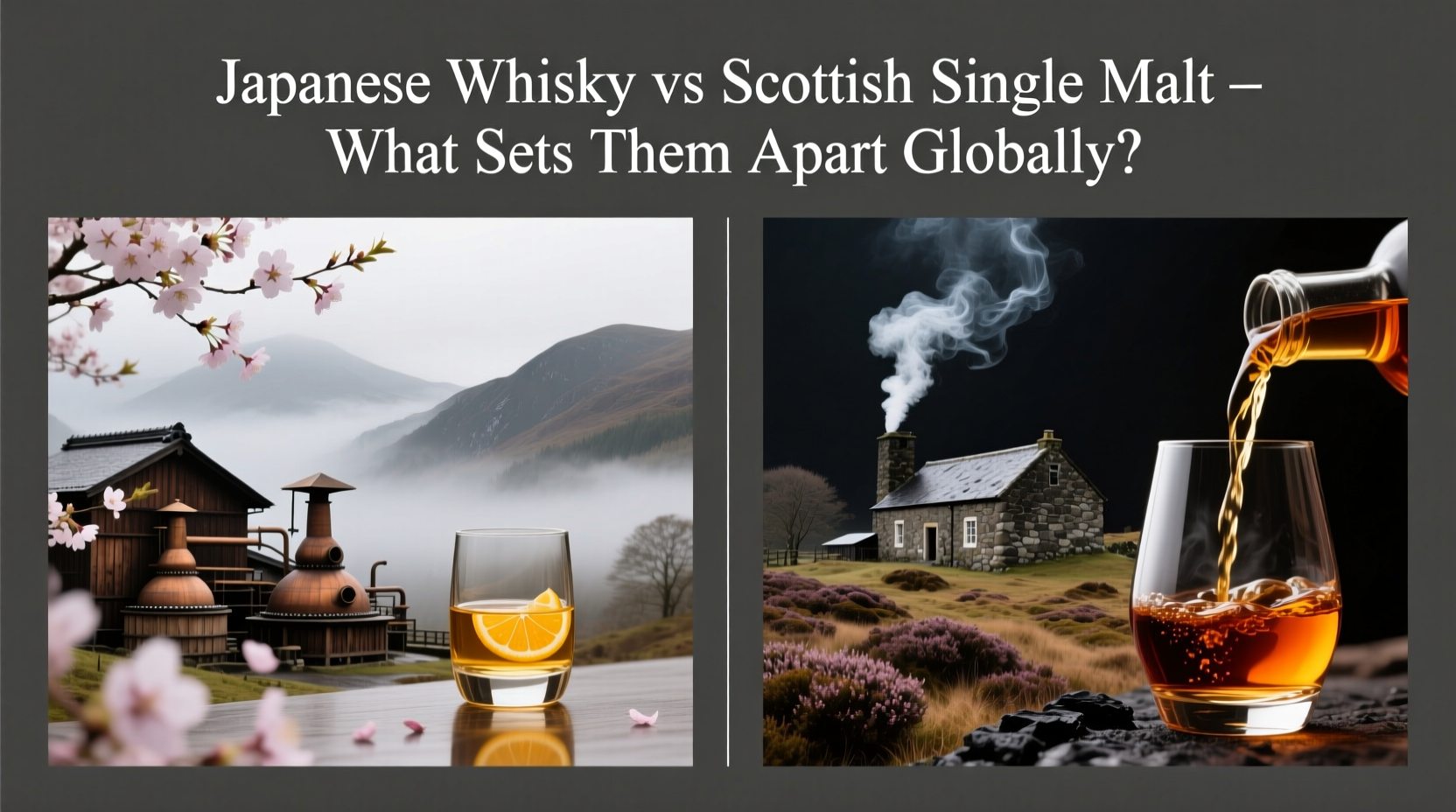
Scottish single malt whisky emerged organically from agrarian necessity—barley surplus, peat-rich soil, and abundant soft water gave rise to small farm distilleries as early as the 15th century. Regulation followed practice: the 1823 Excise Act legalised distillation, and the 1887 Spirits Act formally defined “Scotch whisky” as spirit distilled in Scotland from malted barley, matured in oak casks for at least three years. By the 1960s, over 100 distilleries operated across five designated regions—Highland, Lowland, Speyside, Islay, and Campbeltown—each cultivating stylistic tendencies shaped by local climate, still design, and generations of tacit knowledge.
Japanese whisky began not as an inheritance, but as an act of deliberate apprenticeship. In 1918, Masataka Taketsuru—a chemist trained at Glasgow University and apprenticed at Hazelburn and Longmorn—returned to Japan convinced that the country could produce world-class whisky. His vision met resistance: rice was prioritised for food; barley cultivation was underdeveloped; oak forests were unsuited to coopering. Undeterred, he co-founded Yamazaki Distillery in 1923—the first dedicated whisky distillery in Japan—under the umbrella of Shinjiro Torii’s Kotobukiya (now Suntory). Taketsuru later established Nikka in 1934, building Yoichi Distillery in Hokkaido to replicate the cool, maritime conditions of Islay. Unlike Scotland’s evolutionary path, Japan’s whisky story is one of rapid, intentional translation—followed by confident reinterpretation.
Regulatory Frameworks: Freedom vs Formality
Scotland operates under strict, legally enforceable definitions. To be labelled “Scotch whisky,” a spirit must be: (1) distilled and matured entirely in Scotland; (2) made exclusively from malted barley (for single malt), water, and yeast; (3) aged in oak casks no larger than 700 litres for a minimum of three years; and (4) bottled at no less than 40% ABV. The term “single malt” further specifies that the whisky comes from one distillery and is non-blended. These rules are enforced by the Scotch Whisky Association (SWA) and backed by UK law.
Japan has no statutory definition for “Japanese whisky.” Until 2021, the term was governed only by voluntary industry guidelines issued by the Japan Spirits & Liqueurs Makers Association (JSLMA). Those guidelines required production, fermentation, distillation, and maturation to occur entirely in Japan—but permitted the use of imported grain whisky, neutral spirits, or even non-Japanese casks for finishing. That changed in 2021, when the JSLMA introduced stricter standards: all whisky labelled “Japanese whisky” must now be fermented, distilled, and matured in Japan using Japanese water and malted barley (or other grains), with no added flavours or colourings. Crucially, however, these remain industry guidelines—not law—leaving enforcement reliant on peer accountability rather than government sanction.
Tip: When purchasing Japanese whisky, look for the JSLMA-certified mark on the label—or verify the distillery’s transparency on cask sourcing and blending. Brands like Chichibu, Mars Shinshu, and Eigashima (White Oak) publish full production details; others remain opaque.Production Philosophy and Terroir Expression
Scotland’s terroir is legible in its geography. Islay’s saline air and peat bogs yield smoky, medicinal whiskies; Speyside’s fertile valleys and gentle rivers foster rich, fruity, and floral styles; the Highlands’ dramatic elevation and granite bedrock contribute to robust, waxy, and often maritime profiles. Still shape matters profoundly: tall, narrow stills (e.g., Glenmorangie) encourage reflux and lighter esters; short, squat stills (e.g., Ardbeg) retain heavier congeners and phenolic intensity. Even wood policy reflects regional logic: American oak ex-bourbon casks dominate for their vanilla sweetness, while European oak sherry butts add dried fruit and spice—especially in sherried expressions from Macallan or Glendronach.
Japan’s terroir is more subtle—and more deliberately curated. Rather than accepting natural constraints, Japanese distillers engineered micro-terroirs. Yamazaki’s location near Kyoto’s bamboo forests and mountain springs provides exceptionally soft, mineral-rich water ideal for delicate fermentation. Yoichi’s coastal site in Hokkaido subjects casks to high humidity and wide seasonal temperature swings—accelerating extraction and oxidation, yielding richer, spicier, more concentrated spirit. Crucially, Japanese producers pioneered the use of indigenous Mizunara oak, a slow-growing, porous, and highly aromatic wood native to Honshu. Its high vanillin and coconut lactone content imparts distinctive sandalwood, incense, and oriental spice notes—but it’s notoriously difficult to cooper, prone to leakage, and requires longer toasting. Fewer than 5% of Japanese casks are Mizunara; yet its presence—even in small finishing portions—has become a hallmark of premium Japanese expressions.
“Scotland teaches you how to listen to the land. Japan teaches you how to converse with it—and sometimes, to reshape the conversation.” — Dr. Mariko Tanaka, Master Blender, Chichibu Distillery, speaking at the 2022 World Whiskies Summit
Flavour Architecture and Maturation Realities
Flavour divergence begins at fermentation. Scottish distilleries typically ferment for 48–72 hours, producing clean, fruity washes. Some Islay producers extend this to 120+ hours for heightened ester development. Japanese distilleries routinely ferment for 96–144 hours, often using proprietary yeast strains developed in-house. This extended fermentation yields higher levels of fruity esters (ethyl hexanoate, ethyl octanoate) and complex sulphur compounds—contributing to the signature “umami depth” and layered fruitiness found in Yamazaki 18 or Hakushu 12.
Maturation is where the most consequential difference emerges: climate. Scotland’s cool, stable maritime climate means slow, steady maturation—typically 10–25 years for core single malts. Evaporation (“angel’s share”) runs 1–2% per year. Japan’s humid, subtropical climate accelerates interaction between spirit and wood: evaporation reaches 3–5% annually, and chemical reactions—oxidation, esterification, lignin breakdown—occur at nearly double the rate. A 12-year-old Japanese whisky often displays the concentration and tannic structure of a 20-year-old Speysider. But this speed carries risk: over-oaking, excessive wood tannin, or loss of delicate top notes. Japanese blenders counter this with extraordinary precision—vintage-dated cask selection, multi-cask marrying, and frequent warehouse rotation to balance microclimates within a single facility.
| Characteristic | Scottish Single Malt | Japanese Whisky |
|---|---|---|
| Average Maturation Time (Core Range) | 12–18 years | 8–15 years |
| Annual Evaporation Rate | 1–2% | 3–5% |
| Signature Wood Influence | Ex-bourbon (vanilla, caramel), Sherry (raisin, walnut) | Ex-bourbon, Mizunara (sandalwood, coconut), Japanese cherry (sakura, almond) |
| Typical Fermentation Duration | 48–72 hours | 96–144 hours |
| Regulatory Enforcement | Statutory (UK law) | Voluntary (JSLMA guidelines) |
Global Perception, Market Dynamics, and Authenticity Challenges
For decades, Japanese whisky existed in Scotland’s shadow—admired but niche. That changed dramatically after 2001, when Yamazaki 12 won “Best Blended Malt” at the International Spirits Challenge. Then, in 2013, Yamazaki Sherry Cask 2013 stunned the industry by winning “World Whisky of the Year” from Jim Murray’s Whisky Bible—beating 4,600 entries. Suddenly, Japanese whisky wasn’t just competitive; it was aspirational. Auction prices soared: a bottle of Karuizawa 1960 sold for £85,000 in 2015; a 50-year-old Yamazaki fetched £1.5 million in 2023.
This demand outstripped supply. Pre-2000s Japanese distilleries produced modest volumes—Yoichi made just 200,000 litres annually in the 1980s. When global demand spiked post-2010, stocks vanished. Bottlers responded with creative solutions—and ethical grey areas. Some brands released NAS (no-age-statement) bottlings with minimal transparency. Others blended aged Japanese spirit with younger stock—or even imported Scotch—to meet volume targets. In 2016, the Nikka-owned brand “Nikka From The Barrel” was quietly reformulated to include non-Japanese grain spirit, sparking backlash. Suntory responded by launching the “Hakushu 12” and “Yamazaki 12” age-statement reissues in 2021—explicitly stating “100% Japanese malt whisky, matured in Japan”—a direct rebuttal to market confusion.
Mini Case Study: The Rise and Reckoning of Chichibu
Founded in 2008 by former Suntory executive Ichiro Akuto, Chichibu Distillery embodied Japan’s new wave: small-batch, hyper-transparent, and fiercely independent. Akuto sourced rare, pre-2000s casks—including ex-sherry, ex-rum, and Mizunara—from closed Japanese distilleries, then married them with his own new-make spirit. His 2014 “Ichiro’s Malt & Grain” blend—comprising 20+ casks, some over 30 years old—earned cult status. But Akuto also faced reality: true age statements required patience. So Chichibu launched its “On The Way” series���clearly labelling bottles with distillation date, cask type, and bottling date (e.g., “Distilled 2012, Bottled 2018”). No age claim, no ambiguity. This radical honesty built trust—and proved that transparency, not mystique, fuels long-term credibility.
Practical Tasting Guide: How to Distinguish Them Blind
Blind tasting reveals structural truths beyond aroma. Use these steps to calibrate your palate:
- Nose First, Neat: Swirl gently. Scottish single malts often lead with clear regional markers—peat smoke (Islay), heather honey (Speyside), brine (Coastal Highland). Japanese whiskies tend toward layered fruit—yuzu, green apple, pear—with underlying incense, cedar, or matcha.
- Add Two Drops of Water: Watch for transformation. Scottish malts often open into deeper caramel, leather, or baked fruit. Japanese whiskies frequently reveal hidden umami—soy sauce, miso, or seaweed—alongside intensified sandalwood or sakura blossom.
- Assess Texture: Scottish single malts range from oily (Macallan) to crisp (Glenfiddich). Japanese whiskies almost universally display exceptional viscosity and mouth-coating silkiness—even at cask strength—due to high ester content and careful reduction.
- Check the Finish: Scottish finishes vary widely: Islay lingers with medicinal smoke; Speyside fades on citrus zest. Japanese finishes are often long, evolving, and paradoxical—sweetness giving way to dry spice, then a whisper of salt or green tea.
- Revisit After 15 Minutes: Japanese whiskies frequently gain complexity with air—revealing floral or herbal dimensions absent initially. Scottish malts may lose volatility but rarely gain entirely new dimensions.
FAQ
Are Japanese whiskies always smoother or “lighter” than Scottish ones?
No. While many Japanese expressions are approachable, the category includes bold, peated styles (Mars Iwai Tradition, Chichibu Peated) and heavily sherried releases (Karuizawa, Hanyu) that rival Islay or Campbeltown in intensity. “Smoothness” is often a function of precise cut points and filtration—not nationality.
Why do some Japanese whiskies cost more than 25-year-old Scotches?
Rarity drives price—not inherent superiority. Pre-2000s Japanese stocks are finite and irreplaceable. Distilleries like Karuizawa and Hanyu closed permanently, making their remaining casks museum pieces. Meanwhile, Scotland continues producing at scale. Scarcity, not age alone, commands premiums.
Can I reliably identify Japanese whisky by its use of Mizunara oak?
Not definitively. True Mizunara influence is subtle and takes years to emerge. Many “Mizunara-finished” bottlings use only a few months in the cask, imparting little more than vague spice. Authentic Mizunara character—sandalwood, incense, coconut—requires 5+ years of maturation and appears most clearly in older, single-cask releases from Yamazaki or Chichibu.
Conclusion
Japanese whisky and Scottish single malt are not competitors—they are complementary chapters in whisky’s global evolution. Scotland offers depth of heritage, regional diversity, and democratic accessibility: a 12-year-old Highland malt remains a benchmark of balance and value. Japan offers a masterclass in intentionality, climatic alchemy, and quiet ambition—where every cask decision is a philosophical statement. Neither is “better.” But understanding their distinctions transforms consumption into connoisseurship. It allows you to appreciate why a Yamazaki 18 tastes profoundly different from a Glenfarclas 17—not because one is superior, but because one speaks in the language of Kyoto’s bamboo groves and the other in the dialect of Speyside’s barley fields. The next time you pour a dram, don’t just taste it. Listen to it. Ask what geography, regulation, and human choice made it possible. Then raise your glass—not to a winner, but to two enduring testaments to what happens when culture meets grain, time, and oak.
💬 Have you tasted a Japanese whisky that changed your perspective—or discovered a Scottish single malt that surprised you with its complexity? Share your experience in the comments. Let’s build a community grounded in curiosity, not cliché.








