The highball and the Old Fashioned occupy opposite ends of the cocktail spectrum—not just in ingredients or technique, but in intention. One emerged from postwar Tokyo as a democratizing, thirst-quenching innovation; the other crystallized in 19th-century Louisville as a declaration of spirit-forward integrity. Yet both are revered as benchmarks of their national drinking cultures. To ask which “prioritizes refreshment” is not to declare a winner—but to examine how ritual shapes sensation. Refreshment here isn’t merely about coldness or citrus; it’s the deliberate orchestration of dilution, temperature, aroma, pace, and physiological response. In that precise sense, the Japanese highball doesn’t just offer refreshment—it architecturally engineers it. The Old Fashioned, by contrast, resists it.
The Highball: A Ritual Designed Around Thirst
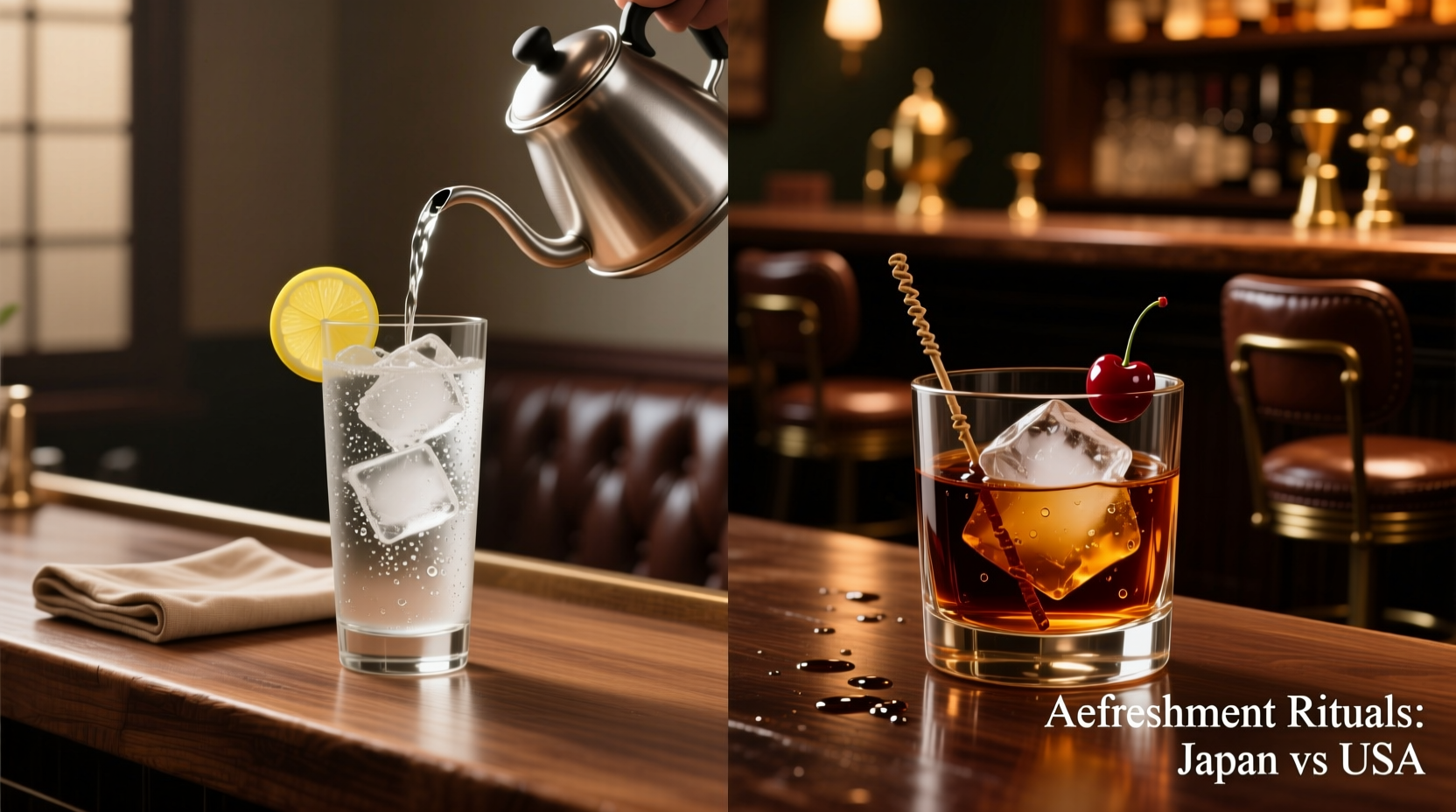
Japan’s highball is not a variation on a Western template—it’s a reimagining born of scarcity, precision, and climate. After World War II, premium Scotch was scarce and expensive. Bartenders at elite Tokyo bars like Bar King (founded 1946) began stretching single malt with copious, ice-chilled soda water—not to mask flavor, but to unlock it. They discovered that carbonation lifted volatile esters, while rapid, controlled dilution softened alcohol’s burn without dulling aromatic complexity. This evolved into a codified ritual: a tall, narrow highball glass chilled to 3°C; hand-cracked ice (large, dense cubes that melt slowly); precisely measured whisky (typically 30–45 mL of blended or light single malt); and soda water poured *over* the ice in two stages—first a gentle stream to wet the surface, then a vigorous, high-pour cascade to aerate and chill further. The result is effervescent, crisp, and startlingly light—designed to be consumed within 5–7 minutes before the ice over-dilutes.
This isn’t improvisation. It’s thermodynamic choreography. Japanese bartenders measure soda-to-whisky ratios down to the milliliter (commonly 3:1 or 4:1), calibrate carbonation pressure (often using Sodastream-style systems set to 4.5–5.0 volumes CO₂), and serve at a strict 4–6°C. The glass shape matters: narrow diameter minimizes surface area, slowing melt; height encourages layered pouring that preserves bubbles longer. Even the garnish—typically a single lemon twist expressed over the top, not dropped in—is chosen for its bright, non-bitter citrus oil, which volatilizes instantly in the carbonated air above the drink.
Tip: For authentic highball refreshment at home, skip pre-mixed sodas. Use chilled, high-pressure sparkling water (like San Pellegrino or Topo Chico) and pour from at least 12 inches above the glass to maximize aeration and chill.The Old Fashioned: A Ritual of Resistance to Dilution
The Old Fashioned, first documented in 1806 in the Baltimore Whig as a “cock-tail”—defined as “spirits of any kind, sugar, water, and bitters”—is fundamentally a study in concentration. Its modern form, standardized in the 1930s, deliberately rejects effervescence, citrus, and rapid consumption. It is built in a short, thick-bottomed rocks glass with large, slow-melting ice (often a single 2-inch cube), stirred—not shaken—with ice for 25–30 seconds. That stirring achieves *just enough* dilution (roughly 20–25%) to round edges and integrate flavors, but no more. The goal is a viscous, syrupy mouthfeel, where the bourbon or rye’s oak, vanilla, and spice notes bloom slowly, supported by the bitter complexity of Angostura and the caramelized sweetness of demerara syrup.
Its ritual is tactile and unhurried: muddling the sugar and bitters, feeling the resistance give way; the low, rhythmic clink of the bar spoon against glass; the deliberate pause before straining. There is no garnish meant to evaporate—only an orange twist expressed to release oils onto the surface, then draped across the rim as a fragrant anchor. It is served at 12–15°C: cool enough to temper alcohol heat, but warm enough to allow volatiles to rise steadily. As cocktail historian David Wondrich observes, “The Old Fashioned isn’t a drink you gulp. It’s a drink you negotiate—with time, with strength, with memory.” Its refreshment lies in satisfaction, not relief; in depth, not dispatch.
“The highball is a drink of the city’s summer noon—sharp, urgent, cleansing. The Old Fashioned is the drink of the porch at dusk: amber light, slow conversation, the weight of something well-made settling in your hands.” — Yoko Sato, Head Bartender, Bar Benfiddich, Tokyo
Comparative Analysis: How Ritual Shapes Sensory Experience
To isolate how each ritual prioritizes (or deprioritizes) refreshment, we must move beyond ingredients to process, physiology, and cultural context. The table below breaks down key dimensions—not as value judgments, but as functional design choices.
| Dimension | Japanese Highball | American Old Fashioned |
|---|---|---|
| Primary Thermal Goal | Maintain sub-6°C throughout consumption; prevent warming at all costs | Stabilize at 12–15°C; allow gradual, controlled warming to release deeper aromas |
| Dilution Strategy | High-volume, rapid, intentional dilution (30–40% by volume) to reduce ABV perception and enhance effervescence | Minimal, precise dilution (20–25%) to soften without weakening; ice serves as thermal regulator, not solvent |
| Pace of Consumption | Designed for 5–7 minute window; loses structural integrity if lingered over | Optimal between 12–20 minutes; flavor evolves positively with time and slight warming |
| Sensory Priority | Volatility (citrus oil, esters), carbonation tingle, clean finish | Viscosity, oak tannin integration, bitter-sweet balance, lingering spice |
| Cultural Timing | After work, with meals (especially fatty foods like yakitori), in humid heat | Pre-dinner aperitif or post-dinner digestif; associated with quiet reflection or celebration |
This isn’t semantics. Neurogastronomy confirms that carbonation triggers TRPA1 receptors on the tongue—producing a mild, cooling pungency akin to mustard oil or wasabi. Combined with rapid chilling, this creates a genuine physiological refreshment response: lowered perceived oral temperature, increased salivation, and accelerated palate reset. The Old Fashioned, by contrast, engages TRPV1 receptors via alcohol warmth and capsaicin-like compounds in rye and bitters—eliciting a gentle, grounding heat. Both are pleasurable—but only one is calibrated to quell thirst.
A Real-World Contrast: Two Summer Evenings
In Shinjuku, 8:15 p.m., 34°C and 78% humidity. Kenji, a graphic designer, slides into the marble counter at Bar Orchard. He orders a Hibiki Highball—no specification needed. In 92 seconds, the bartender presents a glass sweating condensation, filled with crystal-clear liquid shimmering with fine, persistent bubbles. Kenji takes his first sip: immediate lift of yuzu zest, a crisp fizz, the soft grain of Yamazaki blended, then clean finish. He drinks half in three sips. His forehead cools. His shoulders drop. By the fifth minute, he’s ordering a second—not because the first was weak, but because the ritual delivered exactly what his body demanded: thermal reset, palate cleansing, mental clarity. The drink is gone before the ice fully clouds the glass.
Meanwhile, in Louisville, 7:40 p.m., 32°C and 65% humidity. Sarah, a bourbon archivist, sits on her screened porch with her grandfather’s 1948 J.W. Dant bottle. She builds an Old Fashioned: 2 oz bourbon, ¼ oz demerara syrup, 2 dashes Angostura, stirred with one large cube. She watches the ice settle, listens to cicadas, takes her first slow sip at 7:45. The initial impression is rich, viscous, slightly sweet—then the oak emerges, then clove, then a whisper of orange peel. At 7:52, she rotates the glass, feels the warmth rising through the glass. At 8:03, the cube has just begun to shrink; the drink has deepened, grown more resonant. She isn’t thirsty. She’s present. She’s tasting history. Refreshment, here, is secondary to resonance.
Why “Prioritizes Refreshment” Is a Design Question, Not a Quality One
Calling the highball “more refreshing” isn’t diminishing the Old Fashioned’s artistry—it’s acknowledging divergent design imperatives. The highball answers a specific environmental and social need: urban density, high humidity, fast-paced work culture, and the physiological demand for rapid thermal regulation. Its ritual eliminates variables that impede refreshment—excess sugar (no syrup, only optional minimal sweetener), heavy texture (carbonation ensures lightness), and lingering warmth (ice volume and shape are optimized for cold retention, not melt control). Every element serves that singular axis.
The Old Fashioned’s ritual, conversely, exists to preserve and elevate spirit character. Sugar isn’t for sweetness alone—it’s a solvent for bitters and a buffer against alcohol harshness. Stirring, not shaking, prevents aeration that would scatter delicate congeners. The large ice cube isn’t about cold delivery; it’s about minimizing surface-area contact to avoid over-dilution that would flatten complexity. As master distiller Chris Morris of Woodford Reserve notes, “A great bourbon needs space to breathe. The Old Fashioned gives it that room—and asks the drinker to slow down and listen.”
This distinction becomes critical for bartenders and enthusiasts alike. Serving a highball with flat, room-temperature soda or lukewarm ice isn’t just “wrong”—it fails the drink’s core purpose. Similarly, serving an Old Fashioned with crushed ice or excessive dilution doesn’t make it “lighter”; it unravels its architecture. Understanding *why* each ritual evolved reveals not just how to make them correctly—but when and where each belongs.
Practical Guide: Executing Each Ritual Authentically at Home
Authenticity lies in fidelity to intent—not slavish replication of tools. Here’s how to honor each drink’s purpose with accessible equipment:
- For the Highball: Chill your glass in the freezer for 10 minutes. Use large, clear ice cubes (made from boiled, cooled water for clarity). Measure whisky precisely (start with 30 mL). Chill your sparkling water to 2°C (refrigerate overnight, then place in freezer for 15 minutes—do not freeze). Pour soda in two stages: first 60 mL gently to coat ice, then remaining 180 mL in a high, steady stream from 12+ inches up. Express lemon oil over the top and discard twist.
- For the Old Fashioned: Chill your rocks glass. Use one 2-inch ice cube (or two 1.5-inch cubes). In the glass, combine sugar (½ tsp demerara or turbinado), bitters (2 dashes), and ¼ tsp water. Muddle until dissolved. Add whisky (2 oz). Stir with a bar spoon for exactly 28 seconds—count silently, keeping spoon tip against glass wall. Strain into chilled glass *without* ice. Express orange oil over surface, then garnish with twist draped on rim.
- Key Calibration: Taste each drink at 0, 3, and 6 minutes. For the highball, the ideal window closes when bubbles visibly thin and temperature rises above 8°C. For the Old Fashioned, peak harmony arrives around minute 4–5, when dilution integrates but warmth hasn’t yet muted spice.
FAQ
Can I use bourbon in a highball? Isn’t that “inauthentic”?
Authenticity in Japan is defined by function, not origin. While Japanese bartenders traditionally use Scotch or Japanese whisky for their lighter profile, many now experiment with high-proof, low-congener bourbons—especially wheated ones like W.L. Weller. The key is avoiding heavily oaked or high-rye expressions that clash with carbonation. If it stays crisp and clean at 4:1 dilution, it qualifies.
Why does the Old Fashioned use sugar instead of simple syrup?
Muddling raw sugar with bitters creates micro-abrasions that release aromatic oils from the bitters’ botanicals—something pre-dissolved syrup cannot replicate. The granular texture also provides tactile feedback during preparation, anchoring the ritual in physical presence.
Is the highball “healthier” due to lower alcohol content?
Not inherently. A 30 mL whisky highball contains ~11 g of pure alcohol—similar to a standard 5 oz glass of wine. Its advantage is lower perceived intensity and faster gastric emptying due to carbonation and cold, reducing risk of overconsumption in social settings. But nutritional impact depends on total intake, not per-drink ABV.
Conclusion
The Japanese highball and the American Old Fashioned are masterclasses in cultural adaptation—each solving a different human need with elegant precision. One answers the body’s urgent call for cool, clean, invigorating relief; the other answers the mind’s desire for substance, continuity, and quiet reverence. To prioritize refreshment is not to choose simplicity over sophistication—it is to recognize that in a sweltering Tokyo office building or a crowded izakaya after a 12-hour shift, the highest form of hospitality is a drink that restores equilibrium in under seven minutes. That is the highball’s quiet genius: it makes refreshment not an accident of circumstance, but the central act of its existence.
💬 Your turn: Next time you order one—or make one—ask yourself: What does my body need right now? Thirst quenched, or presence deepened? Share your own highball or Old Fashioned moment in the comments—we’re listening.








