Anime has become a global phenomenon, transcending borders and languages. As fans outside Japan engage with these animated works, a long-standing debate persists: is watching anime with subtitles (subbed) closer to the creator’s original vision than viewing it with a translated voiceover (dubbed)? The answer isn’t simply a matter of preference—it involves layers of performance, translation accuracy, cultural nuance, and artistic integrity. Understanding what “authenticity” means in this context requires examining how language, emotion, timing, and production choices shape the viewer’s experience.
The Essence of Authenticity in Anime Viewing
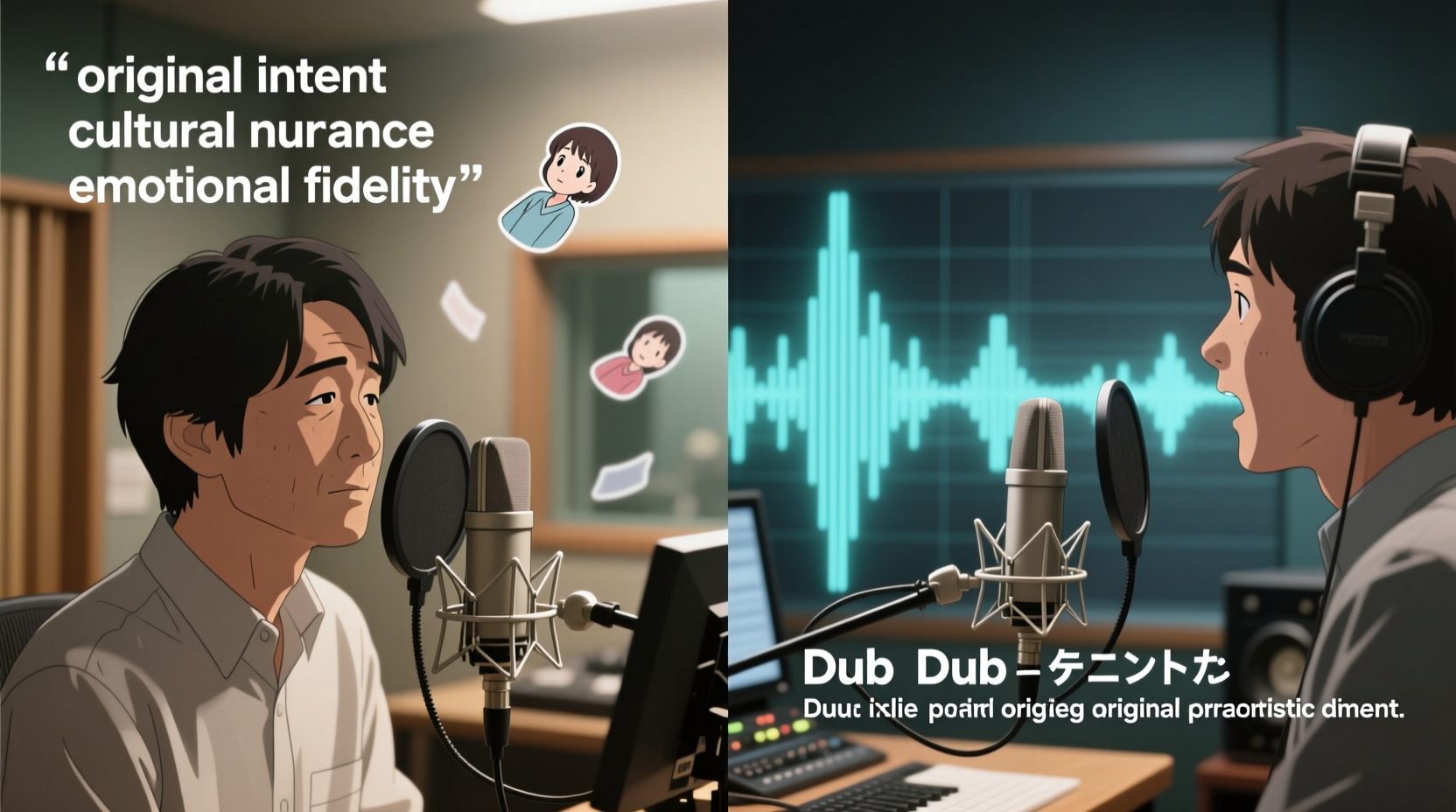
Authenticity in media consumption refers to how closely the final product reflects the creator’s intended message, tone, and emotional impact. In anime, authenticity extends beyond plot and visuals to include vocal performances, pacing, and even silence. Japanese voice actors—known as seiyuu—are carefully cast to embody characters’ personalities, with directors working closely to ensure their delivery aligns with story beats and emotional arcs. When viewers hear the original Japanese audio, they are experiencing the performance that was recorded alongside the animation, often influencing character design and scene choreography.
Subtitles preserve the original audio track exactly as it was created. Every inflection, pause, breath, and background murmur remains intact. This allows viewers to absorb not just what is said, but how it is said—the subtle shifts in tone that signal sarcasm, hesitation, or suppressed anger. Dubbing, on the other hand, replaces the original voices with new performances in another language. While modern dubs have improved dramatically, they inherently involve reinterpretation rather than replication.
“Voice acting is part of the animation process in Japan. The sound informs the motion. Removing it changes the rhythm of storytelling.” — Dr. Akiko Yamamoto, Media Studies Professor at Kyoto University
Linguistic Fidelity: Subtitles vs. Dubbed Scripts
One of the most critical aspects of authenticity lies in translation quality. Subtitles offer a direct textual representation of dialogue, constrained primarily by screen space and reading speed. Translators must balance literal accuracy with natural-sounding English, often making interpretive decisions about honorifics, wordplay, and culturally specific references. Despite these challenges, subtitles maintain a clear link to the source material.
Dubbing introduces additional layers of adaptation. Dialogue must be re-written to match lip movements—a process known as lip-sync localization. This often leads to paraphrasing, omission, or even rewriting entire lines to fit timing. For example, a Japanese sentence like “Omae wa mou shindeiru” (“You are already dead”) from *Fist of the North Star* becomes iconic not only for its meaning but its cadence. A dub might deliver the same line, but the rhythm and emphasis may shift due to syllabic differences between languages.
Tip: Watch a scene first with subtitles, then rewatch it dubbed. Pay attention to pauses, emotional delivery, and whether jokes or dramatic beats land differently.Translation Challenges in Practice
Certain expressions resist direct translation. Honorifics like “-san,” “-kun,” or “-chan” carry social and emotional weight that English lacks equivalents for. Some subtitled releases retain these terms; others omit them entirely. Dubs typically drop honorifics altogether, which can flatten character dynamics—especially in hierarchical relationships.
Puns, idioms, and wordplay are particularly difficult. A character’s name might be a pun on an object or concept (e.g., *Sakura* meaning “cherry blossom”), and jokes based on homophones rarely translate directly. Subtitles sometimes add footnotes or explanatory notes in parentheses, preserving the reference even if the humor doesn’t fully transfer. Dubs may replace such jokes with culturally familiar equivalents, sacrificing fidelity for relatability.
Performance and Emotional Nuance
Voice acting is performance art. Japanese seiyuu undergo rigorous training and are selected not just for vocal range but for their ability to convey complex emotions within tight stylistic conventions. The exaggerated expressions common in anime—screams of rage, soft whispers of affection, manic laughter—are deliberate artistic choices. These vocal extremes are calibrated to match visual exaggeration and narrative intensity.
Dub actors face the difficult task of matching both emotion and mouth flaps. They cannot improvise timing freely. If a character speaks two syllables in Japanese over one second, the English dub must do the same—even if the natural phrasing would take longer. This constraint can lead to rushed delivery or flattened intonation, subtly altering emotional impact.
Consider the climactic monologue in *Neon Genesis Evangelion*, where Shinji Ikari questions his existence. The original delivery is halting, fragile, layered with breath and micro-pauses. A well-done dub may capture the meaning, but the raw vulnerability of the original performance is nearly impossible to replicate under sync constraints.
A Case Study: *Cowboy Bebop*
*Cowboy Bebop* is frequently cited as one of the most successful anime dubs ever produced. The English voice cast, including Steve Blum as Spike Spiegel, brought charisma and depth that resonated globally. Many fans consider the dub definitive. However, a comparison reveals key differences.
In one episode, Faye Valentine says, “Baka na yatsu da ne” after a reckless act by Spike. Literally, this means “He’s a foolish person, isn’t he?”—a resigned observation tinged with irony. The dub translates it as “What an idiot!” which is punchier but loses the melancholic undertone. The original line reflects Faye’s guarded affection; the dub emphasizes exasperation. Both work, but they evoke slightly different interpretations of her character.
This illustrates a broader truth: dubs are adaptations, not reproductions. They create parallel experiences shaped by new creative teams. While some dubs achieve artistic excellence, they inevitably diverge from the original intent in subtle ways.
Production Context and Creative Control
In Japan, voice recording is tightly integrated into production. Animators often use vocal tracks as reference for facial animation and timing. Scenes may be edited to match vocal pacing. This synergy means that removing the original audio disrupts the intended rhythm of a sequence. A laugh that triggers a visual reaction might fall a beat earlier in Japanese than in English, causing a disconnect between action and response.
Dubbing studios operate independently, usually months or years after the original release. Directors and actors work from scripts and rough animations, without input from the original creators. Even when licensors aim for faithfulness, the separation of processes limits true alignment with the source’s artistic goals.
Exceptions exist. Studio Sunrise has occasionally supervised English dubs for *Gundam* series, ensuring continuity with original themes. Crunchyroll and Funimation have also increased collaboration with Japanese studios in recent years. Yet, full creative parity remains rare.
Table: Subbed vs. Dubbed – Key Differences in Authenticity Factors
| Factor | Subbed (Original Audio) | Dubbed (Localized Audio) |
|---|---|---|
| Vocal Performance | Original seiyuu performance as directed | New performance adapted to lip sync |
| Dialogue Accuracy | Close to literal, with translator notes possible | Adapted for timing and clarity |
| Emotional Timing | Preserved as per original edit | May shift due to sync constraints |
| Cultural Nuance | Honorifics, wordplay, context retained | Often simplified or replaced |
| Music & Sound Design | Fully preserved | Preserved, but vocals change emotional texture |
| Creator Involvement | Direct artistic control | Rarely involved in localization |
When Dubbing Enhances Accessibility and Impact
While subbed versions are generally closer to the original intent, dismissing dubs overlooks their role in broadening anime’s reach. For many viewers—children, non-readers, or those who find reading while watching distracting—dubs provide essential access. A well-crafted dub can make anime emotionally resonant for audiences who might otherwise disengage.
Moreover, some dubs enhance storytelling through strong casting and direction. The English dub of *Fullmetal Alchemist: Brotherhood* is widely praised for maintaining tonal consistency and emotional depth. Voice actors studied the original performances and aimed to mirror their intensity. In such cases, the dub becomes a respectful homage rather than a distortion.
Authenticity should not be confused with exclusivity. Preserving original intent matters, but so does inviting diverse audiences into the medium. High-quality dubs represent a form of cultural bridge-building, translating not just words but spirit.
Checklist: How to Evaluate Authenticity in Your Viewing Experience
- Listen to the original audio first before forming judgments about character tone or pacing.
- Compare key scenes across sub and dub versions to spot translation or performance differences.
- Research the voice cast—did the dub actors study the originals or consult the creators?
- Note cultural references that may be altered or omitted in dub scripts.
- Check for studio involvement—was the original team consulted during localization?
- Assess emotional impact—does the version you’re watching feel true to the story’s mood?
Frequently Asked Questions
Does watching dubbed anime make me less of a fan?
No. Enjoying dubbed anime doesn’t diminish your appreciation. Fanship is defined by engagement, not format. Many lifelong enthusiasts started with dubs. What matters is respect for the art form and awareness of the differences between versions.
Are there anime where the dub is better than the sub?
“Better” is subjective. Some dubs, like *Cowboy Bebop* or *Attack on Titan*, have passionate followings and strong performances. However, “better” doesn’t equate to “more authentic.” A dub may be more enjoyable for certain viewers, but it still represents an adaptation rather than the original artistic output.
Can I experience authenticity without understanding Japanese?
You can get close. Watching subbed versions preserves vocal performances and timing. Supplement your viewing with commentary, director interviews, or analyses to deepen understanding of cultural and creative context. True fluency enhances insight, but attentive viewing in any language fosters connection.
Conclusion: Prioritizing Intention Without Excluding Access
The question of whether subbed or dubbed anime is more authentic ultimately leans toward subbed. The original audio is an inseparable component of the artwork—crafted in tandem with animation, music, and direction. It carries nuances that translation, no matter how skilled, cannot fully replicate. To experience anime as its creators envisioned, listening to the original Japanese with subtitles offers the closest approximation.
Yet authenticity shouldn’t be gatekept. Dubbing plays a vital role in democratizing anime, allowing wider audiences to connect with stories that might otherwise remain inaccessible. The ideal landscape isn’t one that pits sub versus dub, but one that values both: honoring the original while embracing thoughtful adaptation.
💬 Which version do you prefer—sub or dub—and why? Share your thoughts and favorite examples in the comments. Let’s celebrate anime together, in all its forms.








