
Weekend camping trips offer a welcome escape from the noise of daily life—fresh air, starlit skies, and the crackle of a campfire. But as much as we crave disconnection, modern adventurers still rely on technology. Smartphones guide us through trails, GPS units keep us safe, headlamps light our way after dark, and cameras capture memories. When outlets vanish and wall chargers become useless, a portable power bank can be the difference between staying powered and being stranded in the dark—literally.
The question isn’t whether electronics have a place in the wild—it’s how we keep them running. While purists may argue for total digital detox, practicality often wins. A well-chosen power bank ensures safety, convenience, and peace of mind without sacrificing the spirit of adventure.
Why Modern Campers Need Reliable Power
Gone are the days when a compass and map were the only navigation tools. Today, most hikers use smartphone apps like Gaia GPS or AllTrails, which consume battery rapidly due to constant GPS and screen usage. Even a single day on the trail can drain a phone completely. Emergency services recommend carrying a charged phone at all times—even in remote areas where signal is spotty, devices can connect via satellite SOS features if powered.
Beyond navigation, personal safety gear such as headlamps, flashlights, and emergency beacons often rely on rechargeable batteries. Some campers bring portable speakers, drones, or even small fans for comfort. Others use tablets for reading or kids’ entertainment. Without access to electricity, these devices become dead weight unless you have a reliable backup power source.
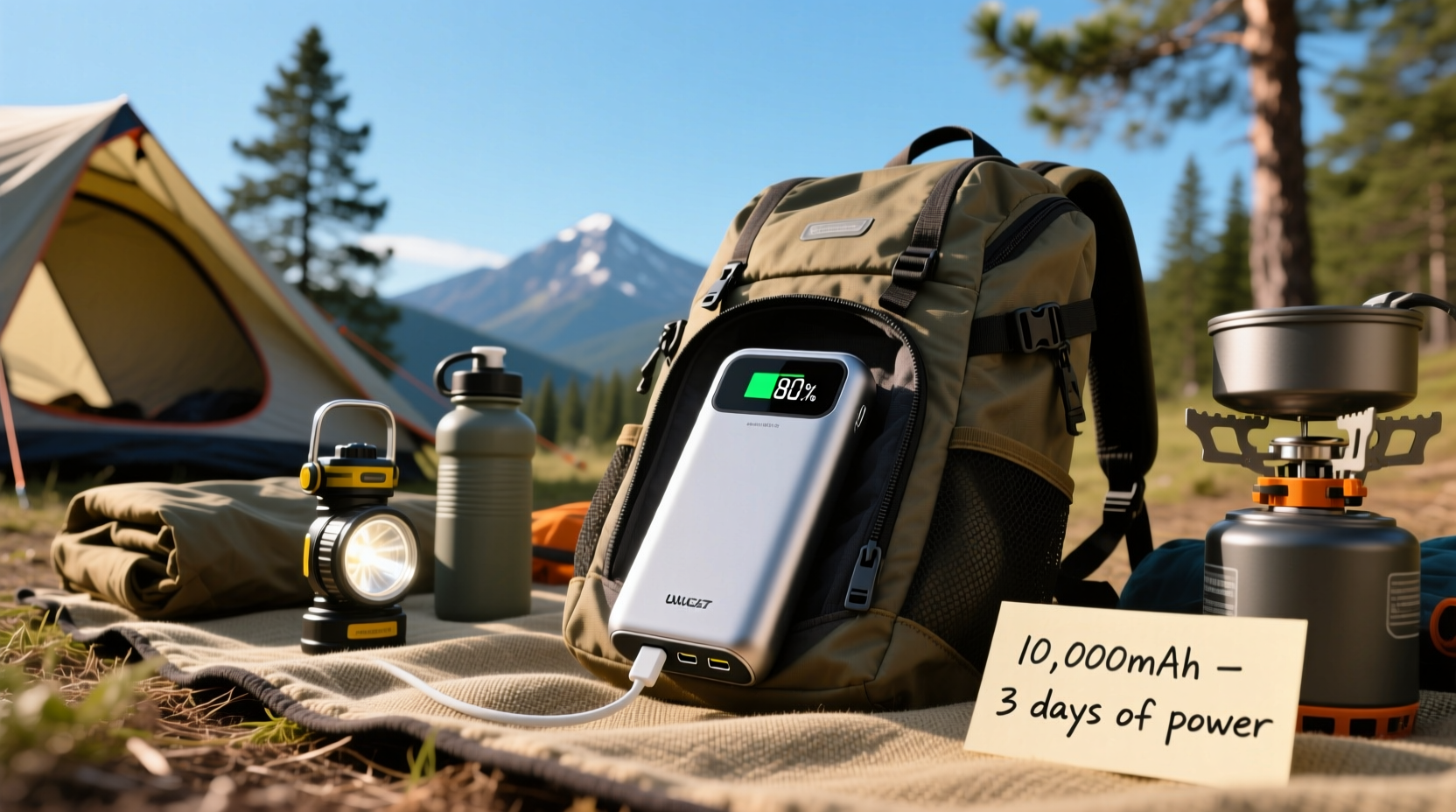
A quality power bank acts as a mobile charging station, turning your backpack into a mini utility hub. For weekend trips lasting 48–72 hours, it bridges the gap between departure and return, ensuring critical devices stay operational.
Tip: Always fully charge your power bank before heading out—and consider bringing a solar charger for extended stays.How to Choose the Right Power Bank for Camping
Not all power banks are created equal. The best model for weekend camping balances capacity, durability, portability, and charging speed. Here’s what to prioritize:
- Capacity (measured in mAh or Wh): Aim for at least 10,000mAh for a two-day trip. This typically provides 2–3 full charges for an average smartphone. For larger devices like tablets or multiple gadgets, consider 20,000mAh models.
- Durability: Look for rugged, water-resistant designs (IPX4 rating or higher). Camping environments expose gear to dust, moisture, and drops.
- Portability: Weight matters. A 20,000mAh unit weighs around 400–500g—manageable but noticeable in a pack. Anything above 30,000mAh becomes cumbersome for casual trips.
- Output Ports: Dual USB-A and USB-C ports allow simultaneous charging of different devices. USB-C PD (Power Delivery) supports faster charging for compatible phones and laptops.
- Recharge Method: Can it be recharged via solar panel? Is it compatible with car chargers? These options add flexibility in off-grid scenarios.
“Even experienced outdoorspeople underestimate how quickly cold weather drains batteries. A power bank isn’t a luxury—it’s risk mitigation.” — Dr. Lena Torres, Outdoor Safety Researcher, National Adventure Institute
Real-World Example: A Weekend Gone Right
Sarah and Mark planned a 48-hour backpacking trip in the Cascade Mountains. They packed light: tents, food, water filters, and their smartphones loaded with offline maps. On Saturday afternoon, thick clouds rolled in, followed by heavy rain that lasted into evening. Their planned route became muddy and hard to follow.
They relied on GPS to reroute safely—but after three hours of continuous use, Sarah’s phone dropped to 12%. With no trees to block wind and dropping temperatures, losing communication wasn’t an option. Fortunately, they had brought a 15,000mAh waterproof power bank. It charged both phones enough to navigate back to camp and send a check-in message via satellite messenger.
“We didn’t plan to use so much battery,” Sarah said later. “But knowing we had backup power kept us calm. That little brick probably saved us from a dangerous night.”
This scenario underscores a key truth: emergencies don’t follow schedules. A power bank doesn’t just extend device life—it extends decision-making time and reduces panic when things go off-plan.
Do’s and Don’ts: Power Bank Use in the Wild
| Do’s | Don’ts |
|---|---|
| Charge all devices fully before leaving | Leave your power bank in direct sunlight |
| Use low-power mode on devices to conserve battery | Overload the power bank with too many devices at once |
| Keep it insulated in cold weather (e.g., inside your sleeping bag at night) | Expose it to rain or submerge it in water (even if rated water-resistant) |
| Bring spare cables and adapters | Assume one charge will last the entire trip without monitoring usage |
| Pair with a foldable solar panel for multi-day resilience | Use cheap, unbranded power banks with unreliable circuitry |
Step-by-Step: Preparing Your Power Bank for a Trip
- Assess your device needs: List every electronic you’re bringing—phone, GPS, headlamp, camera, speaker, etc.—and estimate daily battery consumption.
- Select appropriate capacity: For one smartphone used moderately, 10,000mAh is sufficient. Add 5,000mAh per additional major device.
- Test charge and discharge: Fully charge the power bank, then use it to charge your phone from 0% to 100%. Note how much capacity remains. This reveals real-world performance versus advertised specs.
- Pack protective accessories: Include silicone cases, cable organizers, and ziplock bags for moisture protection.
- Create a charging schedule: Plan to charge devices during daylight hours, especially after high-usage activities like navigation or photography.
- Recharge immediately upon return: Lithium-ion batteries degrade faster when left depleted. Recharge to 50–80% before storage.
When a Power Bank Might Not Be Necessary
Despite the advantages, there are situations where a power bank adds unnecessary weight. If your trip involves:
- Car camping with access to vehicle power outlets,
- Staying in cabins or shelters with electricity,
- Intentional digital detox with no electronics beyond a flashlight,
- Very short hikes under 12 hours with minimal tech use,
—then a power bank may not justify the extra 300–500 grams in your pack.
However, even in these cases, many seasoned campers carry compact 5,000–10,000mAh units as insurance. They weigh little more than a granola bar and can revive a dying phone in an emergency.
Expert Recommendations and Alternatives
For those seeking sustainable power solutions, solar-powered banks are gaining traction. While early models were inefficient, modern solar panels with monocrystalline cells can recharge a power bank in 6–8 hours of direct sunlight. Brands like Goal Zero and Anker offer durable hybrid units combining high-capacity batteries with foldable solar arrays.
Still, experts caution against relying solely on solar in unpredictable climates.
“I’ve seen too many people count on sunny days that never came. Solar is excellent as a supplement—not a primary source—especially in forested or northern regions.” — James Reed, Wilderness Guide and Gear Tester, Pacific Northwest Outdoors
Hand-crank chargers exist but are impractical for regular use. Cranking for 2 minutes might give you 5 minutes of talk time—useful only in dire emergencies.
Another alternative: external battery cases. These combine protection and power in one unit but lack the flexibility of standalone power banks. They also limit compatibility across devices.
Frequently Asked Questions
Can I bring a power bank on a plane for camping trips?
Yes, but with restrictions. Most airlines allow power banks under 100Wh (about 27,000mAh) in carry-on luggage only. Larger units require airline approval. Never pack a power bank in checked baggage due to fire risk.
How long does a power bank hold its charge when not in use?
Quality power banks retain 80–90% of their charge over 3–6 months. However, self-discharge rates vary. Check and top up your unit every few weeks if stored long-term. Avoid storing it fully depleted or fully charged.
Are expensive power banks worth the price?
Often, yes. Premium brands invest in better battery cells, thermal regulation, surge protection, and rugged builds. A $60 power bank from Anker or RAVPower may outlast three $20 generic versions, making it more cost-effective and safer in the long run.
Final Checklist Before You Go
- ✅ Charge power bank to 100% the night before
- ✅ Verify compatibility with all your devices
- ✅ Pack necessary cables (USB-C, Lightning, micro-USB)
- ✅ Test charging function with your phone
- ✅ Confirm weight and size fit comfortably in your pack
- ✅ Consider pairing with a solar charger for longer trips
- ✅ Inform someone of your itinerary—don’t depend solely on digital tracking
Conclusion: Power Smarter, Not Harder
A portable power bank isn’t about clinging to civilization—it’s about enhancing safety, preparedness, and enjoyment in the wilderness. For weekend camping trips, the modest weight and size of a quality unit deliver outsized returns when the unexpected happens. Whether you're navigating a sudden storm, capturing golden-hour photos, or simply checking in with family, having reliable power means fewer worries and more freedom.
The outdoors rewards preparation. Just as you wouldn’t hike without water or a first-aid kit, skipping a power bank could mean missing a crucial tool when you need it most. Technology, when used wisely, doesn’t detract from nature—it helps us engage with it more confidently and responsibly.
💬 Have a story about how a power bank saved your trip? Share your experience below—your insight could help another camper make a smarter choice next time.








