
For professionals juggling work deadlines, family responsibilities, and personal commitments, finding a sustainable eating pattern that supports health without disrupting daily life is essential. Intermittent fasting has gained popularity as a flexible approach to weight management and metabolic health. Among the most discussed protocols are the 16:8 method and One Meal a Day (OMAD). While both offer benefits, their real-world feasibility—especially for busy individuals—varies significantly. Understanding the differences in structure, adherence, energy impact, and long-term viability can help determine which option aligns better with a demanding schedule.
Understanding the Two Protocols
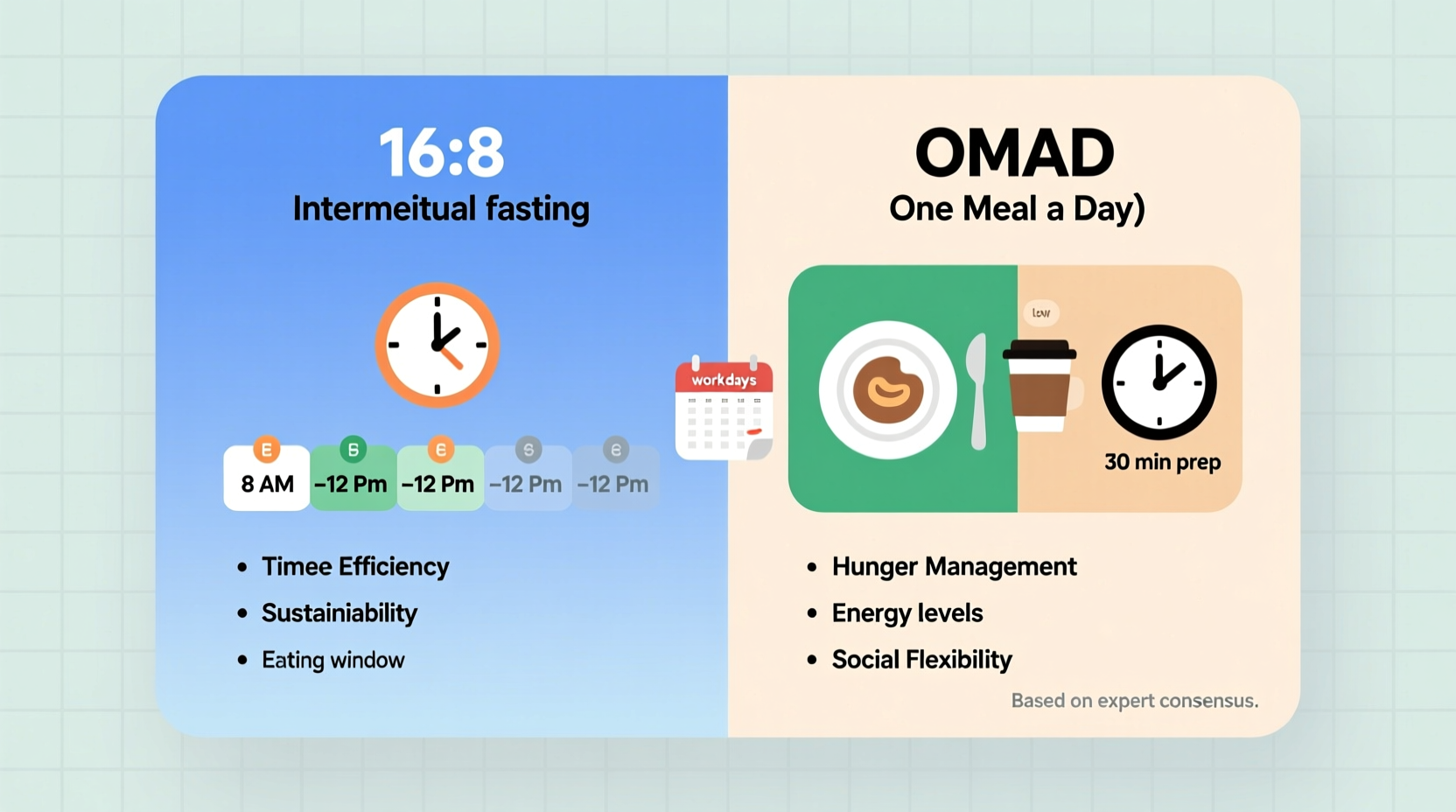
The 16:8 method involves fasting for 16 hours each day and consuming all meals within an 8-hour window. For example, someone might eat between 12:00 PM and 8:00 PM, then fast from 8:00 PM until noon the next day. This model allows for two or three meals and fits naturally into many modern routines, especially for those who skip breakfast.
OMAD, on the other hand, condenses all daily caloric intake into a single meal, typically eaten within a one-hour window. The remaining 23 hours are spent fasting. While this approach can lead to greater calorie restriction and potentially faster results, it demands significant discipline and careful nutritional planning to avoid deficiencies or energy crashes.
Tip: Start with 16:8 before attempting OMAD—easing into longer fasts reduces stress on your metabolism and increases long-term success.Comparing Sustainability for Busy Lifestyles
Sustainability isn’t just about effectiveness—it’s about consistency over time. A protocol may promise rapid results, but if it disrupts focus, social interactions, or sleep quality, it's unlikely to last. For busy individuals, predictability, mental clarity, and minimal logistical friction are key.
With 16:8, most people find they can maintain normal work rhythms, attend business lunches, and manage family dinners without drastic changes. The flexibility to adjust the eating window based on the day’s demands—say, shifting from 10 AM–6 PM to 1 PM–9 PM on late-work days—adds resilience to the routine.
OMAD requires meticulous timing. Eating only once means missing spontaneous meetings over food, skipping office snacks, and resisting hunger cues throughout the day. Evenings may become high-pressure windows where large volumes of food must be consumed quickly, often leading to digestive discomfort or poor food choices under time constraints.
“Fasting should enhance your life, not dominate it. The most effective regimen is the one you can stick to without burnout.” — Dr. Lena Patel, Metabolic Health Specialist
Practical Comparison: 16:8 vs OMAD
| Factor | 16:8 Fasting | OMAD |
|---|---|---|
| Daily Time Commitment | Low – simple window tracking | High – meal prep, timing, digestion |
| Social Flexibility | Moderate to High – can join meals during window | Low – difficult to share meals outside window |
| Energy Levels | Generally stable after adaptation | Often dips midday; post-meal fatigue common |
| Nutritional Balance | Easier to achieve across multiple meals | Challenging to meet macro/micronutrient needs in one sitting |
| Long-Term Adherence | High – integrates well with lifestyle | Moderate to Low – higher dropout due to difficulty |
A Real-World Example: Sarah’s Experience
Sarah, a 38-year-old project manager and mother of two, tried both methods over a six-month period. She began with OMAD, drawn by claims of accelerated fat loss. Initially, she felt a sense of control and even reported losing 5 pounds in the first two weeks. However, by week four, her afternoon concentration declined sharply. She found herself irritable during team calls and struggled to engage in evening family activities due to low energy.
She also missed connecting over coffee with colleagues and felt isolated at work events centered around food. After a stressful client presentation where she experienced dizziness and brain fog, she decided to switch to 16:8. Within days, her energy stabilized. She now eats between 11:30 AM and 7:30 PM, allowing her to have lunch with coworkers and dinner with her family. She maintains steady weight loss—about 1–2 pounds per week—and reports feeling more balanced overall.
“I thought OMAD was the ‘more serious’ option,” Sarah said, “but I realized seriousness shouldn’t come at the cost of my health and relationships. The 16:8 method lets me stay consistent without sacrificing my life.”
Step-by-Step: Transitioning to Sustainable Fasting
Adopting intermittent fasting successfully—especially when time and energy are limited—requires a gradual, intentional approach. Here’s how to implement a sustainable routine:
- Start with Your Current Routine: Track your typical eating times for three days. Identify natural gaps where fasting could begin.
- Begin with 12-Hour Fasts: Fast from dinner at 7 PM to breakfast at 7 AM. This helps your body adapt to not eating overnight.
- Extend Gradually to 14:10: Push breakfast to 8 or 9 AM. Use black coffee, tea, or water during the fast.
- Move to 16:8: Once comfortable, shift your window to 12 PM–8 PM or 11 AM–7 PM. This becomes your baseline.
- Optimize Meal Timing Around Work: Schedule your first meal after peak morning tasks and your last meal before winding down.
- Evaluate After 4 Weeks: Assess energy, focus, digestion, and adherence. If thriving, consider occasional 18:6 or 20:4 days—but avoid making them routine unless necessary.
- Only Consider OMAD Occasionally: Use OMAD for specific days (e.g., travel, light workload) rather than daily practice.
Checklist: Is OMAD Right for You?
Before committing to OMAD, ask yourself these questions:
- ✅ Do I have predictable, low-stress days where I can eat undisturbed?
- ✅ Can I prepare nutrient-dense, large-volume meals without spending excessive time cooking?
- ✅ Am I able to listen to hunger cues and stop fasting if I feel unwell?
- ✅ Do I frequently skip meals already, or do I rely on regular fueling to function?
- ✅ Have I successfully maintained 16:8 for at least 4–6 weeks?
- ✅ Am I doing this for health, or chasing extreme results?
If most answers are “no,” OMAD is likely not sustainable for your current lifestyle. The 16:8 method remains the smarter, more adaptable choice.
Frequently Asked Questions
Can I exercise while doing 16:8 or OMAD?
Yes, but timing matters. With 16:8, exercising in a fasted state (e.g., morning cardio) is common and well-tolerated. Strength training is best done within or shortly after your eating window. For OMAD, intense workouts outside the fed phase increase injury risk and impair recovery. Fueling before or after exercise is crucial.
Will I lose muscle on OMAD compared to 16:8?
Potentially. Without adequate protein distribution throughout the day, OMAD can lead to suboptimal muscle protein synthesis. The body can only utilize about 30–40 grams of protein per meal for muscle repair. Consuming all protein in one sitting leads to waste. 16:8 allows for better protein pacing, preserving lean mass during weight loss.
Is OMAD safe for people with busy jobs?
It depends. Those in cognitively demanding roles—software developers, doctors, teachers—often report reduced focus and increased anxiety on OMAD. Shift workers or those with irregular schedules may struggle even more. While some adapt, most find 16:8 safer and more supportive of performance.
Final Recommendation: Prioritize Consistency Over Intensity
When comparing 16:8 and OMAD for busy individuals, the evidence leans heavily toward 16:8 as the more sustainable, practical, and health-supportive option. It offers metabolic benefits like improved insulin sensitivity, cellular autophagy, and moderate calorie reduction without requiring extreme behavioral shifts.
OMAD may yield faster short-term results, but its long-term adherence rate is low, particularly among those with dynamic schedules. The cognitive load, social limitations, and physical strain make it a poor fit for most professionals aiming for lasting change.
Sustainable health isn’t built on extremes. It’s built on repeatable habits that align with your life—not ones that force your life to revolve around them. The 16:8 method provides the flexibility to thrive at work, enjoy meals with loved ones, and still achieve meaningful health outcomes.
“The best diet is the one you don’t realize you’re on.” — Michael Greger, MD, author of *How Not to Die*🚀 Ready to build a sustainable fasting habit? Start with 16:8 this week. Pick your window, hydrate well, and observe how your energy and focus respond. Small steps create lasting change—share your journey in the comments below.









