
In 2019, two smartphones stood at the forefront of premium Android technology: the Huawei P30 Pro and the Samsung Galaxy Note 9. While both were marketed as flagship devices, their design philosophies, technological ambitions, and market receptions diverged sharply. The P30 Pro brought groundbreaking camera capabilities and AI-driven photography, while the Note 9 leaned on proven performance and the S Pen ecosystem. But when stacked side by side, a critical question emerges: Did Samsung play it too safe—did they, in fact, drop the ball?
Camera Innovation: Where Huawei Took the Lead
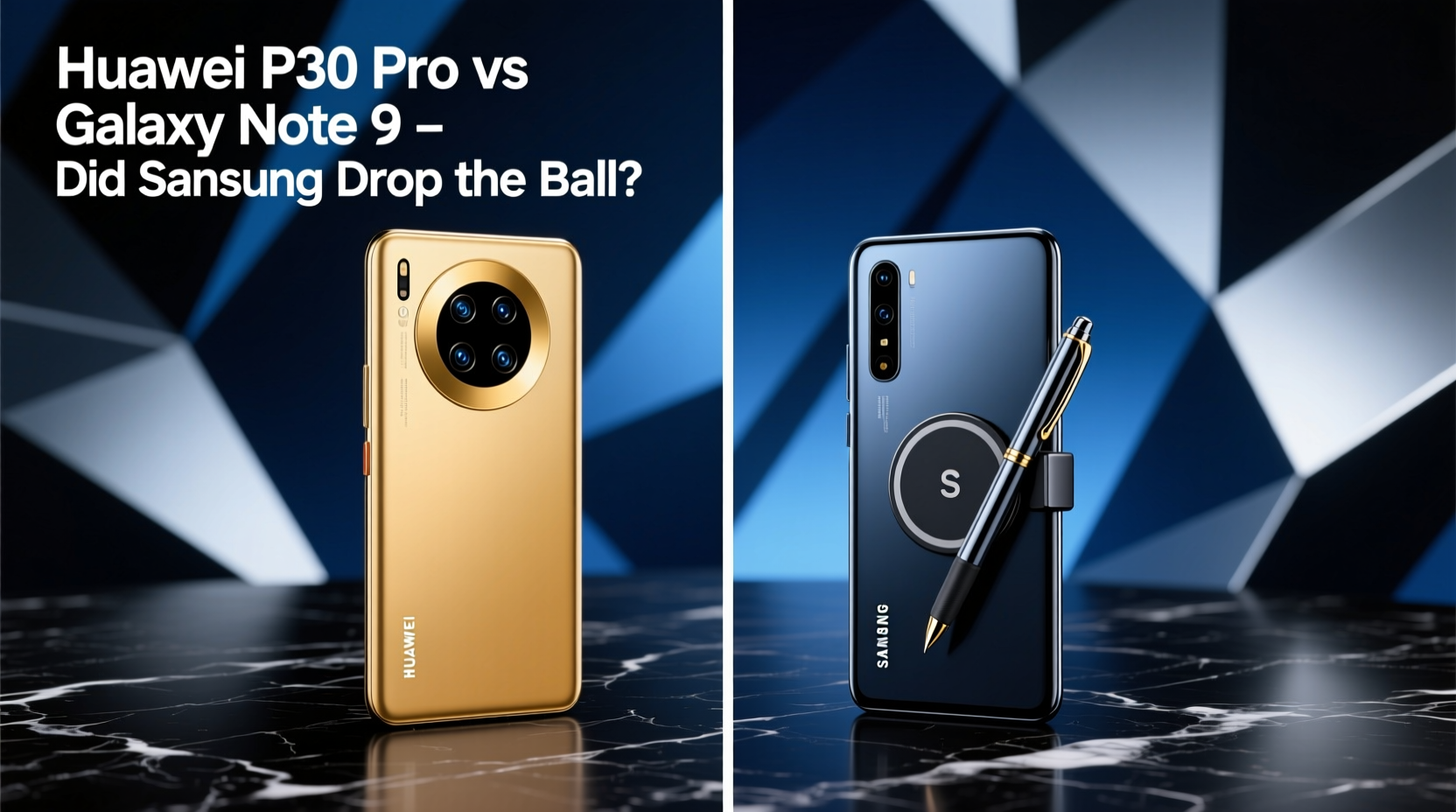
The most striking difference between the two devices lies in their camera systems. Huawei’s P30 Pro didn’t just improve on its predecessor—it redefined what a smartphone camera could do. With a quad-camera setup (including a time-of-flight sensor), periscope-style telephoto lens, and a revolutionary RYYB sensor for improved low-light capture, the P30 Pro offered up to 50x digital zoom and night mode photography that bordered on supernatural.
Samsung’s Galaxy Note 9, by contrast, featured a dual 12MP rear camera system—capable, but fundamentally unchanged from the Galaxy S9+. While it supported variable aperture and solid optical image stabilization, it lacked any significant leap in zoom capability or low-light performance. In head-to-head night shots, the P30 Pro consistently outperformed the Note 9, capturing more detail and dynamic range.
Tip: When comparing smartphone cameras, test low-light and zoom performance first—these are the areas where real innovation shows.A Real Example: Night Photography Showdown
Consider a scenario: a user walking through Seoul at midnight, wanting to capture the city’s neon-lit skyline reflected in a rain-soaked street. The Huawei P30 Pro, using its Night Mode and f/1.6 aperture, would render vibrant colors, sharp details, and minimal noise. The Galaxy Note 9, even with its best settings, would struggle with shadow detail and color accuracy. This isn't a minor gap—it's a generational difference in computational photography.
“Huawei bet big on computational imaging, and the P30 Pro proved that hardware alone isn’t enough—software intelligence is now the differentiator.” — Dr. Lin Zhao, Mobile Imaging Researcher at TechInsight Asia
Performance and Hardware: Samsung’s Strengths
Where Samsung excelled was in raw power and user experience consistency. The Galaxy Note 9 launched with the Snapdragon 845 (or Exynos 9810, depending on region), paired with up to 8GB of RAM and a massive 4,000mAh battery. It was one of the few phones at the time offering a microSD slot, expandable storage, and a headphone jack—features increasingly rare in flagships.
The P30 Pro, while powerful with its Kirin 980 chipset, had only 8GB of RAM max and no headphone jack. Its 4,200mAh battery matched Samsung’s capacity, but without wired reverse charging or an equally robust cooling system, sustained performance under load wasn’t quite as consistent.
For users prioritizing multitasking, gaming, or long-term software support, the Note 9 remained a top-tier choice. Samsung also delivered three major Android OS updates, whereas Huawei’s update path was later disrupted due to U.S. trade restrictions.
Table: Key Specs Comparison
| Feature | Huawei P30 Pro | Samsung Galaxy Note 9 |
|---|---|---|
| Display | 6.47\" OLED, 1080x2340 | 6.4\" AMOLED, 1440x2960 |
| Processor | Kirin 980 | Snapdragon 845 / Exynos 9810 |
| Rear Cameras | 40MP main + 20MP ultra-wide + 8MP periscope zoom + ToF | 12MP wide + 12MP telephoto |
| Zoom | 5x optical, 10x hybrid, 50x digital | 2x optical, 10x digital |
| Battery | 4,200mAh | 4,000mAh |
| Charging | 40W fast, 15W wireless, reverse wireless | Fast charging, 9W wireless, no reverse |
| Headphone Jack | No | Yes |
| Expandable Storage | No (uses NM card) | Yes (microSD, up to 512GB) |
| S Pen Features | No stylus | Bluetooth-enabled, remote functions |
Innovation vs Iteration: The Core Debate
The heart of the “did Samsung drop the ball?” argument comes down to ambition. The Galaxy Note 9 was a refinement—an excellent device built on a well-established formula. It improved battery life, slightly upgraded the camera, and enhanced the S Pen with Bluetooth functionality (allowing it to act as a remote shutter or presentation tool). These are meaningful upgrades, but not transformative.
Huawei, meanwhile, took risks. The periscope zoom lens was unproven in mass-market phones. The RYYB sensor altered traditional color filter arrays to let in more light—a bold engineering move. Even the software, like AIS Super Resolution Zoom and AI scene recognition, demonstrated a commitment to pushing boundaries.
In hindsight, the P30 Pro influenced the entire industry. Within two years, periscope zoom became standard among high-end Android phones. Samsung itself adopted similar tech in the Galaxy S20 Ultra. So while the Note 9 satisfied existing fans, the P30 Pro shaped the future.
Tip: True innovation isn’t about specs—it’s about solving problems in new ways. Look beyond megapixels and RAM.Software Ecosystem and Longevity Concerns
One area where Samsung maintained a clear advantage was in software longevity and ecosystem integration. At launch, the Note 9 ran Android 8.1 with Samsung Experience, later upgrading to Android 10 and receiving security patches for four years. Huawei, despite delivering timely EMUI updates initially, faced major setbacks after being restricted from using Google Mobile Services (GMS) in 2019. This meant no Google Play Store, YouTube, Gmail, or Maps on new Huawei devices—a dealbreaker for many global users.
Even though the P30 Pro launched before the ban fully took effect, its long-term usability outside China diminished quickly. Meanwhile, the Note 9 remained fully compatible with all major apps and services throughout its lifecycle.
Checklist: What to Consider When Choosing Between Flagships
- Evaluate your primary use: Is photography your top priority, or do you need productivity tools?
- Assess software needs: Do you rely on Google apps? If yes, Huawei may pose limitations.
- Test zoom and low-light performance: Take sample photos in challenging conditions.
- Consider future-proofing: Check update policy and app ecosystem stability.
- Factor in accessories: The S Pen offers unique functionality for notes and remote control.
FAQ
Was the Huawei P30 Pro better than the Galaxy Note 9 overall?
It depends on priorities. For photography, especially zoom and night shots, the P30 Pro was superior. However, the Note 9 offered better software longevity, expandable storage, and broader app compatibility. Neither was universally \"better\"—they served different user profiles.
Why didn’t Samsung include better zoom on the Note 9?
At the time, Samsung appeared to prioritize reliability and screen real estate over experimental hardware. Periscope lenses required vertical alignment, which conflicted with their horizontal dual-camera layout. They likely saw limited demand for extreme zoom in 2018, but consumer expectations shifted rapidly in 2019.
Can the Galaxy Note 9 still be used today?
Yes, but with caveats. While it runs modern apps well thanks to its strong processor, it no longer receives official OS updates. Security patches ended in 2021. For casual use, it remains functional, but newer models offer better efficiency and features.
Conclusion: Did Samsung Drop the Ball?
The answer is nuanced. Samsung didn’t fail—the Galaxy Note 9 was a polished, powerful device beloved by business users and S Pen enthusiasts. But in the context of 2019’s technological race, it felt incremental when the market was ready for leaps. Huawei seized that moment with the P30 Pro, showcasing what AI, optics, and bold engineering could achieve.
Dropping the ball doesn’t mean losing the game—it means missing an opportunity to lead. Samsung played it safe, relying on brand loyalty and proven features. Huawei, facing geopolitical headwinds, responded with unmatched innovation. Whether you prefer refinement or revolution, the P30 Pro vs. Note 9 debate highlights a pivotal year in smartphone evolution—one where the rules of competition changed forever.
🚀 What do you value more in a flagship phone: cutting-edge innovation or reliable, long-term performance? Share your thoughts and experiences in the comments below.








