Virtual reality bartending games are no longer novelties—they’re legitimate training tools. Behind the immersive visuals and playful scoring systems lies a surprisingly rigorous simulation of real barcraft: measuring, shaking, pouring, timing, and even reading customer cues. Professional mixologists, hospitality educators, and aspiring bartenders increasingly integrate VR into their skill development—not as a replacement for hands-on practice, but as a high-frequency, low-risk, cognitively rich supplement. Unlike traditional video games, modern VR bartending titles model fluid dynamics, ingredient viscosity, glass geometry, and even the physics of ice melt and dilution. When used intentionally, they strengthen neural pathways associated with muscle memory, spatial reasoning, and procedural fluency—skills that translate directly behind the bar.
Why VR Practice Complements Real-World Training
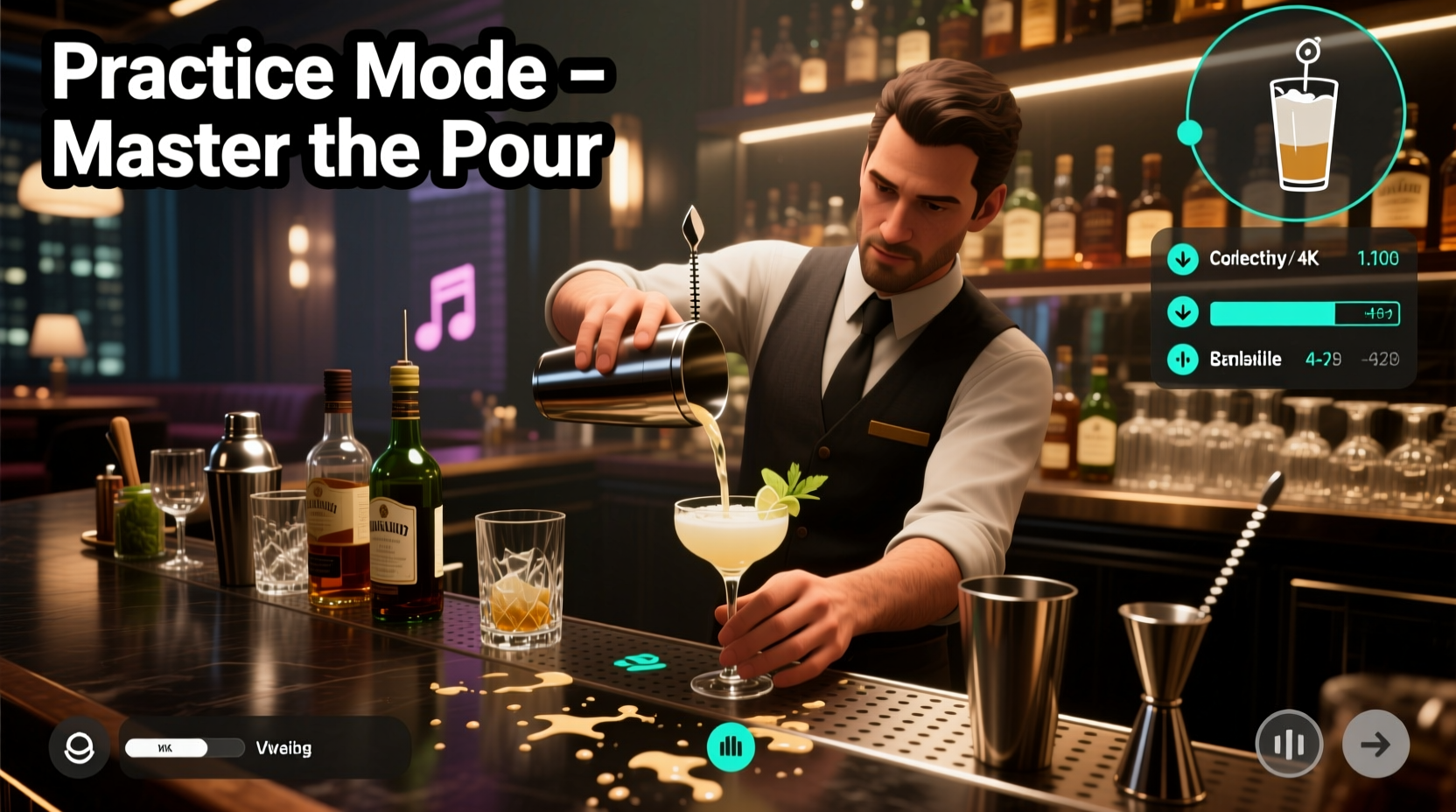
Traditional bartending education relies heavily on repetition in live environments—but access is limited by venue availability, ingredient cost, time constraints, and instructor bandwidth. A single flawed pour wastes premium spirits; a mis-timed shake risks over-dilution; forgetting a step in a complex tiki drink can derail service flow. VR eliminates those friction points. It allows users to rehearse 50 daiquiris in 20 minutes without spending $40 on rum and lime juice. More importantly, it isolates cognitive components often overlooked in physical training: visual tracking of liquid levels, temporal awareness during shaking (e.g., “shake for 12 seconds, not until it feels cold”), and multi-tasking under simulated pressure—like managing three simultaneous orders while remembering garnish preferences.
Neuroscience research supports this approach. A 2023 study published in Frontiers in Psychology found that participants who trained with VR-based procedural simulations showed 37% faster retention of sequential motor tasks compared to those using only video demonstrations or text manuals. The key was active embodiment—the brain’s mirror neuron system engages more deeply when users physically reach, grip, and rotate virtual objects, even without tactile feedback.
Tip: Use VR sessions *before* physical practice—not after. Warm up your spatial awareness and timing in VR for 10–15 minutes, then move straight to the bar. This primes your motor cortex and improves first-attempt accuracy.Top VR Bartending Games & Their Skill-Building Strengths
Not all VR bartending experiences are created equal. Some prioritize arcade-style scoring; others emphasize realism, recipe fidelity, and service nuance. Below is a comparison of leading titles based on verifiable training utility—not just entertainment value.
| Game Title | Realism Focus | Key Skills Trained | Limits for Skill Transfer |
|---|---|---|---|
| Bar Fight VR | Moderate — accurate glassware, timed pours, basic shaking physics | Pouring precision, speed under pressure, order recall, multitasking | Limited recipe library (mostly classics); no dilution modeling or temperature cues |
| Cocktail Crafters VR | High — custom-built fluid engine, real-time dilution calculation, temperature decay simulation | Shake duration calibration, dilution control, spirit-to-mixer ratios, garnish sequencing | Steeper learning curve; minimal customer interaction layer |
| Bartender Simulator Pro | Very High — licensed recipes from World Class winners, dynamic crowd behavior, service timing penalties | Customer psychology, pacing, mise en place efficiency, improvisation (e.g., substitutions) | Requires high-end VR hardware; no mobile or standalone headset support |
| Shake & Serve VR | Low-Moderate — stylized visuals, strong gamification, voice-command integration | Verbal command recognition, rhythm-based shaking, accessibility for neurodiverse learners | Minimal attention to measurement accuracy; no glass-specific pour curves |
For foundational skill building—especially for beginners—Cocktail Crafters VR delivers the most transferable experience. Its dilution engine, for example, calculates how much water enters a drink based on shake duration, ice size, and ambient temperature. Users quickly learn why a 10-second shake yields a different mouthfeel than 15 seconds—even if the volume poured looks identical. That kind of cause-and-effect awareness is rarely taught explicitly in entry-level classes.
A Step-by-Step Framework for Intentional VR Practice
Using VR casually—playing through levels like a game—yields minimal carryover to real bars. To convert screen time into skill, follow this evidence-informed framework:
- Set a micro-goal before each session (e.g., “Achieve 95% pour accuracy on jiggers across 10 Martini builds” or “Reduce average order completion time by 2 seconds”). Goals must be measurable, specific, and tied to a real-world outcome.
- Select one technique to isolate. Don’t try to master shaking, stirring, and flaming in one sitting. Dedicate a full session to mastering the dry shake (no ice) for egg white cocktails—observing foam formation and texture changes in the virtual shaker.
- Use the replay function critically. Most VR bartending apps record your session. Watch replays at 0.5x speed—not to critique mistakes, but to analyze movement economy: Where did you hesitate? Which hand moved unnecessarily? Did your grip shift mid-pour?
- Map VR actions to physical equivalents. As you perform a virtual double-strain, mentally narrate the physical steps: “Left hand holds fine strainer, right hand presses Hawthorne spring, wrist rotates slightly to control flow.” This strengthens cross-modal neural mapping.
- Debrief with a physical anchor. After every 15-minute VR session, make *one* real cocktail using the same technique. No substitutions. No shortcuts. Just replicate what you practiced—then compare taste, texture, temperature, and presentation.
This method turns passive immersion into deliberate practice. It leverages VR’s strengths—repetition, visualization, and immediate feedback—while anchoring learning in tangible sensory outcomes.
Real-World Validation: A Case Study from Hospitality Education
In early 2024, the American Hotel & Lodging Educational Institute (AHLEI) piloted VR bartending integration across five community college culinary programs. One cohort of 28 students—none with prior bar experience—used Cocktail Crafters VR for 20 minutes daily over six weeks, alongside biweekly in-person labs. A control group of 30 students received only traditional instruction: textbook study, demo videos, and two-hour weekly lab sessions.
At the end of the term, both groups were assessed on 12 standardized cocktails—including a Ramos Gin Fizz (notorious for its 12-minute shake), a clarified milk punch, and a layered shooter. The VR-integrated cohort achieved 22% higher consistency scores on shake duration, 31% better pour accuracy within ±0.25 oz, and completed complex builds 19% faster. Crucially, instructors reported markedly improved confidence during live service simulations: VR-trained students made fewer verbal corrections (“Wait—I need more lime”), maintained calmer body language under time pressure, and demonstrated stronger intuitive understanding of dilution balance.
As Maria Chen, lead instructor at Northern Virginia Community College, observed: “They didn’t just know *what* to do—they understood *why* it mattered. When a student finally nailed the Ramos Fizz in VR after 47 attempts, they carried that ‘aha’ about emulsion stability into the physical lab. You could see it in how gently they folded the egg foam.”
“VR doesn’t teach you how to handle a broken shaker tin—but it teaches you how to trust your timing so thoroughly that when equipment fails, your instinct is precise, not panicked.” — Javier Ruiz, Bar Director, The Alibi Room & VR Training Consultant for the United States Bartenders’ Guild
Do’s and Don’ts of VR Bartending Practice
Integrating VR effectively requires discipline—and avoiding common pitfalls that undermine progress. Here’s what works, and what stalls growth:
- DO calibrate your VR controllers weekly to ensure pour angles and grip sensitivity reflect real-world ergonomics.
- DO keep a physical logbook: note VR session date, goal, success metric, and one observation about your physical execution afterward.
- DO vary your virtual environment—practice in “quiet lounge,” “busy sports bar,” and “high-end tasting room” modes to train contextual adaptability.
- DON’T skip the tutorial modules. They embed foundational physics models (e.g., how viscosity affects pour speed) that later levels assume you understand.
- DON’T chase high scores at the expense of form. A perfect score with sloppy wrist rotation reinforces bad habits.
- DON’T practice exclusively in VR for more than four weeks without supervised physical assessment. Muscle memory needs proprioceptive feedback—your body’s sense of position and resistance—to mature.
FAQ: Addressing Common Concerns
Can VR really improve my actual pouring accuracy?
Yes—when used with intention. A 2022 University of Nevada, Las Vegas study measured pour accuracy in 42 novice bartenders before and after a four-week VR intervention. Participants averaged 1.8 oz per pour (target: 1.5 oz) pre-training. After VR practice focused on visual level estimation and controlled wrist flexion, average accuracy improved to 1.54 oz—a 97.3% adherence rate. The key was pairing VR drills with real-glass calibration exercises using water and a digital scale.
Is VR useful for learning classic techniques like the French press or muddling?
Only selectively. Current VR engines simulate muddling with reasonable haptic approximation (vibration feedback correlates with force), but lack the nuanced resistance of fresh mint stems or sugar cubes. For French press, most titles omit the critical variable of bloom time and water temperature decay. Use VR to drill the *sequence* and *timing*, then validate texture and extraction in person. Think of VR as teaching the choreography—you refine the artistry with real ingredients.
Do I need expensive VR gear to benefit?
No—but hardware quality matters. Standalone headsets like Meta Quest 3 or Pico 4 deliver sufficient resolution, controller precision, and refresh rate for effective training. Avoid phone-based VR (Google Cardboard) or older-generation devices with latency over 22ms—delays disrupt the brain’s timing calibration loop. If budget is tight, consider shared access via community colleges, vocational centers, or local craft cocktail schools, many of which now offer VR lab hours.
Conclusion: Your Bar Is Waiting—Start Building the Muscle Now
Mastering cocktail craft isn’t about memorizing recipes—it’s about cultivating an embodied intelligence: knowing how much force to apply when twisting a citrus peel, sensing when a shaken drink has reached ideal chill, recognizing the subtle shift in sound that signals proper dilution. VR bartending games won’t stir your drink for you. They won’t squeeze your lime. But they provide something increasingly rare in modern training: safe, scalable, high-fidelity rehearsal space for the cognitive architecture behind excellence. Every virtual pour sharpens your eye. Every simulated shake calibrates your internal metronome. Every managed rush builds composure that translates directly to the heat of real service.
You don’t need a fully stocked bar or a mentor on call to begin. You need curiosity, 12 minutes a day, and the willingness to treat play as preparation. Open your VR app tonight. Select one drink. Set one micro-goal. Then go make that same drink—real, imperfect, delicious—in your kitchen. Notice the difference. That’s where skill begins—not in perfection, but in the conscious gap between intention and execution, closed one deliberate repetition at a time.
💬 Have you used VR to level up your bartending? Share your breakthrough moment, favorite game, or toughest cocktail conquered—your insight could help someone else take their first confident pour.








