Measuring alcohol by volume (ABV) in homemade liqueurs isn’t guesswork—it’s chemistry made accessible. Unlike spirits distilled from fermented washes, liqueurs are sugar-rich, flavored infusions where alcohol content can shift unpredictably during maceration, dilution, or aging. A hydrometer is the most affordable, reliable, and immediate tool for verifying ABV without sending samples to a lab. Yet many home distillers and infusion enthusiasts misread their hydrometers—or worse, skip calibration entirely—leading to inconsistent sweetness, unstable shelf life, or even microbial spoilage in under-proofed batches. This guide walks through every practical detail: why temperature matters more than you think, how residual sugar skews readings, when to use a proofing hydrometer versus a triple-scale model, and how to interpret results in context—not just as a number on glass.
Why Alcohol Content Testing Matters for Liqueurs (Not Just Spirits)
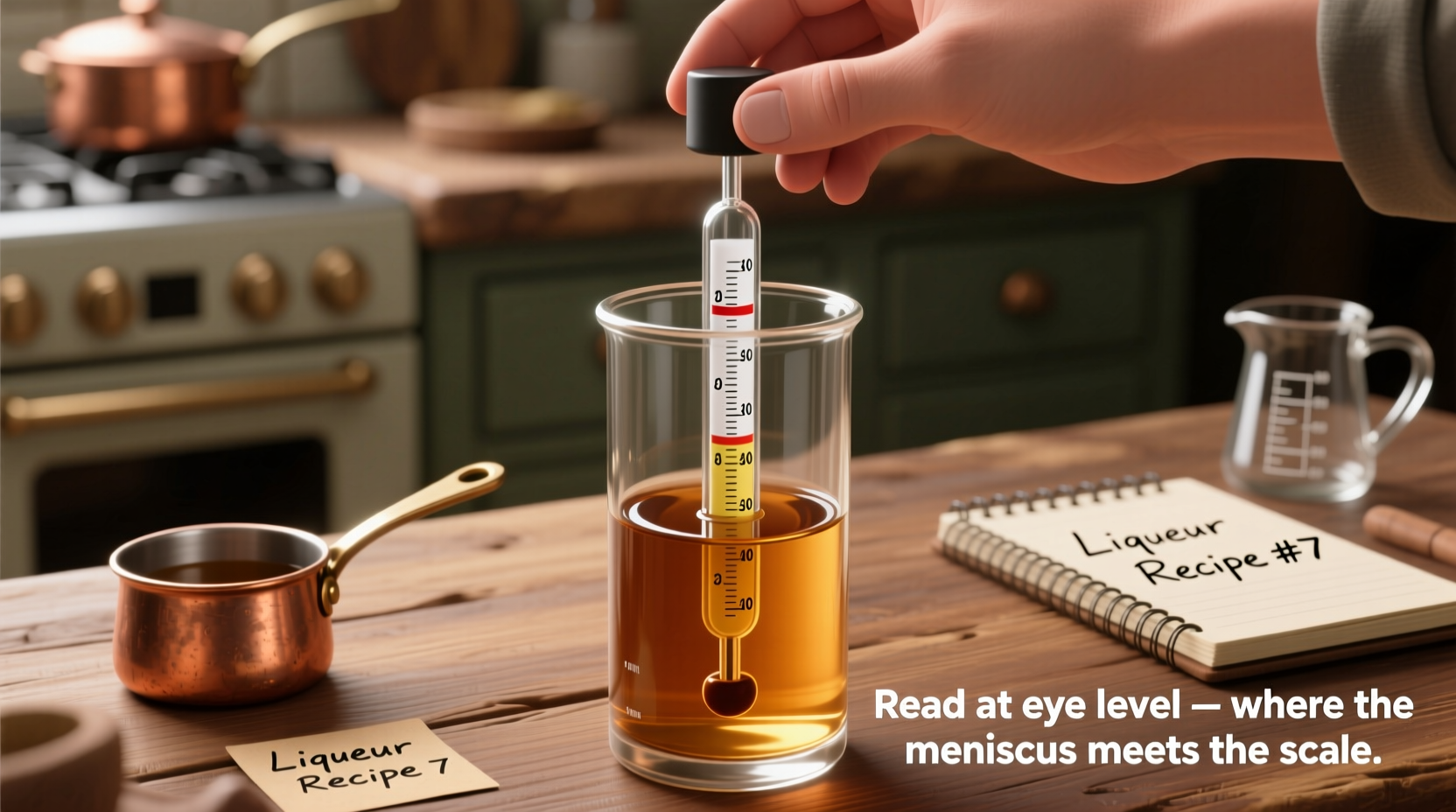
Liqueurs differ fundamentally from neutral spirits. They contain substantial dissolved solids—sugar (often 200–400 g/L), botanical extracts, glycerin, or honey—that increase solution density independently of ethanol. Ethanol lowers density; sugar raises it. The net effect determines what your hydrometer reads—and misinterpreting that reading is the single largest source of error among home producers. An unadjusted reading may suggest 22% ABV when the true value is 18.5%, risking bacterial growth (e.g., Acetobacter) if the batch falls below the 18% safety threshold for long-term room-temperature storage.
Accurate ABV also governs flavor balance. Too little alcohol fails to extract and stabilize aromatic compounds from herbs or citrus peels; too much creates harshness and masks subtlety. And legally, if you ever gift or sell small-batch liqueurs—even informally—you’re responsible for truthful labeling. In the U.S., TTB regulations require ±0.3% ABV accuracy for commercial products; while hobbyists aren’t bound by law, consistency builds trust and repeat enjoyment.
“Hydrometers don’t lie—but they assume ideal conditions. Sugar, temperature, and meniscus error turn precision instruments into misleading ornaments if used without discipline.” — Dr. Lena Torres, Fermentation Scientist & Author of Infusion Chemistry for Artisan Producers
Choosing the Right Hydrometer: Scale, Range, and Calibration
Not all hydrometers suit liqueur work. Avoid general-purpose brewing hydrometers calibrated for wort (which read specific gravity from 0.990–1.120). Instead, select one explicitly labeled for alcohol measurement, with these features:
- Triple-scale hydrometer: Displays % ABV, proof (U.S.), and specific gravity (SG) simultaneously—critical for cross-checking.
- Range: 0–100% ABV or 0–200 proof: Covers everything from light fruit cordials (15–20% ABV) to high-proof base spirits (40–60% ABV) before sweetening.
- Calibration temperature: 20°C (68°F): The standard reference point. Readings taken at other temperatures must be corrected.
- Material: Glass with lead-free weighted bulb: Ensures stable buoyancy and avoids leaching into alcohol-sugar solutions.
A common misconception is that “higher precision” means more decimal places. What matters is proper scale alignment: a 0–100% ABV hydrometer divided into 1% increments offers better practical resolution for liqueurs than a 0–30% model with 0.2% markings but poor thermal stability.
Tip: Before first use, verify calibration in distilled water at exactly 20°C (68°F). The hydrometer should read 0% ABV (or 1.000 SG). If it reads +0.5% ABV, subtract 0.5% from all subsequent readings. Record this offset permanently in your production log.The Step-by-Step Process: From Sample Prep to Final ABV
Accuracy hinges on process discipline—not equipment cost. Follow this sequence precisely for every test:
- Prepare the sample: Stir the liqueur thoroughly to homogenize sugar distribution. Draw 100–150 mL into a clean, dry 250-mL graduated cylinder. Avoid foam or bubbles.
- Control temperature: Let the sample equilibrate to 20°C (68°F). Use a calibrated digital thermometer. If ambient temperature differs, place the cylinder in a water bath for 5 minutes—never heat directly.
- Insert hydrometer gently: Lower it vertically without splashing. Let it settle fully—no spinning or tapping the cylinder.
- Read at eye level: Position yourself so your line of sight aligns with the bottom of the meniscus (the curved surface). Read where the liquid surface intersects the scale. Do not read the top or sides of the curve.
- Apply temperature correction: If sample temperature deviates from 20°C, use this formula:
Corrected ABV = Observed ABV + [(Actual Temp °C – 20) × 0.3]
Example: Reading 24.2% ABV at 25°C → 24.2 + [(25 – 20) × 0.3] = 24.2 + 1.5 = 25.7% ABV - Account for sugar interference (critical for liqueurs): If your liqueur contains >100 g/L sugar, use the sugar correction table below to adjust final ABV downward.
Sugar Correction Table for Liqueur Hydrometer Readings
Dissolved sugar inflates hydrometer readings because it increases density—mimicking higher alcohol content. To compensate, subtract the values below from your temperature-corrected ABV. Estimate sugar concentration based on your recipe (e.g., 300 g sucrose per liter = 30° Brix ≈ 300 g/L).
| Sugar Concentration (g/L) | ABV Overestimation (Subtract from Reading) |
|---|---|
| 0–50 g/L (e.g., dry herbal tincture) | 0.0–0.2% |
| 51–150 g/L (e.g., citrus-based cordial) | 0.3–0.7% |
| 151–300 g/L (e.g., classic crème de cassis) | 0.8–1.6% |
| 301–450 g/L (e.g., rich vanilla or nut liqueur) | 1.7–2.5% |
| >450 g/L (e.g., dessert-style syrup) | 2.6–3.5% (use refractometer instead) |
Note: This table assumes pure sucrose at 20°C. Honey or corn syrup introduces dextrins that affect density differently—reduce correction by ~15% for honey-based liqueurs. For precision beyond ±0.5% ABV, pair hydrometer data with a calibrated refractometer (Brix reading) and use the OIML alcohol-sugar correction formula.
Mini Case Study: Fixing a Batch of Failed Blackberry Liqueur
In late August, home producer Marco infused 1.5 kg ripe blackberries in 1 L of 45% ABV vodka for 10 days, then strained and added 400 g granulated sugar dissolved in 100 mL warm water. His initial hydrometer reading showed 32.4% ABV at 22°C. He assumed it was safe for pantry storage—until week three, when a faint vinegar tang developed. Testing again revealed visible cloudiness and a drop to 29.1% ABV.
Marco re-examined his process: he’d measured the hydrometer in the warm post-sugar mixture (28°C), applied no temperature correction, and ignored sugar density. His true ABV was actually 28.2% (32.4 – 1.2° temp correction – 3.0° sugar correction). Below 30% ABV, acetic acid bacteria thrive in oxygen-permeable bottles. He rebottled into sterile, air-tight amber glass, added 0.5 g/L potassium metabisulfite (a wine stabilizer), and refrigerated. The off-flavor subsided within five days. Now, Marco tests ABV before adding sugar and after full cooling—documenting both readings to track stability.
Common Errors and How to Avoid Them
Even experienced makers fall into these traps. Here’s how to recognize and eliminate them:
| Mistake | Why It Skews Results | Fix |
|---|---|---|
| Reading at non-standard temperature without correction | Every 5°C deviation adds/subtracts ~1.5% ABV error | Always use a calibrated thermometer and apply correction math |
| Using a dirty or scratched hydrometer | Film or micro-scratches alter surface tension and meniscus shape | Rinse with distilled water after each use; store upright in padded case |
| Testing cloudy or particulate-laden liqueur | Suspended solids increase apparent density | Filter through coffee filter or 0.45-micron syringe filter before testing |
| Assuming “final ABV” equals base spirit ABV | Sugar addition dilutes alcohol concentration by volume | Calculate dilution: New ABV = (Original ABV × Original Volume) ÷ Total Final Volume |
| Storing hydrometer in ethanol between uses | Ethanol degrades adhesive holding scale to glass; causes drifting | Store dry, never immersed—rinse only with water or isopropyl alcohol, then air-dry |
FAQ: Practical Questions from Home Liqueur Makers
Can I use a wine hydrometer for liqueurs?
No. Wine hydrometers measure specific gravity from 0.990–1.180 to estimate potential alcohol *before* fermentation—not actual ABV in sugar-rich liquids. Their scales lack ABV/proof markings and aren’t calibrated for high-alcohol solvents. Using one yields meaningless numbers.
My hydrometer reads “0” in water—but gives wildly different results in two identical liqueur batches. Why?
This signals inconsistent sugar dissolution. One batch likely has undissolved sugar crystals at the bottom, creating density gradients. Always stir for 60 seconds with a sanitized spoon, then let sit 2 minutes before drawing the sample from mid-depth—not the top or bottom layer.
Do I need to test every batch—or is once-per-recipe enough?
Test every batch. Ingredient variability matters: blackberry sugar content shifts with ripeness and growing season; citrus peel oils vary by variety and harvest time; even humidity affects sugar crystallization during storage. Your “standard” recipe is a starting point—not a guarantee.
Conclusion: Precision Is Part of the Craft
Using a hydrometer for homemade liqueurs isn’t about rigid perfection—it’s about deepening your understanding of how ingredients interact, respecting the science behind preservation, and honoring the intention behind each bottle. When you know your ABV within ±0.4%, you control mouthfeel, shelf stability, and aromatic fidelity. You stop wondering why last year’s ginger liqueur lasted six months while this one turned sour in four. You move from reactive troubleshooting to intentional design: choosing base spirits at 43% rather than 40% to accommodate sugar dilution, adjusting maceration time based on real-time extraction efficiency, or deciding whether a batch needs cold stabilization before bottling. That knowledge transforms hobbyist infusion into thoughtful craft. So calibrate your instrument today. Take your first corrected reading. Log it—not just the number, but the temperature, sugar weight, and sensory notes. Then pour a small measure, taste deliberately, and feel the difference that precision makes.
💬 Have you calibrated your hydrometer this month? Share your ABV verification tip or sugar-correction hack in the comments—your insight could help another maker avoid a spoiled batch.








