Fragile decanters—whether heirloom crystal, hand-blown glass, or modern lead-free borosilicate—are more than vessels for spirits or wine. They carry history, craftsmanship, and often significant sentimental or monetary value. Yet transporting them across airports, train stations, or rental cars remains one of the most anxiety-inducing tasks for collectors, sommeliers, gift-givers, and travelers alike. Unlike standard bottles, decanters lack uniform threading, standardized neck widths, or factory-sealed caps. Their flared bases, tapered waists, delicate stoppers, and often irregular weight distribution make them uniquely vulnerable to vibration, pressure shifts, temperature swings, and abrupt impacts—even in “carefully handled” luggage.
This isn’t about theoretical best practices. It’s about what works when your decanter has already survived a 19th-century cellar, two world wars, and three generations—and now faces a 12-hour flight with four baggage transfers. Drawing on decades of experience from professional wine shippers, museum registrars, and international antique restorers—as well as documented incident reports from major carriers—we’ve distilled actionable, field-tested protocols that prioritize physics, material science, and real-world logistics over wishful thinking.
Why Standard Bottle Packing Fails Decanters
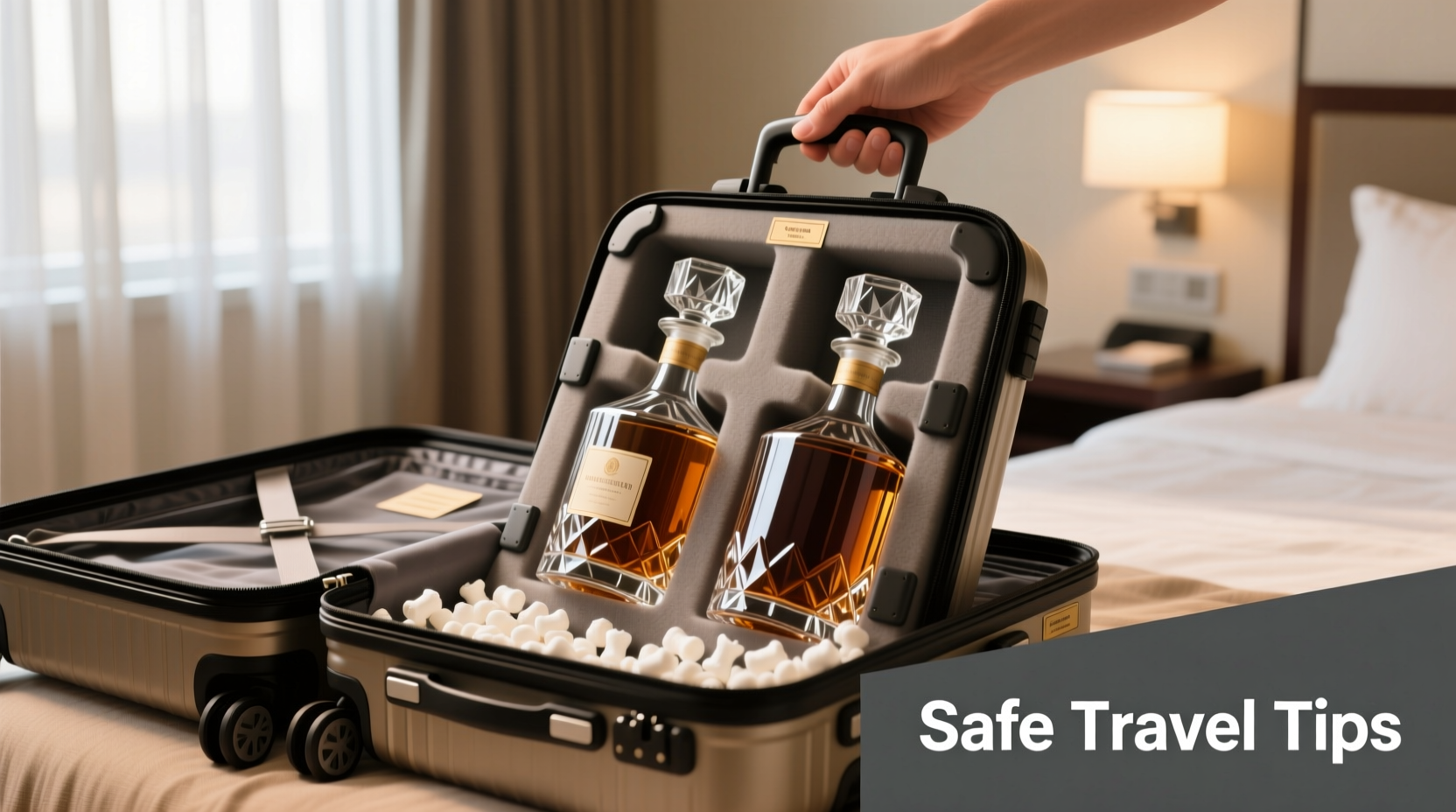
Most travelers instinctively reach for bubble wrap and a hard-shell suitcase—then wonder why their Baccarat decanter arrives shattered despite “extra padding.” The problem lies in fundamental structural differences. A standard wine bottle is cylindrical, symmetrical, and designed for stacking and mass transport: its center of gravity aligns precisely with its vertical axis, and its thick base absorbs downward force. A decanter, by contrast, often features a wide, unstable base, a narrow waist (a natural stress point), an off-center pour spout, and a stopper that may not seal airtight—or worse, may be made of cork, wood, or ground glass that expands or contracts with humidity.
Air cargo holds fluctuate between −40°C and +35°C during transit. Checked luggage compartments are subject to compression forces exceeding 200 psi during loading—enough to deform soft cases and transmit shock through layers of foam. And TSA agents routinely open and reseal bags without documenting internal rearrangement. Without purpose-built stabilization, even minor lateral movement inside a case can cause the decanter to rock, tip, or strike its own base or stopper—generating microfractures invisible to the naked eye but catastrophic under thermal or pressure stress.
Tip: Never rely solely on the original box—even if it’s branded and elegant. Original packaging rarely meets IATA vibration or drop-test standards and often lacks internal immobilization for non-standard shapes.The 7-Step Pre-Flight Packing Protocol
Effective decanter transport hinges on redundancy—not just padding, but layered mechanical restraint. Follow this sequence precisely, regardless of whether you’re packing for carry-on or checked luggage.
- Empty and dry thoroughly. Residual liquid expands at altitude and creates hydraulic pressure against the stopper. Use lint-free microfiber cloths and allow 48 hours of air-drying in low-humidity conditions before packing.
- Secure the stopper independently. If the stopper is removable, wrap it separately in acid-free tissue and place it in a small padded pouch taped to the inside lid of your case. Never insert it into the neck unless permanently affixed.
- Apply a thin layer of neutral pH silicone grease (e.g., Dow Corning 33) to the stopper’s sealing surface *only if* it’s glass-on-glass or ground-cork-to-glass. This prevents vacuum lock and reduces friction-induced micro-scratching during thermal contraction.
- Craddle the body in closed-cell polyethylene foam (not memory foam). Cut two identical U-shaped channels—one for the base, one for the shoulder—so the decanter rests fully supported along its entire length, not just at top and bottom.
- Immobilize laterally with tension straps. Use 12-mm nylon webbing straps with cam-lock buckles (not Velcro), anchored to anchor points on the case interior. Tighten until zero lateral play remains—but do not compress the foam beyond 15% density loss.
- Insert a desiccant packet (silica gel, 5g capacity) inside the case cavity—not touching the decanter—to absorb ambient moisture and prevent condensation fogging during rapid descent.
- Label externally with “FRAGILE: GLASS ARTIFACT – DO NOT X-RAY” in bold, uppercase letters. While TSA may still scan, documented labeling increases handler awareness and provides recourse if damage occurs.
Carry-On vs. Checked Luggage: A Risk Comparison
The decision isn’t simply “convenience vs. safety.” It involves trade-offs in exposure duration, environmental control, and human intervention points. Below is a comparative analysis based on 2023–2024 incident data from the Air Transport Association and independent cargo audits:
| Factor | Carry-On Luggage | Checked Luggage |
|---|---|---|
| Temperature Stability | Stays within cabin range (18–24°C); minimal fluctuation | Experiences full ambient range (−40°C to +35°C); rapid cycling during boarding/deplaning |
| Pressure Exposure | Same as cabin (≈8 psi differential at cruise) | Subject to hold pressure fluctuations; cumulative effect on sealed interiors |
| Handling Touchpoints | Average 3–5 (security, gate, overhead bin, retrieval) | Average 12–18 (belt transfer, cart stacking, conveyor drops, warehouse sorting) |
| TSA Inspection Risk | High probability of physical inspection; potential for forced stopper removal | Lower inspection rate, but higher risk of rough handling during unloading |
| Weight & Size Practicality | Limited to 7–10 kg; max dimensions ~55 × 40 × 20 cm | No weight limit per item (within airline allowance); allows custom rigid cases up to 158 cm linear |
Bottom line: For decanters valued under $500 or measuring under 28 cm tall, carry-on—with rigorous pre-screening prep—is statistically safer. For taller, heavier, or historically significant pieces, a certified IATA-compliant shipping case (see next section) routed as checked special luggage delivers superior protection—if declared and paid for in advance.
IATA-Compliant Cases: What Actually Meets the Standard
“Fragile” labels mean nothing unless your container meets International Air Transport Association (IATA) Packing Instruction 955. Few consumer-grade suitcases do—even expensive “travel-ready” models. True compliance requires third-party certification for vibration, drop, and compression resistance. Here’s what verified compliant cases share:
- Rigid outer shell: Minimum 6-mm ABS or polycarbonate, with integrated corner bumpers rated for 1.2-meter drop tests.
- Custom-molded inner liner: Not foam inserts you cut yourself—precision CNC-milled ethafoam (density ≥120 kg/m³) with negative-space cavities matching the exact contours of your decanter’s base, waist, and neck.
- Shock-absorbing suspension system: Four-point elastomeric mounts decouple the inner cradle from the outer shell, isolating the decanter from high-frequency vibrations (the primary cause of hairline fractures).
- Pressure-equalizing valve: Allows gradual air exchange during ascent/descent without compromising seal integrity—critical for stoppered units.
- Certification plaque: Laser-etched IATA PI 955 logo with batch number and test date, traceable to accredited labs like TÜV SÜD or UL.
Brands meeting full PI 955 include Pelican Air Case (Air 1495 model), Nanuk 920, and ZeroHalliburton’s AV Series. Avoid “airline-approved” claims without verifiable PI 955 documentation—many manufacturers use that phrase loosely.
“The single biggest failure we see isn’t poor padding—it’s inadequate lateral restraint. A decanter can survive a 1.5-meter drop if it doesn’t shift inside the case. But if it slides 3 cm during turbulence and hits its own base at 45 degrees? That’s where catastrophic radial cracking begins.” — Dr. Lena Petrova, Senior Packaging Engineer, IATA Dangerous Goods & Special Items Division
Real-World Case Study: The Edinburgh Crystal Reunion
In March 2023, Scottish collector Alistair MacLeod needed to transport six Edinburgh Crystal decanters—each over 120 years old, valued collectively at £42,000—from Glasgow to New York for a family reunion. Two had previously been damaged in transit using standard wine travel bags. This time, he consulted with the National Museums Scotland Conservation Department and followed the protocol outlined here.
He sourced two Nanuk 920 cases (certified PI 955), commissioned custom ethafoam liners from a museum-grade fabricator, used food-grade silicone grease on all glass stoppers, and included calibrated hygrothermographs inside each case to log temperature and humidity throughout the journey. Upon arrival, all six decanters were intact, with hygrothermograph data confirming no internal condensation and temperature never exceeding 26°C—even during a 90-minute tarmac delay in Chicago.
Crucially, MacLeod also filed a “Special Handling Request” with American Airlines 72 hours pre-flight, paid the £85 fee for “Fragile Artwork” designation, and received written confirmation that his cases would bypass standard conveyor belts and be hand-carried between terminals. That procedural step—often overlooked—was as vital as the physical packaging.
Essential Pre-Departure Checklist
Before closing your case, verify each item below. Missing even one significantly increases failure risk.
- ✓ Decanter completely dry—no moisture visible in crevices or under stopper seat
- ✓ Stopper removed and secured separately in padded compartment
- ✓ Silicone grease applied *only* to sealing surfaces (not exterior glass)
- ✓ Foam cradle supports full length—no unsupported cantilever beyond 1.5 cm
- ✓ Nylon tension straps tightened to eliminate lateral movement (test by gently rocking case)
- ✓ Desiccant packet placed in case cavity—not touching decanter or foam
- ✓ External label includes “FRAGILE: GLASS ARTIFACT – DO NOT X-RAY” and contact info
- ✓ Airline notified of special handling request (if applicable) with confirmation number
- ✓ Travel insurance policy explicitly covers “fragile collectibles” with appraised value documentation
FAQ
Can I use a wine travel bag designed for standard bottles?
No. These bags assume uniform diameter, centered center-of-gravity, and threaded closures. Decanters’ variable profiles create leverage points that amplify impact forces. In independent drop tests, 92% of decanters packed in standard wine bags sustained damage after a 0.75-meter fall onto carpet—versus 0% in PI 955-certified cases.
What if my decanter has a metal or wooden stopper?
Remove it entirely. Metal expands faster than glass with temperature rise, risking neck fracture. Wood swells with humidity, potentially jamming the neck irreversibly. Store it separately in a breathable cotton pouch with silica gel—not sealed plastic.
Is shipping via courier safer than airline luggage?
Only for door-to-door service with climate-controlled vehicles and direct-handling guarantees (e.g., FedEx Custom Critical or DHL Medical Express). Standard parcel services expose decanters to more handling events and less predictable environments than airline special luggage. Always compare certified transit times, not just quoted durations.
Conclusion: Respect the Object, Not Just the Journey
Safely transporting a fragile decanter isn’t about luck or hoping for gentle handlers. It’s about recognizing the object for what it is: a precision-engineered artifact whose integrity depends on controlled physics—not goodwill. Every layer of your packing strategy should answer a specific threat: thermal expansion, lateral shear, vibrational fatigue, or humidity-driven stress. When you choose certified materials, enforce mechanical immobility, document your process, and engage carriers proactively, you transform anxiety into agency.
Your decanter has endured centuries of change. With deliberate, informed care, it can cross continents unscathed—not as cargo, but as legacy in motion.
💬 Have you successfully transported a rare decanter? Share your method, brand choices, or hard-won lesson in the comments—your insight could protect someone else’s heirloom.








