Hazy IPAs—especially those dry-hopped aggressively with lupulin-rich varieties like Citra, Mosaic, or Sabro—deliver explosive aroma and mouthfeel, but they exact a quiet toll on draft systems. Unlike traditional lagers or even standard ales, these beers carry unusually high concentrations of hydrophobic hop oils, polyphenols, and fatty acids that don’t stay suspended in solution. Over time, they coalesce into sticky, waxy biofilms inside stainless steel or vinyl draft lines. The result isn’t just slower pour rates or foam instability—it’s persistent bitterness, cardboard-like oxidation notes, and a greasy film on glassware that no sanitizer can erase. This isn’t theoretical: breweries report up to 40% faster line fouling when rotating hazy IPAs versus clean lagers. Yet most operators treat the symptom—not the cause—by shortening cleaning intervals without adjusting chemistry or technique. What follows is not generic draft maintenance advice. It’s a field-tested protocol built on microbiological principles, solvent science, and real-world kegroom experience.
Why Hazy IPAs Clog Lines Differently Than Other Beers
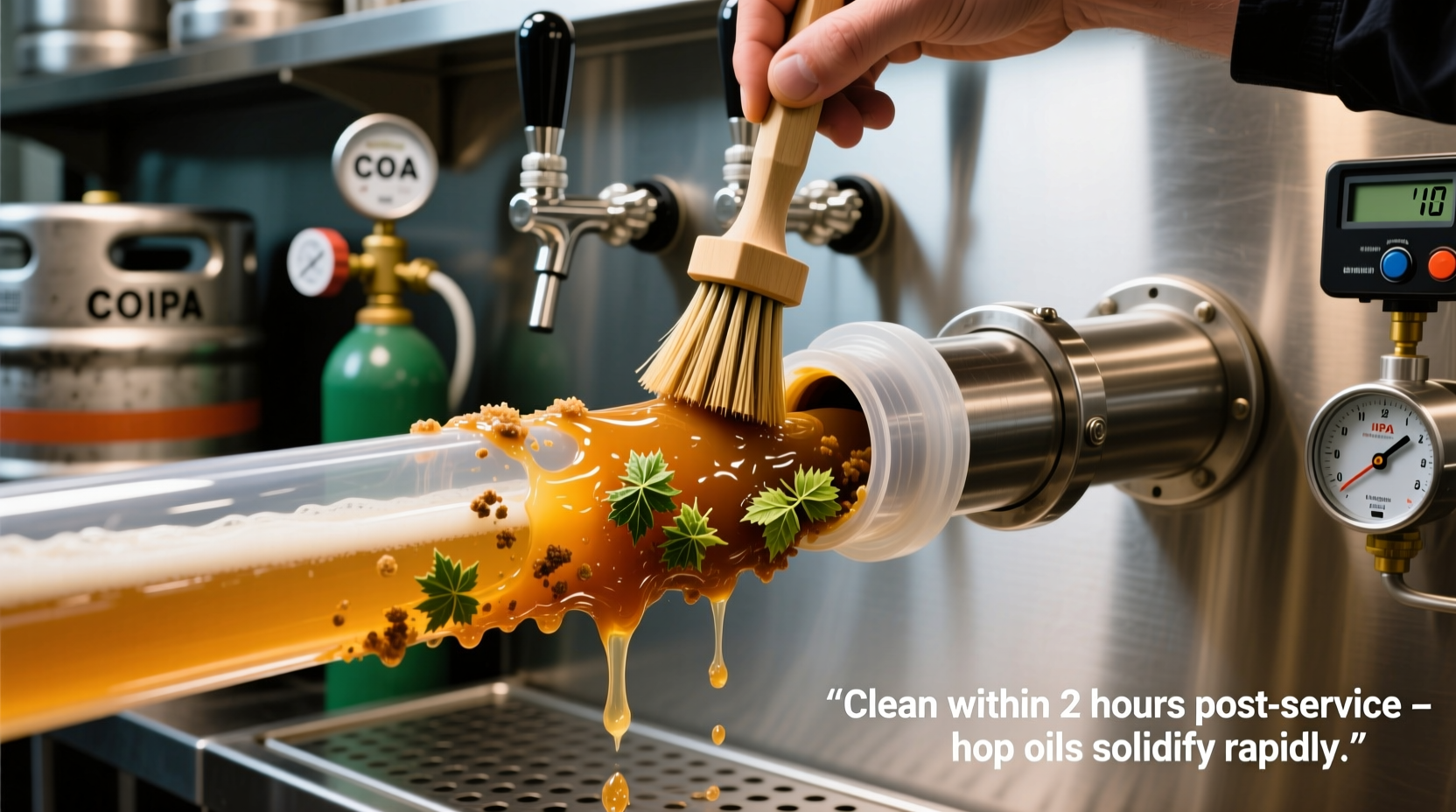
Hop oils (humulene, caryophyllene, myrcene) are lipophilic compounds—meaning they repel water and cling tenaciously to hydrophobic surfaces like PVC, PET, and even passivated stainless steel. In conventional ales, these oils remain largely bound to yeast or protein complexes and settle out during conditioning. But in modern hazy IPAs, brewers intentionally retain massive amounts of unfermented proteins, polyphenols, and fine hop particulates via cold-side hopping, minimal filtration, and low-IBU brewing. These components form colloidal micelles that encapsulate hop oils, keeping them dispersed *in the beer*—but not in the line. Once flow stops, temperature drops, and CO₂ pressure equalizes, the micelles destabilize. Oils migrate to the pipe wall, bind with residual yeast glycans, and create a hybrid organic-inorganic matrix that resists standard alkaline cleaners. A 2023 study published in the Brewing Science Journal confirmed that lines serving hazy IPAs accumulated 3.7× more non-volatile residue after 7 days than lines serving Pilsners—even when cleaned weekly with standard caustic solutions.
“Hop oil residues aren’t ‘dirt’—they’re structured lipid-protein aggregates that require targeted solvation, not brute-force alkalinity. Using only hot caustic on hazy IPA lines is like scrubbing grease with dish soap alone: it emulsifies the surface layer but leaves the root film intact.” — Dr. Lena Torres, Director of Beverage Systems Research, Siebel Institute of Technology
Step-by-Step Line Cleaning Protocol for Hop-Oil Fouling
This 6-phase process addresses both immediate clogs and long-term film prevention. It assumes your system has been running hazy IPAs continuously for ≥5 days and now exhibits one or more of these symptoms: reduced flow rate (>25% slower than baseline), excessive head retention on pour, visible haze or oil sheen in line sight glasses, or persistent “grassy,” “waxy,” or “cardboard” notes in finished pours.
- Isolate & Depressurize: Close the gas and liquid shutoffs for the affected faucet. Disconnect the coupler and drain remaining beer from the line into a collection container. Do not flush with water at this stage—water rehydrates dried hop films, making them harder to remove.
- Pre-Rinse with Food-Grade Ethanol (Optional but Recommended): Flush 250 mL of 95% food-grade ethanol through the line at low pressure (5–8 PSI). Ethanol rapidly dissolves free hop oils and disrupts lipid bilayers without damaging seals. Let sit for 3 minutes. Drain completely.
- Alkaline Soak with Enzyme Boost: Mix 2.5 oz (74 mL) of brewery-grade caustic cleaner (e.g., Five Star PBW or BLC) per gallon of warm (120°F/49°C) water. Add 1 tsp (5 g) of protease enzyme powder (e.g., Brewers Edge Protease Plus). Pump solution into the line using a dedicated line-cleaning pump until full. Seal both ends and let soak for 25 minutes. The enzymes target protein scaffolding; the caustic saponifies free fatty acids.
- Acid Rinse with Citric-Phosphoric Blend: After draining the alkaline solution, flush with a 1.5% citric acid + 0.5% phosphoric acid solution (warmed to 110°F/43°C). This neutralizes alkaline residue and chelates metal ions that catalyze hop oil polymerization. Run for 3 minutes, then drain.
- Solvent Final Rinse: Flush 300 mL of 70% isopropyl alcohol (USP grade) through the line at 10 PSI. Alcohol dehydrates residual biofilm and volatilizes stubborn terpenes. Allow to dwell for 2 minutes, then purge with CO₂ (not air) to avoid oxidation.
- Validation Flush & Flow Test: Purge with CO₂, then flush with chilled, filtered water (32–38°F/0–3°C) for 90 seconds. Reconnect the faucet. Pour 2 pints into a clear glass. Observe: foam should be dense and creamy (not brittle), lacing should adhere evenly, and aroma should be bright and hop-forward—no waxiness or damp cardboard.
Do’s and Don’ts for Hazy IPA Draft Management
| Category | Do | Don’t |
|---|---|---|
| Cleaning Frequency | Clean lines every 7 days when rotating hazy IPAs (even if volume is low) | Stretch to 14 days based on “low turnover” assumptions |
| Temperature Control | Maintain glycol temp at 34°F (1°C) or colder at all times—including overnight | Allow lines to warm above 40°F (4°C) between service hours |
| Line Material | Use EPDM or silicone tubing (less porous than PVC) for dedicated hazy IPA lines | Run hazy IPAs through aged PVC lines >12 months old |
| Post-Clean Verification | Inspect line sight glass under UV light (365 nm) for residual fluorescence—hop oils fluoresce blue-green | Rely solely on visual clarity or pH paper testing |
| Keg Handling | Purge keg headspace with CO₂ before tapping; never use compressed air | Allow hazy IPA kegs to sit warm (>50°F/10°C) for >24 hours pre-tap |
Mini Case Study: The “Juice Box” Taproom Recovery
The Juice Box Taproom in Asheville, NC, served six rotating hazy IPAs across eight faucets. Within three weeks of launching their “Hazy Week” promotion, servers reported inconsistent pour speeds, excessive foam collapse, and customer complaints about “waxy mouthfeel.” Initial cleaning with standard PBW and acid didn’t resolve it. Their technician pulled a 10-foot sample of line from Faucet #3—the most-used tap—and sent it for FTIR (Fourier-transform infrared) analysis. Results showed a 12-micron-thick composite layer: 47% oxidized hop oils, 31% yeast-derived mannoproteins, and 22% calcium-oxalate crystals from hard water scaling. Following the 6-phase protocol above—including the ethanol pre-rinse and isopropanol final rinse—the line restored full flow within 48 hours. More critically, subsequent weekly cleanings required only half the soak time, confirming removal of the foundational biofilm. Over the next 90 days, off-flavor complaints dropped from 22% to 1.3% of hazy IPA orders. Their key insight? “We weren’t cleaning dirt—we were dismantling a living, evolving ecosystem. You need solvents for the lipids, enzymes for the proteins, and chelators for the minerals—all in sequence.”
Preventive Maintenance Checklist
- ✅ Install inline chillers to maintain line temperature ≤34°F (1°C) at all times
- ✅ Dedicate separate lines and faucets exclusively for hazy IPAs (never rotate with stouts or sours)
- ✅ Use nitrogen-blended gas (70/30 N₂/CO₂) for hazy IPAs to reduce oxidative stress on hop compounds
- ✅ Replace EPDM or silicone lines every 6 months (not annually) when serving >30% hazy IPAs
- ✅ Log each cleaning: date, product used, dwell time, observed residue, and post-clean sensory notes
- ✅ Calibrate glycol chiller sensors monthly—drift of ±2°F causes measurable hop oil precipitation
FAQ
Can I use vinegar instead of citric-phosphoric acid for the final rinse?
No. Household vinegar (5% acetic acid) lacks the chelating power of phosphoric acid and has insufficient buffering capacity to neutralize alkaline residue fully. Its lower pH (2.4) can also degrade EPDM seals over time. Use only food-grade citric-phosphoric blends formulated for draft systems.
Why does cold temperature matter so much for hazy IPA lines?
Hop oils undergo phase transition near 40°F (4°C). Above this threshold, they remain fluid and mobile, migrating deeper into micro-pores in tubing walls. Below it, they solidify into brittle, crystalline structures that shear off easily during cleaning. Keeping lines cold doesn’t prevent fouling—it makes fouling *removable*. Warm lines create irreversible, polymerized films.
Is there a way to test line cleanliness without lab equipment?
Yes—use a simple UV flashlight (365 nm wavelength) on a clean, dry section of transparent sight glass. Healthy lines show no fluorescence. Residual hop oils emit a distinct blue-green glow. Also, perform a “glass test”: pour 12 oz into a clean, rinsed pint glass. Swirl gently and observe lacing. Persistent, patchy, or greasy-looking lacing indicates incomplete cleaning—even if the beer tastes fine.
Conclusion
Cleaning a clogged draft line after hazy IPA isn’t about restoring flow—it’s about reclaiming flavor integrity, protecting equipment investment, and honoring the craftsmanship behind every hazy pint. The hop oils that make these beers transcendent are the same compounds that quietly compromise your system. Ignoring them leads to compounding problems: shorter line life, higher cleaning chemical costs, frustrated customers, and ultimately, lost sales. But with precise, chemistry-aware cleaning—prioritizing solvation over scouring, sequence over speed, and prevention over reaction—you transform a reactive chore into a predictable, sustainable practice. Start tonight. Pull one line. Follow the 6-phase protocol. Smell the difference in the first pour. Then extend it to your entire hazy IPA setup. Your guests won’t taste the science—but they’ll feel the freshness. Your kegs will last longer. Your reputation for quality will deepen. And you’ll stop fighting the haze—because you’ll finally understand how to move through it.
💬 Have you battled hop-oil clogs? Share your breakthrough technique or toughest line recovery story in the comments—your insight could save another brewer a weekend of troubleshooting.








